SEARCH

McKenna E, Courtney AE. Visible and non-visible haematuria may herald serious disease. Practitioner. Feb 2018;262(1812):11-15
Visible and non-visible haematuria may herald serious disease
22 Feb 2018
AUTHORS
Dr Eimear McKenna MB BCh, Specialty Trainee in Renal Medicine
Dr Aisling E Courtney FRCP, Consultant Nephrologist, Regional Nephrology Unit, Belfast City Hospital, Belfast, UK
Competing interests: None
Article
Abstract
Both visible (VH) and non-visible haematuria (NVH) may herald serious pathology e.g. malignancy or vasculitis. It is estimated that a typical NHS GP will see a bladder or kidney cancer case once every 29 months. Haematuria is common. It is estimated that for every thousand patients registered in primary care five will consult with VH per annum. The prevalence of asymptomatic NVH in the UK is approximately 2.5%. Red urine is not always caused by blood or by blood originating from the urinary tract. These spurious causes should be excluded, as should temporary haematuria where this is associated with trivial pathology e.g. urinary tract infection or physical exercise. Further questioning can then assess the likelihood of malignancy. Patients should be asked about tobacco use (all cancers), lower urinary tract symptoms (prostate cancer), and previous exposure to radiation, cyclophosphamide or certain occupational chemicals (bladder cancer). Rarer but potentially devastating systemic conditions with renal involvement must be considered with questioning about constitutional symptoms including fever, rash, arthralgia, weight loss, and oedema. All patients with haematuria should have their weight and BP recorded, along with an abdominal examination to exclude a mass or lymphadenopathy. Additional focused examinations will be indicated by the history and differential diagnosis e.g. digital rectal examination in men with lower urinary tract symptoms. All patients with VH or symptomatic NVH should have urinalysis, urinary protein estimation (albumin:creatinine or protein:creatinine ratio), and a renal function test. These should also be requested if asymptomatic NVH persists, i.e. in two out of three samples over 6-8 weeks.
Haematuria has been defined as >2 red blood cells/high power field (RBC/hpf) on two separate urinalyses in the absence of exercise, menses, sexual activity or instrumentation.1
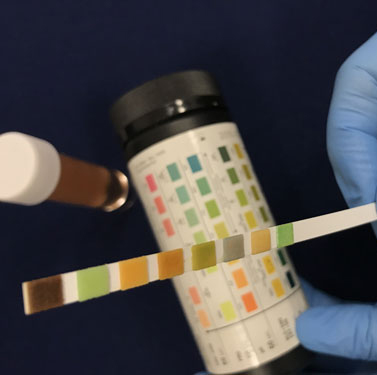
In practice urine microscopy and the counting of red cells is impractical and unnecessary. Haematuria is detected either because it is visible to the naked eye, visible or macroscopic haematuria, or identified on a standard urine dipstick test when it is termed non-visible or microscopic haematuria. Dipstick tests depend on the oxidation of organic peroxide by haemoglobin in a fresh voided urine sample containing no preservative with a reported sensitivity of 95% and specificity of 75%.
Haematuria is important as both visible and non-visible haematuria may herald serious pathology (e.g. malignancy or vasculitis), and also because it is common. It is estimated that for every thousand patients registered in primary care five will consult with visible haematuria per annum,2 with the prevalence of asymptomatic non-visible haematuria in the UK being approximately 2.5%.3
In such a cohort (asymptomatic non-visible haematuria) the overall incidence of serious conditions such as urological malignancy is < 1.5%.4
It is estimated that a typical NHS GP will see a bladder or kidney cancer case once every 29 months.5 A key skill therefore for all GPs is determining whether or not their patient’s often incidental finding of haematuria should be pursued further. Who should be referred for investigation? And to whom - urology or nephrology? And how urgently?
Ideally patients with potentially significant haematuria should be identified and referred to the most relevant specialty in a timely fashion without causing a significant service burden for the healthcare provider or subjecting those with insignificant haematuria to a battery of unnecessary investigations.
Causes
The pathophysiology of haematuria depends on whether the blood loss originates from the nephron (glomerular haematuria) or from any distal part of the urinary tract (extra-glomerular).
Glomerular bleeding indicates a defect in the structural integrity of the glomerular basement membrane (GBM) which is the barrier through which red blood cells pass to travel from the glomerular capillary to the urinary space.
Membrane disruption can result from a genetic aberration (e.g. defective collagen production in Alport’s syndrome) or an acquired condition. There are several postulated injurious agents in the latter category, including leukocyte infiltration, immune complex deposition, cytokine release, endopeptidase activation etc.6 Red blood cells which have passed through the GBM are usually dysmorphic due to a combination of physically squeezing through the membrane and exposure to the changes in osmotic environment encountered at various parts of the tubular system.
Non-glomerular haematuria is the result of anything which disrupts the urothelium or blood loss into the urinary space. The common causes of haematuria in the UK are detailed in table 1.
History
Question one:
Is it haematuria?
This may seem superfluous but is important. Red urine is not always caused by blood, or by blood originating from the urinary tract. Spurious causes include:
• Menstrual contamination/atrophic vaginitis/intrauterine coil/sexual intercourse
• Food colouring e.g. beetroot or rhubarb
• Myoglobin e.g. muscle injury (rhabdomyolysis)
• Medication e.g. rifampicin, methyldopa or phenothiazine
• Poisoning e.g. lead or mercury
Question two:
Is it transient?
Typically temporary haematuria is associated with trivial pathology e.g. urinary tract infection, physical exercise. A collaborative history and the resolution of the haematuria is required.
Question three:
Are there associated concerning features?
These three questions can be answered with a focused history.
First, spurious or temporary causes can be quickly identified by a series of closed questions related to the list above. If these are excluded a second set of questions can frame the likelihood of malignancy (bladder/urothelial, prostate, renal, and endometrial) including for:
All: Age ( ≥ 45 years – bladder and renal) and tobacco use
Prostatic neoplasia: Lower urinary tract symptoms (frequency, hesitancy, urgency, nocturia, retention), erectile dysfunction
Urothelial malignancy: Previous radiation or cyclophosphamide exposure, certain occupational exposures such as aromatic amines, dyes, and benzenes
Third, rarer but potentially devastating systemic conditions with renal involvement must be considered with questioning about constitutional symptoms including fever, rash, arthralgia, weight loss, and oedema. Dark brown, (or cola-coloured) urine suggests glomerular bleeding with alteration of blood as it passes through the urinary tract and may be associated temporally with upper respiratory tract infection symptoms.
A family history of renal disease, stones, or urological malignancy is pertinent. A drug history, particularly if the patient is taking anticoagulant or antiplatelet medication, is also useful. However, whether or not patients are taking anticoagulants is irrelevant when deciding upon referral as these agents generally exacerbate rather than cause haematuria.
Examination
With exemption of spurious causes, it is reasonable for all patients to have their weight and blood pressure recorded, along with an abdominal examination to exclude a mass or lymphadenopathy. Additional focused examinations will be indicated by the history and differential diagnosis e.g. digital rectal examination in men with lower urinary tract symptoms, external genitalia in women with vaginal symptoms, skin/joints if systemic symptoms, fundoscopy if severe hypertension.
Investigation
All patients with visible or symptomatic non-visible haematuria should have: urinalysis; urinary protein estimation (albumin:creatinine or protein:creatinine ratio depending on local availability); and a renal function test (creatinine/eGFR). These should also be requested if there is persistence of asymptomatic non-visible haematuria i.e. in two out of three samples tested over a 6-8 week period.7
Additional laboratory testing may be indicated in specific clinical situations e.g. PSA in men with obstructive lower urinary tract symptoms, full blood count in those with marked infective symptoms, or potentially substantial blood loss.8
Routine radiological imaging is not required, but if there is a positive family history of polycystic kidney disease then an ultrasound scan should be requested. The NICE guidance relating to endometrial cancer recommends considering an ultrasound scan for women ≥ 55 years with visible haematuria and anaemia, or thrombocytosis, or raised blood glucose.9
An algorithm for investigation and referral of haematuria is shown in figure 1.
Important points to remember when investigating haematuria in primary care are listed in box 1.
Referral
The majority of patients with haematuria do not need to be referred, some do require secondary care,
and a small but important minority need urgent specialist input.
The key diagnoses that should not be delayed are malignancy and systemic inflammatory conditions associated with acute and rapidly progressive renal injury e.g. vasculitis. The latter group are typically unwell with constitutional symptoms and hypertension.
The Renal Association and British Association of Urological Surgeons (BAUS) published a succinct joint consensus statement on the initial assessment of haematuria in 2008, and included a useful algorithm.3
This advice has been withdrawn following updated clinical guidelines published by NICE in relation to the recognition and referral of suspected cancer in 20158 and chronic kidney disease (CKD) in adults.7 BAUS has provided a helpful summary of the relevant uro-oncology section.10 In the UK, only a minority of urological malignancies (30% of bladder, 19% of kidney) are diagnosed via the two-week referral pathway.11
It is important to note that there are patients that should have urological or renal assessment but do not need it urgently. There is less consistency in the literature regarding referral criteria in these groups, particularly the age threshold for those with persistent asymptomatic non-visible haematuria. The NICE CKD advice is appropriate for the latter cohort.12
Table 2, summarises suggested criteria for urology and nephrology referral and the urgency required. However, crucially age per se does not exclude malignancy. Kidney cancer can and does present in people of younger age, albeit much less commonly. If the clinician has reason to be concerned, then they should use their clinical judgement to refer with appropriate urgency. A positive family history of renal carcinoma in a first-degree relative for example would increase clinical suspicion in a younger individual.
Monitoring
There will be patients who meet none of the criteria for referral outlined above, or who have been assessed and subsequently care discharged back to primary care. In both cohorts, there remains a chance that in due course significant pathology will develop. Annual monitoring is recommended,7 as long as haematuria persists, with:
• Blood pressure
• Urine dipstick and albumin (or protein) creatinine ratio
• Renal function
This should be conducted until there are two negative urinalyses. Patients with stable CKD should be monitored as per national guidelines according to the stage of CKD, and urological referral should be initiated according to recommendations detailed above.
Conclusion
Haematuria is common and occasionally the harbinger of serious illness. A focused history and directed examination are important skills for primary care in identifying those that require further investigation. It is crucial that those with acute kidney injury or underlying malignancy are highlighted and referred urgently.
REFERENCES
1 Wollin T, Laroche B, Psooy K. Canadian guidelines for the management of asymptomatic microscopic hematuria in adults. Can Urol Assoc J 2009;3:77-80
2 Bruyninckx R, Buntinx F, Aertgeerts B et al. The diagnostic value of macroscopic haematuria for the diagnosis of urological cancer in general practice. Br J Gen Pract 2003;53:31-35
3 Kelly JD, Fawcett DP, Goldberg LC. Assessment and management of non-visible haematuria in primary care. BMJ 2009;338:a3021
4 Woolhandler S, Pels RJ, Bor DH et al. Dipstick urinalysis screening of asymptomatic adults for urinary tract disorders. Hematuria and proteinuria. JAMA 1989;262(9):1214-19
5 NHS Hospital and Community Health Service (HCHS) Workforce Statistics in England, Medical and Dental staff - 2002-2012. www.hscic.gov.uk/catalogue/PUB10394/nhs-staf-2002-2012-medi-dent-tab.xlsx Last accessed 31 January 2018
6 Moreno JA, Martín-Cleary C, Gutiérrez E et al. Haematuria: the forgotten CKD factor? Nephrol Dialysis Transplant 2012;27(1):28-34
7 National Institute for Health and Care Excellence. Pathway for chronic kidney disease in adults: assessment and management. https://pathways.nice.org.uk/pathways/chronic-kidney-disease/assessment-and-monitoring-of-chronic-kidney-disease#content=view-node:nodes-testing-for-haematuria Last accessed 31 January 2018
8 National Institute for Health and Care Excellence. NG12. Suspected cancer: recognition and referral. NICE. London. 2015 www.nice.org.uk/guidance/ng12 Last accessed 31 January 2018
9 National Institute for Health and Care Excellence. Clinical Knowledge Summary. Gynaecological Cancers – Recognition and referral. https://cks.nice.org.uk/gynaecological-cancers-recognition-and-referral#!scenario Last accessed 31 January 2018
10 Jefferies ER, Brewster SF on behalf of British Association of Urological Surgeons Section of Oncology, Summary of NICE guideline suspected cancer: recognition and referral salient findings to urological practice. www.baus.org.uk/_userfiles/pages/files/Publications/BAUS%20Cancer%20Guidelines%20Summary.pdf Last accessed 31 January 2018
11 Public Health England National Cancer Registration and Analysis Service. www.ncin.org.uk/publications/routes_to_diagnosis Last accessed 31 January 2018
12 National Institute for Health and Care Excellence. Pathway for chronic kidney disease overview: When to refer. https://pathways.nice.org.uk/pathways/chronic-kidney-disease#content=view-node%3Anodes-when-to-refer Last accessed 31 January 2018
USEFUL INFORMATION
For healthcare professionals
For patients
 Download this article in PDF format