SEARCH

Todd I. Improving uptake of cardiac rehabilitation. Practitioner Oct 2017;261(1808):17-20
Improving uptake of cardiac rehabilitation
23 Oct 2017
AUTHORS
Dr Iain Todd BSc MD MRCP, Consultant in Cardiovascular Rehabilitation, Astley Ainslie Hospital, Edinburgh, UK
Competing interests: None
Article
Abstract
While post-MI and surgical patients still make up the majority of patients attending cardiac rehabilitation, any patient with heart disease may be referred. Data from the National Audit of Cardiac Rehabilitation show that 50% of eligible MI, PCI, and CABG patients do attend cardiac rehabilitation and that figure continues to rise, but the rates for stable angina and heart failure remain low. Cardiac rehabilitation programmes incorporate six core components: changing health behaviour and patient education; lifestyle and risk factor management; medical risk factor management; psychosocial health; long-term strategies; and audit and evaluation. At the centre of the process is patient education and changing health behaviour while the overall aim is to provide the patient with knowledge and strategies to help them self-manage their long-term condition. At entry to cardiac rehabilitation, assessing the patient’s knowledge and understanding of their condition, and treatment, while identifying any misconceptions which could be barriers to progress is key. Understanding the importance of titrating drugs and adherence to prescribed medication is also crucial as is self-management. Lifestyle risk factors are discussed ensuring that equal importance is placed on smoking cessation, exercise and diet. There is evidence that programmes which have a basis in psychoeducation (goal setting, self-monitoring, relapse prevention) are more likely to achieve long-term behaviour change than those based simply on delivering a fixed agenda of exercise and education. A recent Cochrane review of exercise-based cardiac rehabilitation continues to show the benefit of exercise prescription in terms of cardiovascular mortality, hospital readmission rates, and quality of life.
In the 15 years since SIGN published its first guideline on cardiac rehabilitation, SIGN 57,1 much has changed in the management of coronary heart disease (CHD).
While exercise and education remain cornerstones of modern rehabilitation programmes, cardiac rehabilitation has had to evolve to meet the challenges of managing CHD as a long-term condition.
The British Association for Cardiac Prevention and Rehabilitation (BACPR) has, in the intervening years, published its own standards and guidelines for the delivery of cardiac rehabilitation,
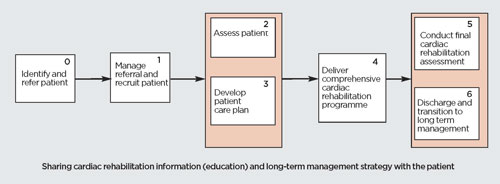
the most recent edition earlier this year.2 The BACPR standards describe a cardiac rehabilitation pathway, see figure 1, from identification and referral of the patient through to long-term management. Cardiac rehabilitation programmes incorporate six core components: changing health behaviour and patient education; lifestyle and risk factor management; medical risk factor management; psychosocial health; long-term strategies; and audit and evaluation.
At the centre of the process is patient education and changing health behaviour while the overall aim is to provide the patient with knowledge and strategies to help them self-manage their long-term condition with particular emphasis on lifestyle risk factors, psychosocial health, and medical risk management.
Programmes are expected to evaluate their success by measuring outcomes and benchmarking themselves through participation in national audits. The new SIGN guideline on cardiac rehabilitation (SIGN 150), published in July 2017,3 provides an evidence-based review of the pathway described in the BACPR standards and considers approaches to, and challenges in, delivering the core components.
While post-MI and surgical patients still make up the majority of those attending cardiac rehabilitation, any patient with heart disease may be referred. Most cardiac rehabilitation teams have access to cardiology wards and actively seek out patients with acute coronary syndrome and those recovering from cardiac surgery.
As a consequence they attend cardiac rehabilitation programmes in reasonable numbers.
Finding the elective PCI patient can be more difficult while patients with stable angina, heart failure or other manifestations of CHD are much less likely to come to the attention of cardiac rehabilitation teams.
Data from the National Audit of Cardiac Rehabilitation show that 50% of eligible MI, PCI, and CABG patients do attend cardiac rehabilitation and that figure continues to rise, but the rates for stable angina and heart failure remain low.4 In 2014/15, of the 87,000 patients receiving cardiac rehabilitation in England, Wales, and Northern Ireland fewer than 4,000 had a diagnosis of heart failure and fewer than 3,000 angina.4
These patients are known to their GP and improving referral pathways into cardiac rehabilitation from general practice would seem an obvious way of improving uptake among these groups.
Once patients are identified there is some evidence that structured telephone calls, motivational letters, early appointments for assessment and flexibly tailored programmes may encourage patients to participate.5
Assessment
Assessment of the patient at entry to cardiac rehabilitation should obviously cover the core components. However, assessing the patient’s knowledge and understanding of their condition while identifying any misconceptions the patient might have which could be barriers to progress is also key. Some of those misconceptions are pre-existing and general in nature. For example, many patients believe that stress caused their heart attack and that rest is the best cure. Others are specific to the individual and relate to things said to them or their family during admission. Patients may be told their heart attack was ‘big’ or ‘small’, that their condition has or has not been fully treated by PCI, or that the drugs they are on are essential to their survival.
Failure to identify and address patients’ concerns and misconceptions at the outset can prevent successful rehabilitation. The cardiac rehabilitation team should have ready access to inpatient records, and where necessary the cardiologist, to provide appropriate information and reassurance.
Assessing the patient’s knowledge and understanding of interventions and medication, e.g. the importance of titrating drugs and adherence to prescribed therapy, is also crucial as is self-management.
Lifestyle risk factors are discussed ensuring that equal importance is placed on smoking cessation, exercise and diet. How the patient is coping psychologically and their progress in returning to normal activities including, where appropriate, work also need to be established.
Tools such as the Hospital Anxiety and Depression Score (HADS)6 or Patient Health Questionnaire (PHQ9)7 and quality of life scores e.g. Dartmouth COOP,8 as well as measures of baseline fitness e.g. the shuttle walk test can be used to provide objective measures.9
The specialist team are trained in health behaviour change techniques and motivational interviewing skills which enable them to discuss the assessment and reach agreement regarding the aims of the rehabilitation process.
What matters to the patient is central to the discussion but the care plan may involve a degree of negotiation to ensure important issues are tackled. Typically, an assessment may take 45 minutes to an hour but at the end of that time there should be a care plan with agreed interventions chosen from a menu covering the core components.
Programme format
The majority of cardiac rehabilitation programmes follow a group format with patients attending for around eight to ten weeks. While a frequency of twice weekly was previously recommended on the basis of supervised exercise, there is an increasing trend to once weekly input. The BACPR recommends
16 supervised sessions over eight weeks as a minimum. It is clear from the literature that behavioural support requires time, but there is no definitive evidence as to the ideal length of programme.
There is evidence that programmes which have a basis in psychoeducation (goal setting, self-monitoring, relapse prevention) are more likely to achieve long-term behaviour change than those based simply on delivering a fixed agenda of exercise and education.10
For those with high motivation information may be all that is required, while for others behavioural support is critical. Additionally, some cases may be straightforward whereas other patients may have complex needs. At either end of the spectrum it may be more appropriate to provide the patient’s programme on an individual basis. The need to individualise programmes more, based on assessment coupled with the desire to integrate more with social care partners to address long-term condition management, is likely to change the delivery model in the future.
Lifestyle risk factors
Smoking cessation, physical activity, and diet are all areas where cardiac rehabilitation input can be beneficial. Many patients have already made the commitment to stop smoking by the time they meet the cardiac rehabilitation team. Data from the national audit suggests that 94% of patients are not smoking at the time of assessment (and 1% stop during cardiac rehabilitation).4
A significant percentage of these will be recent quitters who have understood the rationale for stopping smoking, but may benefit from ongoing support as much as those who continue to smoke. Cochrane reviews of non-pharmacological interventions for smoking cessation suggest that a range of strategies such as behavioural support, telephone contact, and self-help materials can be of benefit, but that any approach should be of at least four weeks’ duration.11 Cardiac rehabilitation programmes provide an ideal opportunity for such support. While referral to specialist smoking cessation is often made for those who continue to smoke, recent quitters can be adequately supported by the cardiac rehabilitation team.
Cardiac rehabilitation programmes began as exercise classes to help patients recover from the consequences of imposed rest after MI. While acute management has moved on and few patients are forced to rest, supervised prescribed exercise continues to be a key component of every cardiac rehabilitation programme.
A recent Cochrane review of exercise-based cardiac rehabilitation continues to show the benefit of exercise prescription in terms of cardiovascular mortality, hospital readmission rates, and quality of life.12 The review covered 63 studies with 14,486 participants with median follow-up of 12 months. Overall, cardiac rehabillitation led to a reduction in cardiovascular mortality, relative risk (RR) 0.74 (95% CI: 0.64-0.86) and the risk of hospital admissions RR 0.82 (95% CI: 0.70-0.96).
Most studies (14 of 20) showed higher levels of health-related quality of life in one or more domains following exercise-based cardiac rehabilitation compared with controls.
SIGN 150 contains a clear recommendation that all patients should be offered a cardiac rehabilitation programme which includes an exercise component for those reasons, but also that the exercise component should be tailored to individual choice and delivered in a range of settings.
There is good evidence that home and community-based exercise can be as effective as attending a group.13
There is also clear evidence of benefit in heart failure patients.14 In a Cochrane review, compared with controls, exercise training reduced the rate of overall hospitalisation (15 trials, 1,328 patients) RR 0.75 (95% CI: 0.62-0.92) and heart failure specific hospitalisation (12 trials, 1,036 patients) RR 0.61 (95% CI: 0.46-0.80). Exercise also resulted in a clinically important improvement in quality of life score on the Minnesota Living with Heart Failure questionnaire (13 trials, 1,270 patients) mean difference: -5.8 points (95% CI: -9.2 to -2.4).
The BACPR recommends that cardiac rehabilitation should be twice weekly for a minimum of eight weeks. The latest Cochrane review undertook a univariate meta-analysis which found that the positive outcomes of exercise-based cardiac rehabilitation were independent of any of the factors studied including dose of exercise, patient diagnosis, and location of exercise.12 These findings open the door to greater flexibility in provision of cardiac rehabilitation and potentially a more balanced approach to intervention across the three major lifestyle risk factors.
While it is reasonable to assume that all cardiac rehabilitation teams will include either a physiotherapist or exercise specialist who is responsible for prescribing and supervising the exercise component, only half the programmes in the UK have input from a dietitian4 while the remainder rely on other health professionals delivering healthy eating advice. There is evidence from individual trials that adherence to that advice can be enhanced by behavioural approaches including continuing contact, contracts with the patient, and the use of educational and nutritional tools,15 but there is no national audit data to show whether this level of support is routinely available within cardiac rehabilitation programmes.
Most programmes will have an educational session on healthy eating either on its own or as part of a lifestyle talk. Given the increasing emphasis on diet as a risk factor, the relative complexity of the advice involved, and the behavioural challenge faced, it is likely that this will be a growth area for cardiac rehabilitation with greater emphasis on behavioural support such as food labelling and purchasing and meal preparation.
There is national audit data regarding weight management, and perhaps not surprisingly this shows that 30% of patients entering cardiac rehabilitation have a BMI >30 and that this changes little during attendance. It is unclear why cardiac rehabilitation has not had more success in helping patients to lose weight. Weight gain associated with smoking cessation has been offered as a possible explanation, but clearly there is a need for greater focus on this area. SIGN 150 reviewed the evidence available for a number of weight loss programmes and concluded that there was sufficient positive evidence to suggest that referral to them should be considered for patients requiring assistance.
Medication management
Patients with CHD invariably have polypharmacy and often drugs are prescribed which need to be titrated after discharge. As a rule the onus for this falls on primary care so it is important that the hospital team informs the GP. Cardiac rehabilitation staff are ideally placed to identify instances where this has not happened and will contact the GP to request dose adjustment.
There is also a growth in non-medical prescribing and the close proximity of cardiac rehabilitation staff to heart failure nurses who commonly prescribe and titrate drugs has led to some cardiac rehabilitation teams taking on a prescribing role. SIGN 150 contains a recommendation that non-medical prescribing should be considered within a cardiac rehabilitation setting on the basis that it is safe and effective.
Medication concordance remains an issue with studies showing that many patients stop taking their medication or take it inconsistently. Adherence rates average around 50%.16 A review of the evidence suggests that some benefit may be obtained from motivational interviewing and behavioural support to address understanding of medication and associated misconceptions and tackle practical barriers around simplifying regimens and addressing side effects.16 Cardiac rehabilitation programmes usually include a presentation on cardiac medication aimed at improving knowledge in the expectation that this will improve concordance.
Psychosocial health
Anxiety and depression are common among cardiac patients the latter estimated to affect 30% of these patients.17 Health-related anxiety is a normal consequence of a serious illness and while worthy of monitoring, may be expected to improve with the adjustment process during the course of cardiac rehabilitation. Rehabilitation teams routinely monitor mood during cardiac rehabilitation and while very few teams include a psychologist, staff often have specialist training and skills to provide low intensity psychological interventions to support adjustment or low mood, and access to psychologists or psychiatrists where higher intensity interventions are required. A matched stepped care model for monitoring symptoms of depression and delivering psychological therapies accordingly is recommended, see table 1.3
Cognitive behaviour therapy is the psychological intervention of choice for anxiety and depression.18 For these patients the interventions may be delivered on an individual basis or through targeted groups within the cardiac rehabilitation programme.
Return to work
Getting back to work is a key goal for many patients attending cardiac rehabilitation. Only around a third of programmes in the UK have occupational therapists in the team4 so it falls to others to address return to work issues. Often the barrier to returning to work is psychological and there is evidence that addressing health beliefs relating to the potential for returning to work, and the dangers in so doing, can increase return to work rates.19
For those whose work is physically demanding, and particularly where absence from work has been prolonged or has involved cardiac surgery, there is evidence that tailoring the exercise component to mimic physical activity involved in the workplace may increase the likelihood of returning to work.20
It is also important to ensure that attendance at cardiac rehabilitation does not delay returning to work.
Transition to long-term management
By the time they are discharged from cardiac rehabilitation patients should have a clear understanding of their condition and have used the self-management skills they have been taught to achieve the initial goals they set at assessment. However, in the limited time afforded them they are unlikely to have achieved all that they or the team would wish but should possess the skills to continue their rehabilitation unsupported. Ultimately success in maintaining lifestyle change will best be measured at 12 months. Routine follow-up within the practice provides an opportunity to review progress with secondary prevention goals but also to ensure that progress is being maintained in self-management and goal setting.
Cardiac rehabilitation should not be seen as a one-off opportunity for support after an acute event, and should the patient require further support then cardiac rehabilitation teams are always happy to review the patient for additional input if required.
REFERENCES
1 Scottish Intercollegiate Guidelines Network. SIGN 57. Cardiac rehabilitation SIGN. Edinburgh. 2002
2 British Association for Cardiovascular Prevention and Rehabilitation (BACPR). The BACPR standards and core components for cardiovascular disease prevention and rehabilitation. British Cardiovascular Society. London. 2017
3 Scottish Intercollegiate Guidelines Network. SIGN 150. Cardiac rehabilitation. SIGN. Edinburgh. 2017
4 British Heart Foundation. The National Audit of Cardiac Rehabilitation. Annual Statistical Report. BHF. London. 2016
5 Karmali KN, Davies P, Taylor F et al. Promoting patient uptake and adherence in cardiac rehabilitation. Cochrane Database Syst Rev 2014 Jun 25;(6):CD007131
6 Zigmond AS, Snaith RP. The hospital anxiety and depression scale. Acta Psychiatr Scand 1983;67(6):361-70
7 Spitzer RL, Williams JBW, Kroenke K. Patient Health Questionnaire (PHQ). http://www.phqscreeners.com/sites/g/files/g10016261/f/201411/English_0.pdf
8 Van Weel C. Functional status in primary care COOP/WONCA Charts. Disabil Rehabil 1993;15:96-101
9 Singh SJ, Morgan MD, Scott S et al. Development of a shuttle walk test of disability in patients with chronic airways obstruction. Thorax 1992;47(12):1019-24
10 Aldcroft SA, Taylor NF, Blackstock FC, O'Halloran PD. Psychoeducational rehabilitation for health behavior change in coronary artery disease: a systematic review of controlled trials. J Cardiopulmon Rehabil Prev 2011;31(5):273-81
11 Barth J, Jacob T, Daha I, Critchley JA. Psychosocial interventions for smoking cessation in patients with coronary heart disease. Cochrane Database Syst Rev 2015;7:CD00688
12 Anderson L, Oldridge N, Thompson DR et al. Exercise-based cardiac rehabilitation for coronary heart disease: Cochrane systematic review and meta-analysis. J Am Coll Cardiol 2016;67:1-12
13 Anderson L, Taylor RS. Cardiac rehabilitation for people with heart disease: an overview of Cochrane systematic reviews. Cochrane Database Syst Rev 2014 Dec 12;(12):CD011273
14 Taylor RS, Sagar VA, Davies EJ et al. Exercise-based rehabilitation for heart failure. Cochrane Database Syst Rev 2014 Apr 27;(4):CD003331
15 Desroches S, Lapointe A, Ratté S et al. Interventions to enhance adherence to dietary advice for preventing and managing chronic diseases in adults. Cochrane Database Syst Rev 2013 Feb 28;(2):CD008722
16 Nieuwlaat R, Wilczynski N, Navarro T et al. Interventions for enhancing medication adherence. Cochrane Database Syst Rev 2014 Nov 20;(11):CD000011
17 Chauvet-Gelinier JC, Trojak B, Verges-Patois B et al. Review on depression and coronary heart disease. Arch Cardiovasc Dis 2013;106(2):103-10
18 National Institute for Health and Care Excellence. CG91. Depression in adults with a chronic physical health problem: recognition and management. NICE. London. 2009
19 Petrie KJ, Cameron LD, Ellis CJ et al. Changing illness perceptions after myocardial infarction: an early intervention randomized controlled trial. Psychosom Med 2002;64(4):580-06
20 Mital A, Shrey DE, Govindaraju M et al. Accelerating the return to work (RTW) chances of coronary heart disease (CHD) patients: part 1 development and validation of a training programme. Disabil Rehabil 2000;22(13-14):604-20
ARTICLE IN PDF
 Download this article in PDF format
PRESET SEARCHES
PubMed
NICE Evidence Search
EXTERNAL WEBLINKS
For healthcare professionals
British Association for Cardiovascular Prevention and Rehabilitation
For patients