SEARCH

Preset searches
PubMed -Respiratory medicine
Obstructive sleep apnoea hypopnoea
Tuberculosis primary care review
Upper respiratory tract infections
Lower respiratory tract infections
Grover HL, Higgins BG. GPs have key role in improving outcomes in acute asthma. Practitioner 2016; 260(1798):15-19
GPs have key role in improving outcomes in acute asthma
24 Nov 2016
AUTHORS
Dr Helen L Grover MB BS BMedSci, Specialist Trainee in Respiratory Medicine
Dr Bernard G Higgins MD FRCP, Consultant Respiratory Physician
Freeman Hospital, Newcastle upon Tyne, UK
Article
Abstract
Asthma deaths in the UK remain among the highest in Europe. The 2014 National Review of Asthma Deaths looked at detailed data over a 12-month period assessing 195 patients who died from asthma and highlighted the avoidable factors in patient deaths. Although faults were found in secondary care, many of the problems related to poor management of patients in the community, both in terms of regular surveillance and assessment and treatment at the onset of attacks. Features which indicate a high risk of severe attacks include: previous admission to intensive care, particularly if requiring mechanical ventilation; previous admission with asthma especially in the past year or repeated emergency admissions; history of worsening asthma in January or February; use of three or more classes of asthma medication; heavy use of beta-2 agonists; anxiety traits; and marital stress. Peak expiratory flow improves the recognition of severity when compared with examination alone. Oxygen should be used to maintain oxygen saturation of 94-98% and it is recommended that GP surgeries have oxygen and an oximeter available. For anything other than life-threatening asthma, a standard metered dose inhaler administered with repeated actuations via a large volume spacer is as effective as a nebuliser. If a nebuliser is used it should ideally be driven with oxygen but nebulisers should not be withheld if oxygen is not available. Oral steroids are required for all patients experiencing attacks of moderate severity or worse as they improve symptoms and reduce mortality, hospital admissions and the need for beta-2 agonists.
There are 5.4 million people with asthma in the UK.1 Attendance at both GP surgeries and emergency departments is high and in 2011-12 there were more than 65,000 hospital admissions,2 a higher admission rate than most comparable European countries.
Asthma deaths in the UK remain among the highest in Europe.3 The 2014 National Review of Asthma Deaths (NRAD) looked at detailed data over a 12-month period, assessing 195 patients who died from asthma and highlighted the avoidable factors in patient deaths.
Although faults were found in secondary care, many of the problems related to poor management of patients in the community, both in terms of regular surveillance and of assessment and treatment at the onset of attacks.
In September 2016, the Scottish Intercollegiate Guidelines Network (SIGN) and the British Thoracic Society (BTS) published an updated version of the British guideline on asthma management.4 Bearing in mind the frequency of acute attacks in the community, and the evidence of failings in managing these, it is timely to review this up to date advice on best practice in acute asthma care. This article will cover management of attacks of moderate severity or greater; all patients should possess an asthma action plan enabling them to self-manage milder attacks without intervention by a healthcare professional.
Awareness of risk
The majority of asthma deaths occur outside hospital and most patients who die from an asthma attack had chronic severe asthma. There are a minority who have a fatal attack on a background of mild to moderate asthma, although it is debatable whether these are genuinely severe episodes out of the blue rather than a case of underestimation of the true baseline severity. It is therefore important to be aware of patients who are particularly at risk, and this applies to all levels of staff beginning with receptionists; as the frontline in a GP surgery they should be made aware that an asthma attack is a medical emergency and requires urgent assessment by a GP or asthma nurse.
An interesting UK study,5 not yet replicated, showed benefit from setting up a formal risk register of patients considered to be most likely to experience severe problems from their asthma. These patients trigger an alert whenever they contact the practice, which among other things can be used to ensure that appointments are expedited.
This approach is worth exploring more widely, although there is an obvious danger that other patients could get less attention.
Features which indicate a high risk of severe attacks include:5-7
• Previous admission to intensive care, particularly if requiring mechanical ventilation
• Previous admission with asthma especially in the past year or repeated emergency department admissions
• History of worsening asthma in January or February
• Use of three or more classes of asthma medication
• Heavy use of beta-2 agonists
• Anxiety traits
• Marital stress
Personal asthma action plans
More than 80% of patients in one case control study reported worsening symptoms in the previous 48 hours and had felt unwell at least seven days prior to hospital admission.6 This suggests that there is a window of opportunity to assess and treat patients adequately before a near fatal or fatal attack develops.
The first step is appropriate action by the patient, and there is good evidence8 that this is more likely if the patient possesses a personalised written action plan. This should include advice on self-administration of appropriate treatment and a clear escalation plan detailing when and how to access a healthcare professional for help. The NRAD report showed that only 23% of patients who died had an asthma action plan, see figure 1.
Assessment and severity
Initial assessment by a healthcare professional should include a focused history and examination together with commencement of treatment.
The classic symptoms are breathlessness (how much can the patient say without stopping for breath?) and wheeze with attention to the timing and duration, especially noting whether symptoms disturb sleep. Key observations are those which have been shown to allow a grading of severity, specifically heart rate and respiratory rate (still regularly omitted, although less often than it used to be).
Other signs, such as excessive use of accessory muscles of respiration or cyanosis indicate that an attack is severe or life-threatening, see table 1.
Peak expiratory flow (PEF) is an extremely useful measurement and improves the recognition of severity when compared with examination alone.9 PEF is expressed in terms of percentage of a patient’s best peak flow measurement and is more accurate if this is known within the past two years.
It is also helpful to measure oxygen saturation to guide oxygen therapy and targets of treatment (although lack of pulse oximetry should not prevent oxygen being delivered).
Treatment
Treatment should be implemented alongside the initial assessment of the patient. Oxygen should be used to maintain oxygen saturation of 94-98% and it is recommended that GP surgeries have oxygen and an oximeter available.
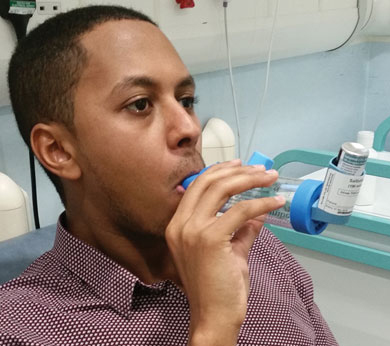
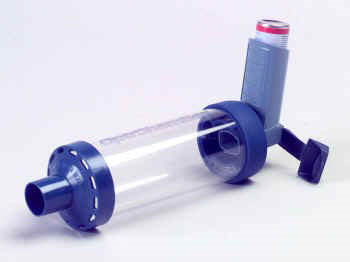
Short-acting beta-2 agonists are quickly effective and easily administered. For anything other than life-threatening asthma a standard metered dose inhaler (MDI) administered with repeated actuations via a large volume spacer, is as effective as a nebuliser, see figure 2.10 It is particularly useful to be aware of this in primary care when staff on duty may be less practised in setting up a nebuliser. The latest SIGN/BTS guideline recommends giving four separate puffs of beta-2 agonist initially, followed by two further puffs at two-minute intervals depending on response, up to a maximum of ten puffs. If a nebuliser is used it should ideally be driven by oxygen, but do not withhold nebulisers if oxygen is not available.
Oral steroids are required for all patients experiencing attacks of moderate severity or worse as they improve symptoms and reduce mortality, hospital admissions and the need for beta-2 agonists. The earlier steroids are administered the better the outcome.11 Prednisolone 40-50 mg daily should be given for at least five days or until the patient has recovered.
Referral to hospital
Admission is critical for patients with features of life-threatening asthma. Patients with a severe asthma attack who have persisting symptoms despite treatment should also be admitted. Judgement should be applied for patients with moderate asthma attacks but with recent hospital admission, previous severe attacks or concern regarding social circumstances. These patients may still require admission to hospital. Patients being reviewed in the afternoon or evening or those with recent worsening of nocturnal symptoms may also require admission as these patients can often deteriorate again following initial assessment.
Other considerations
The course of asthma in pregnancy is very variable but some patients experience deterioration in symptoms and have more frequent asthma attacks. A review of pregnant women with asthma attacks showed that they are often undertreated particularly with regard to steroid therapy, and this resulted in poorer outcomes.12
It is recommended that pregnant patients receive the same treatment for acute asthma as their counterparts who are not pregnant.
If infection is present in asthma attacks it is usually caused by a virus, and antibiotics are not appropriate. Good antibiotic stewardship is vital and antibiotics should be reserved for the minority of cases with a likely bacterial cause. Unfortunately, this advice is widely ignored. The recent AZALEA trial did not find any benefit in the use of macrolide treatment with azithromycin in asthma attacks, but a standout feature of this study was the extreme difficulty of recruiting patients because so many had already been given unnecessary antibiotic treatment.13
Follow-up
SIGN/BTS recommend that on discharge from hospital patients should be seen within two days by their GP or asthma nurse and that they should be seen in a specialist clinic in one month. This advice is sensible but tricky to adhere to. It will certainly never happen unless the hospital sends discharge information out promptly and GP surgeries are organised to react appropriately when they receive this. Follow-up provides a key time to check adherence to treatment, inhaler technique and to construct or amend personal asthma action plans.
Those patients who have had a severe attack should be followed up by an asthma specialist for at least a year afterwards, and those with a near fatal attack should be under specialist follow-up indefinitely.
It is advisable that patients who are admitted to hospital with a mild to moderate asthma attack should be followed up in primary care every six months and all other patients seen on an annual basis.
Conclusions
Asthma attacks remain a common presentation in both primary and secondary care. All patients should recover and most do, but the NRAD report is an important warning against complacency in managing this medical emergency. The updated SIGN/BTS guideline is a valuable reminder of current best practice for acute asthma management.
REFERENCES
1 Asthma UK. Number of people treated for asthma in the United Kingdom. 2013. www.asthma.org.uk/about/media/asthma-facts-and-statistics
2 Royal College of Physicians. Why asthma still kills: the National Review of Asthma Deaths (NRAD) Confidential Enquiry report. RCP. London. 2014
3 Department of Health. An outcomes strategy for people with chronic obstructive pulmonary disease (COPD) and asthma in England. DH. London. 2011 www.gov.uk/government/publications/an-outcomes-strategy-for-people-with-chronic-obstructive-pulmonary-disease-copd-and-asthma-in-england
4 British Thoracic Society/Scottish Intercollegiate Guidelines Network. British guideline on the management of asthma. SIGN. Edinburgh. 2016 www.brit-thoracic.org.uk/document-library/clinical-information/asthma/btssign-asthma-guideline-2016/
5 Smith JR, Noble MJ, Musgrove S et al. The at-risk registers in severe asthma (ARRISA) study: a cluster-randomised controlled trial examining effectiveness and costs in primary care. Thorax 2012;67(12):1052-60
6 Turner MO, Noertjojo K, Vedal S et al. Risk factors for near fatal asthma. A case-control study in hospitalised patients with asthma. Am J Respir Crit Care Med 1998;157(6 pt 1): 1804-09
7 Vázquez I, Romero-Frais E, Blanco-Aparicio M et al. Psychological and self-management factors in near-fatal asthma. J Psychosom Res 2010;68(2):175-81
8 Gibson PG, Powell H. Written action plans for asthma: an evidence based review of the key components. Thorax 2003;59:94-99
9 Emerman CL, Cydulka RK. Effect of pulmonary function testing on the management of acute asthma. Arch Intern Med 1995;155(20):2225-28
10 Cates CJ, Walsh EJ, Rowe BH. Holding chambers (spacers) versus nebulisers for beta-agonist treatment of acute asthma. Cochrane Database Syst Rev 2013 Sep 13;(9):CD000052.pub3
11 Rowe BH, Spooner C, Ducharme F et al. Early emergency department treatment of acute asthma with systemic corticosteroids. Cochrane Database Syst Rev 2001;(1):CD002178
12 Cydulka RK, Emerman CL, Schreiber D et al. Acute asthma among pregnant women presenting to the emergency department. Am J Respir Crit Care Med 1999;160(3):887-92
13 Johnston SL, Szigeti M, Cross M et al. Azithromycin for acute exacerbations of asthma. The AZALEA randomized clinical trial. JAMA Intern Med 2016; 176(11):1630-37
ARTICLE IN PDF
 Download this article in PDF format
PRESET SEARCHES
Pubmed
NICE evidence
See also CPD prompts in the left-hand column
EXTERNAL WEBLINKS
The British guideline on asthma management. SIGN 153
Last revised 2016
Asthma: diagnosis, monitoring and chronic asthma management NICE NG80
In November 2017 NICE published the above guideline on diagnosing, monitoring and managing asthma in adults, young people and children. It does NOT cover managing severe asthma or acute asthma attacks.
Putting NICE NG80 guideline into practice in the UK
NICE recommends objective testing with spirometry and FeNO for most people with suspected asthma. Additional infrastructure and training is needed in primary care. In the meantime, NICE say primary care services should implement what they can of NG80 guideline, using currently available approaches to diagnosis.
Asthma UK professional resources
Videos to talk through inhaler technique with patients
Action plans for adults
Action plans for children
Non-English action plans
Filling in an asthma plan with a patient