SEARCH

Keenan D, Maxwell AP. Optimising the management of polycystic kidney disease. Practitioner 2016;260(1790):13-16
Optimising the management of polycystic kidney disease
22 Feb 2016
AUTHORS
Dr Declan Keenan MB BCh MRCP, Specialist Registrar in Nephrology
Professor Alexander P. Maxwell MD PhD FRCP, Consultant Nephrologist, Regional Nephrology Unit, Belfast City Hospital, Belfast, UK
Article
Polycystic kidney disease (PKD) is the most common inherited renal disorder that results in chronic kidney disease. The prevalence of PKD is estimated to be between 1:500 and 1:1,000 therefore many general practices will have families with PKD registered for care.
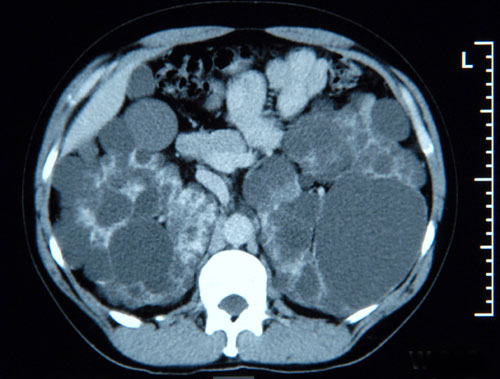
A diagnosis of PKD should be considered in any individual with kidney cysts on an abdominal scan especially if there is a history of hypertension. PKD is associated with multiple bilateral renal cysts, slowly increasing kidney size and progressive chronic kidney disease (decline in estimated glomerular filtration rate [eGFR]). Up to 10% of adults with end-stage renal disease (ESRD), requiring chronic dialysis or kidney transplantation, have a genetic disorder such as PKD.1
Causes
PKD is an autosomal dominant condition hence each child of an affected adult has a 50% chance of inheriting the disorder.2 PKD is caused by mutations in two distinct genes encoding polycystins which are proteins important in the normal function of cell membranes lining the renal tubules and hepatic ducts.3
Mutations in the gene PKD1 (located on chromosome 16p13.3-p12.1) account for around 85% of cases and inheritance of a PKD1 mutation is associated with an earlier onset of ESRD at a median age of 53 years. In contrast, mutations in PKD2 (located on chromosome 4q21-q23) account for around 15% of cases and are associated with a later onset of ESRD at a median age of 69 years.3,4
Genetic diagnostic testing is not routinely undertaken partly because of its complexity and the associated costs of analysing the very large number of unique mutations affecting these two genes. Up to 25% of patients diagnosed with PKD will have a negative family history.2
Presentation
PKD is a multisystem disorder of polycystin proteins with a variety of renal and extrarenal manifestations, see table 1. The diagnosis of PKD is often made coincidentally following radiological imaging of the abdomen. PKD can present at any age but the most common clinical features are visible haematuria, loin pain, urinary tract infection (UTI) and hypertension. Loin pain may be caused by expansion of one or more cysts, bleeding into a cyst or ureter (causing clot colic), cyst infection, UTI or renal calculi.
The typical clinical course of PKD is characterised by a progressive increase in both the number and size of renal cysts leading to localised pressure effects, cytokine release, inflammation with damage to neighbouring cells, fibrosis and disruption of the normal tissue architecture. This is associated with gradual loss of kidney function (falling eGFR) and progression through the stages of chronic kidney disease to ESRD.
Risk factors for progressive chronic kidney disease include:
• Younger age at diagnosis
• Large kidney volume (size) on imaging
• Rapid cyst growth
• Hypertension
• Male gender
• Visible haematuria
• Inheritance of a PKD1 versus a PKD2 mutation
Once chronic kidney disease develops the annual decline in eGFR is usually predictable and around 5 ml/min/1.73m2.5 Approximately 50% of individuals with PKD will require renal replacement therapy by the sixth decade of life.2,6
Confirming diagnosis
Genetic testing to identify PKD1 and PKD2 mutations is rarely undertaken in clinical practice, unless as part of a research project. Computer tomography (CT), magnetic resonance imaging (MRI) and ultrasound sonography (USS) can all be used to identify PKD but USS is the safest and most cost-effective scan to establish the diagnosis, see figure 1.
USS criteria have been published (incorporating age, number of cysts seen and whether cysts are unilateral or bilateral) to allow confirmation of a PKD diagnosis, see table 2.7
CT and MRI are both more sensitive than USS in detecting cysts as small as 0.5 cm. CT and MRI also permit assessment and serial measurement of kidney mass/size, which USS alone cannot accurately determine. Patients with larger kidney volumes (> 1,500 ml) at baseline have more rapid loss of renal function.8
Extrarenal clinical features
Liver cysts
More than 80% of patients with PKD will also have multiple liver cysts. Expansion of liver cysts can lead to local pressure effects causing liver capsular pain.
Liver cysts do not by themselves cause abnormal liver function tests and hepatic failure is not a clinical feature of PKD. Occasionally, infection of a liver cyst can cause serious illness requiring hospitalisation for antimicrobial therapy ± drainage of the infected cyst. Massive liver cysts are more common in women than men, particularly in those who have had multiple pregnancies, suggesting hormones may play a role in accelerating cyst growth.
Cerebral haemorrhage
Cerebral haemorrhage, secondary to rupture of an intracranial berry aneurysm, occurs in up to 8% of patients with PKD. Screening for intracranial aneurysm remains controversial and there are no universally agreed consensus guidelines. Decisions to undertake screening are usually made based on patient-specific risk factors, including a family history of intracranial aneurysm or subarachnoid haemorrhage (SAH), prior SAH, neurological symptoms, high-risk professions (such as pilots), or those undergoing major elective surgery.9
Cardiac valve abnormalities
Mitral valve prolapse is the most common valvular abnormality occurring in up to 25% of patients. Aortic and tricuspid valve prolapse, along with aortic root dilation and ascending aortic aneurysm and dissection have all been reported in patients with PKD.
Management
Hypertension
Hypertension often develops prior to the onset of obvious chronic kidney disease. Excellent control of blood pressure is a key element in the management of patients with PKD. Non-pharmacological measures to help lower blood pressure (salt restriction, weight loss, exercise and reduction in alcohol intake) can be advised.
The rise in blood pressure is mediated in part by increased renin and angiotensin II production. For this reason blockade of the renin-angiotensin system with an angiotensin converting enzyme inhibitor (ACEi) or angiotensin receptor blocker (ARB) is appropriate.10 A blood pressure < 130/80 mmHg is a reasonable target and a calcium channel blocker can be added to ACEi or ARB therapy to achieve this treatment goal. More aggressive control of hypertension has not been shown to reduce the rate of eGFR decline in patients with PKD.11
Diuretics should not be prescribed for hypertension primarily because these drugs are associated with fluid volume depletion and stimulation of antidiuretic hormone (ADH) secretion. Higher levels of ADH are associated with faster cyst growth, increased kidney size and more rapid loss of renal function.
Drinking plenty of water to stay well hydrated and reducing consumption of caffeinated drinks is recommended to try to reduce circulating ADH levels (although there is a limited evidence base for this advice).2
Cyst infections
Cyst infections may present with loin pain, fever and/or septic shock and can be difficult to manage. A causative organism may not be cultured from blood or urine samples partly because the cysts usually do not communicate with the renal tracts. Infected renal cysts can be challenging to treat effectively since antibiotics may not penetrate the larger cysts. Lipid-soluble antibiotics such as ciprofloxacin are preferred as they can diffuse into cyst fluid more readily than penicillins and prolonged treatment is usually necessary to eradicate infection.12,13
New therapies
Several drugs (tolvaptan, octreotide, everolimus) have shown promise in clinical trials to limit cyst growth.
A study of octreotide (an analogue of somatostatin), reported a smaller increase in cyst size and kidney volume in treated patients compared with those receiving placebo.14 Short-term trials with mammalian target of rapamycin (mTOR) inhibitors, such as everolimus and sirolimus, have reported that cyst growth is reduced in patients but there were no beneficial effects on renal function.15
Tolvaptan, a vasopressin (ADH) receptor antagonist, is now licensed for use in adults with PKD. It reduces the rate of decline in eGFR in patients with PKD by inhibiting the binding of vasopressin (ADH) to renal tubule V2 receptors, and thus reduces cell proliferation, kidney cyst formation and fluid accumulation within cysts.
Compared with placebo, treatment with tolvaptan was associated with a modest reduction in annual rate of eGFR decline.16 Tolvaptan, compared with placebo, had a higher frequency of adverse events because of increased aquaresis (polyuria, polydipsia, nocturia, and urinary frequency), but a lower frequency of adverse events related to PKD (kidney pain, haematuria, urinary tract infection, and back pain).
NICE has approved the use of tolvaptan to slow the progression of cyst development in adults with PKD.17
This advice applies to patients who have chronic kidney disease stage 2 or 3 at the start of treatment, with evidence of rapidly progressive chronic kidney disease and provided that the pharmaceutical company gives a medication discount agreed in the patient access scheme.
Treatment options for end-stage renal disease
When individuals with PKD develop chronic kidney disease then onward referral for nephrology follow-up is appropriate.
Planning for renal replacement therapy (dialysis and transplantation) is undertaken and individuals with PKD can be assessed for the option of pre-emptive kidney transplantation.
If the polycystic kidneys are very large a transplant surgeon may recommend removal of one or both kidneys to provide room for a transplanted kidney. Potential living related kidney donors need to be screened carefully to ensure that they do not have PKD.
Conclusion
PKD is a common renal disorder with a variety of renal and extrarenal clinical presentations. Excellent control of hypertension and prompt treatment of cyst infections are important aspects of management. Clinical trials of novel therapies are being undertaken to delay or prevent progression to ESRD.
REFERENCES
1 UK Renal Registry report. www.renalreg.org/reports/2014-seventeenth-annual-report
2 Grantham JJ. Autosomal dominant polycystic kidney disease. N Engl J Med 2008;359:1477-85
3 Harris PC. 2008 Homer W. Smith Award: Insights into the pathogenesis of polycystic kidney disease from gene discovery. J Am Soc Nephrol 2009:20:1188-98
4 Reed BY, McFann K, Bekheirnia MR et al. Variation in age at ESRD in autosomal dominant polycystic kidney disease. Am J Kidney Dis 2008;51:173-83
5 Klahr S, Breyer J, Beck G et al. Dietary protein restrictions, blood pressure control and the progression of polycystic kidney disease modification of diet in renal disease study group. J Am Soc Nephrol 1995;5:2037-47
6 Torres VE, Harris PC. Autosomal dominant polycystic kidney disease: the last 3 years. Kidney Int 2009;76:149-68
7 Pei Y, Obaji J, Dupuis A et al. Unified criteria for ultrasonographic diagnosis of ADPKD. J Am Soc Nephrol 2009;20:205-12
8 Grantham JJ, Torres VE, Chapman AB et al. Volume progression in polycystic kidney disease N Engl J Med 2006;354:2122-30
9 Rozenfeld MN, Ansari SA, Shaibani A et al. Should patients with autosomal dominant polycystic kidney disease be screened for cerebral aneurysms? AJNR Am J Neuroradiol 2014;35:3-9
10 Chapman AB, Johnson A, Gabow PA, Schrier RW. The renin-angiotensin-aldosterone system and autosomal dominant polycystic kidney disease. N Engl J Med 1990;323:1091-96
11 Schrier RW, Abebe KZ, Perrone RD et al. Blood pressure in early autosomal dominant polycystic kidney disease. N Engl J Med 2014;371:2255-66
12 Schwab SJ, Bander SJ, Klahr S. Renal infection in autosomal dominant polycystic kidney disease. Am J Med 1987;82:714-18
13 Sklar AH, Caruana RJ, Lammers JE, Strauser GD. Renal infections in autosomal dominant polycystic kidney disease. Am J Kidney Dis 1987;10:81-88
14 Hogan MC, Masyuk TV, Page LJ, et al. Randomized clinical trial of long-acting somatostatin for autosomal dominant polycystic kidney and liver disease. J Am Soc Nephrol 2010;21:1052-61
15 He Q, Lin C, Ji S, Chen J. Efficacy and safety of mTOR inhibitor therapy in patients with early-stage autosomal dominant polycystic kidney disease: a meta-analysis of randomized controlled trials. Am J Med Sci 2012;344:491-7
16 Torres VE, Chapman AB, Devuyst O et al. Tolvaptan in patients with autosomal dominant polycystic kidney disease. N Engl J Med 2012;367:2407-18
17 National Institute for Health and Care Excellence. TA358. Tolvaptan for treating autosomal dominant polycystic kidney disease. NICE. London. 2015 www.nice.org.uk/guidance/ta358
ARTICLE IN PDF
 Download this article in PDF format
PRESET SEARCHES
PubMed
Polycystic kidney disease review
NICE evidence search
Immediate CPD prompts
These handy templates* prompt immediate drafting of personal learning, reflection and planning. Save your record straight into your personal development folder on your device or Cloud storage system.
*Adobe reader needed for iPad
EXTERNAL WEBLINKS
We welcome your feedback
If you would like to comment on this article or have a question for the authors, write to: [email protected]