SEARCH

McLaughlin M. Courtney A E. Early recognition of CKD can delay progression. Practitioner 2013;257(1758):13-17
Early recognition of CKD can delay progression
21 Feb 2013
AUTHORS
Dr Mary-Jo McLaughlin MB ChB, First Year General Practice Specialty Trainee
Dr Aisling E Courtney FRCP, Consultant Nephrologist
Regional Nephrology Unit, Belfast City Hospital, Belfast, UK
Article
Chronic kidney disease (CKD) is defined as a reduction in estimated glomerular filtration rate (eGFR) for three consecutive months, or evidence of kidney damage alone with preserved renal function (eGFR >60 ml/min/1.73m2). Kidney damage comprises persistent nonvisible haematuria, persistent proteinuria (albumin:creatinine ratio >30 mg/mmol) or structural abnormalities on imaging such as polycystic kidney disease.1
CKD affects 8.5% of the UK population,2 however symptoms are often nonspecific, e.g. fatigue, or absent until the disease has reached an advanced stage. An estimated 30% of people with CKD are referred to secondary care only a short time before they need renal replacement therapy,3 and this is associated with poorer outcomes.
Early recognition allows intervention that may delay or avoid progression to end-stage disease and modify the cardiovascular risk associated with CKD. The importance of this as a public health issue is reflected by its inclusion in the Quality and Outcomes Framework, see box 1, rewarding GPs with 36 points for recognition and initial and ongoing management of CKD.4
CKD is classified into five stages as shown in table 1.1 The majority of individuals have stages 1-3 CKD and many of these will never progress to end-stage renal disease. It is important to provide optimal management to these patients in primary care, and recognise those with progressive disease and make a timely referral to specialist services.1,3
Common causes of CKD
Frequently the aetiology of reduced renal function is multifactorial. A decline in GFR with age is expected and there is debate as to whether a reduced GFR in the elderly should be considered a disease or whether it reflects the normal physiological aging process. An age-related decline in nephron mass in combination with hypertension and potentially atherosclerosis, accounts for much of the CKD burden in older individuals.
The most frequent specific renal diseases resulting in progressive CKD in the UK are:1,3
• diabetes mellitus
• atheromatous renal vascular disease
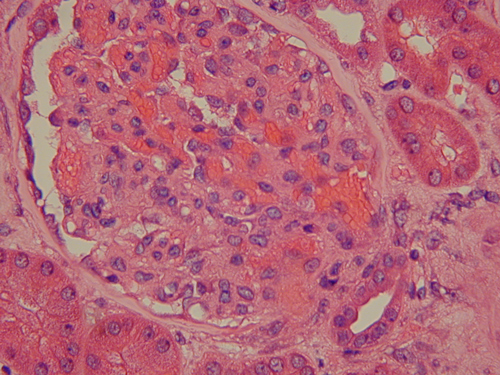
• glomerulonephritis (see figure 1)
• chronic pyelonephritis
• inherited renal disease such as polycystic kidney disease
Investigation and assessment
Historically the serum creatinine concentration was used to diagnose kidney disease, however since this is dependent not only on the renal clearance of creatinine but also on its generation, those with reduced muscle mass (e.g. older patients of both sexes and women of all ages compared with men of the equivalent age) may have advanced kidney disease without a particularly high serum creatinine concentration.
Thus all laboratories in the UK now routinely provide an eGFR with a serum creatinine value in all adult patients.5 This estimation is based on serum creatinine, age, gender, and ethnicity, and was validated in a population with CKD. Hence its accuracy in those with normal or mild CKD is not robust, and a result of >60 ml/min/1.73 m2 is reported in this group.5
Baseline assessment in a patient with newly diagnosed CKD should include:1,3
• blood pressure
• dipstick urinalysis
• urine albumin:creatinine ratio (ACR) or protein:creatinine ratio (PCR)
• glucose, lipid profile and a full blood count
An ultrasound scan should be considered in certain individuals (see box 2). In patients with a family history of inherited kidney disease a discussion of risks and benefits should occur before imaging, this may be more appropriately conducted by renal or genetic specialists.1,3
Proteinuria
Proteinuria is a very important prognostic marker in CKD. The risks of overt cardiovascular disease and of progressive kidney disease are both increased in those with urinary protein leak.6
Commonly used urine dipsticks are cheap and an easily accessible simple screening tool, however they do not quantify the amount of protein and fail to detect very low levels of albumin. The dipstick test is a measure of concentration: a normal individual may drink a minimal amount of fluid and pass 500 ml in 24 hours or drink enough to pass 2,500 ml in 24 hours, on both days the amount of protein excreted will be the same but the concentration of protein in a spot sample on the 500 ml day will be five fold greater than on the 2,500 ml day (and may have 1+ or even 2+ protein on dipstick).
Previously 24-hour collections of urine were used to assess proteinuria but these are cumbersome and inconvenient for both the patient and laboratory, and the accuracy of the collection was often uncertain. These have been largely replaced by the spot urine tests of ACR or PCR.
A urine ACR < 3 mg/mmol is normal, 3-30 mg/mmol is microalbuminuria, (the earliest clinical indicator of damage in diabetic nephropathy), while >30 mg/mmol is equivalent to approximately 0.5 g of protein in 24 hours and dipstick-positive proteinuria in someone euvolaemic.1,3 Urine PCR is less frequently used and equivalent values are shown in table 2. ACR is the preferred measure as it has greater sensitivity for lower levels of proteinuria and is the recommended method in those with diabetes.1,3
Haematuria
Haematuria is common, and although often not concerning it can occasionally be the presenting feature of significant disease. Determining which individuals need further investigation and then referring appropriately to urology or nephrology is an important skill in general practice. The initial evaluation should include:
• History – symptoms of infection/ obstruction/systemic illness
• Examination – unwell/hypertension/ bladder or prostate
• Urine – dipstick urinalysis/MSSU/ACR
• Blood – renal function
The Renal Association and British Society of Urological Surgeons consensus paper on haematuria is a useful guide to further management.7 See table 3, for a summary of which patients should be referred, and to whom.
Potential complications
The potential health problems associated with CKD can be divided into two main categories.
• Risk of progressive renal disease with the development of renal bone disease and renal anaemia
• Risk of overt cardiovascular disease. The majority of patients, even with stage 4 CKD never progress to
end-stage disease but there is an increased incidence of cardiovascular disease and premature death in this population.8 CKD should be treated as a significant risk factor (equivalent to diabetes) when assessing cardiovascular disease risk.1
Monitoring and referral
The maintenance of an accurate electronic CKD register in general practice is valuable to facilitate appropriate monitoring (as outlined in table 4), heighten awareness for opportunities to reduce cardiovascular risk, and potentially minimise inappropriate prescribing for those with renal impairment. Importantly it should also allow timely onward referral in the subgroup at risk of progressive disease, ensuring that the morbidity and mortality associated with late referral is reduced and that there is appropriate planning for renal replacement therapy.
Patients with CKD who should be considered for renal referral are listed in box 3.1,3
There are two important caveats when considering referral. First, fluctuation in renal function is common, particularly in elderly patients with CKD. A fall in eGFR can result from any intercurrent illness
(e.g. chest or urinary infection), medication (commonly trimethoprim or NSAIDs), or volume depletion (caused by diarrhoea or increased diuretic therapy). Referral is this subset should ideally be made after serial eGFR measures, which show a progressive decline over time.
Second, it is important to consider the individual patient’s wishes and comorbidities. The majority of elderly patients, even with severe CKD, will not have a decline in function that will lead to significant renal problems in their lifetime.6 In such cases referral to the nephrology team may be unhelpful both for the individual themselves, who will have unnecessary anxiety and potentially investigations, and for overall service provision.
Management
The key issues to address are:
• Minimisation of progression of CKD — particular attention to blood pressure control and reducing proteinuria
• Management of cardiovascular risk
• Avoidance of inappropriate prescribing — i.e. nephrotoxic drugs and dose adjustment of renally excreted medication
It is important to note however that the evidence base for tight blood pressure control in elderly individuals, particularly with atherosclerotic disease, is not robust. A blood pressure of, for example, 120 mmHg systolic may actually be detrimental to renal perfusion and result in deterioration in renal function.
This may be most noticeable with ACE inhibitor or angiotensin receptor blocker (ARB) therapy. Withdrawal of these agents in elderly patients with progressive CKD may arrest, or even reverse, the decline in function.
Patient education
This is an integral part of improving compliance with treatment measures (e.g. antihypertensive therapy) and is of particular relevance in CKD as the condition is often asymptomatic until advanced stages. 1,3
Lifestyle modification is also vital. Dietary advice with respect to caloric and salt restriction should be given along with support for smoking cessation.1,3
Pharmacotherapy
A blood pressure target < 130/80 mmHg should be aimed for in those with proteinuria (urine ACR >70 mg/mmol), and/or those with diabetes (first-line agent should be an ACE inhibitor or ARB). Otherwise the target should be < 140/90 mmHg in accordance with the current NICE guidelines.3
ACE inhibitor/ARB therapy should be titrated to the maximum tolerated dose in those with proteinuria.
The eGFR and potassium should be measured before commencement of therapy and 7-10 days after initiation or a dose increase. If any changes in these values are detected guidance should be followed as shown in box 4.3
To reduce cardiovascular disease risk, statin therapy and antiplatelet therapy should be considered, and it is important to aim for good glycaemic control.1
Recent developments
Virtual nephrology service
Some centres have developed a virtual nephrology service which may involve virtual clinics or 24-hour access to specialist advice via a telephone service. In one centre more than one-fifth of outpatient referrals were seen at a virtual clinic. Innovative approaches such as these have demonstrated a cost-effective, rapid access approach for non-complicated CKD in conjunction with the traditional outpatient clinic service.9 There are obvious benefits for both patients and physicians, and in the present financial constraints, with an aging population, it is likely that this approach will become more widely adopted.
Palliative care in renal disease
In certain cases of advanced CKD, dialysis would not be appropriate.
This can often be gauged best by the patient’s GP who has an appreciation of their overall disease burden and level of functioning. There is increasing recognition that conservative care in CKD is an important issue. Some renal services provide conservative care clinics or advice, and in the future this is likely to become more streamlined and widely available.
REFERENCES
1 Northern Ireland Guidelines for Management of Chronic Kidney Disease. Guidelines and Audit Implementation Network and the Northern Ireland Nephrology Team. February 2010.
www.gainni.org/images/Uploads/ Guidelines/Chronic%20Kidney%20Disease.pdf
2 Stevens PE, O’Donoghue DJ, de Lusignan S et al. Chronic kidney disease management in the United Kingdom: NEOERICA project results. Kidney Int 2007;72(1):92-9
3 National Institute for Health and Clinical Excellence. CG73. Chronic kidney disease: Early identification and management of chronic kidney disease in adults in primary and secondary care. NICE. London.2008
4 Quality and Outcomes Framework for 2012/13. March 2012 www.nhsemployers.org/Aboutus/Publications/Documents/QOF_2012-13.pdf
5 Courtney AE, Maxwell AP, Fogarty DG. Using estimated glomerular filtration rate (eGFR) to help manage patients with chronic kidney disease. Ulster Med J 2007;76(3):154-6
6 Conway B, Webster A, Ramsay G et al. Predicting mortality and uptake of renal replacement therapy in patients with stage 4 chronic kidney disease. Nephrol Dial Transplant 2009;24(6):1930-7
7 Joint Consensus statement on the initial assessment of haematuria. Renal Association and British Association of Urological Surgeons. 2008 www.renal.org/clinical/OtherGuidelines.aspx
8 Go AS, Chertow GM, Fan D et al. Chronic kidney disease and the risks of death, cardiovascular events, and hospitalization. N Engl J Med 2004;351(13):1296–305
9 Mark DA, Fitzmaurice GJ, Haughey KA et al. Assessment of the quality of care and financial impact of a virtual renal clinic compared with the traditional outpatient service model. Int J Clinic Pract 2011;65(10):1100-7
ARTICLE IN PDF
 Download this article in PDF format
PRESET SEARCHES
Immediate CPD prompts
These handy templates* prompt immediate drafting of personal learning, reflection and planning. Save your record straight into your personal development folder on your device or Cloud storage system.
*Adobe reader needed for iPad
EXTERNAL WEBLINKS
Useful information
Kidney Patient Guide
www.kidneypatientguide.org.uk/contents.php
The Renal Association
NHS Kidney Care
Edinburgh Renal Unit