SEARCH

Lewis G, Maxwell AP. Early diagnosis improves survival in kidney cancer. Practitioner 2012;256(1748):13-16
Early diagnosis improves survival in kidney cancer
24 Feb 2012
AUTHORS
Dr Gareth Lewis MB BCh MRCP PhD
Specialist Registrar in Nephrology
Professor Alexander P. Maxwell MD PhD FRCP
Consultant Nephrologist, Regional Nephrology Unit, Belfast City Hospital, Belfast
Article
The diagnosis of kidney cancer is often challenging because of its diverse and non-specific symptoms, limited or absent physical signs on examination and lack of any specific biomarkers. Many kidney cancers are actually discovered incidentally when abdominal imaging investigations are undertaken for unrelated symptoms or conditions.
Kidney cancers account for 2-3% of all adult malignancies in the UK. The incidence has been increasing which may reflect changing risk factors including a rise in obesity. Men are predominantly affected by renal cancer, a male:female ratio of 3:2, with an average age at diagnosis of 64 years.
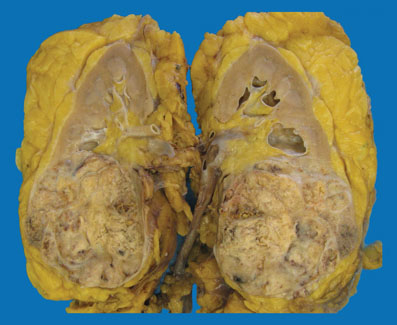
Renal (or clear) cell carcinoma (RCC) accounts for 90% of kidney cancers and will be the focus of this article.1
Early diagnosis improves survival with five-year survival rates for renal cancer of 70-94% for localised tumours, in the UK, but this survival rate falls to 40-70% when cancer has spread beyond the kidney. A continuing clinical challenge is to recognise the possibility of a kidney cancer so that the patient has appropriate investigations and prompt referral to a uro-oncology clinic if kidney cancer is present.
Clinical features
RCC should be suspected in the presence of:
• localising symptoms such as flank pain, a loin mass or haematuria
• constitutional upset including weight loss, pyrexia and/or night sweats or
• unexplained laboratory tests
Abnormal test results can include anaemia, raised ESR or other inflammatory markers in the absence of infection, or a number of paraneoplastic syndromes arising from secretion of tumour-derived hormones resulting in polycythaemia, hypercalcaemia or hypertension, see table 1, above.
One or several of these symptoms may trigger a patient’s initial primary care consultation. Abnormal test results may increase the index of suspicion for underlying malignancy.
Abdominal CT or ultrasound examinations may reveal an incidental renal mass or the patient may request such tests if there is a family history or inherited predisposition to kidney cancer.2 A new onset right-sided varicocoele has classically been considered an indication to search for an abdominal or renal mass causing venous obstruction.
Risk factors
Lifestyle
Several well characterised risk factors exist for RCC, see table 2, right. Smoking, obesity and hypertension are the most important and most common risk factors. All three demonstrate a dose-response relationship in terms of relative risk of RCC.3,4 The rising incidence of RCC in many geographical areas parallels the increasing prevalence of these three conditions in the general population, providing further justification for health promotion interventions in primary care.
Environmental
Environmental exposure to asbestos, cadmium and trichloroethylene are recognised, but less common, risk factors for RCC. Aniline dyes, used in the textile, rubber and plastics industry particularly predispose to renal pelvis transitional cell carcinomas.
Patients on chronic dialysis and renal transplant recipients are at increased risk of RCC in their native kidneys. This is likely to be secondary to the acquired cystic kidney disease seen in such individuals with subsequent malignant transformation of the cysts. Interestingly, inherited polycystic kidney disease does not appear to be a demonstrable risk factor for RCC.
Genetic
An inherited susceptibility to RCC is increasingly recognised.5 In first-degree relatives of those with RCC there is at least a twofold increased risk of RCC, underlining the fact that a family history of either kidney cancer or unusual and early cancers is relevant.
Studies of rare genetic diseases such as the von Hippel-Lindau syndrome (retinal, cerebellar, spinal and renal tumours) and tuberous sclerosis (developmental delay, epilepsy with central nervous system, skin and renal hamartomas) have helped unravel many of the underlying genetic and molecular pathways that promote the development of RCC leading to more rational treatments.
Protective factors such as physical activity, a diet rich in fruit and vegetables and moderate alcohol intake have all been suggested by epidemiological studies and healthy lifestyle advice seems just as relevant for prevention of kidney cancers as for many other chronic diseases.
Investigations
If kidney cancer is suspected on history, physical examination or initial screening tests then a red flag ultrasound examination of the renal tracts should be requested.
Some simple tests such as urinalysis, full blood picture, ESR, urea and electrolytes, liver function tests and bone profile can be organised. Dipstick urinalysis is of great value as asymptomatic haematuria may be the only abnormal test in the presence of non-specific symptoms such as weight loss or loin pain.
Persistent painless haematuria should trigger urgent referral to secondary care. A urine spot test to measure the albumin:creatinine ratio will quantify any proteinuria. Visible or non-visible haematuria, in the absence of proteinuria, suggests an underlying structural abnormality is present in the kidneys, ureters or bladder.
Ultrasound is helpful in detecting renal masses while a CT scan with contrast can help differentiate between benign and malignant kidney lesions and simultaneously stage any tumours found. Some patients will require a cystoscopy to exclude co-existing bladder pathology.
The recommendations from the 2005 NICE guidelines on referral for suspected cancer are summarised in table 3, opposite. 6
Treatment
Surgery
As up to 85% of suspicious lesions on CT scanning are found to be carcinomas at nephrectomy many surgeons will proceed to excise a part of, or the entire, affected kidney without performing a preliminary biopsy. Surgical removal of RCCs, where feasible, may result in cure in up to 40-60% of cases. 7
There is also a role for cytoreductive surgery followed by drug therapy in improving patient survival in cases where distant metastatic spread has already occurred. 8 The timing of, and decision to perform, such debulking surgery is still controversial. Individuals too frail for major surgery may benefit from evolving surgical approaches such as thermal ablation and cryotherapy, often employed in combination with active surveillance aiming to reduce interventional morbidity. An advantage is that repeat interventions can be performed but disadvantages include the inability to treat tumours larger than 3.5 cm in diameter effectively and the long-term outcomes compared with more conventional surgical treatment remain unknown.
In cases where surgical excision is not clearly curative, treatment of RCC can be challenging. 9 RCC tends to be relatively resistant to chemotherapy or radiotherapy and this limits the usefulness of such treatments. These difficulties, however, have promoted the development of both the surgical techniques discussed previously and targeted immunotherapy with agents designed to modulate the molecular pathways that promote tumour growth.
Immunotherapy
Patients for whom surgery would not be curative or who have advanced disease at presentation historically received interferon or aldesleukin immunotherapy. However, the standard care has now changed with the introduction of agents that target the VEGF (vascular endothelial growth factor) and mTOR (mammalian target of rapamycin) pathways. These drugs are considered first line in the treatment of metastatic RCC. Sunitinib, now recommended by NICE,10 is administered orally and acts by inhibiting the VEGF receptor. There is robust trial data supporting its efficacy and it has an acceptable side effect profile. 11,12
Other drugs such as sorafenib, bevacizumab and temsirolimus are not yet endorsed by NICE but are used in clinical practice in other countries.
Opportunities exist, however, for individuals to be enrolled in one of several trials evaluating these newer agents (see Useful information box, below).
Primary care
Patients receiving chronic treatment with drugs for RCC will require ongoing monitoring and may present to GPs
with troubling side effects. Common toxicities of sunitinib include fatigue, diarrhoea, nausea, altered taste sensation, mucositis, hypothyroidism and hand-foot syndrome. More serious side effects include blood dyscrasias such as anaemia and neutropaenia, and bleeding diatheses. In some cases, hypertension and left ventricular failure develop and may necessitate dose reduction or drug discontinuation. The frequency of these adverse effects and guidance in managing them has recently been comprehensively reviewed.13
Conclusions
Kidney cancer affects at least 1 in 50 adults so GPs will see patients with a new kidney cancer diagnosis quite frequently. A high index of suspicion is required when patients present with non-specific symptoms and signs which may indicate a renal tract malignancy. The clinical features may be quite subtle until advanced stage malignancy is present.
Modifiable risk factors such as smoking, hypertension and obesity provide scope for intervening at an early stage during routine visits. Basic blood and urine tests, in conjunction with an ultrasound scan, can provide the necessary information needed before following guidelines on referral to a surgeon or oncologist.
The repertoire of treatments is expanding with the introduction of novel targeted therapies. Allied to traditional surgical techniques these drug treatments, and their side effects, require the co-ordinated follow-up of patients by both primary and secondary care teams.
REFERENCES
1 Pascual D, Borque A. Epidemiology of kidney cancer. Adv Urol 2008;782381. Epub 2008 Nov 4
2 Rini BI, Campbell SC, Escudier B. Renal cell carcinoma. Lancet 2009;373:1119-1132
3 Bergström A, Hsieh CC, Lindblad P et al. Obesity and renal cell cancer – a quantitative review. Br J Cancer 2001;85(7):984-990
4 Wong-Ho C, Dong LM, Devesa SS. Epidemiology and risk factors for kidney cancer. Nat Rev Urol 2010;7(5):245-257
5 Morrison PJ, Donnelly DE, Atkinson AB, Maxwell AP. Advances in the genetics of familial renal cancer. Oncologist 2010;15:532-538
6 National Institute for Health and Clinical Excellence. CG27. Referral guidelines for suspected cancer. NICE. London. 2005
7 Blute ML, Leibovich BC, Lohse CM et al. The Mayo clinic experience with surgical management, complications and outcome for patients with renal cell carcinoma and venous tumour thrombosis. BJU Int 2004;94:33-41
8 Powles T, Blank C, Chowdhury S et al. The outcome of patients treated with sunitinib prior to planned nephrectomy in metastatic clear cell renal cancer. Eur Urol 2011;60:448-454
9 Leveridge MJ, Jewett MAS. Recent developments in kidney cancer. Can Urol Assoc J 2011;5(3):195-203
10 National Institute for Health and Clinical Excellence. TA169. Sunitinib for the first-line treatment of advanced and/or metastatic renal cell carcinoma. NICE. London. 2009
11 Motzer RJ, Rini BI, Bukowski RM et al. Sunitinib in patients with metastatic renal cell carcinoma. JAMA 2006;295:2516-2524
12 Ferguson T, Gore M. Which patients with renal cancer may benefit from sunitinib therapy? Ther Adv Med Oncol 2010;2(2):69-74
13 Bhojani N, Jeldres C, Patard JJ et al. Toxicities associated with the administration of sorafenib, sunitinib and temsirolimus and their management in patients with metastatic renal cell carcinoma. Eur Urol 2008;53:917-930
ARTICLE IN PDF
 Download this article in PDF format
EXTERNAL WEBLINKS
NCI
Supportive and palliative care
PubMed
Cancer Research UK
Provides a searchable database of trials including those relevant to kidney cancer. Search under ‘renal cell cancer’ in the ‘find a clinical trial’ dialogue box cancerhelp.cancerresearchuk.org/trials/
NHS Choices
Patient-oriented website with useful and straightforward explanations
www.nhs.uk/Conditions/Cancer-of-the-kidney/Pages/Introduction.aspx
Patient support and advocacy sites
www.kidneycancersupportnetwork.co.uk/
UK Risk Assessment Tools
QCancer
Qcancer men
Qcancer women
UK Early diagnosis programmes
UK NCAT
Macmillan - early diagnosis