SEARCH

Corr MP, Maxwell AP. GPs should be vigilant for accelerated progression of CKD. Practitioner January 2022;266(1854):11-15
GPs should be vigilant for accelerated progression of CKD
24 Jan 2022
AUTHORS
Dr Michael P. Corr MBBCh MSc MRCP, Specialist Trainee in Renal Medicine, Regional Nephrology Unit, Belfast City Hospital, Belfast, UK
Professor Alexander P. Maxwell MD PhD FRCP, Professor of Renal Medicine, Centre for Public Health, Royal Victoria Hospital, Queen’s University Belfast, Belfast, UK
Competing interests: None
Article
Chronic kidney disease (CKD) is a potentially progressive condition resulting in a decline in renal function secondary to a range of causes. An individual is considered to have CKD if abnormalities of kidney function or structure have been present for more than three months. Despite being common, CKD often remains undiagnosed partly because of lack of symptoms until late in the disease process. Late detection of CKD, and hence lack of effective management, increases the risk of progression to end-stage renal disease which often requires renal replacement therapy such as dialysis or transplantation. Furthermore, delayed diagnosis of CKD is associated with increased morbidity and mortality. Derangement in serum creatinine and eGFR will alert a clinician to a patient with potential CKD. However, creatinine and eGFR are imperfect measurements of kidney function and should be interpreted in the context of the individual patient. All patients with CKD should have the following parameters checked at the earliest opportunity: blood pressure; full blood profile, glucose and lipid profile; dipstick urinalysis; and urinary albumin:creatinine ratio. Patients with CKD should be provided with information and education tailored to the severity of their CKD and risk of progression. Timely referral for specialist nephrology input when required is key. The decision to refer to nephrology should take account of the patient’s wishes and their comorbidities.
Chronic kidney disease (CKD) is a potentially progressive condition resulting in a decline in renal function secondary to a range of causes. An individual is considered to have CKD if abnormalities of kidney function or structure have been present for more than three months.
The definition of CKD includes all individuals with markers of kidney damage or those with an estimated glomerular filtration rate (eGFR) of less than 60 ml/min/1.73m2 on at least two occasions 90 days apart (with or without markers of kidney damage).
Markers of kidney damage include: albuminuria (ACR > 3 mg/mmol), haematuria (of presumed or confirmed renal origin), electrolyte abnormalities due to tubular disorders, renal histological abnormalities, structural abnormalities detected by imaging (e.g. polycystic kidneys, reflux nephropathy) or a history of kidney transplantation.
CKD is predicted to be the fifth leading cause of death globally by 2040.1 Currently, 10% of adults have some form of CKD, resulting annually in 1.2 million deaths and 28 million lost years of life worldwide.2 The prevalence of CKD (eGFR < 60ml/min/1.73m2)in England is estimated to be between 5.2 and 7.7%.3
Despite being common, CKD often remains undiagnosed partly because of lack of symptoms until late in the disease process. One UK study found that 18.2% of individuals aged over 60 had CKD, but 44% of this population were undiagnosed.4 Late detection of CKD, and hence lack of effective management, increases the risk of progression to end-stage renal disease (ESRD) which often requires renal replacement therapy such as dialysis or transplantation. Furthermore, delayed diagnosis of CKD is associated with increased morbidity and mortality.5
NICE published updated guidelines on the assessment and management of CKD (NG203) in August 2021.6
Risk factors
CKD has a wide range of causes including diabetes, hypertension, renovascular disease, urological disorders, and hereditary conditions and can occur following acute kidney injury (AKI). In older patient populations, CKD may be caused by a combination of associated conditions such as hypertension and atherosclerotic vascular disease.
NICE recommends testing for the presence of CKD in certain adult patient groups at increased risk by using eGFR and/or urinary albumin: creatinine ratio (ACR) to quantify proteinuria, see table 1.
NICE recommends that patients who have experienced an episode of AKI should have annual checks of eGFR and urinary ACR for at least three years post AKI, even if their eGFR has returned to baseline.
Investigations
Serum creatinine and eGFR
Derangement in serum creatinine and eGFR will alert a clinician to a patient with potential CKD. Initially, it is important to differentiate AKI from established CKD or a new AKI in the setting of CKD. Reviewing previous creatinine and eGFR results is helpful or, if not available, repeat sampling within two weeks is recommended to assess whether kidney function is stable or is continuing to decline.
Creatinine and eGFR are, however, imperfect measurements of kidney function and should be interpreted in the context of the individual patient.
For example, eGFR is not a reliable measurement of renal function during an episode of AKI or during pregnancy. As serum creatinine is a breakdown product of creatinine and phosphocreatine in muscle, caution is needed interpreting results in patients at the extremes of muscle mass.
For example, individuals with significant muscle wasting or limb amputees may have their eGFR overestimated, while body builders with high muscle mass may have their eGFR underestimated.
The updated NICE guidance recommends omitting ethnicity in calculating eGFR.6 There is no evidence to support its use and including ethnicity in the eGFR calculation risks delaying appropriate referral and treatment.
NICE has recommended further research to establish how best to estimate GFR in non-Caucasian patients.
Other investigations
All patients identified as having CKD should have the following parameters checked at the earliest opportunity.
• Blood pressure
• Full blood profile, glucose and lipid profile
• Dipstick urinalysis
• Urinary ACR
Ultrasound imaging should be offered to all adults with CKD as outlined in box 1. Patients with suspected hereditary conditions, such as polycystic kidney disease, should be counselled about the implications of an abnormal result before imaging is requested.
Assessing for albuminuria or proteinuria in CKD is important. Proteinuria predicts those patients at highest risk of progressive CKD and is associated with increased risk of cardiovascular mortality.
NICE does not recommend the use of reagent strips in measuring proteinuria in patients with CKD. Urinary ACR, rather than urinary protein: creatinine ratio (PCR), should be the first-line investigation for proteinuria as it is more sensitive for detecting low levels of proteinuria.
Urinary ACR results are interpreted as follows:
• < 3 mg/mmol – normal
• 3-70 mg/mmol – should be repeated with an early morning sample in the first instance but may represent early proteinuria
• ≥ 70 mg/mmol equates to proteinuria (no need for repeat testing)
At high levels of proteinuria (ACR ≥ 70 mg/mmol) PCR testing may be used as an alternative.
Haematuria
Asymptomatic invisible haematuria is a common finding on urinalysis. The cause is often urological such as renal stones, urological malignancy, urinary tract infection or hyperplasia/infection of the bladder or prostate.
In young people haematuria is often transient and of little consequence.
NICE recommends regarding two/three reagent strips positive for haematuria as persistent invisible haematuria.
The UK Kidney Association recommends testing patients with persistent invisible haematuria for eGFR and proteinuria. It recommends the following management:7
• Age ≥ 40 years; usually refer to urology. If renal impairment and/or proteinuria consider simultaneous referral to nephrology
• Age < 40 or ≥ 40 years with negative urological investigations; if no proteinuria and eGFR ≥ 60 ml/min/1.73m2 manage as CKD stage G1/G2. Otherwise, refer to nephrology
Note that previous guidance from the British Association of Urological Surgeons on haematuria has been withdrawn since the publication of NICE guideline NG12. Suspected cancer: recognition and referral.8
CKD staging
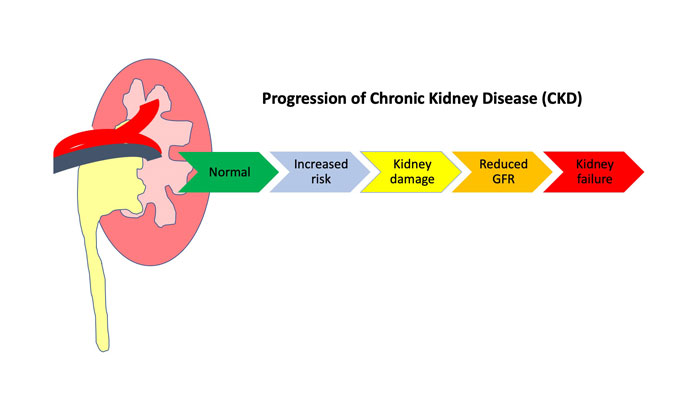
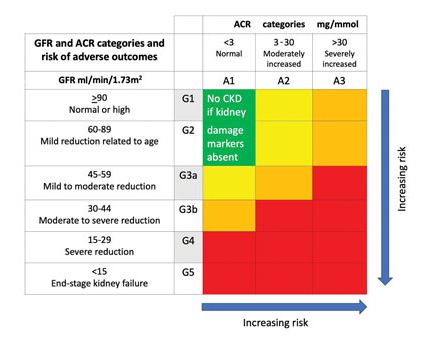
CKD is classified based on GFR and ACR with the GFR categories G1-G5 similar to previous GFR thresholds for CKD stages 1-5. ACR is categorised as A1-A3 according to the levels of proteinuria.
A1-A3 are added to CKD classification to highlight the risks that proteinuria is associated with progression to ESRD and cardiovascular disease, see figure 2. The GFR and ACR categories are listed in table 2.
Prognosis
Risk factors associated with progression of CKD include:
• Cardiovascular disease
• Proteinuria
• Previous episode of AKI
• Hypertension
• Diabetes
• Smoking
• African, African-Caribbean or Asian ethnicity
• Chronic use of NSAIDs
• Untreated urinary outflow obstruction
Monitoring
Most patients with CKD can be successfully managed in primary care. Fortunately, CKD is not progressive in many cases and care should be taken not to alarm patients unduly who are at lower risk of progressing to ESRD. Agreement should be made with the patient about the frequency of eGFR and ACR monitoring. The minimum suggested monitoring from NICE based on CKD staging annually is outlined in table 3.
Other factors can be considered in tailoring the management of individual patients. Enhanced monitoring may be required with recent AKI, high-risk comorbidities (diabetes, hypertension or heart failure), or changes in treatment such as introduction or dose changes of renin-angiotensin-aldosterone system (RAAS) antagonists or diuretics. Reduced monitoring may be appropriate in patients who have opted for conservative care.
It is vital to detect accelerated progression of CKD, this may be a catalyst for referral to specialist nephrology services because of the risk of progression to ESRD. NICE defines accelerated progression of CKD as:
• Sustained decrease in GFR of 25% or more and a change in GFR category within 12 months or
• Sustained decrease in GFR of 15 ml/min/1.73m2 per year
Management
Patients with CKD should be provided with information and education tailored to the severity of their CKD and personal risk of progression.
Patients should be given appropriate support and have access to their own data (test results, correspondence regarding their diagnosis and management plan) to enable them to self-manage aspects of their condition.
Maintaining a healthy weight, smoking cessation, dietary salt reduction, good glycaemic control and exercise all help to minimise CKD progression and also help reduce morbidity and mortality associated with comorbid conditions e.g. cardiovascular disease.
Statin therapy for primary prevention and antiplatelet therapy for secondary prevention of cardiovascular disease should be considered.
Patients can be advised how to lower their risk of AKI particularly with regard to medications and sick day rules. They should avoid NSAIDs and trimethoprim containing antibiotics and also be advised that medications such as diuretics and RAAS antagonists should be temporarily withheld when at risk of dehydration (for example during vomiting and diarrhoeal illness.) Diuretics and RAAS antagonists can be restarted 2-3 days after recovery from acute illness.
Blood pressure
In patients with CKD, blood pressure (BP) should be targeted to a clinic systolic pressure below 140 mmHg (target range 120-139 mmHg) and clinic diastolic pressure below 90 mmHg even if multiple agents are required. If patients with CKD have an ACR > 70 mg/mmol then the BP target should be for a clinic systolic pressure less than 130 mmHg (target range 120-129 mmHg) and diastolic pressure less than 80 mmHg. ACE inhibitors (ACEi) or angiotensin receptor blockers (ARB) are first-line agents.
Caution is needed when reducing BP in elderly individuals with widespread vascular disease as kidney perfusion may be compromised by the fall in BP leading to AKI. Serum creatinine, eGFR and potassium should be monitored 7-10 days after commencement or dose change of ACEi/ARB.
The Kidney Disease Improving Clinical Outcomes (KDIGO) 2021 updated guideline and other international bodies now recommend a systolic BP target < 120 mmHg for patients with CKD.9 This is largely based on evidence from the SPRINT study (Systolic Blood Pressure Intervention Trial) which showed a significant reduction in cardiovascular events with tighter BP control without a significant increase in adverse outcomes (with the exception of AKI where there was an increased risk).10 Whether this, along with the increasing use of ambulatory/home BP measurements11 leads to changes in UK hypertension guidance remains to be seen.
Proteinuria
ACEi/ARB therapy should be offered to patients with CKD to reduce proteinuria. Treatment should be commenced and titrated to maximum tolerated dose in patients with CKD and:
• Diabetes with ACR ≥ 3 mg/mmol
• Hypertension with ACR > 30 mg/mmol
• ACR ≥ 70 mg/mmol
SGLT2 inhibitors are increasingly being used in individuals with diabetes, CKD and proteinuria following the impressive results in CREDENCE12 and DAPA-CKD13 trials that demonstrated their ability to reduce eGFR decline and slow progression to ESRD. NICE guidance on the management of type 2 diabetes14 in adults was updated in 2021 stating that:
For patients with diabetic nephropathy on maximum tolerated ACEi/ARB therapy and:
• ACR 3-30 mg/mmol – addition of an SGLT2 inhibitor should be considered
• ACR > 30 mg/mmol – addition of an SGLT2 inhibitor should be offered
It is likely that the role of SGLT2 inhibitors will expand to treatment for proteinuria in other conditions that cause CKD with additional trials, such as EMPA-KIDNEY, due to publish results in the near future. This is a large double-blind placebo-controlled trial of empagliflozin involving more than 6,000 patients with CKD. This trial will help to establish if empagliflozin reduces the rate of CKD progression, all-cause mortality and cardiovascular mortality in individuals with CKD. (www.empakidney.org)
Referral
Appropriate and timely referral for specialist nephrology input when required is key. The decision to refer to nephrology should always take into account the individual patient’s wishes and their comorbidities.
Often patients do not require regular hospital review and agreement on management can be reached through liaison between primary care and nephrology.
Referral of adults with CKD to the nephrology service should be considered if they have the following:
• Five-year risk > 5% of needing renal replacement therapy, measured using the 4-variable Kidney Failure Risk Equation. (See external weblinks)
• ACR > 70 mg/mmol or more, unless known to be caused by diabetes and already appropriately treated
• ACR > 30 mg/mmol (ACR category A3), together with haematuria
• Sustained decrease in eGFR > 25% or more and a change in eGFR category within 12 months
• Sustained decrease in eGFR > 15 ml/min/1.73m2 or more per year
• Hypertension that remains poorly controlled (above the patient’s individual target) despite the use of at least four antihypertensive medications at therapeutic doses (see also NICE guideline on hypertension in adults)15
• Known or suspected rare or genetic causes of CKD
• Suspected renal artery stenosis
Patients with CKD and renal outflow obstruction should be referred to urological services, unless urgent treatment is needed.
Conclusion
Despite being common, CKD is often under recognised leading to late diagnosis and increased risk of progression to ESRD with associated higher mortality. An individual’s risk of progressive CKD is assessed by measuring eGFR and ACR.
Effective monitoring and early management of CKD in primary care can reduce rapid progression to ESRD and ensure timely referral to nephrology if required.
REFERENCES
1 Foreman KJ, Marquez N, Dolgert A et al. Forecasting life expectancy, years of life lost, and all-cause and cause-specific mortality for 250 causes of death: reference and alternative scenarios for 2016-40 for 195 countries and territories. Lancet 2018;392(10159):2052-90
2 GBD Chronic Kidney Disease Collaboration. Global, regional, and national burden of chronic kidney disease, 1990-2017: a systematic analysis for the Global Burden of Disease Study 2017. Lancet 2020; 395:709-33
3 Fraser SDS, Aitken G, Taal MW, Mindell JS et al. Exploration of chronic kidney disease prevalence estimates using new measures of kidney function in the Health Survey for England. PLoS One 2015;10:e0118676
4 Hirst JA, Hill N, O'Callaghan CA et al. Prevalence of chronic kidney disease in the community using data from OxRen: a UK population-based cohort study. Br J Gen Pract 2020;70(693):e285-e293
5 Smart NA, Dieberg G, Ladhani M, Titus T. Early referral to specialist nephrology services for preventing the progression to end-stage kidney disease. Cochrane Database Syst Rev 2014;(6):CD007333
6 National Institute for Health and Care Excellence. NG203. Chronic kidney disease: assessment and management. NICE. London. 2021
7 The UK eCKD Guide. UK Kidney Association. 2017 https://ukkidney.org/health-professionals/information-resources/uk-eckd-guide
8 National Institute for Health and Care Excellence. NG12. Suspected cancer: recognition and referral. NICE. London. 2015 Updated 2021 www.nice.org.uk/guidance/ng12
9 Kidney Disease: Improving Global Outcomes (KDIGO) Blood Pressure Work Group. KDIGO 2021 Clinical practice guideline for the management of blood pressure in chronic kidney disease. Kidney Int 2021;99(3S):S1-S87
10 SPRINT Research Group, Wright JT Jr, Williamson JD et al. A randomized trial of Intensive versus standard blood-pressure control. N Engl J Med 2015;373(22):2103-16 Erratum in: N Engl J Med 2017;377(25):2506
11 Carey RM, Whelton PK; 2017 ACC/AHA Hypertension Guideline Writing Committee. Prevention, detection, evaluation, and management of high blood pressure in adults: synopsis of the 2017 American College of Cardiology/American Heart Association Hypertension Guideline. Ann Intern Med 2018;168(5):351-58
12 Perkovic V, Jardine MJ, Neal B et al. Canagliflozin and renal outcomes in type 2 diabetes and nephropathy. N Engl J Med 2019;380(24):2295-2306
13 Heerspink HJL, Stefánsson BV, Correa-Rotter R et al. Dapagliflozin in patients with chronic kidney disease. N Engl J Med 2020;383(15):1436-46
14 National Institute for Health and Care Excellence. NG28. Type 2 diabetes in adults: management. NICE. London. 2015 Updated 2021 www.nice.org.uk/guidance/ng28
15 National Institute for Health and Care Excellence. NG136. Hypertension in adults: diagnosis and management. NICE. London. 2019 www.nice.org.uk/guidance/ng136
ARTICLE IN PDF
 Download this article in PDF format
EXTERNAL WEBLINKS
UK Kidney Association eCKD Guide
A quick online support for the diagnosis and management of CKD
An online support tool for patients and healthcare professionals that explains CKD stages, causes of CKD and has an individual risk calculator
Articles on kidney disease for both healthcare professionals and patients