SEARCH

McAnallen S M, McCaughan J A. Tailoring dialysis modality to the patient. Practitioner Feb 2019 263(1823):15-19
Tailoring dialysis modality to the patient
22 Feb 2019
AUTHORS
Dr Susan M McAnallen MB BCh BAO MRCPI, SpR Nephrology
Dr Jennifer A McCaughan PhD MRCP FRCPath, Consultant Nephrologist
Regional Nephrology Unit, Belfast City Hospital, Belfast, UK
Competing interests: None
Article
Abstract
End stage renal disease (ESRD) can be defined as the requirement for kidney transplantation or dialysis therapy. In the UK in 2016, of the 63,162 people receiving renal replacement therapy 53% were renal transplant recipients, 41% were on haemodialysis and 6% were on peritoneal dialysis. Dialysis should be started when: symptoms of uraemia impact on day to day living; the need is indicated by biochemical measures or uncontrollable fluid overload or at an eGFR of 5-7 ml/min/1.73 m2 in the absence of symptoms. The choice of dialysis modality is influenced by the individual’s functional status, social circumstances and confidence. Advantages of peritoneal dialysis include independence from hospital, flexibility, lack of requirement for vascular access and preservation of residual renal function. Home haemodialysis enables patients to have longer and more frequent dialysis resulting in reduced dietary and fluid restrictions and a need for fewer additional antihypertensive medications. Dialysis patients are a vulnerable cohort of patients with increased general and cardiovascular morbidity. They are also susceptible to infection. Dialysis catheters, grafts and arteriovenous fistulae can all become infected. Vascular access associated infections can be particularly serious and lead to dissemination of infection (e.g. endocarditis, discitis, osteomyelitis). Any suspicion of infection related to dialysis access should be discussed urgently with the dialysis team.
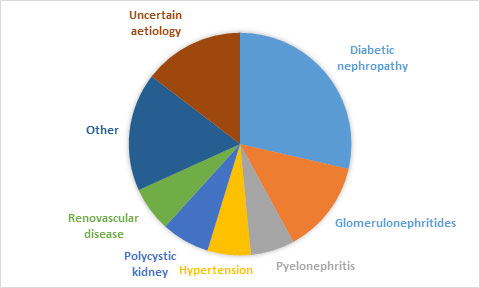
End stage renal disease (ESRD) can be defined as the requirement for kidney transplantation or dialysis therapy. In the UK, the number of people receiving dialysis is increasing; at the end of 2016, there were 63,162 patients receiving renal replacement therapy (RRT): 53% of these were renal transplant recipients, 41% were on haemodialysis and 6% were on peritoneal dialysis.1 Common causes of ESRD in the UK are shown in figure 1.
Dialysis partially replaces the solute and water excreting functions of the kidneys (this equates to a GFR of approximately 5%). It does not replace the kidney’s role in blood pressure management (via the renin-angiotensin system), haemoglobin synthesis or calcium and phosphate homoeostasis.
Indications for dialysis
The patient’s overall symptom burden is considered in the context of their fluid status and biochemical parameters when a decision on initiating dialysis is made, see table 1, below. The 2018 NICE guideline3 states that dialysis should be started when: symptoms of uraemia impact on day to day living; the need is indicated by biochemical measures or uncontrollable fluid overload or at an eGFR of 5-7 ml/min/1.73 m2 in the absence of symptoms.
NICE also recommends that a decision to commence dialysis is made in partnership with the patient or, where appropriate, their carers. Before starting dialysis in response to symptoms, it is important to ensure that the symptoms are not attributable to other comorbidities.
The principle of dialysis is that blood is separated from a suitable fluid by a semipermeable membrane allowing electrolytes and other substances to diffuse across the membrane until equilibrium is reached. In addition to diffusion, haemofiltration enhances the clearance of toxins in haemodialysis. Fluid is also removed during dialysis; this can be driven by a pressure gradient or by using a concentrated dialysis fluid (in peritoneal dialysis) into which water moves by osmosis.
There are two main types of dialysis: haemodialysis and peritoneal dialysis. Haemodialysis can be either hospital or home based. The choice of dialysis modality is often heavily influenced by the individual’s functional status, social circumstances and confidence. The advantages and disadvantages of hospital-based haemodialysis, home haemodialysis and peritoneal dialysis are compared in table 2.
Peritoneal dialysis
Peritoneal dialysis remains an important modality of RRT in the UK. The peritoneum is employed as the selectively permeable membrane. A catheter is inserted into the peritoneum to allow dialysis fluid to be infused into the peritoneal cavity. Solutes and water pass from the blood into the peritoneal fluid by diffusion and osmosis and the fluid is then drained via the catheter. This cycle is repeated to allow adequate removal of fluid and toxins.
NICE recommends peritoneal dialysis as the modality of choice for children aged two years or under, people with residual renal function and adults without significant associated comorbidities.3
Peritoneal dialysis can be categorised into two types: continuous ambulatory peritoneal dialysis and automated peritoneal dialysis. The latter is also referred to as continuous cycling peritoneal dialysis. Many prescriptions incorporate elements of both techniques.
Patients receive a personalised dialysis prescription from their team which is programmed into their peritoneal dialysis machine. Each day, the patient weighs him/herself and records the volume of fluid removed during dialysis. Most patients perform peritoneal dialysis every day. There is a regular review at a specialist peritoneal dialysis clinic and, in many centres, the peritoneal dialysis team may also arrange home visits to support patients.
The advantages of peritoneal dialysis include independence from hospital, flexibility, lack of requirement for vascular access and preservation of residual renal function. However, it does require a motivated, dexterous operator with an intact peritoneal cavity and suitable body habitus. Absolute contraindications include large diaphragmatic defects, excessive peritoneal adhesions, surgically uncorrectable abdominal hernia or ischaemic or infectious bowel disease.4
The peritoneal membrane changes with exposure to dialysis fluid which means that peritoneal dialysis is a dialysis option for a finite period. Prolongation of peritoneal dialysis has been associated with a serious complication related to scarring of the peritoneum called encapsulating sclerosing peritonitis. Most patients on peritoneal dialysis will eventually make the transition to haemodialysis, usually within five years, if transplantation is not an option.
Assisted peritoneal dialysis
In the past, peritoneal dialysis was only an option for those patients with the capacity to carry out the dialysis themselves. Assisted peritoneal dialysis is suitable for patients who would otherwise be unable to perform peritoneal dialysis independently.
It requires assistance from carers or family members to carry out the lifting, connecting and machine work necessary to facilitate peritoneal dialysis.
This can offer a good quality of life and symptom relief for a cohort of patients and avoid the need for hospital haemodialysis. Clinical experience worldwide shows that assisted peritoneal dialysis permits acceptable survival for many elderly or disabled patients in the comfort of their own home, with no significant difference in complications from those who self-administer peritoneal dialysis.5
A multidisciplinary peritoneal dialysis team, incorporating expertise from nurse specialists, nephrologists, carers and patients, is essential for an effective peritoneal dialysis programme. Peritoneal dialysis allows many patients with ESRD to retain their independence.
Haemodialysis
The majority of patients on dialysis in the UK receive haemodialysis. The patient’s blood passes through a dialysis machine where a selectively permeable synthetic membrane separates it from the dialysis fluid. Solutes and water move from the blood into this fluid by diffusion and osmosis. Additionally, the rate of flow of the dialysate enhances solute removal. There is also a pressure gradient between the blood and dialysate that enhances fluid removal.
Hospital-based haemodialysis
Patients who receive hospital-based haemodialysis typically attend a dialysis unit for four hours, three times a week. The advantages of hospital-based haemodialysis are that the dialysis is performed by trained healthcare professionals and there is close medical supervision. The main disadvantages are the requirement for travel to hospital, inflexible dialysis sessions and limited hours of dialysis.
Home haemodialysis
Home haemodialysis allows patients to be flexible and adjust dialysis schedules to suit their personal and professional commitments. It enables patients to have longer and more frequent dialysis (e.g. nocturnal dialysis) which achieves a homoeostatic state more similar to that of healthy kidneys. This results in reduced dietary and fluid restrictions and a need for fewer additional antihypertensive medications.
Training for home haemodialysis typically involves 4.5-6 hours/day for five days a week for three to eight weeks. If patients are already proficient at accessing their arteriovenous fistula (AVF) or graft, training can be shorter. Most people train in conjunction with a partner or carer.
Access to advice 24 hours a day and regular visits from a home haemodialysis nurse specialist are standard.
Vascular access and vein preservation
Patients on haemodialysis require vascular access to allow blood to be pumped at high speed around the dialysis machine. The three main options for vascular access are AVF, synthetic grafts and central venous catheters.
The AVF is the vascular access of choice. AVFs are surgically formed by joining an artery to a vein. A newly created AVF takes six to eight weeks to mature and be useable. NICE recommends creating the AVF six months before the anticipated start of dialysis to allow for maturation and the possibility of the first fistula failing or the need for further interventions prior to use.3
Patients with CKD 3 who may progress to ESRD should have vein preservation at an early stage. This involves avoidance of blood pressure measurement and venesection in the non-dominant arm. Vein preservation enhances the chances of forming a functional AVF in the future.
Primary care management
Dialysis patients are a vulnerable cohort with increased cardiovascular morbidity and mortality when compared with the general population. They are also susceptible to infection. Dialysis patients should receive an annual flu vaccination. Other vaccinations should be administered according to the general population guidance.
Nutrition
Dialysis patients are a high-risk group for malnutrition, see table 3; it has been suggested that the incidence of malnutrition can be as high as 40%.6
The causes are multifactorial including dialysis related nutritional losses, the catabolic effect of dialysis itself, and the often advanced age of those on dialysis. Malnutrition has been shown to increase the risk of morbidity and mortality in this patient cohort; therefore the importance of optimising nutritional status cannot be underestimated.
Smoking cessation
The leading cause of mortality in patients with ESRD remains cardiovascular disease, see figure 2. Smoking cessation advice is crucial for dialysis patients as smoking has been shown to be associated with increased morbidity and mortality in patients with chronic kidney disease.7,8 Many hospitals and community practices have access to smoking cessation teams.
Sepsis
Dialysis catheters, grafts and AVFs can all become infected. Vascular access associated infections can be particularly serious and lead to dissemination of infection (e.g. endocarditis, discitis, osteomyelitis). One in five of these cases are fatal.8 Pyrexia and rigors are highly predictive of positive blood cultures in dialysis patients with tunnelled dialysis catheters.9,10,11 Table 4, below, illustrates symptoms suggestive of potential access infection. Any suspicion of infection related to dialysis access should be discussed urgently with the dialysis team.
Infection of peritoneal dialysis catheters is associated with the development of peritoneal dialysis peritonitis; reported rates vary from 0.06 to 1.66 episodes per patient year.12
If identified early, it is often possible to manage this without removing the catheter allowing the patient to remain on peritoneal dialysis. Peritoneal dialysis peritonitis contributes to 2-6% of deaths of patients on peritoneal dialysis and is associated with 20% of peritoneal dialysis failures.13 Ensuring high standards of hygiene and close attention to detail when performing peritoneal dialysis can reduce the risk of peritonitis.13 The 2016 International Society of Peritoneal Dialysis update recommends antifungal prophylaxis (e.g. oral nystatin or fluconazole) in all peritoneal dialysis patients who receive a course of antibiotics.14 This is because the majority of cases of fungal peritonitis are preceded by courses of antibiotics.14,15
In addition, many patients are troubled by constipation which can interfere with the effectiveness of peritoneal dialysis, see table 4.
The short- and long-term complications of haemodialysis are shown in table 5. For patients who have been on dialysis long term, malnutrition, renal bone disease, increased cardiovascular and infection risk and difficulties with vascular access are serious potential problems.
Holidays
Dialysis patients may enquire about whether they can go on holiday. Many dialysis centres have a nurse specialist who is experienced in helping ensure suitable patients can travel and have dialysis facilitated in approved centres. Travel insurance is recommended, see Useful information box, below.
Conclusion
Kidney transplantation remains the RRT modality of choice for the majority of patients with ESRD. However, many patients have to wait for an acceptable donor and require dialysis during that time. In addition, some renal patients will require a number of transplants and periods on dialysis during their lifetime.
While dialysis is an effective treatment strategy for those with ESRD who are unsuitable for transplantation, it is not without potential problems. In elderly patients and those with multiple comorbidities, it is important to consider both quality of life as well as quantity of life before embarking on dialysis. Some individuals will opt for conservative care and avoid the need for regular hospital attendance.3 Many nephrology centres now have conservative care teams that support patients in this choice.
NICE recommends that decisions about RRT modalities or conservative management are made jointly between the patient (or their carers) and the healthcare team, taking into account predicted quality of life, life expectancy, individual preferences and comorbidities. Patients should also be given the opportunity to review the decision and discuss any concerns or changes in their preferences.
REFERENCES
1 Moeller S, Gioberge S, Brown G. ESRD patients in 2001: global overview of patients, treatment modalities and development trends. Nephrol Dial Transplant 2002;17: 2071-76
2 Schieppati A, Remuzzi G. Chronic renal disease as a public health problem: epidemiology, social, and economic implications. Kidney Int Suppl 2005;68:7-10
3 National Institute for Health and Care Excellence. NG107. Renal replacement therapy and conservative management. NICE. London. 2018 www.nice.org.uk/guidance/ng107 [Last accessed 31 Jan 2019]
4 Woodrow G, Fan SL, Reid C et al. Renal Association Clinical Practice Guideline on peritoneal dialysis in adults and children. BMC Nephrol 2017;18:333
5 Dimkovic N, Aggarwal V, Khan S et al. Assisted peritoneal dialysis: what is it and who does it involve? Adv Peri Dial 2009;25:165-70
6 De Mutsert R, Grootensdorst DC, Boeschoten EW et al. Subjective global assessment of nutritional status is strongly associated with mortality in chronic dialysis patients. Am J Clin Nutr 2009;89(3):787-93
7 Liebman SE, Lamontagne SP, Huang LS et al. Smoking in dialysis patients: A systematic review and meta-analysis of mortality and cardiovascular morbidity. Am J Kidney Dis 2011;58(2):257-65
8 Staplin N, Haynes R, Herrington WG et al on behalf of the SHARP Collaborative Group. Smoking and adverse outcomes in patients with CKD: The Study of Heart and Renal Protection (SHARP). Am J Kidney Dis 2016;68(3):371-80
9 Krishnasami Z, Carlton D, Bimbo L et al. Management of haemodialysis catheter-related bacteraemia with an adjunctive antibiotic lock solution. Kidney Int 2002;61(3):1136-42
10 Poole CV, Carlton D, Bimbo L, Allon M. Treatment of catheter-related bacteraemia with an antibiotic lock protocol: effect of bacterial pathogen. Nephrol Dial Transplant 2004;19(5):1237-44
11 Miller LM, Clark E, Dipchand C et al. Haemodialysis tunnelled catheter-related infections. Can J Kidney Health Dis 2016;3:2054358116669129
12 Piraino B, Bernardini J, Brown E et al. ISPD position statement on reducing the risks of peritoneal dialysis-related infections. Perit Dial Int 2011;31:614-30
13 Cho Y, Johnson DW. Peritoneal dialysis-related peritonitis: towards improving evidence, practices and outcomes. Am J Kidney Dis 2014;64(2):278-89
14 Li PK, Szeto CC, Piraino B et al. ISPD peritonitis recommendations: 2016: Update on prevention and treatment. Perit Dial Int 2016;36(5):481-508
15 Goldie SJ, Kiernan-Troidle L, Torres C et al. Fungal peritonitis in a large chronic peritoneal dialysis population: a report of 55 episodes. Am J Kidney Dis 1996;28:86-91
16 Lo W-K, Chan C-Y, Cheng S-W et al. A prospective randomized control study of oral nystatin prophylaxis for candida peritonitis complicating continuous ambulatory peritoneal dialysis. Am J Kidney Dis 1996;28(4):549-52
17 Byrne C, Caskey F, Castledine C. UK Renal Registry: 20th Annual Report of the Renal Association. Nephron 2018;139 (suppl 1)
18 Byrne C, Caskey F, Castledine C et al. UK Renal Registry: 19th Annual Report of the Renal Association. Nephron 2017;137 (suppl 1)
ARTICLE IN PDF
 Download this article in PDF format
EXTERNAL WEBLINKS
Travel insurance advice for patients on dialysis