SEARCH

McLaughlin M, Östör A. Early treatment of psoriatic arthritis improves prognosis. Practitioner 2014;258 (1777)21-24
Early treatment of psoriatic arthritis improves prognosis
15 Dec 2014
AUTHORS
Dr Maeve McLaughlin MBBS MA MRCP, Rheumatology Clinical Research Fellow, Clinical Supervisor
Dr Andrew Östör MBBS MA FRACP FRCP FRCP (Ed), Rheumatology Consultant, Associate Lecturer, School of Clinical Medicine, Cambridge University, Director of the Cambridge Rheumatology Research Unit
University of Cambridge Rheumatology Research Unit, Addenbrooke’s Hospital, Cambridge University Hospitals NHS Foundation Trust, Cambridge, UK
Article
Psoriatic arthritis (PsA) is a chronic, autoimmune disease, affecting up to 1% of the adult population and up to 40% of patients with psoriasis.
The aetiology is unknown, although genetic, environmental and immunological factors almost certainly contribute to the development of the condition.
The manifestations of PsA are varied in nature and severity and as a result, there is no universally accepted definition or diagnostic criteria for the disease. This confusion no doubt has contributed to its underdiagnosis particularly in patients with psoriasis. The CASPAR classification of PsA is now the most widely used, see box 1.1
PsA has a peak age of onset between 35 and 55 years with an equal gender distribution. Around 20% of patients develop PsA before psoriasis, often many years before skin or nail changes.
Of note, skin psoriasis affects around 2-3% of the general population and has a bimodal mean age of onset with the first peak between 15 and 20 years of age and the second between 55 and 60 years.
Presentation
Diagnosis of PsA relies on a detailed history, particularly as many of the manifestations may be mild or transient, and therefore not reported by the patient.
There may be a previous, current, or family history of psoriasis. As with any arthropathy, it is important to establish a clear history.
Features suggestive of an inflammatory aetiology include early morning stiffness, gelling phenomenon (stiffness after inactivity), pain which is relieved by exercise, and systemic features such as mild fever and fatigue.
Joints
Inflammatory joint pain (worse with rest, improved with activity) is characteristic. It may be asymmetrical. Large or small joints, often the distal interphalangeal joints (DIPJs) in the hands, may be affected. Inflammatory spinal pain may also be present.
Dactylitis
Dactylitis i.e. fusiform swelling of an entire digit (finger or toe) may be present.
Enthesitis
Enthesitis pain and tenderness at the insertion of any tendon onto the bone, is characteristic. Patients may report recurrent heel, elbow, or groin pain from plantar fasciitis, ‘tennis elbow’ (lateral epicondylitis) or adductor tendons respectively. Screening for enthesitis should include palpation of three sites:
• Lateral epicondyle of the humerus
• Medial condyle of the femur
• Achilles tendon insertion
Skin
The skin may be erythematous and flaky, with well defined patches of skin with silvery white scales. It may or may not be itchy. Any part of the skin (including intraoral areas) can be affected. Typical sites are the ears, umbilicus, posterior hairline, extensor surfaces of elbows/knees, and the natal cleft.
Nails
Look for changes affecting the nail bed: oil drop or salmon patch, hyperkeratosis, onycholysis, splinter haemorrhages.
Changes affecting the nail matrix such as pitting, Beau lines of the proximal nail matrix, leukonychia of the midmatrix, nail plate crumbling, spotted lunula may also be present.
Investigations
Laboratory
There are no diagnostic blood tests for PsA. Erythrocyte sedimentation rate (ESR) and C-reactive protein (CRP) are non-specific and may be normal or only moderately raised. The presence of rheumatoid factor (RF) or anti-CCP antibodies does not preclude a diagnosis of PsA, but should prompt careful scrutiny of the diagnosis.
Imaging
X-rays of the hands and feet should be performed at baseline for all those with suspected inflammatory arthritis. They are usually normal in early disease. The radiographic changes found in PsA are often confused with degenerative change and should be reviewed by a musculoskeletal radiologist where the index of suspicion is high.
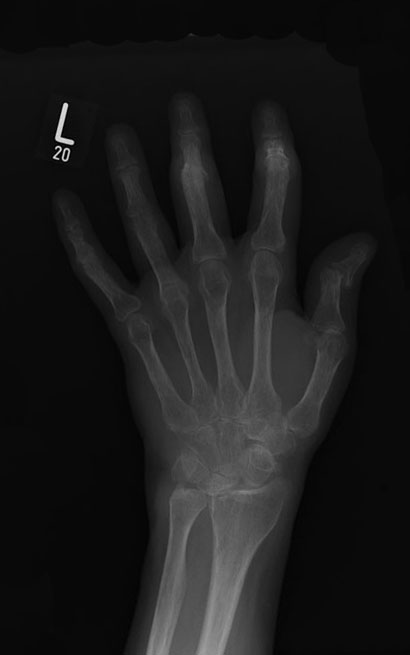
Key radiographic features include joint erosions, joint space narrowing, bony proliferation, osteolysis (including pencil-in-cup deformity), ankylosis, and new bone formation at enthuses, both central and peripheral, see figure 1.
Soft tissue abnormalities such as enthesitis and dactylitis as well as synovitis may be visualised on ultrasound.
Periarticular soft tissue, ligaments, tendon sheath and bony abnormalities as well as synovitis may be demonstrated on MRI in patients with even subclinical disease.2
Differential diagnosis
The differential diagnosis depends on the particular pattern of joint involvement.
• In patients with symmetrical synovitis of the small joints of the hands, the main differential diagnosis is rheumatoid arthritis
• In those with predominantly DIPJ involvement, appearances are similar to Heberden’s nodes of osteoarthritis
• In patients with inflammatory back pain, the differential diagnosis
includes other seronegative spondyloarthropathies (SpA),
e.g. ankylosing spondylitis, reactive arthritis, enteropathic-associated SpA. Any of these conditions can also present with peripheral joint arthropathy, enthesitis or dactylitis
• Care must be taken to avoid misdiagnosing patients as having fibromyalgia, as the tenderness associated with enthesitis or periosteal lesions may be falsely attributed to tender fibromyalgic trigger points
Features of back pain that suggest an inflammatory cause, rather than a mechanical problem, include the presence of early morning stiffness and pain that is relieved by exercise and exacerbated by rest.
Management
Any patient with suspected inflammatory arthritis and a six-week history of painful, swollen joints should be referred for specialist assessment.
The key objectives of treatment
are to:
• Achieve disease remission, by suppressing inflammation as comprehensively as possible
• Prevent the development of erosions, joint damage, deformity and disability
• Identify and treat comorbidities and risk factors (e.g. cardiovascular risk factors such as obesity, diabetes mellitus, hypertension and hypercholesterolaemia should be addressed)
• Address psychological and social wellbeing with appropriate referrals made (e.g. to mental health or social services)
• Patients should be encouraged to adopt a healthy lifestyle incorporating regular exercise and should maintain
a healthy weight (BMI 18.5-24.9). Cessation of smoking and moderation of alcohol consumption should be encouraged
Patients are best managed by a multidisciplinary team ideally involving a rheumatologist, dermatologist, physiotherapist, occupational therapist, specialist nurses and rheumatology practitioners along with the patient’s GP.
Pharmacological treatment
NSAIDs have an important role but also have drawbacks, and do not prevent disease progression, see table 1.
Corticosteroids: Intraarticular injections may be given for monoarthritis, or when only a limited number of joints are involved.3 Oral steroids can be used occasionally for polyarticular symptom relief. Avoid long-term use because of the potential for significant toxicity.
DMARDs: DMARDs may be initiated under specialist care. All DMARDs require monitoring, often through shared care arrangements (see the British Society for Rheumatology guidelines).4
Sulfasalazine is effective as monotherapy in PsA,5 as oral therapy, initially 500 mg daily, increased by 500 mg at one week intervals to a maximum of 2-3 g daily in divided doses
Methotrexate can be used as an alternative first-line agent to sulfasalazine. It is given as a weekly dose either orally or by subcutaneous injection. It is usually co-prescribed with folic acid (e.g. 5 mg weekly PO), the dose of which can be increased to counteract mucosal or gastrointestinal side effects (e.g. oral ulceration, abdominal discomfort, diarrhoea).
Leflunomide may be used when there are contraindications or side effects from methotrexate or sulfasalazine. The therapeutic effect starts after 4-6 weeks and improvement may continue for a further 4-6 months.
The long half-life of the active metabolite necessitates active wash-out therapy in the case of serious adverse events, before a change in treatment, or (in both genders) prior to conception.
Anti-TNF therapy: A number of agents have been produced that block the effect of tumour necrosis factor (TNF), an important cytokine in systemic inflammation.
There is evidence from randomised, controlled trials (RCTs) that anti-TNF therapy can bring about improvements in symptoms, functional status, quality of life and radiographic progression.6
A meta-analysis has found these drugs to be superior to conventional DMARDs for the treatment of PsA.7
In routine clinical practice, they have been found to be more effective than methotrexate.8 Safety of anti-TNF therapy seems acceptable on the basis of several large RCTs and cohort studies, with infection and elevation of liver transaminases the most worrisome findings.
Specialist care is required for initiation and monitoring. NICE guidance on the use of anti-TNF agents to treat PsA requires that the patient has active disease (three swollen and three tender joints) and has failed to improve after two or more conventional DMARDs.9
The 2012 British Society for Rheumatology and British Health Professionals in Rheumatology guidelines for the treatment of PsA with biologics is a useful document containing treatment algorithms and a review of the evidence surrounding anti-TNF use in PsA.10
There are currently four anti-TNF agents approved by NICE for the treatment of PsA:
• Etanercept – weekly SC injection
• Infliximab – IV infusion
• Adalimumab – fortnightly SC injection
• Golimumab – monthly SC injection
NICE is currently discussing whether to recommend ustekinumab for the treatment of PsA. If approved, this would increase our therapeutic options for this condition.
Surgery
Surgery does not appear to offer beneficial effects for enthesopathies but it can be used to remove bony spurs. It may also be required for end-stage damage to large joints (e.g. hip, knee). Antibiotic cover should be considered because of the higher rate of superficial and deep infection reported in PsA.11 Patients may also develop psoriasis in the surgical scar, the Koebner phenomenon.
Monitoring and follow-up
Blood monitoring including FBC, U&Es, and LFTs for patients on DMARDs and biologics (the frequency varies with agent and over time) should be carried out. Most patients with at least moderate PsA will have rheumatology follow-up.
Several tools exist to monitor disease activity and response to treatment:
• Psoriasis Area and Severity Index (PASI)
• Dermatology Life Quality Index (DLQI)
• Bath Ankylosing Spondylitis Disease Activity Index (BASDAI)
• PsA Response Criteria (PsARC)
Prognosis
PsA can affect people's ability to work and carry out daily activities, which can have a substantial impact on quality of life. The effect of severe psoriasis on health-related quality of life is considered to be similar to that of other major medical conditions including diabetes, heart disease and cancer.
Patients with PsA have a higher self-rated disease severity than those with psoriasis only and a 60% higher risk of premature mortality than the general population,12,13,14 their life expectancy is estimated to be approximately three years shorter.15
Aggressive treatment of early stage progressive PsA can substantially improve the long-term prognosis.
Conclusion
PsA is an under-recognised form of inflammatory arthritis with a wide clinical spectrum. Features include peripheral and axial joint disease, dactylitis, enthesitis, skin and nail changes. All patients with suspected inflammatory arthritis should be referred for specialist review. Various treatments are now available with the overall aim of management being disease remission.
REFERENCES
1 Taylor W, Gladman D, Helliwell P et al for the CASPAR Study Group. Classification criteria for psoriatic arthritis: development of new criteria from a large international study. Arthritis Rheum 2006;54(8):2665-73
2 Emad Y, Ragab Y, Gheita T et al. Knee enthesitis and synovitis on magnetic resonance imaging in patients with psoriasis without arthritic symptoms. J Rheumatol 2012;39(10):1979-86
3 Eder L, Chandran V, Ueng J et al. Predictors of response to intra-articular steroid injection in psoriatic arthritis. Rheumatology (Oxford) 2010;49:1367-7
4 Chakravarty K, McDonald H, Pullar T et al. BSR/BHPR guideline for disease-modifying anti-rheumatic drug (DMARD) therapy in consultation with the British Association of Dermatologists. Rheumatology 2008. doi:10.1093/rheumatology/kel216b
5 Jones G, Crotty M, Brooks P. Interventions for treating psoriatic arthritis. Cochrane Data Syst Rev 2000, Issue 3. Art. No.: CD000212. DOI: 10.1002/14651858.CD000212
6 Soriano ER, McHugh NJ.Therapies for peripheral joint disease in psoriatic arthritis. A systematic review. J Rheumatol 2006;33:142-3
7 Ravindran V, Scott DL, Choy EH. A systematic review and meta-analysis of efficacy and toxicity of disease modifying anti-rheumatic drugs and biologic agents for psoriatic arthritis. Ann Rheum Dis 2008;67:855-9
8 Heiberg MS, Kaufmann C, Rodevand E et al. The comparative effectiveness of anti-TNF therapy and methotrexate in patients with psoriatic arthritis: 6 month results from a longitudinal, observational, multicentre study. Ann Rheum Dis 2007;66:1038-4
9 National Institute for Heath Care Excellence. TA199. Etanercept, infliximab and adalimumab for the treatment of psoriatic arthritis. NICE. London. 2010
10 Coates L, Tillett W, Chandler D et al. The 2012 BSR and BHPR guideline for the treatment of psoriatic arthritis with biologics.doi:10.1093/rheumatology/ket187
11 Menon T, Wroblewski BM. Charnley low friction arthroplasty in patients with psoriasis. Clin Orthop 1983;248:108-111
12 Mease P, Goffe B. Diagnosis and treatment of psoriatic arthritis. J Am Acad Dermatol 2005;52:1-19
13 Wong K, Gladman DD, Husted J et al. Mortality studies in psoriatic arthritis: results from a single outpatient clinic. Causes and risk of death. Arthritis Rheum 1997;40:1868-72
14 Gladman D, Farewell V, Wong K, Husted J. Mortality studies in psoriatic arthritis: results from a single outpatient center. II Prognostic indicators for death. Arthritis Rheum 1998;41:1103-10
15 Ali Y, Tom BD, Schentag CT et al. Improved survival in psoriatic arthritis with calendar time. Arthritis Rheum 2007;56:2708-14
ARTICLE IN PDF
 Download this article in PDF format
PRESET SEARCHES
Immediate CPD prompts
These handy templates* prompt immediate drafting of personal learning, reflection and planning. Save your record straight into your personal development folder on your device or Cloud storage system.
*Adobe reader needed for iPad