SEARCH

Paisley P, Serpelll M. Diagnosis and management of postherpetic neuralgia. Practitioner 2015;259 (1778):21-24
Diagnosis and management of postherpetic neuralgia
22 Jan 2015
AUTHORS
Dr Peter Paisley MB ChB MSc FRCA, Anaesthetic Registrar, Victoria Infirmary, NHS Greater Glasgow & Clyde, Glasgow, UK
Dr Michael Serpell MB ChB FCPodS ECFMG FRCA FFPMRCA, Consultant and Senior Lecturer in Anaesthesia & Pain Medicine, University of Glasgow, Glasgow, UK
Article
Following an initial chickenpox infection with varicella-zoster in childhood or early adulthood, the virus remains dormant in the nerve cell bodies of the asymptomatic host.1 Less commonly it becomes latent in the satellite cells of the dorsal root, cranial nerves or autonomic ganglia.2
Reactivation of the latent herpes zoster virus occurs in 50% of those who reach the age of 85. The reduction in cell- mediated immunity that accompanies ageing is thought to be accountable for this viral recrudescence which, in turn, leads to an acute, often painful rash commonly referred to as shingles or acute herpetic neuralgia.1
Pain usually subsides within three to five weeks, but a significant number of patients develop persistent pain classified as sub-acute herpetic neuralgia, 30-120 days following rash onset, and postherpetic neuralgia (PHN), 120 days following rash onset.3,4
Risk factors for PHN include:
• Increasing age. Age confers considerable risk with 40% of patients over 50 and 75% of those over 75 going on to develop PHN following resolution of the rash5-7
• A prodrome of pain before rash onset
• The degree of spread of the rash, particularly if it extends beyond a single dermatome
• Severity of pain during the acute attack5
The exact pathogenesis of why some individuals go on to develop PHN is yet to be fully established. Examination of pathological specimens from the ganglia of those with persistent pain has demonstrated a diffuse infiltration of chronic inflammatory cells.8,9 The discovery of varicella-zoster proteins incorporated within mononuclear cells of the peripheral blood of patients with PHN further supports the theory that a chronic low-grade ganglionitis is responsible.10, 11
Presentation
Following a history of acute herpes zoster infection with a resultant rash, patients may present with pain within the timescales defined above.
Pain in PHN can be either constant or paroxysmal and is commonly described as burning, stabbing or itching in character and located in the same dermatomal distribution as the shingles rash.
Precipitation of the pain by a non-painful stimulus such as touch or pressure (e.g. from clothing) is referred to as allodynia, which can accompany hyperalgesia (intense exaggerated pain from a painful stimulus). These are frequently distressing features of PHN, which can lead to sleep disturbance, anorexia, reduced socialisation and reactive depression.12
Prevention
A detailed approach to the management of acute herpetic neuralgia is beyond the scope of this article. However, the way that acute herpetic neuralgia is managed does have implications for the subsequent development of PHN. The antiviral agents aciclovir, valaciclovir and famciclovir are known to reduce the pain of acute shingles and hasten the resolution of the skin lesions.13-15 Despite this, antiviral treatment is probably underprescribed with some studies reporting treatment rates in the community setting of approximately 40%.16
In addition to treating the acute presentation, earlier evidence in the literature tended to support the use of antiviral agents for reduction of both the incidence and severity of PHN.17 Treatment has been shown to be effective as prophylaxis, particularly when started within 72 hours of the rash,18 but also when initiated beyond three days if the rash is continuing to spread.19 Despite these findings, a Cochrane review published online in 2014, has questioned the level of evidence to support the use of antivirals as prophylaxis for PHN.20
It neither affirms nor refutes their routine use but rather suggests that further trials focusing on outcomes such as pain severity and quality of life are required before such recommendations can be made.
Perhaps because of their proven efficacy in treating acute herpetic neuralgia and low incidence of adverse events, NICE guidelines published in May 2013 (later than any of the trials included in the Cochrane review) advocate the use of antivirals for all patients over 50 in the acute phase of herpes zoster reactivation.21
A typical prescription would be valaciclovir 1,000 mg tid for seven days, which has a simpler dosage regimen than the alternative aciclovir 800 mg five times daily.
The prescription of corticosteroids during the acute stage can cause a significant reduction in symptoms.22-24 Interestingly, this effect is only seen when they are prescribed alongside an antiviral agent. As a result, NICE recommends their use be reserved for those with severe pain and in whom the side effects of systemic corticosteroids would not adversely impact on any comorbidity such as diabetes mellitus.21
A suggested regimen is prednisolone 40 mg daily for seven days, then tapering the dose down by 5-10 mg every three days over a total treatment period of 21 days.
Unfortunately, despite their anti-inflammatory effect, they have no impact, when administered alone, on the subsequent development of PHN when given for acute varicella-zoster infection.22-24
Management
Initial assessment of the patient presenting with PHN allows the opportunity to explain the diagnosis and set realistic expectations in terms of symptom duration and the likely success of the different treatments.
The approach to managing the patient’s symptoms requires treatment to be tailored to individual factors such as stage of illness (acute herpetic neuralgia or PHN), pain severity and the limitations of specific treatments when considered alongside patient factors such as age and any significant comorbidities.
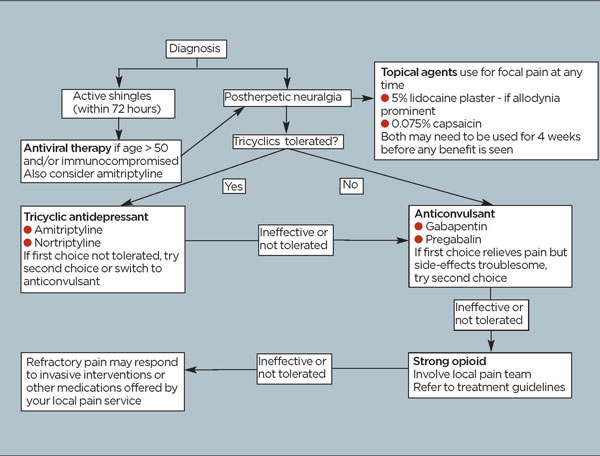
An algorithm to simplify the approach to management has been previously described by one of the authors,25 see figure 1.
Simple analgesia
Paracetamol should be tried initially for mild to moderate pain, either alone or in combination with codeine. Two different guidelines recommend this initial approach,26,27 although NICE Clinical Knowledge Summaries could find no evidence to support this.
Patients taking codeine should be reviewed regularly and the duration of treatment kept to a minimum, in accordance with expert opinion.28
There is no evidence to support the use of NSAIDs in the context of PHN. Simple analgesia such as co-codamol may provide some benefit but the likelihood in clinical practice is that the patient will require treatment with an anticonvulsant or tricyclic antidepressant (TCA).
Tricyclic antidepressants
Amitriptyline and nortriptyline are known to be effective in the context of PHN.29 A randomised controlled trial found that amitriptyline 25 mg per night for 90 days, starting within two days of the onset of the rash, can reduce the incidence of postherpetic neuralgia from 35% to 16%; number needed to treat = 6.30
Compared with other antidepressants, TCAs are the most likely to confer benefit in neuropathic pain.31 Their use has to be carefully considered against the side effects which include urinary retention, dry mouth, ataxia and constipation. More serious adverse effects include hypotension and cardiac dysrhythmias. These can be particularly problematic in frail elderly patients, in whom nortriptyline appears to be better tolerated. Furthermore, by up-titrating the dose gradually these effects can be minimised.
A reasonable approach in patients over 50 is to start with nortriptyline10 mg nocte. This can be titrated upwards in increments of 10 mg every 3-7 days to a maximum dose of 100 mg. It is worthwhile explaining to patients that the maximal effect typically takes at least three weeks and that the analgesic effects of these medications are separate from their historical use as antidepressants. If this fails to control symptoms, or is not tolerated because of side effects, then treatment with an anticonvulsant is indicated.
Anticonvulsant therapy
Both gabapentin and pregabalin can reduce pain and improve sleep patterns in patients with PHN.32, 33
A small randomised controlled trial showed pregabalin to be superior to amitriptyline when used for PHN.34
A single bedtime dose of 100 mg gabapentin for frail elderly patients can be up-titrated to a maximum of 1,200 mg tid. Pregabalin 75 mg 12 hourly up to a maximum of 300 mg bd can be tried if sedation or ataxia limits gabapentin use. Abrupt withdrawal should be avoided.
Opioids
In isolation, strong opioids provide similar pain relief to TCAs but their use is complicated by a greater incidence of side effects including neuropsychiatric and gastrointestinal disturbance.35 There is evidence to suggest an additive or even synergistic effect when combined with gabapentin for neuropathic pain.36,37 Their use is complicated by addiction and drug diversion, therefore it is vital to monitor patients’ usage frequently and have defined treatment goals. The British Pain Society provides guidance for the use of strong opioids in non-cancer pain.38
Tramadol has the additional benefit of modulating descending inhibitory pain pathways by its inhibitory effect on serotonin and noradrenaline reuptake. It may provide some benefit but there is as yet insufficient evidence for its use in PHN.39
Topical therapy
Capsaicin 0.075% can be applied four times per day once the skin lesions have healed. Acutely it produces a burning sensation which overwhelms peripheral sensory nerves by calcium influx. A delayed benefit is seen after four weeks, when it is thought to reduce pain transmission by depletion of neurotransmitters and blockade of neurogenic inflammation.40
The uncomfortable burning sensation tends to settle with ongoing use, but can be ameliorated by mixing the capsaicin with GTN paste or EMLA cream.41
Lidocaine 5% plasters are approved by the MHRA as third-line therapy for PHN, applied over the area of pain for 12 hours followed by 12 hours off. This is particularly useful where allodynia is a prominent feature, or in patients in whom other treatments are not tolerated – adverse events occur in 6% of patients compared with 42%
with pregabalin when used for PHN.42 In the authors’ experience, using the plaster continuously for 36 of the initial 48 hours can reduce the pain from repeated application and removal.
Referral
Postherpetic neuralgia remains a common and difficult condition to manage in the elderly population. Patients with severe pain or those in whom the condition is affecting their daily activities and function should be referred to a specialist in pain management.21
This can facilitate a multidisciplinary approach to the assessment and management of the pain and provide additional treatments such as opioids, cannabinoids, ketamine, perineural local anaesthetic injections, physiotherapy, TENS and psychological coping strategies.
New developments
In future, management may focus on increasing attempts to prevent the development of PHN. In 2013 the Scottish Government introduced a vaccination programme for those over 70, with the NHS in England and Wales following suit.43
In addition, there is increasing research interest in the role of biomarkers to identify which patients are at greatest risk of developing this debilitating condition.
REFERENCES
1 Johnson RW, Dworkin RH. Clinical review: Treatment of herpes zoster and postherpetic neuralgia. BMJ 2003;326 (7392):748-750
2 Kennedy PG. Varicella-zoster virus latency in human ganglia. Rev Med Virol 2002;12(5):327-334
3 Dworkin RH, Portenoy RK. Proposed classification of herpes zoster pain. Lancet 1994;343:1648
4 Desmond RA, Weiss HI, Arani RB et al. Clinical applications for change-point analysis of herpes zoster pain. J Pain Symptom Manage 2002;23:510-516
5 Dworkin RH, Schmader KE. Epidemiology and natural history of herpes zoster and postherpetic neuralgia. Herpes zoster and postherpetic neuralgia, 2nd edition. pp 39-64. Elsevier Press. New York. 2001
6 Portenoy RK, Duma C, Foley KM. Acute herpetic and postherpetic neuralgia: clinical review and current management. Ann Neurol 1986;20(6):651-64
7 Lancaster T, Silagy C, Gray S. Primary care management of acute herpes zoster: systematic review of evidence from randomized controlled trials. Br J Gen Pract 1995;45(390):39-45
8 Smith FP. Pathological studies of spinal nerve ganglia in relation to intractable intercostal pain. Surg Neurol 1978;10(1):50-3
9 Ware JE, Gandek B. Overview of the SF-36 Health-Survey and the International Quality of Life Assessment (IQOLA) Project. J Clin Epidem 1998;51(11):903-12
10 Vafai A, Wellish M, Gilden DH. Expression of varicella-zoster virus in blood mononuclear cells of patients with postherpetic neuralgia. Proc Natl Acad Sci USA 1988;85 (8):2767-70
11 Mahalingam R, Wellish M, Brucklier J, Gilden DH. Persistence of varicella-zoster virus DNA in elderly patients with postherpetic neuralgia. J Neurovirol 1995;1(1):130-3
12 Schmader KE. Epidemiology and impact on quality of life of postherpetic neuralgia and painful diabetic neuropathy. Clin J Pain 2002;18(6):350-4
13 Wood M, Kay R, Dworkin RH et al. Oral acyclovir therapy accelerates pain resolution in patients with herpes zoster: a meta-analysis of placebo-controlled trials. Clin Infect Dis 1996;22:341-347
14 Beutner K, Friedman D, Forszpaniak C et al. Valaciclovir compared with aciclovir for improved therapy for herpes zoster in immunocompetent adults. Antimicrob Agents Chemother 1995;39:1546-53
15 Tyring S, Barbarash R, Nahlik J et al. Famciclovir for the treatment of acute herpes zoster: effects on the acute disease and post herpetic neuralgia: a randomised, double-blind, placebo-controlled trial. Ann Intern Med 1995;123:89-96
16 MacIntyre CR, Chu CP, Burgess MA. Use of hospitalisation and pharmaceutical prescribing data to compare the revaccination burden of varicella and herpes zoster in Australia. Epidemiol Infect 2003;131:675-682
17 Christo PJ, Hobelmann G, Maine DN. Post-herpetic neuralgia in older adults: Evidence-based approaches to clinical management. Drugs Aging 2007;24(1):1-19
18 Wood MJ, Shukla S. Fiddian AP, Crooks RJ. Treatment of acute herpes zoster: effect of early
(< 48 h) versus late (48-72 h) therapy with aciclovir and valaciclovir on prolonged pain. J Infect Dis 1998 Nov;178 Suppl 1:S81-S84
19 Decroix J, Partsch H, Gonzalez R et al. Outcome in herpes zoster: an observational study with valaciclovir.
J Eur Acad Dermatol Venereol 2000;14:23-33
20 Chen N, Li Q, Yang J et al. Antiviral treatment for the prevention of postherpetic neuralgia. Cochrane Database System Rev 2014, Issue 2. Art. No.: CD006866. DOI: 10.1002/14651858.CD006866.pub3
21 National Institute for Health and Care Excellence. Clinical Knowledge Summaries. Post-Herpetic Neuralgia. NICE. London 2013. http://cks.nice.org.uk/
post-herpetic-neuralgia#!scenario
22 Whitely R, Weiss H, Gnann J Jr et al. Aciclovir with and without prednisone for the treatment of herpes zoster. A randomised, placebo-controlled trial. The National Institute of Allergy and Infectious Disease Collaborative Antiviral Study Group. Ann Intern Med 1996;125:376-383
23 Wood M, Johnson R, McKendrick M et al. A randomized trial of acyclovir for 7 days or 21 days with and without prednisolone for treatment of acute herpes zoster. N Engl J Med 1994;330:896-900
24 Cunningham A. Board of the Australian Herpes Management Forum. Managing herpes zoster: guidelines for clinicians. New South Wales, Australia. 2011. http://ahmf.squarespace.com /storage/ Managing%20Herpes%20Zoster_final.pdf
25 Panickar A, Serpell M. Guidelines for general practitioners for the treatment of pain in post-herpetic neuralgia. Shingles Support Society. London. 2010
26 British Society for the Study of Infection (BSSI) Working Party. Guidelines for the management of shingles. J Infect 1995:30(3);1 93-200
27 Johnson R, Patrick D. International Herpes Management Forum. Online Publication:Improving the management of varicella, herpes zoster and zoster-associated pain. International Herpes Management Forum (2002). www.ihmf.org/
28 Spence D. Bad medicine: co-codamol. BMJ 2013:Mar 20;346:f1821. doi: 10.1136/bmj.f1821
29 Collins SL, Moore RA, McQuay HJ, Wiffen P. Antidepressants and anticonvulsants for diabetic neuropathy and postherpetic neuralgia: a quantitative systematic review. J Pain Symptom Manage 2000;20(6):449-58
30 Bowsher D. The effects of pre-emptive treatment of postherpetic neuralgia with amitriptyline: a randomized, double-blind, placebo-controlled trial. J Pain Sympt Manage 1997;13(6):327–31
31 Saarto T, Wiffen PJ. Antidepressants for neuropathic pain: a systematic review. Cochrane Library, Issue 3, 2009. www.thecochranelibrary.com
32 Rowbotham M, Harden N, Stacey B et al. Gabapentin for the treatment of postherpetic neuralgia: a randomized controlled trial. JAMA 1998;280(21):1837-1842
33 Sabatowski R, Galvez R, Cherry DA et al. Pregabalin reduces pain and improves sleep and mood disturbances in patients with post-herpetic neuralgia: results of a randomised, placebo controlled clinical trial. Pain 2004;109(1-2):26-35
34 Achar A, Chakraborty P, Biswas A et al. Comparative study of clinical efficacy of amitriptyline and pregabalin in postherpetic neuralgia. Acta Dermatovenerol Croat 2012;20(2):89-94.
35 Raja SN, Haythornthwaite JA, Pappagallo M et al. Opioids versus antidepressants in postherpetic neuralgia. A randomized, placebo-controlled trial. Neurology 2002; 59(7):1015-21
36 Gilron I, Bailey JM, Tu D et al. Morphine, gabapentin or their combination for neuropathic pain. N Engl J Med 2005;352:1324-34
37 Hanna M, O’Brien C, Wilson M. Prolonged-release oxycodone enhances the effects of existing gabapentin therapy in painful diabetic neuropathy patients. EJP 2008;12:804-813
38 Stannard C, Chumbley G, Myles J et al. Opioids for Persistent Pain – Good Practice. British Pain Society. London. 2010. www.britishpainsociety.org/static/ uploads/resources/files/book_opioid_main.pdf
39 Boureau F, Legallicier P, Kabir-Ahmadi M. Tramadol in post-herpetic neuralgia: a randomized, double-blind, placebo-controlled trial. Pain 2003;104(1-2):323-31
40 Geppetti P, Nassini R, Materazzi S et al. (2008).The concept of neurogenic inflammation. BJU Internat 2008;101:2-6
41 McCleane GJ, McLaughlin M. The addition of GTN to capsaicin cream reduces the discomfort associated with application of capsaicin alone. A volunteer study. Pain 1998;78:149-151
42 Baron R, Mayora V, Leijon G et al. 5% lidocaine medicated plaster versus pregabalin in post-herpetic neuralgia and diabetic polyneuropathy: a two-stage randomized, controlled, open-label, noninferiority trial. Curr Med Res Opinion 2009;25:1663-6
43 Scottish Government Newsroom Publications. Shingles Vaccination. Published online 02/09/13; accessed 05/01/14.http://news.scotland.gov.uk/News/ Shingles-vaccination-38c.aspx
ARTICLE IN PDF
 Download this article in PDF format
PRESET SEARCHES
Pubmed
NICE evidence search
Immediate CPD prompts
These handy templates* prompt immediate drafting of personal learning, reflection and planning. Save your record straight into your personal development folder on your device or Cloud storage system.
*Adobe reader needed for iPad