SEARCH

Negoescu A, Östör AJK. Early recognition improves prognosis in elderly onset RA. Practitioner 2014;258 (1767)11-14
Early recognition improves prognosis in elderly onset RA
22 Jan 2014
AUTHORS
Dr Andra Negoescu, Clinical Research Fellow, Rheumatology Research Unit, Addenbrooke’s Hospital, Cambridge, UK
Dr Andrew JK Östör MA MBBS FRACP, Consultant Rheumatologist and Associate Lecturer, School of Clinical Medicine, University of Cambridge, Director, Rheumatology Research Unit, Addenbrooke’s Hospital, Cambridge, UK
Article
Rheumatoid arthritis (RA) is a chronic, systemic, inflammatory disorder, affecting around 1% of the adult population. Although the cause is unknown, genetic, immunological, hormonal and environmental factors all have a role in its pathogenesis.
The disorder is characterised by joint inflammation, however extra-articular features are common. Patients complain of joint pain which may lead to significant disability, reduced quality of life and increased mortality.1, 2
Although commonly diagnosed in the third to fifth decades of life, the incidence and prevalence of RA continue to increase up to the ninth decade.
Age at onset is particularly relevant as the presentation may differ in elderly onset RA (EORA) compared with young onset RA (YORA).3-5
RA prevalence has been reported as 1.16% in women and 0.44% in men.6 The prevalence of RA in people above the age of 60 (EORA) is approximately 2%, with a more equal sex distribution. YORA tends to be three times more common in women than men.
Presentation
Onset
While patients with YORA most commonly describe an insidious onset of symptoms, patients with EORA frequently report a more acute presentation, especially if positive for rheumatoid factor (RF). Although both YORA and EORA may have constitutional symptoms at the onset such as fever, fatigue and weight loss, this appears to be more common in EORA.
Pattern of joint involvement
Although small joints are most frequently involved in the RA population overall, numerous investigators have noted common involvement of large joints in EORA (e.g. the shoulders).3,4 Thus the proximal symptoms in EORA may mimic polymyalgia rheumatica (PMR), see table 1, above, for the differential diagnosis.
Practical tip: An accurate history is critical with any suspicion of inflammatory arthritis. Ask about elements suggestive of inflammatory disease such as prolonged early morning and inactivity stiffness which improves with movement, symmetry of symptoms, joint swelling and constitutional symptoms.
Investigations
Inflammatory markers
Erythrocyte sedimentation rate (ESR) and C-reactive protein (CRP) are non-specific inflammatory markers which may rise with infection, systemic inflammatory disorders, or malignancy. In RA, both the ESR and CRP correlate with disease activity and radiographic damage.7
The ESR and/or CRP in EORA patients are generally higher than in YORA patients. It is normal, however, for ESR and CRP to increase with age, which should be taken into consideration when judging individual cases.
In YORA, approximately 80% of patients are seropositive for RF, however a lower frequency has been reported in EORA.4,5,7 It is worth remembering that RF is a non-specific test. RF can be found in healthy individuals, and increases in prevalence with age.
Anti-cyclic citrullinated peptide antibodies
Anti-cyclic citrullinated peptide (anti-CCP) antibodies have been detected in over 70% of patients with RA. These antibodies are highly specific for RA (more specific than RF), and hence are useful in the diagnostic process, particularly early in the disease course. The value of anti-CCP antibodies is even higher in patients with an atypical presentation (e.g. PMR-like symptoms), or those who are RF negative. Unfortunately, no controlled study exists looking at anti-CCP antibodies in EORA. As with RF, they are not useful in monitoring disease activity.
Plain radiographs
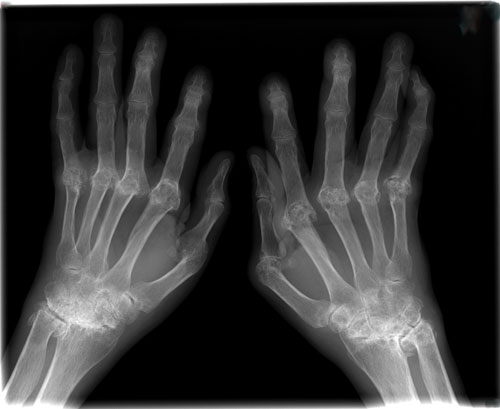
X-rays of the hands and feet should always be performed in patients with a suspected inflammatory arthritis. Baseline joint erosions are present in a similar proportion in patients with YORA and EORA although with early detection baseline X-rays are usually normal.8
Practical tip: Perform baseline blood tests for every patient with presumed inflammatory joint symptoms, including inflammatory markers, RF, anti-CCP antibodies (if available) and ANA, as well as a full blood count, liver and renal function tests and urate.
Differential diagnosis
In the elderly, the differential diagnosis of RA is extensive as many conditions present in a similar way e.g. PMR, osteoarthritis, polyarticular gout, pseudogout and malignancy,
which are all prevalent in this population, see table 1.
Among these, polymyalgia rheumatica is probably the most challenging, because of its overlapping symptoms with EORA. This differential diagnosis is particularly difficult in patients who have seronegative disease.
Anti-CCP antibodies are very useful for identifying EORA patients with a polymyalgic onset. The presence of these in a patient presenting with clinical symptoms of PMR is highly suggestive of EORA.
Ultrasonography or magnetic resonance imaging (MRI), can also be helpful in differentiating PMR from EORA. While joint effusion, bursitis, and tenosynovitis can be found in both PMR and EORA, only patients with PMR have inflammatory changes outside the joint cavity on MRI of the shoulders.
Similarities in presentation often lead to delays in establishing the correct diagnosis, therefore early follow-up is essential in unclear cases.
Osteoarthritis
Hand OA is common in elderly women. Early morning stiffness < 30 minutes, pain which increases by the end of the day or with activity, involvement of joints commonly affected by OA (first carpo-metacarpal joint, distal interphalangeal joints), are key clinical features which help to differentiate OA from RA. The two may however co-exist especially in elderly patients, therefore blood tests and plain X-rays are required to help clarify the diagnosis.
Paraneoplastic arthritis
This is a seronegative inflammatory arthropathy which may present in a similar fashion to RA. The temporal relationship between arthritis onset and malignancy, as well as improvement of arthritis following treatment of the tumour are arguments for the existence of paraneoplastic arthritis as an entity.10
Practical tip: Refer all patients with suspected inflammatory arthritis urgently to a specialist. Many rheumatology departments offer rapid access clinics for such patients.
Management
Therapy for EORA should be instituted based on disease activity (often reflected by the DAS 28 score), with the aim of achieving clinical remission or the lowest possible level of disease activity. Comorbidities and drug toxicity profiles are major considerations when choosing the most suitable therapy for EORA patients.
Nonsteroidal anti-inflammatory drugs
NSAIDs are effective in improving pain and stiffness in RA, but their use in the elderly is limited by comorbidities and adverse effects on the central nervous system, cardiovascular, renal, and gastrointestinal systems.
Corticosteroids may be very effective in the elderly, however, prolonged use and/or high dosage may lead to marked toxicity especially osteoporosis and diabetes. Thus, careful consideration of the dose and indication is essential when corticosteroids are prescribed to elderly patients.
The British Society for Rheumatology recommends that all patients who are prescribed corticosteroids, should take calcium and vitamin D supplements concomitantly. Furthermore, patients over 65 and those with a prior fragility fracture should also be prescribed a bisphosphonate.11 Intra-articular corticosteroids may be beneficial and are extremely safe.
Disease modifying anti-rheumatic drugs
The current approach is for early, intensive intervention with combination therapy. However, the possible reduction in the functional capacity of bone marrow, liver and kidney noted in the elderly is of particular importance as these drugs have the potential for serious toxicity. Strict adherence to a drug regimen is necessary and careful monitoring, both clinical and laboratory, is required. The commonly used disease modifying anti-rheumatic drugs (DMARDs) in the elderly include hydroxychloroquine, sulfasalazine and methotrexate, see table 2.
Several studies have shown that, when disease activity, duration and comorbidities are taken into account, elderly RA patients have a significantly lower chance of receiving biologic DMARDs such as anti-TNF alpha therapy within the same time period as younger patients despite fulfilling NICE criteria.12,13 However, biologic therapy should not be denied to patients purely on the basis of age, as studies have shown that these drugs are safe and effective in the elderly.14
As ischaemic heart disease is the leading cause of death in the RA population, cardiovascular (CV) risk factors must be monitored at least yearly in these patients and managed according to local guidelines. Primary care is pivotal to this process and CV risk assessment in patients with RA
is one of the indicators for the Quality and Outcomes Framework (QOF), see box 1, left.15
Practical tip: All patients on DMARDs (exception: hydroxychloroquine) and anti-TNF alpha require regular blood tests. In addition monitoring of blood pressure, fasting lipids and glucose should be carried out at least yearly in elderly patients with RA.
Prognosis
The presence of RF and anti-CCP antibodies, elevated inflammatory markers at onset, female gender, erosions at baseline, a high swollen joint count and impaired function at presentation are associated with poor outcome in both YORA and EORA.16 If recognised and treated early however the prognosis is excellent.
Comorbidities such as hypertension, cardiovascular disease, diabetes and neurological disorders can be an important limitation for EORA treatment and can contribute to reduced quality of life.
Conclusions
Because of its prevalence and chronicity, as well as the impact on the individual, RA has become an increasingly important health issue. This is especially true in elderly patients.
Overall EORA differs from YORA in a number of ways including:
• A more balanced gender distribution
• A higher frequency of acute onset
• More frequent involvement of large joints (especially shoulders)
• Higher levels of inflammatory markers
• Seronegativity in a higher percentage of patients
It is questionable whether EORA should be seen as a separate clinical entity, however it may be as damaging as classical RA.
Primary care is pivotal in establishing the correct diagnosis and instituting treatment as early as possible to maximise outcomes.
REFERENCES
1 Gregersen PK, Silver J, Winchester RJ. The shared epitope hypothesis. An approach to understanding the molecular genetics of susceptibility to rheumatoid arthritis. Arthritis Rheum 1987;30:1205-13
2 Heliovaara M, Aho K, Knekt P et al. Coffee consumption, rheumatoid factor, and the risk of rheumatoid arthritis. Ann Rheum Dis 2000;59:631-5
3 Deal CL, Meenan RF, Goldenberg DL et al. The clinical features of elderly-onset rheumatoid arthritis. A comparison with younger-onset disease of similar duration. Arthritis Rheum 1985;28:987-94
4 El-Labban AS, Omar HA, El-Shereif RR et al. Pattern of young and old onset rheumatoid arthritis (YORA and EORA) among a group of Egyptian patients with rheumatoid arthritis. Clin Med Insights Arthritis Musculoskelet Disord 2010;3:25-31
5 Spinel-Bejarano N, Quintana G, Heredia R et al. Comparative study of elderly-onset rheumatoid arthritis and young-onset rheumatoid arthritis in a Colombian population: clinical, laboratory and HLA-DRB1 findings. Clin Exp Rheumatol 2013;31:40-6
6 Symmons D, Turner G, Webb R et al. The prevalence of rheumatoid arthritis in the United Kingdom: new estimates for a new century. Rheumatology 2002;41:793-800
7 Hopkins A, Lozada CJ. Rheumatoid arthritis in the elderly: A distinct clinical entity? Clin Geriatrics 2008;16:5-6
8 van der Heijde DM, van Leeuwen MA, van Riel PL et al. Biannual radiographic assessments of hands and feet in a three year prospective follow up of patients with early rheumatoid arthritis. Arthritis Rheum 1992;35:26-34
9 Bhagat S, Ostör AJK. Diagnosing joint pain in the older people. Practitioner 2010;254 (1735):17-21
10 Butler RC, Thompson JM, Keat ACS. Paraneoplastic rheumatic disorders: a review. J Roy Soc Med 1987;80:168-72
11 Dasgupta B, Borg FA, Hassan N et al. BSR and BHPR guidelines for the management of polymyalgia rheumatica. Rheumatology 2010;49(1):186-90
12 Radovitz BJ, Fransen J, Eijsbouts A et al. Missed opportunities in the treatment of elderly patients with rheumatoid arthritis. Rheumatology 2009;48:906-10
13 Tutuncu Z, Reed G, Kremer J et al. Do patients with older-onset rheumatoid arthritis receive less aggressive treatment? Ann Rheum Dis 2006;65:1226-9
14 Schneeweiss S, Setoguchi S, Weinblatt ME et al. Anti-tumor necrosis factor alpha therapy and the risk of serious bacterial infections in elderly patients with rheumatoid arthritis. Arthritis Rheum 2007;56:1754-64
15 www.nhsemployers.org/Aboutus/Publications/Documents/qof-2013-14.pdf
16 Pease CT, Bhakta BB, Devlin J et al. Does the age of onset of rheumatoid arthritis influence phenotype?: a prospective study of outcome and prognostic factors. Rheumatology 1999;38:228-34
ARTICLE IN PDF
 Download this article in PDF format