SEARCH

Abdelhafiz AH, Sinclair AJ. Tailor treatment in the older patient with type 2 diabetes. Practitioner 2013;257 (1757):21-25
Tailor treatment in the older patient with type 2 diabetes
24 Jan 2013
AUTHORS
Dr Ahmed H Abdelhafiz MSc MD FRCP, Consultant Physician and Honorary Senior Clinical Lecturer, Department of Elderly Medicine, Rotherham General Hospital, Rotherham, UK
Professor Alan J Sinclair MSc MD FRCP, Dean and Professor of Medicine, Bedfordshire & Hertfordshire Postgraduate Medical School, Luton, Beds, UK
Article
In older people, diabetes is a disabling disease due to the associated vascular complications, multiple comorbidities and the increased prevalence of geriatric syndromes. Because of the complexity of diabetes in old age a comprehensive assessment is important at initial diagnosis, with the aim of preventing loss of autonomy and preserving independence.
Clinical presentation
Around 50% of older people with diabetes are asymptomatic.1 When symptoms are present they are often nonspecific, patients may feel generally unwell, tired or lethargic. Symptoms may be atypical such as anorexia rather than the typical polyphagia. Classic osmotic symptoms are usually less prominent in older age because of an increased renal threshold for glucose, resulting in reduced polyuria, and impairment of thirst sensation, resulting in reduced polydipsia. Diabetes complications such as nonketotic hyperosmolar coma may be the presenting symptom or diabetes may be first diagnosed during an acute illness or routine screening.
Diagnosis
Diabetes should be diagnosed if fasting plasma glucose is ≥ 7 mmol/L or two hour postprandial glucose ≥ 11.1 mmol/L.2
Normal glycaemia is defined as fasting plasma glucose < 6.1 mmol/L or two hour postprandial glucose < 7.8 mmol/L. Therefore, there are two categories between normal glycaemia and diabetes:
• Impaired fasting glycaemia when plasma fasting glucose is ≥ 6.1 but < 7 mmol/L
• Impaired glucose tolerance when two hour postprandial glucose is ≥ 7.8 but < 11.1 mmol/L
Patients in these two categories are at high risk of developing diabetes and vascular complications.3 HbA1c can be used as a diagnostic test with a cut-off ≥ 48 mmol/mol (6.5%) for a diagnosis of diabetes. The advantages of testing for HbA1c are: convenience to patients, less day to day variability, and international standardisation. However, HbA1c has high specificity (98.7%) for diagnosing diabetes but low sensitivity (46.8%) which means that more than 50% of individuals with diabetes may be missed.4
Assessment
In addition to traditional micro- and macrovascular complications seen in younger people, older people with diabetes are at risk of developing atypical complications or geriatric syndromes such as cognitive dysfunction, depression, disability, falls, persistent pain and urinary incontinence. Therefore, older people with diabetes should have a comprehensive assessment on diagnosis, see table 1.
Management
Lifestyle modification and drug therapy
Adopting a healthy lifestyle, such as weight reduction in overweight patients, regular exercise and smoking cessation, is beneficial across all age groups.
However, special considerations should be undertaken when making decisions about drug therapy in older people with diabetes, see table 2.
Glycaemic targets
These should be individualised taking into consideration the patient’s overall health and life expectancy. Both hyperglycaemia, which causes dehydration, visual impairment, infections and lethargy, and hypoglycaemia, which causes confusion and falls, need to be avoided. It is important to remember that older people may tolerate higher levels of blood glucose before they develop osmotic symptoms because of a higher renal threshold for glucose with increasing age. On the other hand, they may appear to tolerate lower levels of blood glucose because of diminished autonomic symptoms of hypoglycaemia with increasing age. Targets are day to day or long term:
Day to day: A comfortable daily target of random blood glucose > 4 but < 15 mmol/L seems suitable to avoid development of symptoms as blood glucose outside this range is likely to be symptomatic and results in cognitive changes.5 Maintaining blood glucose in this ‘comfort zone’ especially in frail patients may ensure ‘comfort care’ avoiding extreme blood glucose levels to maintain mental function and general wellbeing.6
Long term: Long-term targets are based on HbA1c levels which should be around 53 mmol/mol (7%) for the fit elderly in the community with new onset diabetes, similar to that for younger patients.
However, for older people with established cardiovascular disease and long-standing diabetes a safer target around 58 mmol/mol (7.5%) is appropriate. In frail older people with multiple comorbidities a target around 64 mmol/mol (8%) is suitable. Targets could be even higher for more frail elderly patients especially those in nursing homes with a very short life expectancy where day to day glucose levels are more important than the long term HbA1c value to avoid symptoms and preserve quality of life.7
Special considerations in older people
Reducing hypoglycaemia: The increased risk of hypoglycaemia in older people with diabetes is not only related to tight glycaemic control but also to overall health and associated multiple comorbidities.8
Older patients are at an increased risk of hypoglycaemia even at a comparable level of glycaemic control to younger patients. The use of sulfonylureas, stroke, transient ischaemic attack, heart failure and depression have been shown to predict an increased risk for hypoglycaemia in older people.9 Recognising symptoms and risk factors for hypoglycaemia is important, see tables 3 and 4, above. 10-13
Medications should be reviewed, and patients taking longer acting sulfonylureas switched to shorter acting agents. In insulin-treated patients the new class of long-acting insulin analogues may be a good option as they reduce the risk of hypoglycaemia.
Patients who have erratic eating patterns and unpredictable caloric intake could be managed with a regimen where short-acting insulin analogues are administered only after meals, thus preventing insulin-induced hypoglycaemia if a meal is missed or only partly consumed.
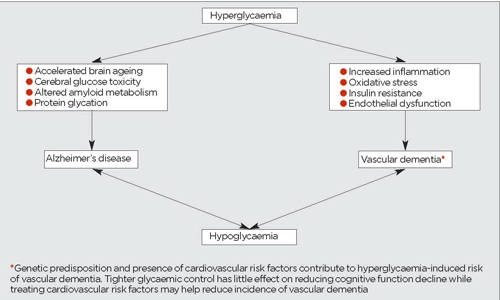
Dementia: Older people with diabetes have been found to be twice as likely to develop Alzheimer’s disease or vascular dementia as age-matched controls without diabetes.14
Persistent hyperglycaemia may play a part in increasing cerebrovascular disease by inducing inflammation, endothelial dysfunction, oxidative stress and insulin resistance. These cerebrovascular changes may explain the increased incidence of vascular dementia.15
Accelerated brain ageing due to insulin dysregulation, altered amyloid metabolism, protein glycation and direct cerebral glucose toxicity may explain the increased incidence of Alzheimer’s disease.16
Hypoglycaemia, on the other hand, is related to cognitive dysfunction in a mutual way. Cognitive dysfunction increases risk of hypoglycaemia17 and a history of severe hypoglycaemia increases risk of cognitive dysfunction,18 see figure 1.
Structural changes in the brain have been noted to be associated with diabetes. Cerebral atrophy and lacunar infarctions are reported more frequently in older people with diabetes and contribute to cognitive dysfunction. Hippocampal atrophy has also been observed and correlated with impairment in immediate memory. The hippocampus is susceptible to acute metabolic changes suggesting that it might be susceptible to diabetes-related metabolic complications such as hypoglycaemia.19
Although there is an association between hyperglycaemia and cognitive dysfunction, it has been shown that intensive glycaemic control is not able to prevent a decline in mental function.20
In a community-based study of 1,398 older patients with diabetes, mean (SD) age 70 (7.4) years, adherence to diabetes self-care tasks (taking diabetes medication, performing regular exercise, following a recommended eating plan, undertaking blood glucose monitoring and foot inspection) decreased as cognitive impairment increased. Specific self-care tasks
of exercise and diet adherence were the most strongly associated with cognitive impairment.21
The findings of this study may alert clinicians to the importance of screening for cognitive dysfunction if noncompliance with self-care tasks is observed, see table 5.
Care home residents: Around one in four residents in care homes has diabetes. Comorbidity burden is high in this population especially with regard to continence, feeding, mobility and communication. In one study, patients had a mean of four
comorbidities (range 1-8) in addition to diabetes.22 Therefore, diabetes management in these settings should take into account patients’ frail condition and complex needs.
Quality of life should be maintained without subjecting residents to unnecessary therapeutic interventions. Tight glycaemic control including dietary restriction, frequent blood testing, insulin injections and polypharmacy may be a burden leading to additional complications. For example, dietary restriction may cause weight loss, frequent finger pricks and insulin injections may lead to agitation especially in cognitively impaired patients and polypharmacy may increase risk of falls.
Hydration should be maintained because of impaired thirst sensation particularly in patients with dementia to avoid risk of volume depletion and hyperglycaemic crises.
Individualised vs disease oriented models of care: The individualised care model covers a holistic approach to address the complex needs of the individual rather than focusing on a single disease. The health status of older people with diabetes is too heterogeneous to develop a single intervention strategy to fit all. Therefore, educational programmes should be adapted to patients’ abilities. Each individual should have their own care plan — taking into consideration their wishes and preferences, functional status and life expectancy — putting quality of life at the heart of therapeutic goals.
Conclusion
Older patients with diabetes are a heterogeneous group with varying health status. The management of diabetes in older people poses unique challenges. The increased prevalence of comorbidities associated with ageing combined with the increased prevalence of geriatric syndromes contributes to the complexity of managing diabetes in older people.
The diagnosis of diabetes in older people also presents challenges as symptoms may be less prominent or atypical in old age. When diabetes is first diagnosed older patients should have a comprehensive assessment to screen for microvascular complications, screen and treat cardiovascular risk factors and screen for geriatric syndromes. Clinicians should adopt an individualised rather than a disease-orientated approach to care focused on maintaining and improving quality of life.
Cognitive and physical dysfunction are common in older people with diabetes which may affect health outcomes and quality of life. Individual therapeutic targets should take into consideration functional status, life expectancy and patient preferences.
REFERENCES
1 Meneilly GS, Tessier D. Diabetes in the elderly. In: Morley JE, van den Berg L. Eds. Contemporary Endocrinology, Endocrinology of Aging. Humana Press. Totowa, NJ. 2000
2 American Diabetes Association. Report of the expert committee on the diagnosis and classification of diabetes mellitus. Diabetes Care 2002;25(suppl 1):S5-S20
3 Barzilay JI, Spiekerman CF, Wahl PW et al. Cardiovascular disease in older adults with glucose disorders: comparison of American Diabetes Association criteria for diabetes mellitus with WHO criteria. Lancet 1999;354:622-5
4 Peter A, Fritsche A, Stefan N et al. Diagnostic value of hemoglobin A1c for type 2 diabetes mellitus in a population at risk. Exp Clin Endocrinol Diabetes 2011;119: 234-7
5 Cox DJ, Kovatchev BP, Gonder-Frederick LA et al. Relationships between hyperglycemia and cognitive performance among adults with type 1 and type 2 diabetes. Diabetes Care 2005;28:71–7
6 Lee SJ, Eng C. Goals of glycemic control in frail older patients with diabetes. JAMA 2011; 305:1350-1
7 Sinclair AJ, Paolisso G, Castro M et al. European Diabetes Working Party for Older People 2011 Clinical Guidelines for Type 2 Diabetes Mellitus. (EDWPOP). Diabetes Metab 2011; 37:S27-S38
8 Abdelhafiz AH, Sinclair AJ. Hypoglycemia in residential care homes. Br J Gen Pract 2009; 59:49-50
9 Bramlage P, Gitt AK, Binz C et al. Oral antidiabetic treatment in type-2 diabetes in the elderly: balancing the need for glucose control and the risk of hypoglycaemia. Cardiovasc Diabetol 2012; 11: 122. doi: 10.1186/1475-2840-11-122
10 Childs BP, Clark NG, Cox DJ et al. Defining and reporting hypoglycaemia in diabetes: A report from the American Diabetes Association Workgroup on Hypoglycaemia. Diabetes Care 2005;28:1245-50
11 Jaap AJ, Jones GC, McCrimmon RJ et al. Perceived symptoms of hypoglycaemia in elderly type 2 diabetic patients treated with insulin. Diabet Med 1998;15:398-401
12 Chelliah A, Burge MR. Hypoglycaemia in elderly patients with diabetes mellitus: causes and strategies for prevention. Drugs & Aging 2004;21:511-30
13 Bruce DG, Davis WA, Casey GP et al. Severe hypoglycaemia and cognitive impairment in older patients with diabetes: the Fremantle Diabetes Study. Diabetologia 2009;52:1808-15
14 Lu FP, Lin KP, Kuo HK. Diabetes and the risk of multi-system aging phenotypes: a systematic review and meta-analysis. PLoS ONE 2009; 4: e4144. doi:10.1371/journal.pone.0004144
15 Middleton LE, Affe K. Promising strategies for the prevention of dementia. Arch Neurol 2009;66:1210–5
16 Biessels GJ, Staekenborg S, Brunner E et al. Risk of dementia in diabetes mellitus: A systematic review. Lancet Neurol 2006;5:64–74
17 Punthakee Z, Miller ME, Launer LJ et al.; ACCORD Group of Investigators; ACCORD-MIND Investigators. Poor cognitive function and risk of severe hypoglycaemia in type 2 diabetes: post hoc epidemiologic analysis of the ACCORD trial. Diabetes Care 2012;35: 787–93
18 Whitmer RA, Karter AJ, Yaffe K et al. Hypoglycemic episodes and risk of dementia in older patients with type 2 diabetes mellitus. JAMA 2009;301:1565-72
19 McCrimmon RJ, Ryan CM, Frier BM. Diabetes and cognitive dysfunction. Lancet 2012; 379:2291–9
20 Launer LJ, Miller ME, Williamson JD et al. ACCORD MIND investigators. Effects of intensive glucose lowering on brain structure and function in people with type 2 diabetes (ACCORD MIND): a randomised open-label substudy. Lancet Neurol 2011;10:969–77
21 Feil DG, Zhu CW, Sultzer DL. The relationship between cognitive impairment and diabetes self-management in a population-based community sample of older adults with type 2 diabetes. J Behav Med 2012;35:190–9
22 Gadsby R, Barker P, Sinclair A. People living with diabetes resident in nursing homes: assessing levels of disability and nursing needs. Diabet Med 2011; 28:778-80
ARTICLE IN PDF
 Download this article in PDF format
EXTERNAL WEBLINKS
Diabetes UK
For healthcare professionals
Good Clinical Practice Guidelines for Care Home Residents with Diabetes available on the website
For patients
The charity also provides information and advice for patients and carers