SEARCH

Practitioner 2012; 256 (1747):17-20
Tackling anxiety and depression in older people in primary care
23 Jan 2012
AUTHORS
Dr Phillip Bland BA BM BCh MRCGP DRCOG
GP with an interest in mental health, Dalton-in-Furness
Article
Epidemiological studies suggest that anxiety and depression, as defined by ICD-10 and DSM-IV criteria, are less common in older than younger adults.1,2 However, this does not mean that they are less important:
• One in ten people aged ≥ 65 fulfil the diagnostic criteria for at least one common mental disorder (see table 1)
• Older depressed patients have an increased risk of both cardiac and all-cause mortality, and there is some evidence that this risk extends to those with subthreshold depressive symptoms.4 (The evidence of a possible association between anxiety and increased mortality is limited and conflicting).5
• Both anxiety and depression in older patients are often unrecognised and untreated, and have a poor prognosis.6,7
Subthreshold depression is defined by DSM IV as two to four depressive symptoms, one of which must be depressed mood or loss of interest, which have been present for most of the time for at least two weeks, and are associated with some impairment of functioning.
ICD-10 mixed anxiety-depressive disorder is less well defined and comprises those with clinically significant anxiety or depressive symptoms (CIS-R score ≥ 12) who do not meet the diagnostic criteria for a specific disorder (see table 1).1
Prevalence paradox
Old age is often a time of loss: of physical health, sensory capacity, cognitive function, independence, work, income and social support. So it is surprising that there is a progressive decline in the prevalence of common mental disorders after age 55,1 and that, worldwide, major depression is relatively rare among older people (average prevalence 1.8%).2
There are four possible explanations:
• Older people have a lower lifetime prevalence of anxiety and depression than those from more recent generations.8
• Depressed patients have a reduced life expectancy,4 creating a healthy survivor effect.2
• Older people are more likely to regard depression as a sign of weakness and conceal their symptoms.9
• Diagnostic criteria were generated to reflect symptoms in young people and underestimate prevalence among older people.10
Risk factors
Anxiety and depression often occur together, and they share many risk factors. However, evidence from longitudinal studies suggests that anxiety tends to follow threats or traumatic events, whereas depression follows loss events.11
Biological
Chronic diseases, cognitive impairment, pain and functional disability are risk factors for the onset of depression, but not anxiety.11
Depression is between two and three times more common among those with a chronic physical health problem, such as diabetes, coronary heart disease and chronic obstructive pulmonary disease.12
One in six dementia patients have clinically significant depressive symptoms.13 Depression is more prevalent in vascular dementia than in Alzheimer’s disease,14 and cerebrovascular disease is thought to disrupt prefrontal-striatal circuits, resulting in treatment-resistant vascular depression.15 Most patients with Parkinson’s disease have some degree of cognitive impairment, and nearly half have depression.16
Psychological
Personality traits (e.g. neuroticism), poor coping skills and previous psychiatric history are risk factors for the onset of both anxiety and depression.11 Generalised anxiety disorder is a chronic condition, which typically waxes and wanes over many years.7
Social
Social isolation and bereavement are risk factors for the onset of depression, whereas anxiety follows traumatic events (e.g. serious accidents or life-threatening illness).11
Diagnostic challenge
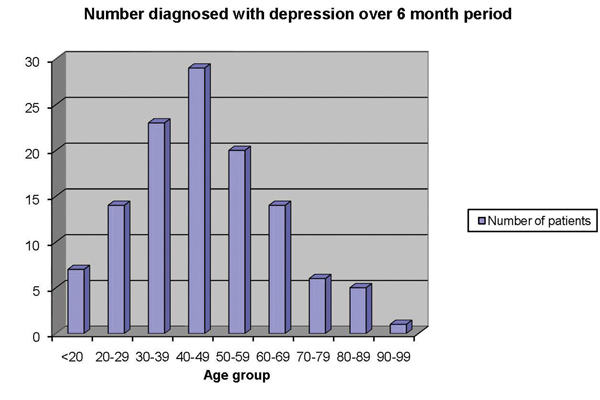
An audit in our practice of patients commenced on antidepressants for depression found that the peak prevalence occurred among those aged 40-49 and that only 18/119 patients (15%) were aged 65 years and over (see figure 1, p17). If our intention was to limit the diagnosis of depression to those with DSM IV major depression, and avoid the prescription of antidepressants to those with subthreshold depression, these results are comparable with our predicted point prevalence of 22 patients aged ≥ 65. However, if we adopt the broader definition of clinically significant depression, our predicted point prevalence was 172 patients aged ≥ 65, suggesting a substantial problem of underdiagnosis.
Even those with major depression often remain unrecognised and untreated. A Dutch study found that only 40% of older depressed patients were receiving treatment at baseline. The proportion receiving treatment declined over time and at one year follow-up only 35% had recovered.6
Generalised anxiety disorder (GAD) is by far the most common anxiety disorder in older people.1 Most GAD patients are not recognised in primary care and only a third of them receive any form of treatment;1 this proportion is likely to be substantially less in older patients.
There are a number of reasons why anxiety and depression in older patients may not be recognised:
• Patients often deny feeling anxious or depressed and are more likely to present with insomnia, irritability, agitation and multiple somatic complaints.9,17
• Depression is harder to recognise among those with chronic conditions e.g. patients may present indirectly with a worsening of their physical illness.
• Most older patients will have subthreshold symptoms, and will not be recognised if we rigidly apply DSM IV diagnostic criteria.
• GPs may wrongly believe that depression is a normal reaction to the losses of old age, and may be reluctant to initiate treatment because of concerns about antidepressant side effects or a belief that older patients cannot change their thinking or behaviour.17
Cognitive impairment is commonly associated with anxiety and depression, and it can be difficult to determine the direction of causality. Overall 40% of older depressed patients complain of memory problems and in some the cognitive impairment may be sufficiently serious to be considered pseudodementia.18 At the same time, depression, apathy and irritability are common in the early stages of dementia.13 In patients with pseudodementia, acute onset, prominent memory loss, variable cognitive impairment and frequent ‘don’t know’ answers may suggest the diagnosis.19
Behavioural disturbance e.g. aggression can be a sign of depression in older people, especially in association with dementia.9
Assessment: are rating scales helpful?
DSM IV criteria were generated to reflect symptoms in young people,10 and they are difficult to apply to older patients, whose somatic symptoms may be caused by depression, physical health problems or aging itself.
An alternative is provided by AGECAT which is a computerised diagnostic system designed for use with the Geriatric Mental State (GMS, a 157-item standardised semi-structured psychiatric interview which places a greater emphasis on psychological symptoms. AGECAT categorises depression as subclinical (severity level 1-2) or case level (severity level 3-5). The prevalence of case level depression (8.7%)20 is much greater than that of DSM IV depression but, unfortunately, the diagnostic criteria have not been published.
The PHQ-9 is based on the DSM IV criteria for major depression and is subject to the same limitations. A good case can be made for replacing it with the 15-item version of the Geriatric Depression Scale which almost entirely avoids somatic questions. This is a screening, not a diagnostic tool and does not evaluate symptom severity; nevertheless, it is thought to be a reliable measure of depression severity (see box 1).21
Almost half of older patients with major depression also meet the diagnostic criteria for an anxiety disorder.22 Comorbid generalised anxiety disorder should not be diagnosed as a separate disorder if it is experienced only during the course of a depressive illness but is nevertheless a marker of depression severity. The GAD-7 questionnaire is a useful screening tool with a threshold score of ≥ 10.
Physical illness
When making a diagnosis of depression in older patients, it is important to consider whether it is associated with an underlying physical condition. We should screen for endocrine disorders (thyroid and parathyroid conditions are most common), occult malignancy (especially pancreatic cancer) and nutritional deficiencies (vitamin B12, folate or vitamin D deficiency), see box 2.19,23
Generalised anxiety disorder management
NICE recommends a stepped care approach to the management of generalised anxiety disorder (GAD).
If patients have marked functional impairment or if low intensity interventions are ineffective, we are advised to offer either individual CBT or an SSRI.24 Unfortunately, there is very limited evidence from studies in older patients to support this guidance.
A recent RCT of CBT for primary care patients aged ≥ 60 reported a significant improvement in worry severity and depressive symptoms, but no effect on GAD severity.25 The only published RCT of SSRIs in older GAD patients suggested that citalopram was effective, but the study was very small.26
Depression management
NICE recommends that those with mild or persistent subthreshold depression should be offered low intensity psychosocial interventions, whereas those with moderate to severe depression should be offered a combination of antidepressants and CBT (see table 2).27
Low intensity treatment
There is some evidence of short-term benefit from physical exercise programmes, but these probably need to be continued long-term for the improvement to be maintained.28 Guided self-help provides only limited short-term benefit;29 life review group therapy is a promising alternative which attempts to change patients’ negative evaluations of their past lives.30
High intensity treatment
Antidepressants are effective in older patients but the antidepressant-placebo difference is smaller than in young adults with an NNT of 7-8.31 At the same time, there is a greater risk of clinically significant side effects among older patients and all classes of antidepressants are associated with increased mortality.32
There is evidence that SSRIs are slightly better tolerated31 and NICE recommends their use.27 However, a recent cohort study found that tricyclics were the safest class of antidepressants in older patients and that SSRIs were associated with the highest risk of falls and hyponatraemia.32 SSRIs are also associated with an increased risk of upper GI bleeding, fractures32 and cataracts,33 and a case can be made for using lofepramine as first-line treatment in older patients.
Psychological treatments are as effective in older people as they are in younger adults. There is a medium to large effect size (d = 0.72) and there is no evidence to support one type of therapy over another.34
Conclusion
The diagnosis of anxiety and depression in older patients is difficult. There is a complex relationship between depression and physical illness, there is uncertainty regarding diagnostic criteria and the PHQ-9 should probably not be used.
We are more likely to recognise late life anxiety and depression if we are aware of the risk factors and the less obvious ways in which patients can present.
Antidepressants are potentially hazardous in older patients and their use should be restricted to those with more severe depression or those who have not responded to psychological treatments.
REFERENCES
1 McManus S, Meltzer H, Brugha T et al. Adult psychiatric morbidity in England, 2007: results of a household survey. NHS Information Centre for Health and Social Care. 2009. www.ic.nhs.uk/pubs/psychiatricmorbidity07
2 Beekman ATF, Copeland JRM, Prince MJ. Review of community prevalence of depression in later life. Br J Psychiatry 1999;174:307-11
3 Rai D, Skapinakis P, Wiles N et al. Common mental disorders, subthreshold symptoms and disability: longitudinal study. Br J Psychiatry 2010;197:411-2
4 Seymour J, Benning TB. Depression, cardiac mortality and all-cause mortality. Adv Psych Treat 2009;15:107-13
5 Mykletun A, Bjerkeset O, Dewey M et al. Anxiety, depression and cause-specific mortality: the HUNT study. Psychosom Med 2007;69:323-31
6 Licht-Strunk E, Van Marwikjk HWJ, Hoekstra T et al. Outcome of depression in later life in primary care: longitudinal cohort study with three years’ follow-up. BMJ 2009;338:a3079
7 Lenze EJ, Mulsant BH, Mohlman J et al. Generalised anxiety disorder in late life: lifetime course and comorbidity with major depressive disorder. Am J Geriatr Psychiatry 2005;13:77-80
8 Kessler RC, Berglund P, Demler O et al. Lifetime prevalence and age-of-onset distributions of DMS-IV disorders in the National Comorbidity Survey replication. Arch Gen Psychiatry 2005;62:593-602
9 Evans M, Mottram P. Diagnosis of depression in elderly patients. Adv Psych Treat 2000;6:49-56
10 Chew-Graham C. Treating depression in later life. BMJ 2004;329:181
11 Vink D, Aartsen MJ, Schoevers RA. Risk factors for anxiety and depression in the elderly: a review. J Affect Disord 2008;106:29-44
12 National Institute for Health and Clinical Excellence. CG 91. Depression in adults with a chronic physical health problem: treatment and management. NICE. London. 2009
13 Lyketsos CG, Lopez O, Jones B. Prevalence of neuropsychiatric symptoms in dementia and mild cognitive impairment: results from the Cardiovascular Health Study. JAMA 2002;288:1475-83
14 Newman SC. The prevalence of depression in Alzheimer’s disease and vascular dementia in a population sample. J Affect Disord 1999;52:169-76
15 Sheline YI, Pieper CF, Barch DM et al. Support for the vascular depression hypothesis in late-life depression. Arch Gen Psychiatry 2010;67:277-85
16 Allain H, Schuck S, Madui N. Depression in Parkinson’s disease. BMJ 2000;320:1287
17 Tylee A, Katona CLE. Detecting and managing depression in older people. Br J Gen Pract 1996;46:207-8
18 Mitchell A. Depression as a risk factor for later dementia: a robust relationship? Age Ageing 2005;34:207-9
19 Kane RL, Ouslander JG, Abrass IB. Essentials of clinical geriatrics (5th edition). McGraw Hill. New York. 2004
20 McDougall FA, Kvaal K, Matthews FE et al. Prevalence of depression in older people in England and Wales: the MRC CFA study. Psychol Med 2007;37:1787-95
21 Almeida O, Almeida SA. Short versions of the geriatric depression scale: a study of their validity for the diagnosis of a major depressive episode according to ICD-10 and DSM-IV. Int J Geriat Psychiatry 14;858-65
22 Beekman ATF, de Beurs E, van Balkom AJLM et al. Anxiety and depression in later life: co-occurrence and communality of risk factors. Am J Psychiatry 2000;157:89-95
23 Stewart R, Hirani V. Relationship between vitamin D levels and depressive symptoms in older residents from a national survey population. Psychosom Med 2010;doi:10.1097/PSY/0b013e3181e9bf15
24 National Institute for Health and Clinical Excellence. CG113. Generalised anxiety disorder and panic disorder (with or without agoraphobia) in adults: management in primary, secondary and community care. NICE. London. 2011
25 Stanley MA, Wilson NL, Novy DM et al. Cognitive behaviour therapy for generalised anxiety disorder among older adults in primary care. A randomised clinical trial. JAMA 2009;301:1460-7
26 Lenze EJ, Mulsant BH, Shear KM et al. Efficacy and tolerability of citalopram in the treatment of late-life anxiety disorders: results from an 8-week, randomised, placebo-controlled trial. Am J Psychiatry 2005;162:146-50
27 National Institute for Health and Clinical Excellence. CG90. Depression: the treatment and management of depression in adults (update). NICE. London 2009
28 Mead GE, Morley W, Campbell P et al. Exercise for depression. Cochrane Database of Systematic Reviews 2009, Issue 3. Art. No.:CD004366. DOI:10.1002/14651858.CD004366.pub4
29 Coull G, Morris PG. The clinical effectiveness of CBT-based guided self-help interventions for anxiety and depressive disorders: a systematic review. Psychol Med 2011;doi:10.1017/S0033291711000900
30 Korte J, Bohlmeijer ET, Cappeliez P et al. Life review therapy for older adults with moderate depressive symptomatology: a pragmatic randomised controlled trial. Psychol Med 2011; doi:10.1017/S0033291711002042
31 Anderson IM, Ferrier IN, Baldwin RC et al. Evidence-based guidelines for treating depressive disorders with antidepressants. A revision of the 2000 British Association for Psychopharmacology guidelines. J Psychopharmacol 2008;22:343-96
32 Coupland C, Dhiman P, Morriss R et al. Antidepressant use and risk of adverse outcomes in older people: population based cohort study. BMJ 2011;343:d4551
33 Etminan M, Mikelberg FS, Brophy JM. Selective serotonin reuptake inhibitors and the risk of cataracts. Ophthalmology 2010;117:1251-5
34 Cuijpers K, van Straten A, Smit F. Psychological treatment of late-life depression: a meta-analysis of randomised controlled trials. Int J Geriatr Psychiatry 2006;21:1139-49
ARTICLE IN PDF
 Download this article in PDF format