SEARCH

Practitioner 2011; 255 (1736): 15–17
Tackling dementia in patients with Parkinson’s disease
24 Jan 2011
AUTHORS
Dr Michal Rolinski BA (Hons) BM BCh
Foundation Year 2
Fulbrook Centre, Oxford
Professor Klaus P Ebmeier
State Exam Med MD FRCPsych
Specialist in General Psychiatry and Honorary Consultant in Old Age Psychiatry, Warneford Hospital, Oxford
Article
Almost 200 years ago, James Parkinson described a condition with ‘involuntary tremulous motion, lessened voluntary powers,' but with ‘uninjured senses and intellect' that would later be named Parkinson's disease by Charcot. Since then, it has emerged that cognitive impairment is present in a large proportion of patients with Parkinson's disease.
Cognitive symptoms in patients with Parkinson's disease are associated with more rapid deterioration and eventually, a two-fold increase in mortality.1 Patients with cognitive impairment place a greater burden on their care givers and many such patients are admitted to nursing homes.
Lewy bodies are eosinophilic neuronal inclusion bodies that contain α-synuclein and, when accompanied by the clinical triad of tremor, rigidity and bradykinesia, histopathologically define idiopathic Parkinson's disease. Dementia with cortical Lewy bodies (DLB) is associated with deficits of acetylcholine and dopamine. These neurotransmitters have been found to be deficient in Alzheimer's and Parkinson's disease, respectively.
Dementia more than a year after the onset of motor features associated with Parkinson's disease is defined as Parkinson's disease with dementia (PDD). If it develops within one year of the motor features, the term dementia with Lewy bodies (DLB) is used.2
There continues to be some controversy about whether DLB and PDD are the same condition, however, since clinical and pathological features are similar, it is generally accepted that both represent a continuum of the same disorder, and they will be treated as one for the purpose of this review.
Epidemiology
PDD together with DLB account for around a fifth of all cases of dementia in older people reaching autopsy,3 thus making it the second most common degenerative dementia in the elderly, after Alzheimer's disease. The reported prevalence varies greatly between studies and the true figure is difficult to assess.
A systematic review found the average prevalence to be around 40%.4
Longitudinal studies suggest that most patients with Parkinson's disease would eventually develop dementia if they were to survive for long enough. The annual risk of dementia in Parkinson's patients is around 1.7 times that of age-matched controls.5, 6 The risk of developing dementia is dependent solely on the age of the patient, and not on the duration of the disease.7
Diagnosis
Although patients with Parkinson's disease may suffer from all types of dementia, the diagnosis of PDD in the presence of long-standing and pronounced motor features rarely poses a diagnostic dilemma. Conversely, the diagnosis of DLB may be more difficult.
Unlike patients with Alzheimer's disease who tend to present with memory problems, patients with DLB typically have rather non-specific problems with frontal and executive function, often fluctuating during the course of the week or even during the day. Patients can show poor attention and disinhibition, and have difficulty multitasking, often struggling with common tasks at home and in the workplace.8 During early stages of the disease, there can be very little change in the mini-mental state examination (MMSE), as executive function is underrepresented in this test.
No single pathognomonic clinical sign can be used to make the diagnosis of DLB, so the clinician relies on the revised consensus clinical criteria which have a specificity of 80% and sensitivity of 60-80% (see table 1).2
These criteria require the presence of at least two of the following three syndromes:
- Persistent visual hallucinations
- Fluctuating defects in cognitive and functional ability (over a period of hours or days)
- Parkinsonism
The diagnosis can be supported further by the presence of other clinical features, such as repeated falls, non-visual hallucinations, systematised delusions and neuroleptic sensitivity that can be seen with both typical and atypical neuroleptics.2 During REM sleep, patients with behaviour disturbance experience vivid dreams associated with simple or complex motor behaviour. This occasionally precedes the development of Parkinson's disease and DLB.
Visual hallucinations are present in approximately two-thirds of patients with DLB and, at presentation, are the most specific factor in differentiating the condition from Alzheimer's disease.9, 10 Patients commonly describe images of children or small animals, which disappear when attention is focused directly on them. The visuospatial defects observed tend to be more pronounced than expected for the overall level of cognitive function, again suggesting a marked deficit in visual processing in DLB. It is therefore not surprising that the development of visual hallucinations has been associated with a higher risk of dementia in patients with Parkinson's disease.11
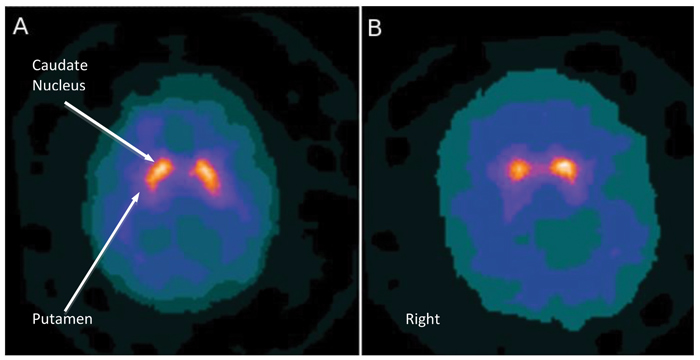
No investigation can reliably differentiate PDD and DLB from Alzheimer's disease and this is complicated further when the two coexist in the same patient. Structural imaging, such as MRI, may sometimes reveal a degree of atrophy of the medial temporal lobes and can be used to support the diagnosis of dementia. Novel imaging methods, such as 123I-ioflupane SPECT imaging (DaTSCAN) are now available to image basal ganglia pathology directly by labelling the presynaptic dopamine transporter site (see figure 1).12 Although very useful in the differential diagnosis, they are often only accessible through specialist memory clinics.
Management
Clinicians dealing with patients with DLB or PDD are faced with a mixture of cognitive, psychiatric and motor symptoms. The involvement of a multidisciplinary team is key. As treatment of one complaint may lead to the deterioration of another, patients and their carers need to be engaged in active dialogue to identify the factors most important to them. An early referral to a specialist clinic may not only help to confirm the diagnosis, but also to co-ordinate the group of professionals working with the patient.
The involvement of carers is also important, and the diagnosis needs to be explained to them. Social workers and care support workers can work with patients and their carers to assess requirements, arrange appropriate financial support such as the disability living allowance, attendance allowance and carer's allowance or respite care. An effort must be made to structure the home environment to make it safe and help patient mobility. Well lit rooms and the use of glasses and hearing aids, where required, can help to reduce the number of hallucinations.
Although not included in the NICE guidelines on the treatment of dementia, cholinesterase inhibitors used in Alzheimer's disease do have a role in DLB and PDD. Two large randomised controlled trials showed moderate improvements in cognitive function in patients treated with rivastigmine.13, 14 The greatest impact, however, seemed to be on the psychotic features of the disease, with patients experiencing an improvement in their hallucinations and delusions. It has been suggested that the patients who suffer from visual hallucinations are most likely to benefit from rivastigmine.14
To date, no studies have compared the effect of cholinesterase inhibitors versus neuroleptic drugs on the psychiatric features of DLB or PDD. However, as a large number of patients can experience the life-threatening neuroleptic sensitivity syndrome, characterised by sedation, rigidity, postural instability and confusion, cholinesterase inhibitors are often used first line.
In severe cases, low-dose clozapine has been shown to be most efficacious without leading to worsening of parkinsonian signs.15
Although, overall, patients with DLB are less likely to have a good motor response from L-dopa therapy than patients with Parkinson's disease or PDD,16 patients with severe parkinsonism seem to gain a similar benefit, independent of the aetiology.17 While dopamine replacement therapy can ease some of the severe motor features associated with PDD and DLB, it can lead to worsening of hallucinations and the development of psychotic features.
In one study, only 22% of patients on L-dopa therapy showed an improvement in motor rating scales, without developing psychiatric complications.18
Therefore, it is often recommended that dopamine replacement therapy should be started at a low dose and titrated slowly and carefully according to the individual patient's need.
Conclusion
Primary care plays a significant role in the recognition of DLB and PDD. Early recognition and referral to a specialist memory clinic can help to educate the patient about their often worrying symptoms and initiate the relevant treatment. Through the involvement of the multidisciplinary team, appropriate care networks can be set up to provide support and education for both patients and carers.
REFERENCES
1 Louis ED, Marder K, Cote L et al. Mortality from Parkinson disease. Arch Neurol 1997;54(3):260-4
2 McKeith IG, Dickson DW, Lowe J et al. Diagnosis and management of dementia with Lewy bodies: third report of the DLB Consortium. Neurology 2005;65(12):1863-72
3 Perry RH, Irving D, Blessed G et al. Clinically and neuropathologically distinct form of dementia in the elderly. Lancet 1989;1(8630):166
4 Cummings JL. The dementias of Parkinson's disease: prevalence, characteristics, neurobiology, and comparison with dementia of the Alzheimer type. Eur Neurol 1988;28 Suppl 1:15-23
5 Marder K, Tang MX, Cote L et al. The frequency and associated risk factors for dementia in patients with Parkinson's disease. Arch Neurol 1995;52(7):695-701
6 Aarsland D, Andersen K, Larsen JP et al. Prevalence and characteristics of dementia in Parkinson disease: an 8-year prospective study. Arch Neurol 2003;60(3):387-92
7 Hughes TA, Ross HF, Musa S et al. A 10-year study of the incidence of and factors predicting dementia in Parkinson's disease. Neurology 2000;54(8):1596-602
8 Goldmann Gross R, Siderowf A, Hurtig HI. Cognitive impairment in Parkinson's disease and dementia with Lewy bodies: a spectrum of disease. Neurosignals 2008;16(1):24-34
9 Ballard C, Holmes C, McKeith I et al. Psychiatric morbidity in dementia with Lewy bodies: a prospective clinical and neuropathological comparative study with Alzheimer's disease. Am J Psychiatry 1999;156(7):1039-45
10 Tiraboschi P, Salmon DP, Hansen LA et al. What best differentiates Lewy body from Alzheimer's disease in early-stage dementia? Brain 2006;129(Pt 3):729-35
11 Stern Y, Marder K, Tang MX et al. Antecedent clinical features associated with dementia in Parkinson's disease. Neurology 1993;43(9):1690-2
12 Colloby SJ, Taylor JP, Firbank MJ et al. Covariance 99mTc-exametazime SPECT patterns in Alzheimer's disease and dementia with Lewy bodies: utility in differential diagnosis. J Geriatr Psychiatry Neurol 2010; 23(1):54-62
13 McKeith I, Del Ser T, Spano P et al. Efficacy of rivastigmine in dementia with Lewy bodies: a randomised, double-blind, placebo-controlled international study. Lancet 2000;356(9247):2031-6
14 Emre M, Aarsland D, Albanese A et al. Rivastigmine for dementia associated with Parkinson's disease. N Engl J Med 2004;351(24):2509-18
15 Low-dose clozapine for the treatment of drug-induced psychosis in Parkinson's disease. The Parkinson Study Group. N Engl J Med 1999;340(10):757-63
16 Burn DJ, Rowan EN, Minett T et al. Extrapyramidal features in Parkinson's disease with and without dementia and dementia with Lewy bodies: A cross-sectional comparative study. Mov Disord 2003; 18(8):884-9
17 Bonelli SB, Ransmayr G, Steffelbauer M et al. L-dopa responsiveness in dementia with Lewy bodies, Parkinson disease with and without dementia. Neurology 2004 27;63(2):376-8
18 Goldman JG, Goetz CG, Brandabur M et al. Effects of dopaminergic medications on psychosis and motor function in dementia with Lewy bodies. Mov Disord 2008;23(15):2248-50
ARTICLE IN PDF
 Download this article in PDF format
EXTERNAL WEBLINKS
Parkinson's UK
215 Vauxhall Bridge Road
London
SW1V 1EJ
Tel: 020 7931 8080
Helpline: 0808 800 0303
Email: [email protected]
www.parkinsons.org.uk
The Alzheimer's Society
Devon House
58 St Katharine's Way
London E1W 1LB
Tel: 020 7423 3500
Helpline: 0845 300 0336 (8.30am-6.30pm, Mondays to Fridays)
Email: [email protected]
http://www.alzheimers.org.uk/