SEARCH

Stageman W, Hay K, Allan CL. Diagnosing and treating mood disorders in older people. Practitioner Jan 2019;263(1822):11-15
Diagnosing and treating mood disorders in older people
05 Feb 2019
AUTHORS
Dr William Stageman MBBS MRCP MRCPsych, Specialist Registrar in Old Age and Adult Psychiatry, Castleside Day Unit, Campus for Ageing and Vitality, Newcastle upon Tyne, UK
Dr Katherine Hay MBBS MRCPsych, ST6 in Old Age Psychiatry, Memory Assessment and Management Service, Centre for the Health of the Elderly, Newcastle upon Tyne, UK
Dr Charlotte L Allan MD (Res) MRCPsych, Consultant Psychiatrist and Honorary Clinical Senior Lecturer, Memory Assessment and Management Service, Centre for the Health of the Elderly, Newcastle upon Tyne, UK
Competing interests: None
Article
Abstract
Depression in older adults is common. Depressive symptoms may be part of a recurrent depressive disorder or experienced for the first time in later life as a result of changes in risk and resilience factors. Bipolar disorder rarely presents for the first time in older adults and a presentation of elevated mood and symptoms of mania should prompt investigations to exclude organic pathology and delirium. Risk factors for late life depression can be classified using a biopsychosocial framework. There is an association between cerebrovascular pathology, vascular risk factors and depression. Physical illnesses, particularly those associated with frailty, are also important risk factors for depression. Conditions such as chronic or severe pain, Parkinson’s disease and COPD may have direct effects on the brain, or indirect effects on psychosocial risk factors such as lack of sleep, reduced mobility and social isolation. Visual or hearing loss can lead to low self-esteem, isolation, loneliness and depression. Depression has a distinct presentation in late life and low mood may not be the predominant presenting symptom. When asked directly, older patients may deny that they feel sad or low in mood. They may present with physical symptoms, apathy, cognitive symptoms, agitation, retardation, fatigue or weight loss. Cognitive decline associated with depression is often misdiagnosed as dementia. Moreover, depression is frequently comorbid with dementia, particularly vascular dementia, so it is essential to consider depression as a potential cause of any new symptoms in such patients. Assessment of an older person presenting with possible symptoms of depression should be similar to that of any younger person. Assessment of suicidality is essential: older people are far less likely to articulate their suicidal thoughts.
Depression in older adults is common, with clinically significant depressive symptoms affecting 15% of people over the age of 55,1 and up to a third of people experiencing some depressive symptoms.2 The prevalence increases in those over the age of 85 years in hospitals and in nursing homes.1
Depressive symptoms may be part of a recurrent depressive disorder, or experienced for the first time in later life as a result of changes in risk and resilience factors.
Depression may also be seen in the context of bipolar disorder; reviewing past history carefully and enquiring about past symptoms of mania is important. Bipolar disorder rarely presents for the first time in older adults3 and a presentation of elevated mood and symptoms of mania should prompt investigations to exclude organic pathology and delirium.
Risk factors
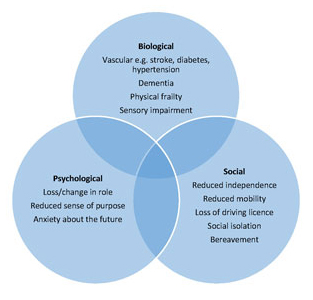
Risk factors for late life depression can be classified using a biopsychosocial framework. These risks are closely related and frequently overlap (see figure 1).
Cerebrovascular changes are common as people age and are associated with increased risk of depressive symptoms and depression.4 Neuroimaging studies have repeatedly shown that cerebrovascular pathology, including white matter hyperintensities, can predispose, precipitate or perpetuate a depressive syndrome in the elderly.5 Individuals with late life depression have greater white matter hyperintensities on structural imaging, and these are associated with poor outcomes.6,7
Diabetes mellitus and hypertension are particularly important risk factors for these end-organ changes in the brain.8,9 Vascular risk factors not only increase the risk of depression, but also the risk of cognitive changes and dementia. There is a bidirectional relationship between depression and dementia, with common aetiological causes and shared risk factors.1
Physical illnesses, particularly those conditions associated with frailty, are important risk factors for depression. Conditions such as chronic or severe pain, Parkinson’s disease and COPD, may have direct effects on the brain, or indirect effects on important psychosocial risk factors such as lack of sleep, reduced mobility and social isolation. Additionally, the psychological and social effects of sensory impairment, particularly visual and hearing loss, can reduce communication and impact on wellbeing. Hearing loss can lead to low self-esteem, isolation, loneliness and depression.10
The ageing process requires ongoing psychological adaptation to changes in everyday life with alteration in roles and responsibilities (e.g. through retirement) and physical morbidity. Psychological adaptation to ageing, particularly when it is associated with loss of externally validating roles, can reduce an individual’s sense of purpose and self-esteem.
There may be anxieties or fears over the future in relation to loss of independence, practicalities of obtaining support, financial pressures, or the dying process itself. Psychological adaptation may be harder for those who have historically responded poorly to stress or who have a history of multiple stressful life events.
As people age, illness is more common among their peers. The death of friends or family members (especially the loss of a spouse or partner) is a risk factor for depression.
Living alone and a dwindling social circle through death of friends or family or relocation can increase social isolation and loneliness. This may be compounded by reduced mobility and independence caused by musculoskeletal problems or stopping driving.
Changing needs of peers may require individuals to take on new caring roles, and while these may provide a greater sense of purpose, they can also be a source of stress contributing to risk for depression.
Bipolar disorder has been known to present for the first time as late as 86 years of age; risk factors are physical illness, cognitive impairment and previous depression.11
Presentation
Identifying depression in an older patient may be a challenge for a number of reasons. It has a distinct presentation in late life and low mood may not be the predominant presenting symptom. Indeed, when asked directly, the older person may deny that they feel sad or low in mood.
Furthermore, the cognitive decline that can accompany depression may often be misdiagnosed as dementia.12 It is therefore important to recognise other symptoms as potential indicators of depression in the older person.
The older person with depression may present with:13
• Physical symptoms
• Apathy
• Poor motivation
• Cognitive symptoms
• Agitation
• Retardation
• Fatigue
• Weight loss
These symptoms may trigger concerns of an underlying physical illness, however, the clinician should always consider depression as a cause of such symptoms in an older person.
A recent study suggested that apathy symptoms may identify patients who are at increased risk of dementia.14
A further challenge in identifying depression in older people is posed when the patient has established cognitive impairment. A number of studies have found that depression is frequently comorbid with dementia, particularly vascular dementia, so it is essential to consider depression as a potential cause of any new symptoms in such patients.
Although less common, older people may also present with manic symptoms later in life. Mixed affective symptoms such as agitation or irritability are more common in older people than in those who present at a younger age. Understandably, this could be misdiagnosed as dementia in an older person. As such, in any older person presenting with a change in behaviour which seems atypical of dementia, mania should be considered a potential diagnosis. It is worth bearing in mind that the older person may also present with the typical manic symptoms seen in younger people such as elevated mood, poor sleep and risky and disinhibited behaviours.
Comorbidity
There is a correlation between low mood and:
• Chronic pain
• Any chronic physical illness
• Stroke
• Parkinson’s disease
• Cognitive impairment (both as a cause and a symptom of depression)
Furthermore:
• Persistent severe depression is linked to the onset of dementia15,16
• There is a link between depression and worse outcomes for physical illness17
• There is a link between depression and increased mortality17
It is therefore essential to identify depression quickly and effectively, and to treat it adequately. If a patient has multiple comorbidities, a referral to a geriatrician may be helpful as a means of holistically approaching the patient’s presentation, and in turn, this will be beneficial to the patient’s mood.
Assessment
When an older person presents with possible symptoms of depression, the assessment should be similar to that of any younger person. A symptom check as per diagnostic criteria should be completed, bearing in mind the aforementioned predominance of biological symptoms in older people. The assessing clinician should also be vigilant for self-neglect and psychotic symptoms. Specific rating scales such as the Geriatric Depression Scale (GDS) are available to assess depressive symptoms in older people. The GDS is preferred to other commonly used tools such as the Patient Health Questionnaire-9 (PHQ-9), as it avoids questions about somatic symptoms (which in older people may be attributable to other causes). It is worth noting that the GDS is not a diagnostic tool but may be helpful in establishing severity of depressive symptoms.
A risk assessment in this group of people is vital as it will inform any management plan. The degree of mood disturbance may be impinging on the older person’s functional ability, and as such, the individual may pose a risk to self and potentially others around the home. It is important to remember that many older people continue to drive and their ability and judgment may be impaired in this area.
Assessment of suicidality is essential: older people are far less likely to articulate their suicidal thoughts than younger people. The main risk factors for suicide in older people are social isolation and depression and they are more likely to use violent methods. It is worth bearing in mind that self-harm without underlying suicidal intent is rare in older people, therefore, any attempt at self-harm or suicide should be taken extremely seriously.
A cognitive assessment should also be completed in older people presenting with a possible mood disorder. If there is a significant degree of impairment, information from a family member or another person may be helpful. On cognitive testing, you may find that a patient with an underlying dementia lacks insight into their memory loss, whereas an older person with a primary mood disorder maintains this insight. Another possible finding on cognitive testing may be preservation of higher function such as problem solving and speech but reduced concentration.
In older people, a medication review is essential as there are a number of drugs that may have been prescribed for comorbidities which may be contributing to their mood disturbance. Depression is a recognised side effect of certain beta-blockers, montelukast, corticosteroids and also proton pump inhibitors. Mania in older people should not be ignored and may indeed present later in life, with steroids being a relatively common cause of manic presentations.
If a patient presents with mood disturbance, either elevated or low mood, blood tests may help direct management should a contributory medical factor be identified. Suggested tests include:
• Full blood count
• Renal profile
• Thyroid function
• Vitamin B12 and folate
• Glucose
These tests may help identify potential causes of mood disturbance, as well as possible physical causes of somatic symptoms.
Management
Depression is not a normal part of ageing and, even if there are understandable triggers, this should not deter GPs from offering treatment. Indeed, early intervention is recommended, as a short duration of untreated illness improves the likelihood of response.18 Management involves a stepped care approach.
For persistent subthreshold symptoms, or mild to moderate depression, low intensity psychological or psychosocial interventions should be considered. These could include sleep hygiene advice, behavioural activation, CBT, structured exercise, referral to a befriending service (such as one of those offered by Age UK, see External websites) or social prescribing if available.19 If symptoms persist or there is a moderate to severe burden, pharmacological or high intensity psychological therapies should be considered, see figure 2.
When using antidepressant medication, assessing response systematically and utilising rating scales (such as the PHQ-9) have both been shown to reduce time to remission significantly as this prompts timely dose or medication change in those who fail to respond.20,21
SSRIs should generally be offered first line; sertraline and citalopram are often preferred because of their lower propensity for interactions. Be mindful that the risk of hyponatraemia with SSRIs increases with age and concurrent NSAID use. Combining antidepressants with NSAIDs raises the risk of bleeding in susceptible individuals or those on warfarin, and this includes the risk of brain haemorrhage.22,23 Mirtazapine could be considered as an alternative.
Patients should be reassessed at four weeks after commencing medication. If there has been minimal change (2 points or less on PHQ-9), switching to a different class of antidepressant could be trialled. If there has been a partial response (PHQ-9 score decreased but still > 5) a dose increase could be considered. If there are ongoing sleep symptoms CBT for insomnia or a short course of hypnotics may help.
If residual symptoms remain despite dose optimisation of an antidepressant to which there was a partial response, augmentation could be considered, but this usually requires consultation with a psychiatrist.
The addition of lithium, quetiapine, aripiprazole and mirtazapine are common augmentation strategies. A systematic review of treatment resistant depression in older people found an overall response rate of 58% to antipsychotic augmentation and a 42% response rate to lithium.24 Although not licenced, there is a growing body of evidence that aripiprazole is both an effective and well tolerated augmentation strategy in older people.25 To reduce the risk of relapse, the medication(s) on which the individual achieved remission should be continued for at least a year in a first episode of depression, at least two years in a second, and perhaps indefinitely after a third.26
In those with moderate or severe depression and chronic physical health or complex needs collaborative care has been shown to be effective.27 A care coordinator helps improve compliance with treatment and improves joint working between physical and mental health services.
In bipolar disorder treatment follows the same principles as for younger adults, although very few studies have been directed at older people. Generally, older people are more susceptible to adverse reactions, owing to end-organ sensitivity and impairment in both circulation and hepatic and renal clearance. This may be especially pertinent with lithium. Treatment doses are therefore generally lower than those used in younger adults and should be more carefully titrated.28 The risk of switching to mania when using antidepressants without mood stabilisers is high in older people with bipolar depression and this should be avoided.
Referral
Most patients with depressive disorders are treated in primary care. Referral to specialist mental health services may be indicated in the following cases:
• Risk of suicide
• Risk of self-neglect
• Poor response to treatment
• Significant psychiatric comorbidity
• Psychotic symptoms
• Diagnostic difficulty (commonly differentiation between depression and early cognitive impairment)
• New onset or undertreated bipolar disorder
REFERENCES
1 Kok RM, Reynolds CF. 3rd. Management of depression in older adults: A review. JAMA 2017;317(20):2114-22
2 Rodda J, Walker Z, Carter J. Depression in older adults. BMJ 2011;343:d5219
3 Kroon JS, Wohlfarth TD, Dieleman J et al. Incidence rates and risk factors of bipolar disorder in the general population: a population-based cohort study. Bipolar Disord 2013;15(3):306-13
4 Allan CL, Sexton CE, Filippini N et al. Sub-threshold depressive symptoms and brain structure: A magnetic resonance imaging study within the Whitehall II cohort. J Affect Disord 2016;204:219-25
5 Alexopoulos GS, Meyers BS, Young RC et al. “Vascular depression” hypothesis. Arch Gen Psychiatry 1997;54(10):915-22
6 Hickie I, Scott E, Mitchell P et al. Subcortical hyperintensities on magnetic resonance imaging: clinical correlates and prognostic significance in patients with severe depression. Biol Psychiatry 1995;37(3):151-60
7 Teodorczuk A, Firbank MJ, Pantoni L et al. Relationship between baseline white-matter changes and development of late-life depressive symptoms: 3-year results from the LADIS study. Psychol Med 2010;40(4):603-10
8 Moulton CD, Pickup JC, Ismail K. The link between depression and diabetes: the search for shared mechanisms. Lancet Diabetes Endocrinol 2015;3(6):461-71
9 Allan CL, Zsoldos E, Filippini N et al. Lifetime hypertension as a predictor of brain structure in older adults: Cohort study with a 28-year follow-up. Br J Psychiatry 2015;206(4):308-15
10 NHS England. Action Plan on Hearing Loss. Department of Health 2015 www.england.nhs.uk/wp-content/uploads/2015/03/act-plan-hearing-loss-upd.pdf
11 Broadhead J, Jacoby R. Mania in old age: A first prospective study. Int J Ger Psych 1990;5:215-22
12 Pocklington C. Depression in older adults. BJMP 2017;10(1):1007
13 Hegeman JM, Kok RM, Van der Mast RC et al. Phenomenology of depression in older compared with younger adults: meta-analysis. Br J Psychiatry 2012;200(4):275-81
14 van Dalen JW, Van Wanrooij LL, Moll van Charante EP et al. Apathy is associated with incident dementia in community-dwelling older people. Neurology 2018;90:e82-9
15 Mizra SS, Wolters FJ, Swanson SA et al. 10-year trajectories of depressive symptoms and risk of dementia: a population-based study. Lancet Psychiatry 2016;3(7):628-35
16 Saczynski JS, Beiser A, Seshadri S et al. Depressive symptoms and risk of dementia. Neurology 2010;75(1):35-41
17 Alexopoulos GS. Depression in the elderly. Lancet 2005;365:1961-70
18 de Diego-Adeliño J, Portella MJ, Puigdemont D et al.
A short duration of untreated illness (DUI) improves response outcomes in first-depressive episodes. J Affect Disord 2019;120(1-3):221-25
19 Mead N, Lester H, Chew-Graham C et al. Effects of befriending on depressive symptoms and distress: systematic review and meta-analysis. Br J Psychiatry 2010;196(2):96-101
20 Bauer M, Pfennig A, Linden M et al. Efficacy of an algorithm-guided treatment compared with treatment as usual: A randomized, controlled study of inpatients with depression. J Clin Psychopharmacol 2009;29(4):327-33
21 Guo T, Xiang YT, Xiao L et al. Measurement-based care versus standard care for major depression: A randomized controlled trial with blind raters. Am J Psychiatry 2015;172:10:1004:1013
22 Movig KLL, Leufkens HGM, Lenderink AW et al. Association between antidepressant drug use and hyponatraemia: A case-control study. Br J Clin Pharmacol 2002;53:363-69
23 Shin J-Y, Park M-J, Lee SH et al. Risk of intracranial haemorrhage in antidepressant users with concurrent use of non-steroidal anti-inflammatory drugs: nationwide propensity score matched study. BMJ 2015;351:h3517
24 Cooper C, Katona C, Lyketsos K et al. A systematic review of treatments for refractory depression in older people. Am J Psychiatry 2011;168:681-88
25 Lenze EJ, Mulsant BH, Blumberger DM et al. Efficacy, safety, and tolerability of augmentation pharmacotherapy with aripiprazole for treatment-resistant depression in late life: A randomised, double-blind, placebo-controlled trial. Lancet 2015;386:2404-12
26 Kok RM, Reynolds CF. Management of depression in older adults: A review. JAMA 2017;317(20):2114-22
27 Unützer J, Katon W, Callahan CM et al. Collaborative care management of late-life depression in the primary care setting: A randomized controlled trial. JAMA 2012;288:2836-45
28 Goodwin GM, Haddad PM, Ferrier IN et al. Evidence-based guidelines for treating bipolar disorder: Revised third edition recommendations from the British Association for Psychopharmacology. J Psychopharmacol 2016;30(6):495-553
29 McAllister-Williams H, Yates S. ABC of Anxiety and Depression. Wiley. 2014
ARTICLE IN PDF
 Download this article in PDF format
EXTERNAL WEBLINKS
Educational resource on mental health
Royal College of Psychiatrists