SEARCH

Webb J, Jackson T, Claridge S, Sammut E, Behar J, Carr-White G. Management of heart failure with preserved ejection fraction. Practitioner 2015;259 (1786):21-24
Management of heart failure with preserved ejection fraction
21 Oct 2015
AUTHORS
Dr Jessica Webb BM BCh MA MRCP FHEA, Cardiology Clinical Research Fellow
Dr Tom Jackson BSc MBBS MRCP, Cardiology Clinical Research Fellow
Dr Simon Claridge LLB MBBS MRCP, Cardiology Clinical Research Fellow
Dr Eva Sammut MBBS MRCP, Cardiology Clinical Research Fellow
Dr Jonathan Behar MBBS MRCP, Cardiology Clinical Research Fellow
Division of Imaging Sciences and Biomedical Engineering, King’s College, London, UK
Dr Gerald Carr-White MBBS PhD, Consultant Cardiologist
Department of Cardiology, Guy’s and St Thomas’ NHS Foundation Trust, London, UK
Article
Heart failure (HF) is a complex clinical syndrome resulting from the impaired ability of the heart to cope with the metabolic needs of the body, resulting in breathlessness, fatigue and fluid retention. It is a progressive disease characterised by high rates of hospitalisation. The National Heart Failure Audit in England and Wales in 2012/2013 reported that 5% of all emergency hospitalisations were related to heart failure, with 11% inpatient mortality and 26% of those discharged dead within the follow-up period.3
At present HF affects nearly one million people in the UK.3,4 Studies suggest that approximately half these patients have normal, or near normal, left ventricular ejection fraction (LVEF) and are classified as heart failure with preserved ejection fraction (HFpEF).5 The prevalence of HFpEF in HF studies has been reported as 40-71%.1 This variation reflects both the current challenges in accurately diagnosing HFpEF and that different LVEF cutoffs (varying from 40% to over 55%) have been used.
In 2007, the average number of patients on a practice list in England was 6,487 which would equate to around 50 patients with HFpEF per practice. However, the true overall prevalence of HFpEF in the community has been estimated to be higher, so each practice could have up to 200 patients with HFpEF.6 This means it is important for all clinicians to consider HFpEF when seeing patients with signs and symptoms of heart failure.6
Pathophysiology
The exact pathophysiology of HFpEF remains uncertain although increased left ventricle passive stiffness is consistently reported.7,8 Patients often have overlapping comorbidities and it has only recently been convincingly demonstrated that HFpEF represents more than the sum of all its comorbidities and is a condition in its own right.9
HFpEF is likely to be caused by: diastolic dysfunction, impaired systolic function on exercise, abnormal ventricular-arterial coupling, inflammation and endothelial dysfunction, chronotropic incompetence, altered myocardial energetics and peripheral skeletal muscle metabolism and perfusion, pulmonary hypertension and renal insufficiency.8
HFpEF was initially referred to as diastolic HF as opposed to systolic HF that corresponded with HFrEF (heart failure with reduced ejection fraction). However, diastolic dysfunction has been shown not to be unique to HFpEF. Furthermore, newer imaging techniques have confirmed that systolic function in HFpEF patients is not completely normal, with reduced long axis function and extensive but subtle changes on exercise. HFpEF is the accepted name, although preserved implies that the left ventricular ejection fraction was known previously and is unchanged, which is not always the case.10
Risk factors
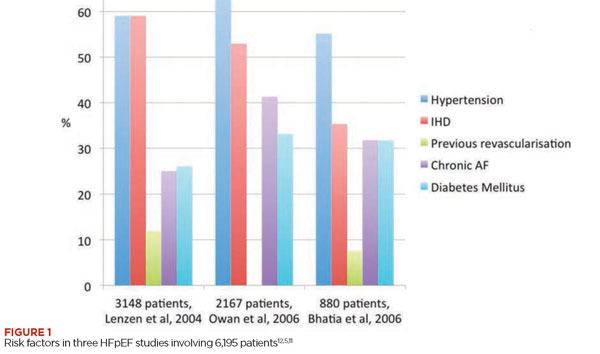
Large epidemiological studies have found that HFpEF patients are likely to be older women with a history of hypertension.5,11,12 Other cardiovascular risk factors, such as diabetes mellitus, atrial fibrillation and coronary artery disease are prevalent in the HFpEF population, see figure 1.
Non-cardiovascular comorbidities, renal impairment, chronic lung disease, liver disease, hypothyroidism and anaemia, consistent with an elderly population have also been reported.13
Presentation
Clinical symptoms and signs in HFpEF are often nonspecific although the primary symptoms of HF are fatigue, breathlessness and fluid retention.
Patients often find their exercise tolerance is limited by fatigue and breathlessness. Fluid overload can result in weight gain, peripheral oedema, or swelling of the ankles and legs, as well as abdominal congestion, resulting in impaired absorption and also renal dysfunction.
Depression is common in heart failure, with a prevalence of 20-40%.14 Patients with heart failure and depression have been found to have increased morbidity and mortality with impaired quality of life, when compared with heart failure patients without depression.15,16
The New York Heart Association (NYHA) functional classification provides an easy way to classify patients depending on their physical limitations, see table 1.17 Criticisms of the classification system focus on difficulties defining the difference between slight and marked limitation18 with low reproducibility values between clinicians.19 However, the NYHA classification system provides a rapid assessment of exercise capacity that is easy to communicate and has been well documented to predict prognosis.20, 21
Assessment
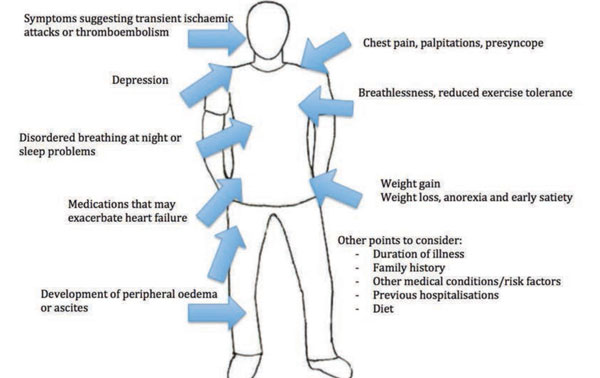
Despite significant advances in medical imaging, the cornerstone in the assessment of HF remains a thorough medical history and physical examination, see figure 2. There is still no single diagnostic test for HFpEF.
The medical history needs to include previous cardiac disease such as coronary artery disease and atrial fibrillation, as well as previous episodes of hospitalisation. Other cardiovascular risk factors and family history should be documented.
The duration of symptoms is relevant as are the extent of symptoms such as chest pain, breathlessness and exercise limitation. It is useful to classify patients according to the NYHA functional assessment. Rapid weight gain is suggestive of fluid overload, whereas anorexia, weight loss and early satiety suggest cardiac cachexia that is associated with an adverse prognosis.22
The physical examination needs to include the patient’s BMI and weight, heart rate and rhythm, lying and standing blood pressure and auscultation to rule out valvular disease and pulmonary congestion.
Estimating the jugular venous pressure and the presence of peripheral oedema allows assessment of the patient’s volume status. Cool extremities indicate poor cardiac output and perfusion. Hepatomegaly and ascites both indicate fluid overload.
Confirming diagnosis
Recent guidelines have been published to improve the diagnosis of HFpEF, see table 2.1,23 Echocardiography is clearly critical in the diagnosis of HFpEF, but not all GPs have access to this and most have to refer patients to their local cardiology department.
Before referral an ECG can be performed to check for heart rate and rhythm, as well as any suggestion of previous ischaemic disease,
left ventricular hypertrophy or atrial enlargement. Blood tests for full blood count, serum electrolytes including magnesium and calcium, renal function, thyroid function, glucose, liver function, fasting lipid profile and NT-proBNP, see box 1, can all add important information to the early assessment of a patient with suspected HFpEF.
Patients with heart failure should be referred to heart failure nurses and have follow-up with local cardiology services, as these have both been shown to reduce mortality.3
Once the patient has been referred to cardiology, it is likely that further specialist investigations will be undertaken, such as cardiac magnetic resonance imaging, coronary angiography, computer tomography coronary angiography, exercise testing and lung function tests.
Long-term outcomes
Studies suggest that the mortality rate in HFpEF patients is substantial ranging from 10 to 30%, with higher rates in epidemiological studies than clinical trials.24 Mortality rates are clearly higher than controls matched for age and comorbidities25 and may be as high as mortality rates in HFrEF.5,11 In clinical trials, sudden death and HF death are the leading causes of cardiovascular death.26 Survival has improved in HFrEF over the past 10 to 20 years although no change has been observed for HFpEF patients.
Management
Given the uncertainty in diagnoses and pathophysiology it is not surprising that there have been no evidence-based HFpEF therapies beyond treatment directed at comorbidities and diuretics for fluid overload.8 Several large-scale trials have demonstrated neutral results although there were no universal entry criteria and so different populations have been studied. Recent heart failure guidelines have concluded that ‘no treatment has yet been shown convincingly to reduce mortality or morbidity in patients with HFpEF’.
The recommendations include managing breathlessness and fluid overload with diuretics, managing heart rate control and treating myocardial ischaemia and hypertension.23
Drug therapy
Loop diuretics and thiazides are effective for the rapid relief of symptoms and may improve quality of life, although do not reduce morbidity or mortality.27 There is some evidence that thiazide diuretics may reduce morbidity and mortality in older hypertensive patients.28,29 There is no such evidence for loop diuretics. Identifying and treating depression is important in these patients.
Conclusion
The prevalence of HF is expected to increase by 25% by 203030 and approximately half of all HF patients have HFpEF.
HFpEF represents a collection of different conditions and current imaging and physiological research is seeking to understand this better and improve characterisation.
Symptoms and signs of heart failure are central to the diagnosis of HFpEF. Currently no treatments have convincingly been shown to reduce mortality or morbidity in these patients with comparable outcome data to HFrEF.
Improved characterisation of HFpEF will enable future trials to define inclusion criteria, ensuring that similar patients are being studied.
REFERENCES
1 Yancy CW, Jessup M, Bozkurt B et al. 2013 ACCF/AHA Guideline for the Management of Heart Failure. A Report of the American College of Cardiology Foundation/ American Heart Association Task Force on Practice Guidelines. J Am Coll Cardiol 2013;62(16):e147-e239
2 van Veldhuisen DJ, Linssen GC, Jaarsma T et al. B-type natriuretic peptide and prognosis in heart failure patients with preserved and reduced ejection fraction. J Am Coll Cardiol 2013;61(14):1498-506
3 Cleland J, Dargie H, Hardman S et al. National Heart Failure Audit. National Institute for Cardiovascular Outcomes Research. 2012:1-64
4 National Institute for Health and Care Excellence. CG108. Chronic heart failure: the management of adults with chronic heart failure in primary and secondary care (Partial update). NICE. London. 2010
5 Owan TE, Hodge DO, Herges RM et al. Trends in prevalence and outcome of heart failure with preserved ejection fraction. N Engl J Med 2006;355(3):251-9
6 Taylor CJ, Roalfe AK, Tait L et al. Observational longitudinal cohort study to determine progression to heart failure in a screened community population: the Echocardiographic Heart of England Screening Extension (ECHOES-X) study. BMJ Open 2014;4(7): e005256
7 Zile MR, Baicu CF, Gaasch WH. Diastolic heart failure-abnormalities in active relaxation and passive stiffness of the left ventricle. N Engl J Med 2004;350(19):1953-9
8 Sharma K, Kass DA. Heart failure with preserved ejection fraction: mechanisms, clinical features, and therapies. Circ Res 2014;115(1):79-96
9 Mohammed SF, Borlaug BA, Roger VL et al. Comorbidity and ventricular and vascular structure and function in heart failure with preserved ejection fraction:a community-based study. Circ Heart Fail 2012;5(6):710-9
10 Sanderson JE. HFNEF, HFpEF, HF-PEF, or DHF: what is in an acronym? JACC Heart Fail 2014;2(1):93-4
11 Bhatia RS, Tu JV, Lee DS et al. Outcome of heart failure with preserved ejection fraction in a population-based study. N Engl J Med 2006;355(3):260-9
12 Lenzen MJ, Scholte op Reimer WJ, Boersma E et al. Differences between patients with a preserved and a depressed left ventricular function: a report from the EuroHeart Failure Survey. Eur Heart J 2004;25(14):1214-20
13 Lam CS, Donal E, Kraigher-Krainer E, Vasan RS. Epidemiology and clinical course of heart failure with preserved ejection fraction. Eur J Heart Fail 2011;13(1):18-28
14 Rutledge T, Reis VA, Linke SE et al. Depression in heart failure a meta-analytic review of prevalence, intervention effects, and associations with clinical outcomes. J Am Coll Cardiol 2006;48(8):1527-37
15 Jiang W, Kuchibhatla M, Clary GL et al. Relationship between depressive symptoms and long-term mortality in patients with heart failure. Am Heart J 2007;154(1):102-8
16 Gottlieb SS, Kop WJ, Ellis SJ et al. Relation of depression to severity of illness in heart failure (from Heart Failure And a Controlled Trial Investigating Outcomes of Exercise Training [HF-ACTION]). Am J Cardiol 2009;103(9):1285-9
17 The Criteria Committee of the New York Heart Association. Nomenclature and Criteria for Diagnosis of Diseases of the Heart and Great Vessels. 1964;9th edition:253-6 Little Bac. Boston
18 Raphael C, Briscoe C, Davies J et al. Limitations of the New York Heart Association functional classification system and self-reported walking distances in chronic heart failure. Heart 2007;93(4):476-82
19 Goldman L, Hashimoto B, Cook EF, Loscalzo A. Comparative reproducibility and validity of systems for assessing cardiovascular functional class: advantages of a new specific activity scale. Circulation 1981;64(6):1227-34
20 Kirk V, Bay M, Parner J et al. N-terminal proBNP and mortality in hospitalised patients with heart failure and preserved vs. reduced systolic function: data from the prospective Copenhagen Hospital Heart Failure Study (CHHF). Eur J Heart Fail 2004;6(3):335-41
21 Muntwyler J, Abetel G, Gruner C, Follath F. One-year mortality among unselected outpatients with heart failure. Eur Heart J 2002;23(23):1861-6
22 Anker SD, Ponikowski P, Varney S et al. Wasting as independent risk factor for mortality in chronic heart failure. Lancet 1997;349(9058):1050-3
23 McMurray JJ, Adamopoulos S, Anker SD et al. ESC guidelines for the diagnosis and treatment of acute and chronic heart failure 2012: The Task Force for the Diagnosis and Treatment of Acute and Chronic Heart Failure 2012 of the European Society of Cardiology. Developed in collaboration with the Heart Failure Association (HFA) of the ESC. Eur J Heart Fail 2012; 14(8):803-69
24 Meta-analysis Global Group in Chronic Heart Failure (MAGGIC). The survival of patients with heart failure with preserved or reduced left ventricular ejection fraction: an individual patient data meta-analysis. Eur Heart J 2012; 33(14):1750-7
25 Redfield MM, Jacobsen SJ, Burnett JC Jr et al. Burden of systolic and diastolic ventricular dysfunction in the community: appreciating the scope of the heart failure epidemic. JAMA 2003;289(2):194-202
26 Komajda M, Lam CS. Heart failure with preserved ejection fraction: a clinical dilemma. Eur Heart J 2014;35(16):1022-32
27 Yip GW, Wang M, Wang T et al. The Hong Kong diastolic heart failure study: a randomised controlled trial of diuretics, irbesartan and ramipril on quality of life, exercise capacity, left ventricular global and regional function in heart failure with a normal ejection fraction. Heart 2008;94(5):573-80
28 Prevention of stroke by antihypertensive drug treatment in older persons with isolated systolic hypertension. Final results of the Systolic Hypertension in the Elderly Program (SHEP). SHEP Cooperative Research Group. JAMA 1991;265(24):3255-64
29 Beckett NS, Peters R, Fletcher AE et al. Treatment of hypertension in patients 80 years of age or older. N Engl J Med 2008;358(18):1887-98
30 Go AS, Mozaffarian D, Roger VL et al. Heart disease and stroke statistics- 2013 update: a report from the American Heart Association. Circulation 2013;127(1):e6-e245
ARTICLE IN PDF
 Download this article in PDF format
PRESET SEARCHES
PubMed
Preserved ejection fraction review
Immediate CPD prompts
These handy templates* prompt immediate drafting of personal learning, reflection and planning. Save your record straight into your personal development folder on your device or Cloud storage system.
*Adobe reader needed for iPad
EXTERNAL WEBLINKS
British Society for Heart Failure
LETTERS TO THE EDITOR
If you would like to comment on this article for publication or have a question for the authors, write to: