SEARCH

Leo M, Betts T. Have a high index of suspicion for atrial fibrillation. Practitioner 2014;258 (1775)15-20
Have a high index of suspicion for atrial fibrillation
23 Oct 2014
AUTHORS
Dr Milena Leo MD Clinical Fellow
Dr Tim Betts MD FRCP, Consultant Cardiologist and Electrophysiologist, Oxford Heart Centre, John Radcliffe Hospital, Oxford, UK
Article
Although the first recorded description of atrial fibrillation (AF) is in The Yellow Emperor's Classic of Internal Medicine, believed to date between 1696 and 2598 BC, only in the last century has this cardiac dysrhythmia been recognised as a very common condition associated with increased cardiac and cerebrovascular morbidity and mortality.
In June 2014, NICE published updated guidelines for the management of AF, in the light of new evidence, including stroke and bleeding risk stratification and the role of new antithrombotic agents and ablation strategies.1
AF is a very heterogeneous condition. There are a number of aspects to consider, including aetiology, comorbidities, symptoms, stroke risk and other potential detrimental effects such as tachycardia cardiomyopathy. There are a variety of different treatment strategies and therapies.
For these reasons, a personalised package of care and information is necessary. Fortunately, there are a number of accessible information resources for patients and physicians, including the Atrial Fibrillation Association website.
When to consider AF
Thirty-three million individuals across the globe have AF, with more than five million new cases each year.
The prevalence is around 1.5% in the general population but it increases with age, approaching 8% in those over 65 years old and is higher than 10% in the over-80s. The lifetime risk of AF for men and women over the age of 40 is approximately 25%.
The condition affects around 800,000 people in the UK, of which it is estimated that 250,000 are undiagnosed. With such a high prevalence, GPs will be faced with identifying and managing AF on a regular basis.
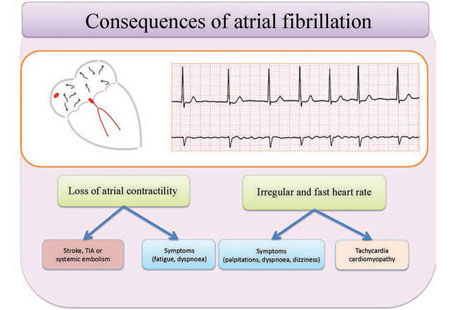
The chaotic atrial electrical activation during AF translates into the loss of atrial contractility and an irregular and often fast ventricular rate. A rapid heart rate may result in palpitations, dyspnoea or chest tightness, whereas the loss of atrial contractility may lead to fatigue and reduced exercise capacity.
Presentation can range from the truly asymptomatic, with AF diagnosed by chance, to those with vague, non-specific symptoms who turn out to have an irregular pulse on palpation, to clear-cut rapid, irregular palpitations with severe compromise. As up to one third of patients have no recognisable symptoms, a high index of suspicion is required.
The lack of an organised atrial contraction during AF can result in some stagnant blood in the left atrium, with an increased risk of thrombus formation that may subsequently dislodge, resulting in a five-fold increased risk of ischaemic stroke, transient ischaemic attack or systemic embolism. AF strokes are larger, more disabling and have a higher mortality rate than those with other causes.
It is important to note that the risk of stroke is not related to the presence or absence of symptoms, or whether the AF is paroxysmal (intermittent) or persistent.
Indeed, it is not clear whether there is a safe burden of AF, and there is good evidence that episodes lasting more than 5-6 minutes confer an increased risk of stroke.
Although it can occur in the absence of structural heart disease or identifiable risk factors, so-called lone AF, half of patients with AF have associated cardiovascular disease, including hypertension, valvular heart disease, congestive heart failure, coronary artery disease, pericarditis, obstructive sleep apnoea and cardiomyopathy. Moreover, physiological stressors such as surgical procedures, pulmonary embolism, chronic lung diseases, hyperthyroidism, and alcohol ingestion can induce AF in individuals with a predisposition.
Diagnosis
An irregular pulse is the textbook diagnostic sign, however with the advent of automatic blood pressure monitoring, pulse palpation may no longer be part of a routine assessment and is limited by being a very infrequent, brief encounter.
With this in mind, blood pressure monitors for use in primary care have been developed that can simultaneously detect pulse irregularity and display an AF icon.
NICE has concluded that the WatchBP Home A blood pressure monitor is cost saving and could provide significant clinical benefits when used for opportunistic AF detection in asymptomatic patients being screened or monitored for hypertension, and that it would be particularly beneficial for older patients at higher risk of stroke.2
When an irregular pulse is detected it should precipitate further assessment with a 12-lead ECG.
In patients with intermittent palpitations that may represent AF, prolonged ECG monitoring, ideally with 7-28 day event monitors, can be used to increase the chance of diagnosis. The choice of monitor should be based on the frequency of symptoms. A 24-hour monitor should only be used if symptoms occur every day.
Investigation
A comprehensive physical examination should be undertaken, including blood pressure measurement, cardiovascular examination to look for valvular heart disease or heart failure and lung examination looking for signs of lung disease or pulmonary oedema. Blood tests, including urea and electrolytes, liver function tests, full blood count, blood glucose and thyroid function tests should be carried out.
A transthoracic echocardiogram should be performed when there is a suspicion of structural or functional heart disease based on physical examination, if a rhythm control strategy with class IC antiarrhythmic drugs (propafenone, flecainide) or electrical cardioversion are being considered, for patients under 60 years of age or in rare instances for refinement of clinical risk stratification for antithrombotic therapy.
Management
In patients with a confirmed diagnosis of AF, three key factors need to be considered, all of which are independent of one another:
• Stroke risk
• Symptoms
• Risk of tachycardia cardiomyopathy
The following areas are emphasised in the recent NICE guidelines.
Risk stratification
The thromboembolic risk and the bleeding risk related to the initiation of anticoagulant therapy should be promptly stratified in each patient.
The CHA2DS2-VASc score is currently used to assess the stroke risk in patients with AF. Oral anticoagulation should be offered to patients with a CHA2DS2-VASc score of 2 or more, and considered for men with a CHA2DS2-VASc score of 1. Although female gender is considered a risk factor, this is only in patients aged 65 years or older, see table 1.
The risk of severe bleeding with warfarin should also be assessed using the HAS-BLED score, see table 2. A score of 3 or more indicates that caution is required when starting any anticoagulant therapy.
Of note, risk of falls is not a good reason to withhold anticoagulation — modelling studies have calculated that it takes nearly 300 falls per annum before the risks of warfarin overweigh the benefits.
In some instances, such as previous life-threatening bleeds, the risks of oral anticoagulation outweigh the benefits. In these situations, percutaneous left atrial appendage occlusion is an interventional procedure currently being evaluated as an alternative,3 see table 3.
Oral anticoagulant therapy
When appropriate, oral anticoagulant therapy should be promptly initiated, choosing the best option for the patient.
Oral anticoagulant therapy can reduce the risk of having a stroke by approximately 50-70%.
Until recently, warfarin was the only available option. Although cheap and effective, the need for regular monitoring and dose adjustments, combined with multiple food and drug interactions, results in suboptimal time in the therapeutic range, a high rate of non-compliance and treatment cessation in 25-40% by three-year follow-up.
Starting in 2012, a number of drugs belonging to a new generation of novel oral anticoagulants (NOACs) have been approved by NICE for prevention of stroke and systemic embolism in patients with non-valvular (i.e. not caused by rheumatic heart disease) AF: dabigatran,4 rivaroxaban5 and apixaban.6
Their anticoagulant effect is predictable, thus they do not require regular monitoring and dose adjustments. It should be noted that their excretion is affected by renal function, their safety in the very elderly is not known and they also have side effects and still have a relatively high incidence of discontinuation. Although they do not have formal antidotes, studies show that this does not have an impact on outcome following severe bleeds.
Making the choice between warfarin and the different NOACs is a complex process7 that should take into account not only the patient’s age and comorbidities but NICE guidance based on trial entry criteria as well as patient preference and compliance, see table 4, below. It is pertinent to note that in the 2012 European Society of Cardiology Guidelines, NOACs are given preference over warfarin.8
NICE has produced a patient decision aid to help patients weigh up the potential advantages and disadvantages of the different treatment options so that they can discuss these factors with a health professional and come to a joint decision, see Useful information box, p20.
A major change, yet to be fully appreciated in the front line, is that aspirin is no longer recommended for thromboembolic stroke prevention in AF. It is not as effective as anticoagulants at preventing stroke yet in the elderly may have a similar risk of severe bleeds.
Dual antiplatelet therapy with aspirin and clopidogrel might be considered if anticoagulation is contraindicated or not tolerated and the patient has a CHA2DS2-VASc score of 2 or above, however this is likely to be superseded by percutaneous left atrial appendage occlusion.
Anticoagulant reviews
The indications for, and effectiveness of, anticoagulant therapy should be reviewed periodically in all patients with AF.
Anticoagulation should be started when the patient reaches the age of 65 or if he/she develops any of the risk factors for stroke. The need for anticoagulation and its quality should be re-evaluated in the case of bleeding or other relevant clinical events.
In patients receiving warfarin, the adequacy of anticoagulant control should be assessed by calculating the individual time in therapeutic range (TTR) at each visit. Poor control is defined as two INR values higher than 5 or one INR value higher than 8 within the past six months, two INR values less than 1.5 within the past 6 months or TTR less than 65%. In this situation, switching to a NOAC is recommended.
Rate control
Rate control is currently suggested as a first-line strategy, except in patients with AF that is of new onset, has a reversible cause, or with persistence of symptoms despite good rate control.
Rate control means the atria are left to fibrillate while aiming to keep the resting heart rate below 100 bpm to alleviate symptoms and prevent tachycardia cardiomyopathy.
It is a good strategy in patients whose symptoms are mainly related to rapid ventricular rate, but it will not abolish symptoms resulting from the loss of atrial contractility. Standard beta-blockers, e.g. bisoprolol, or the calcium channel blockers verapamil or diltiazem are preferred as initial monotherapy. Digoxin monotherapy is relatively ineffective.
Combination drug therapy or catheter ablation of the atrioventricular node to create complete heart block combined with insertion of a permanent pacemaker can be considered in cases of poor ventricular control. Rate control is relatively easy to achieve, yet may often end up as a compromise.
Rhythm control
Rhythm control strives to restore and maintain sinus rhythm, preserving atrial contractility as well as a normal heart rate. It is harder to achieve, yet for many patients it is the only way to abolish all symptoms. The options for rhythm control include electrical cardioversion if the AF is persistent, plus antiarrhythmic drugs and catheter ablation.
External or internal electrical cardioversion will restore sinus rhythm on the day in 90-95% of patients, however only 20-30% are still in sinus rhythm one year later. This can be increased to 50% with the addition of a long-term antiarrhythmic drug, typically amiodarone.
Once AF has been continuous for 48 hours, a minimum of three weeks of therapeutic anticoagulation is required before cardioversion.
Antiarrhythmic drugs for long-term rhythm control include standard beta-blockers (e.g. bisoprolol), flecainide, propafenone, amiodarone, sotalol or dronedarone. In selected cases (infrequent, long-lasting paroxysms of AF, no history of left ventricular dysfunction or valvular or ischaemic heart disease) a ‘pill in the pocket strategy’ with a single 200-300 mg dose of flecainide taken at the onset of the attack can be used to try to restore sinus rhythm promptly. Unfortunately, most drugs merely reduce the frequency of AF rather than eliminate it entirely and are commonly accompanied by side effects, see table 5, above.
Radiofrequency ablation is an invasive rhythm control strategy performed through femoral vein needle punctures. It aims to isolate the pulmonary veins from the left atrium electrically. The veins are often the source of ectopics that act as electrical triggers, initiating and perpetuating AF. It is indicated in highly symptomatic patients with paroxysmal or persistent AF who have failed drug therapy and in whom a rhythm control strategy is preferred.
Current techniques have a 90% success rate for paroxysmal AF and an 80% success rate for persistent AF but this is often only achieved after multiple procedures. There is a small but real risk of serious complications, such as tamponade, stroke, vascular complications and death, even in the hands of experienced doctors. There were more than 5,500 ablation procedures for AF performed in the UK in 2013.
Referral
NICE advises referral at any stage if treatment fails to control the symptoms of AF or if more specialised management is needed. Referral is also appropriate when the balance of risks and benefits of anticoagulation makes for difficult decisions or there are problems with anticoagulation tolerance and/or compliance.
Conclusions
AF is a common condition but may be difficult to detect without a high index of suspicion. There is a role for screening using BP monitors with pulse regularity algorithms. Evaluation should prioritise stroke risk and symptomatology.
There are now a variety of oral anticoagulants, many of which have a predictable effect and do not require monitoring. Symptoms may be tackled using medications, ablation or pacing.
The broad spectrum of presentation and consequences means that an individualised, patient-centred approach is mandatory.
REFERENCES
1 National Institute for Health and Care Excellence. CG180. Atrial fibrillation: the management of atrial fibrillation. NICE. London. 2014
2 National Institute for Health and Care Excellence. MTG13. WatchBP Home A for opportunistically detecting atrial fibrillation during diagnosis and monitoring of hypertension. NICE. London. 2013
3 National Institute for Health and Clinical Excellence. IPG349. Percutaneous occlusion of the left atrial appendage in non-valvular atrial fibrillation for the prevention of thromboembolism. NICE. London. 2010
4 National Institute for Health and Clinical Excellence. TA249. Dabigatran etexilate for the prevention of stroke and systemic embolism in atrial fibrillation. NICE. London. 2012
5 National Institute for Health and Clinical Excellence. TA256. Rivaroxaban for the prevention of stroke and systemic embolism in people with atrial fibrillation. NICE. London. 2012
6 National Institute for Health and Clinical Excellence. TA275. Apixaban for the prevention of stroke and systemic embolism in people with atrial fibrillation. NICE. London. 2013
7 Savelieva I, Camm AJ. Practical considerations for using novel oral anticoagulants in patients with atrial fibrillation. Clin Cardiol 2014;37(1):32-47
8 Camm AJ, Lip GY, De Caterina R et al. 2012 Focused Update of the ESC Guidelines for the Management of Atrial Fibrillation: an update of the 2010 ESC Guidelines for the Management of Atrial Fibrillation. Eur Heart J 2012;33(21):2719-47
ARTICLE IN PDF
 Download this article in PDF format
PRESET SEARCHES
PubMed
atrial+fibrillation+diagnosis+review
NICE evidence search
Immediate CPD prompts
These handy templates* prompt immediate drafting of personal learning, reflection and planning. Save your record straight into your personal development folder on your device or Cloud storage system.
*Adobe reader needed for iPad