SEARCH

Mills JD. More patients could benefit from referral for cardiac rehabilitation. Practitioner Nov 2019;263(1831):17-20
More patients could benefit from referral for cardiac rehabilitation
25 Nov 2019
AUTHORS
Dr Joseph D Mills MB BChir MA MD FRCP(UK), Consultant Cardiologist, Liverpool Heart and Chest Hospital NHS Foundation Trust, Liverpool, UK
Competing interests: None
Article
Cardiac rehabilitation is a combination of medical and behavioural interventions designed to facilitate recovery and prevent future cardiovascular disease (CVD) events. An effective cardiovascular prevention and rehabilitation programme (CPRP) can be defined as: The delivery of a coordinated sum of activities which favourably influences the underlying cause(s) of CVD, as well as the provision of optimum physical, mental and social conditions to enable patients to take control of their condition, restore function and adopt healthy lifestyle behaviours. A CPRP is a critical element within the management pathway for most patients with heart disease and has a particularly strong evidence base for those with either symptomatic atherothrombotic vascular disease or heart failure. Following acute MI and/or coronary revascularisation, attending and completing a CPRP is associated with an absolute risk reduction in cardiovascular mortality from 10.4% to 7.6%, when compared with not undergoing a CPRP, with a number needed to treat (NNT) of 37. In addition, there is a significant reduction in acute hospital admissions (from 30.7% to 26.1%, NNT 22). Cardiac rehabilitation does not reduce total mortality in heart failure but does result in a 25% relative risk reduction in overall hospital admissions and a 39% reduction (NNT 18) in acute heart failure related episodes.
Cardiac rehabilitation (CR) is a combination of medical and behavioural interventions designed to facilitate recovery and prevent future cardiovascular disease (CVD) events.
An effective cardiovascular prevention and rehabilitation programme (CPRP) can be defined as: The delivery of a coordinated sum of activities which favourably influences the underlying cause(s) of CVD, as well as the provision of optimum physical, mental and social conditions to enable patients to take control of their condition, restore function and adopt healthy lifestyle behaviours.
Risk reduction
A CPRP is a critical element within the management pathway for most patients with heart disease and has a particularly strong evidence base for those with either symptomatic atherothrombotic vascular disease or heart failure.
Following acute myocardial infarction (MI) and/or coronary revascularisation, attending and completing a CPRP is associated with an absolute risk reduction in cardiovascular mortality from 10.4% to 7.6%, when compared with not undergoing a CPRP, with a number needed to treat (NNT) of 37. In addition, there is a significant reduction in acute hospital admissions (from 30.7% to 26.1%, NNT 22) which is a key factor contributing to the intervention’s very favourable cost-efficacy profile.1
CR does not reduce total mortality in heart failure, but does result in a 25% relative risk reduction in overall hospital admissions and a 39% reduction (NNT 18) in acute heart failure related episodes.2
For patients with symptoms of intermittent claudication caused by peripheral vascular disease (PVD), there is compelling evidence that a structured programme of exercise therapy (a key element of all CPRPs) has multiple, sustained benefits including: reduced limb symptoms, improved functional capacity and an improvement in CVD risk profile.3
Therefore, given the strength of supportive scientific data it is of no surprise that referral to a CPRP receives a class 1a recommendation in the European Society of Cardiology (ESC) CVD prevention guidelines,4 is a priority ‘call to action’ in a recent WHO report5 and is endorsed by NICE within its clinical guidelines and quality standards.6-9
Programme structure
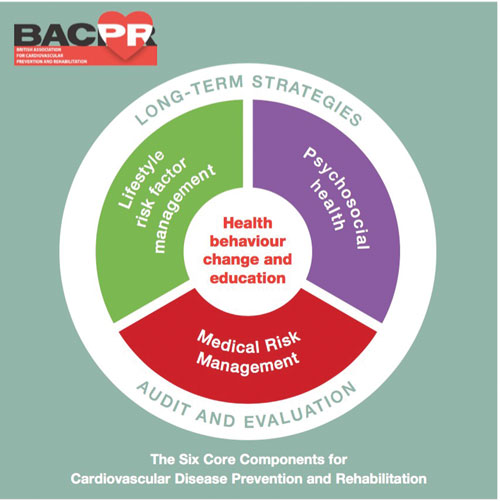
The benefits of CR are now well recognised. With an ever-expanding pool of eligible patients, referral numbers and patient complexity have increased significantly over the past decade and will continue to do so. CPRPs continue to develop and strive to deliver an intervention in accordance with the standards/core components described by the British Association for Cardiovascular Prevention and Rehabilitation (BACPR). The BACPR standards and core components (see figure 1) were updated in 2017 and reflect the current evidence base.10 As with any behavioural intervention, the mechanisms for successful delivery are complex and challenging, and are described in detail within the document, but the essential elements of the six principal standards include the following:
• Patients who are eligible for a CPRP include those with proven athero-thrombotic vascular disease (i.e. with diagnoses such as MI, PVD, or who have had procedures such as percutaneous coronary intervention or coronary artery bypass graft, and/or symptomatic heart failure). Once identified as eligible, referral to a local programme should be made within three days
• The six core components of the CPRP (see figure 1) should be delivered by a qualified and competent multidisciplinary team, led by a clinical coordinator. Ideally the MDT should include a dietitian; exercise specialist; nurse specialist; occupational therapist; pharmacist; physician with a special interest in prevention and rehabilitation; physiotherapist and a psychologist
• The CPRP should commence with an initial assessment within ten days of receipt of referral
• The CPRP should follow a defined pathway of care which meets the individual’s goals and is aligned with their preferences and choices
• Programme completion is determined by a final assessment of individual patient needs and demonstration of sustainable health outcomes
• Registration and submission of data to the National Audit of Cardiac Rehabilitation (NACR) and participation in the National Certification Programme is required for all CPRPs
For the majority of patients, their CPRP begins at the point of initial assessment (see figure 2). This includes a detailed review of clinical, lifestyle and behavioural factors and culminates in a personalised pathway of care geared towards patient-selected objectives. Patients should then access a minimum of 16 sessions (usually over an eight-week period) before undertaking a final assessment to ensure that goals have been achieved and longer-term strategies developed.
Most CPRP sessions occur either within hospital, or community-based facilities and are delivered within groups or individually depending on the nature of the intervention. Home-based sessions are becoming increasingly common (which may or may not be supported by the use of web-based/digital applications) although some form of contact/arms-length supervision from the CPRP remains essential.
Follow-up
Once the programme has been completed, patients must be offered strategies to maintain long-term healthy behaviours. These may include further semi-supervised and subsidised sessions at local leisure centres, activities organised by the voluntary sector and local authority funded services.
Finally, patients should be assessed 12 months after completion of their programme in order to identify any relapses in lifestyle or medical risk factors and to reaffirm the importance of healthy behaviours. Unfortunately, although such data would provide invaluable evidence of CPRP efficacy and stimulate the need for service improvement, very few programmes have the resources to deliver such an annual review.
In accordance with the BACPR standards and core components 2017,10 CPRPs are expected to register with the NACR and submit a full data set for all registered patients. The NACR is one of the most comprehensive national audits of CR in the world and is currently funded by the British Heart Foundation.
The NACR publishes its main report (Quality and Outcomes) on an annual basis and since 2018 has automatically assessed each programme against a predefined set of key performance indicators (KPIs). Only those CPRPs which successfully meet all seven KPIs can be approved as BACPR/NACR fully certified programmes – a system which is designed to ensure that the evidence base is properly implemented and that service quality is assured.11
On the basis of the most recent NACR report,12 of 229 CPRPs submitting data across England, Wales and Northern Ireland, only 46 programmes (20%) are fully certified while the vast majority (40%) meet between four and six of the KPIs. (Unfortunately, information from programmes based in Scotland has been unavailable for a number of years because of data transference restrictions.) The certification process was launched
in 2015 and has taken time to embed. Before assessment became automatic in 2018, programmes could voluntarily request the BACPR/NACR to assess their application.
Referral and uptake
Table 1, above, shows the trend in CR uptake among patients with ischaemic heart disease (IHD) over the five-year period 2014-18.12 In 2014, a total of 134,525 patients were eligible for a CPRP because of an IHD diagnosis/procedure and 60,140 patients started their programme (45% uptake). In 2018, the eligible IHD population was similar in number (134,191) with an uptake of 50%, a fall of 1% from a peak of 51% in 2017. Overall, of those patients who commenced a CPRP in 2018, 76% completed the programme, a statistic which is comparable with the retention of participants in well organised clinical trials.
However, the situation for patients with heart failure is far less encouraging. According to the National Institute for Cardiovascular Outcomes Research (NICOR) National Heart Failure Audit,13 in 2017/2018, the total number of patients admitted to hospital with a primary diagnosis of heart failure was just under 90,000 and although it is unclear how the numbers were derived, 26,517 should have been referred for CR.
Only 4,114 patients were actually referred and almost all of these took up the offer of a programme. This uptake rate of 16% is a significant overestimate since the actual number of eligible heart failure patients also includes non-hospitalised individuals with a new diagnosis of heart failure.
Despite the persuasive evidence base and the overwhelming cost-efficacy profile,14 only a minority of eligible IHD patients access and complete a CPRP (38%) and most patients with a heart failure diagnosis are not even referred.
The reasons for this dichotomy are complex and only partially understood, but include: perceived unimportance from the patient’s perspective; deficiencies in process (inefficient identification, referral and call/recall mechanisms); lack of flexibility (Monday-Friday 9-5 working, lack of community- or home-based schemes, non-personalised care pathways); social/cultural obstacles (language barriers, pressures of returning to work) and lack of advocacy among staff.15
The eligible patient population is also very different from that of 20 years ago with advanced age and multimorbidity being the norm and, therefore, offering a complex, behavioural intervention through a CPRP has become an even greater challenge.
Within the NACR Quality and Outcomes Report 2018,12 the Index of Multiple Deprivation is strongly correlated with both uptake and completion demonstrating that patients from lower socioeconomic backgrounds are far less likely to commence and complete their programmes. Women with heart disease are significantly under-represented within programmes and there is considerable regional variation with respect to levels of uptake among ethnic minority populations.
Improving uptake
All healthcare professionals involved in the management of patients with CVD need to communicate consistent and positive messages concerning the benefits of CPRPs and the essential part that they play in a patient’s treatment pathway. Access to supporting literature that explains exactly what these programmes actually do can be very helpful, particularly if it is specific to local services.
Benefits of completing a CPRP
• Patients’ risk of death or hospitalisation due to heart disease will be reduced
• Patients’ physical activity levels and quality of life will improve
• CPRPs can aid return to work
• Smokers will be more likely to quit and then remain non-smokers
• Risk factors for heart disease such as high blood pressure and cholesterol will be better controlled
• The psychological aspects of suffering from heart disease will be addressed
• Patients will be better educated about their condition and more equipped to self-manage
• Patients (and their families) can become part of a ‘prevention community,’ share experiences and learn from each other.
The GP’s role
GPs are ideally placed to explain the benefits of attending and completing a CPRP to their patients. They can play a key role as community-based champions for CR and provide the encouragement, referral details and re-referral opportunities for all eligible patients so that attendance at a CPRP can be viewed as integral to their patients’ treatment pathway.
GPs should always ask patients with a new diagnosis of either HF or IHD if they have attended, or been contacted by, a CPRP. It is important that GPs are familiar with the referral and eligibility criteria for their local CPRP and have direct access to the referral pathway.
Conclusion
The recently published NHS Long Term Plan suggests a significant shift in healthcare strategy towards a far more preventative approach.16 Bold aspirations are described concerning CVD risk factors such as tobacco smoking, obesity and type 2 diabetes along with some specific targets concerning CR. By scaling up CR services and with improved awareness, the ambition is to achieve the best rates of CR uptake in Europe by ensuring that up to 85% of eligible patients commence a CPRP by 2028.
Given that UK uptake rates have only increased by 5% in the past five years (and have stalled/fallen in the past two) and that countries such as Lithuania, Belgium and Denmark already enrol at least 70% of their eligible populations, the challenge is daunting. However, there are some simple strategies that could be implemented quickly and effectively.
First, the pathway to prevention should start from the moment an IHD patient enters the hospital, either as an emergency or for a planned procedure. All cardiology staff should be aware of the critical messages to convey when it comes to the key aspects of CVD prevention and should highlight the merits of CR at every opportunity.
The pathway to a CPRP should be as enshrined in hospital processes as admission clerking and prescription of take-home medication.
Second, approximately 90% of patients who are discharged from hospital following acute MI return for a follow-up clinic visit.17 These clinical assessments may not be as thorough as those that take place within a CPRP. Well organised programmes with the back-up of appropriate medical support (on-site or phone contact) could easily assume the role of the post-discharge routine review, providing a seamless entry point for these patients directly into CR.
REFERENCES
1 Dalal HM, Doherty P, Taylor RS. Cardiac rehabilitation. BMJ 2015;351:h5000
2 Sagar VA, Davies EJ, Briscoe S et al. Exercise-based rehabilitation for heart failure: systematic review and meta-analysis. Open Heart 2015;2(1):e000163. doi: 10.1136/openhrt-2014-000163
3 Iso Y, Suzuki H. Exercise therapy for intermittent claudication in peripheral artery disease. E-J Cardiol Practice 2015;13(34)
4 Piepoli MF, Hoes AW, Agewall S et al. 2016 European Guidelines on cardiovascular disease prevention in clinical practice: The Sixth Joint Task Force of the European Society of Cardiology and Other Societies on Cardiovascular Disease Prevention in Clinical Practice (constituted by representatives of 10 societies and by invited experts): Developed with the special contribution of the European Association for Cardiovascular Prevention & Rehabilitation (EACPR). Eur J Prev Cardiol 2016;23(11):NP1-NP96
5 Gimigliano F, Negrini S. The World Health Organization. Rehabilitation 2030: a call for action. Eur J Phys Rehabil Med 2017;53(2):155-68
6 National Institute for Health and Care Excellence. CG147. Peripheral arterial disease: diagnosis and management. NICE. London. 2012 (updated February 2018)
7 National Institute for Health and Care Excellence. CG172. Myocardial infarction: cardiac rehabilitation and prevention of further cardiovascular disease. NICE. London. 2013
8 National Institute for Health and Care Excellence. CG106. Chronic heart failure in adults: diagnosis and management. NICE. London. 2018
9 National Institute for Health and Care Excellence. QS9. Chronic heart failure in adults. NICE. London. 2011 (updated September 2018)
10 Cowie A, Buckley J, Doherty P et al. Standards and core components for cardiovascular disease prevention and rehabilitation. Heart 2019;105:510-15
11 Furze G, Doherty P, Grant-Pearce C. Development of a UK National Certification Programme for Cardiac Rehabilitation (NCP_CR). Br J Cardiol 2016;23:102-05
12 National Audit of Cardiac Rehabilitation. Annual reports 2014 to 2018. York: British Heart Foundation: University of York
13 National Heart Failure Audit (2018). NICOR (National Institute for Cardiovascular Outcomes Research). www.ucl.ac.uk/nicor/audits/heartfailure/additionalfiles
14 Shields GE, Wells A, Doherty P et al. Cost-effectiveness of cardiac rehabilitation: a systematic review. Heart 2018;104(17):1403-10. doi: 10.1136/heartjnl-2017-312809. Epub 2018 Apr 13
15 Karmali KN, Davies P, Taylor F et al. Promoting patient uptake and adherence in cardiac rehabilitation. Cochrane Database Syst Rev 2014 Jun 25(6):CD007131
16 The NHS Long Term Plan. NHS England (2019) www.longtermplan.nhs.uk
17 Liverpool Heart and Chest Hospital NHS Foundation Trust internal data
ARTICLE IN PDF
 Download this article in PDF format
PRESET SEARCHES
PubMed
NICE evidence search
EXTERNAL WEBLINKS
British Association for Cardiovascular Prevention and Rehabilitation
National Audit of Cardiac Rehabilitation
Contact details for local CPRPs