SEARCH

Aung MZ, Maxwell AP. GPs play an important role in identifying acute kidney injury. Practitioner Feb 2020;264(1834):11-14
GPs play an important role in identifying acute kidney injury
24 Feb 2020
AUTHORS
Dr Myint Zu Aung MB BS MRCP, International Training Fellow in Renal Medicine
Professor Alexander P. Maxwell MD PhD FRCP, Consultant Nephrologist
Regional Nephrology Unit, Belfast City Hospital, Belfast, UK
Competing interests: None
Article
Abstract
Acute kidney injury (AKI) is a common complication in hospitalised patients and is associated with an increased risk of chronic kidney disease (CKD) and higher mortality. Two thirds of AKI cases develop in the community prior to hospital admission. The relationship with CKD is bidirectional: patients with CKD are at much higher risk of AKI and AKI can contribute significantly to the progression of CKD. AKI can result from abnormal perfusion to a structurally normal kidney (pre-renal AKI), injury to the nephrons (renal AKI) or obstruction to urinary flow (post-renal AKI). Restoring fluid volume to optimal levels may reverse pre-renal AKI. However, prolonged pre-renal AKI can lead to kidney cell damage known as acute tubular necrosis which is not fluid volume responsive. Recovery may be slow and incomplete. AKI may be challenging to recognise because it is typically asymptomatic. It is usually detected incidentally in the setting of another illness when a rise in serum creatinine from baseline is identified. AKI may also be associated with a reduction in urine output but this is difficult to detect in community settings. Risk factors for AKI include age ≥ 65, diabetes, CKD, neurological or cognitive impairment, heart failure and the use of potentially nephrotoxic medications. Recognition of those at risk should prompt earlier and more frequent testing of U&E during any acute illness. If an unexpected rise in serum creatinine is observed, a careful assessment of the patient’s history, and a medication review, should be carried out to establish if any of the more common AKI risk factors are present.
Acute kidney injury (AKI) is a common complication in hospitalised patients and is associated with an increased risk of chronic kidney disease (CKD) and higher mortality.1,2
Approximately two thirds of AKI cases develop in the community, prior to hospital admission.3 AKI may be challenging to recognise because it is typically asymptomatic, hence the opportunities for prevention of AKI are often missed.4 AKI is a potentially reversible process so improvements in timely recognition and earlier interventions could have a substantial impact on patient outcomes.4 GPs play an important role in identifying AKI.5
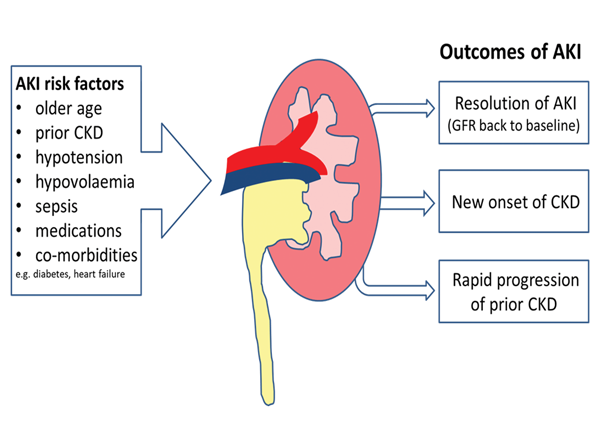
AKI is a major risk factor for the development of CKD.6 This relationship is bidirectional; patients with CKD are at substantially higher risk of AKI.7 As a result, AKI is frequently superimposed on CKD, and can contribute significantly to progression of CKD. With the increasing burden of CKD worldwide, effective management of AKI is crucial.7,8
Identification
In patients with AKI an acute reduction in kidney function typically occurs within hours to days with resulting impairment in toxin removal and associated disturbance of fluid, electrolyte and acid-base balance. As the glomerular filtration rate (GFR) is falling a single estimated GFR (eGFR) measurement is not a reliable indicator of the current level of kidney function.
AKI is usually detected incidentally in the setting of other illness when a urea & electrolytes (U&E) test has been ordered and a rise in serum creatinine from baseline is identified. Most laboratories now issue electronic AKI alerts, which flag changes in serum creatinine indicative of AKI, helping to identify patients at an earlier stage.9,10 AKI may also be associated with a reduction in urine output but this is difficult to detect in community settings.
Risk factors
There are multiple background risk factors that make some individuals more vulnerable to AKI particularly when they become acutely unwell.3,4 Recognising these risk factors may lead to earlier and more frequent testing of U&E in adults during any acute illness such as diarrhoea, vomiting, reduced fluid intake, and worsening of underlying conditions.
In adults with acute illness, the risk of AKI is high if any of the features listed in box 1, are present.
It is important to note that in patients with CKD and no clear precipitating illness, a rise in creatinine may still indicate AKI rather than progression of the underlying CKD.11
There could be potentially reversible factors contributing to an acute rise in serum creatinine e.g. nephrotoxicity from a newly introduced drug or urological symptoms (hesitancy, poor stream, frequency) that indicate superimposed bladder outlet obstruction. AKI may be present in individuals who develop a rash after drug exposure e.g. antibiotics (penicillin and its derivatives, cephalosporins) or proton pump inhibitors.12
Common causes
AKI can result from abnormal perfusion to a structurally normal kidney (pre-renal AKI), injury to the nephrons (renal AKI) or obstruction to urinary flow (post-renal AKI). Common causes of AKI are shown in box 2.
Restoring fluid volume to optimal levels may reverse pre-renal AKI. However, prolonged pre-renal AKI can lead to kidney cell damage known as acute tubular necrosis (ATN) which is not fluid volume responsive. Recovery may be slow and the patient’s renal function may not recover to its previous baseline.
AKI due to acute glomerular disease is far less common than pre-renal AKI in the community.
If the patient has a fever, rash, joint pains or pulmonary infiltrates on chest X-ray a less common aetiology for AKI should be considered. Proteinuria and/or haematuria on urine dipstick may indicate an underlying glomerular disease.
Diagnosis
If an unexpected rise in serum creatinine is observed, a careful assessment of the patient’s history should be carried out to establish if any of the more common AKI risk factors are present (see box 1, below). This should be accompanied by a thorough clinical examination, a review of prescribed medication and baseline renal function (where known).
AKI might be suspected where there is reduced fluid intake and/or increased fluid losses, worsening urinary tract symptoms and recent drug ingestion.
The presence of other clinical features such as fever, rash, joint pains, haemoptysis and non-specific malaise may indicate AKI secondary to a systemic disease.
Clinical examination includes assessment of fluid volume status, which is guided by clinical signs including heart rate, blood pressure, jugular venous pressure, peripheral perfusion (capillary refill time), skin turgor and mucous membranes. It is important to remember that postural changes in pulse and blood pressure are more sensitive indicators of hypovolaemia than supine observations.
Patients with heart or liver failure are at particular risk of AKI especially when the underlying disease becomes decompensated. Of note, the presence of fluid overload (peripheral oedema or ascites) does not prevent AKI developing.
A urine dipstick test for blood, protein, leucocytes, nitrites and glucose is helpful if AKI is suspected or detected. Proteinuria and haematuria (2+ to 4+) on urinalysis raises the possibility that an acute glomerulonephritis is causing AKI and this indicates the need for more urgent referral to hospital.11
A high specific gravity (> 1.020) suggests fluid volume depletion and increased oral fluid intake may be needed.
If the cause of AKI is readily apparent then an ultrasound of the urinary tract is not necessary.11 If an infected and obstructed kidney is suspected then an immediate ultrasound of the urinary tract is needed to help plan management including drainage and antibiotics.11 When individuals have no obvious cause for AKI or may be at risk of urinary tract obstruction urgent ultrasound of the urinary tract is recommended (within 24 hours of assessment).11
Basic laboratory investigations for AKI include: U&E (results should be compared with baseline values whenever possible); full blood count; CRP; liver function tests; glucose and a bone profile.
Immunological tests for rarer causes of AKI may be required such as: antineutrophil cytoplasmic antibodies (for vasculitis); anti-glomerular basement membrane (GBM) antibody (for anti-GBM disease); autoantibody screen including anti-dsDNA titres and complement levels (for SLE and lupus nephritis); serum free light chains, serum immunoglobulins, plasma protein electrophoresis (for myeloma).
Management
The focus of AKI management is the identification of modifiable risk factors and management of the conditions contributing to renal dysfunction.
The fluid volume status of patients with AKI must be accurately assessed by taking a careful history and examination. If the patient is hypovolaemic or dehydrated increased oral intake of fluids should be encouraged. However,
it is important to avoid inadvertent fluid overload. Monitoring their weight may help patients assess their fluid volume status.
Individuals with suspected sepsis should be referred to hospital for blood cultures, antibiotics and fluid resuscitation. Early treatment of infections that may be contributing to hypotension is advised.
Drugs that may induce, exacerbate or complicate AKI should be stopped, at least temporarily. Diuretics, angiotensin receptor blockers (ARBs), ACE inhibitors, and NSAIDs will exacerbate hypoperfusion of the kidneys and should be withheld until the patient has recovered and AKI has resolved. Drugs that can complicate the management of AKI are shown in box 3.
Medications are often co-factors in the development of AKI. Furthermore, because of a sudden decrease in renal function associated with AKI, many drugs will need their dosage reduced to avoid serious side effects. It is important to review all the patient’s regular medications (see box 3).
If medications which might aggravate hyperkalaemia are being commenced in patients with advanced CKD, who are already at risk, careful monitoring of potassium is paramount.
Urgent referral to a urologist for relief of urinary tract or bladder outlet obstruction is crucial.
Referral
Not all patients with AKI need to be referred to hospital. If there is a clear cause for the AKI and it is responding to management in the community referral is not necessary.
Direct same day contact with a nephrology team is advised for those patients who may require urgent dialysis for AKI complications such as hyperkalaemia, metabolic acidosis, and/or pulmonary oedema.11 NICE also recommends urgent referral to hospital for those patients suspected to have urinary tract obstruction; AKI and sepsis; hypovolaemia with the need for IV fluids and individuals with no identifiable cause for AKI.11
Management of AKI should be discussed with a nephrologist if the patient has one or more of the following:
• A renal transplant
• A possible diagnosis requiring specialist investigation and treatment e.g. glomerulonephritis, vasculitis, myeloma
• AKI without an obvious cause
• AKI occurring in a patient with advanced CKD (where the baseline eGFR is < 30 ml/min/1.73m2)
If a patient seems to have recovered from their AKI but still has an eGFR < 30 ml/min/1.73m2 or significant proteinuria (urinary albumin:creatinine ratio > 50 mg/mmol) referral to nephrology should be considered.11
Prevention
Providing information and support to high-risk patients and carers can help to prevent AKI. Some nephrologists advocate discussing the risk of AKI in the setting of acute illness and the use of sick day rules i.e. temporary cessation of certain drugs (diuretics, ACE inhibitors, ARBs, metformin, NSAIDs) in adults with diarrhoea, vomiting or sepsis until their condition has improved and stabilised, see box 4. Although such sick day rules advice for AKI has been widely adopted there is still limited evidence for its effectiveness.13,14,15
Conclusion
AKI can result in prolonged hospitalisation and is associated with an increased risk of CKD and higher mortality. It is a common but potentially reversible condition. Identifying those at risk of AKI, and educating them about the condition, in particular the potential harm from prescribed drugs, may limit the frequency and severity of AKI.
GPs play a key role in the early identification and management of patients with AKI in the community. Good communication between primary and secondary care teams and timely access to appropriate investigations and treatment are critical to reducing the impact of AKI.
REFERENCES
1 Fortrie G, de Geus HRH, Betjes MGH. The aftermath of acute kidney injury: a narrative review of long-term mortality and renal function. Crit Care 2019;23(1):24
2 Chertow GM, Burdick E, Honour M et al. Acute kidney injury, mortality, length of stay, and costs in hospitalized patients. J Am Soc Nephrol 2005;16(11):3365-70
3 Wonnacott A, Meran S, Amphlett B et al. Epidemiology and outcomes in community-acquired versus hospital-acquired AKI. Clin J Am Soc Nephrol 2014;9(6):1007-14
4 Stewart J, Findlay G, Smith N et al. Adding insult to injury. A review of the care of patients who died in hospital with a primary diagnosis of acute kidney injury. National Confidential Enquiry into Patient Outcome and Death. NCEPOD. London. 2009
5 Blakeman T, Harding S, O’Donoghue D. Acute kidney injury in the community: why primary care has an important role. Br J Gen Pract 2013;63(609):173-74
6 He L, Wei Q, Liu J et al. AKI on CKD: heightened injury, suppressed repair, and the underlying mechanisms. Kidney Int 2017;92(5):1071-83
7 Pannu N. Bidirectional relationships between acute kidney injury and chronic kidney disease. Current Opin Nephrol Hypertens 2013;22(3):351-56
8 Susantitaphong P, Cruz DN, Cerda J et al. Acute Kidney Injury Advisory Group of the American Society of Nephrology. World incidence of AKI: a meta-analysis. Clin J Am Soc Nephrol 2013;8(9):1482-93
9 Selby NM, Crowley L, Fluck RJ et al. Use of electronic results reporting to diagnose and monitor AKI in hospitalized patients. Clin J Am Soc Nephrol 2012;7(4):533-40
10 Aiyegbusi O, Witham MD, Lim M, et al. Impact of introducing electronic acute kidney injury alerts in primary care. Clin Kidney J 2018;12(2):253-57
11 National Institute for Health and Care Excellence. NG148. Acute kidney injury: prevention, detection and management. NICE. London.2019
12 Al-Aly Z, Maddukuri G, Xie Y. Proton pump inhibitors and the kidney: Implications of current evidence for clinical practice and when and how to deprescribe. Am J Kidney Dis 2019 Oct 10. pii: S0272-6386(19)30939-4. doi: 10.1053/j.ajkd.2019.07.012. [Epub ahead of print]
13 Morrison C, Wilson M. Medicine sick day rules cards – interim evaluation. NHS Highland
14 Whiting P, Morden A, Tomlinson LA et al. What are the risks and benefits of temporarily discontinuing medications to prevent acute kidney injury? A systematic review and meta-analysis. BMJ Open 2017;7(4):e012674. doi: 10.1136/bmjopen-2016-012674
15 Sykes L, Nipah R, Kalra P, Green D. A narrative review of the impact of interventions in acute kidney injury. J Nephrol 2018;31(4):523-35
ARTICLE IN PDF
 Download this article in PDF format