SEARCH

The Practitioner 2009 – 253 (1724): 15-18
Improving recognition of psoriatic arthritis
17 Dec 2009
AUTHORS
Professor Philip G Conaghan MBBS PhD FRACP FRCP, Professor of Musculoskeletal Medicine
Dr Laura C CoatesMBChB MRCP, ARC Clinical Research Fellow
Section of Musculoskeletal Disease, Leeds Institute of Molecular Medicine, University of Leeds & NIHR Leeds Musculoskeletal Biomedical Research Unit
Article
Psoriatic arthritis (PsA) is a common form of inflammatory arthritis but is underdiagnosed. Psoriasis affects more than 1.5% of the UK population so a GP with an average list size is likely to care for around 40 patients with psoriasis. Around 15% of these patients will be diagnosed with PsA, but up to 40% of them may have evidence of arthritis if reviewed thoroughly.
PsA is a member of the family of spondyloarthritides which also includes ankylosing spondylitis (AS), reactive arthritis and enteropathic arthritis (related to inflammatory bowel disease). There are shared genetic links in these disorders, in particular the HLA-B27 gene. The trigger for the onset of disease is also poorly understood although many patients report that their disease seemed to be triggered by physical or psychological stress. PsA has a similar impact on quality of life and function as rheumatoid arthritis.
Diagnosis
PsA can be difficult to diagnose as patients present with a variety of different patterns of arthritis, but a high level of suspicion can help to identify joint problems. Patients with PsA most commonly experience onset of skin psoriasis before they present with arthritis. Most patients with PsA have relatively mild skin psoriasis, but some have more significant disease. Only around 10-20% develop arthritis before their skin disease, and these cases may be labelled as undifferentiated arthritis until their skin disease becomes obvious.
In some patients it is possible to make a diagnosis of PsA because they have typical patterns of arthritis and a family history of psoriasis. Many patients have mild skin psoriasis that they may be unaware of, or have never had diagnosed.
Five domains have been identified in PsA (see box 1, above).
Joint involvement is far more variable in PsA, compared with rheumatoid arthritis, and patients may present with:
- a monoarthritis (just one inflamed joint) or an oligoarthritis (four or fewer swollen joints) typically involving large joints of the lower limbs (knee and ankle)
- involvement of the distal interphalangeal (DIP) joints which can cause some confusion with Heberden's nodes seen in osteoarthritis
- a rheumatoid arthritis-like picture with multiple joints involved including the small joints in the hands. These
so-called grey cases present the most difficulty in diagnosis. Blood tests may help in the differential diagnosis. Features such as dactylitis (uniform 'sausage-like' swelling of the whole digit, either finger or toe) and enthesitis (inflammation at the sites of muscle or tendon attachment to bone) may also help to make a diagnosis of PsA
- axial disease producing symptoms similar to AS; with or without peripheral joint disease
There are now classification criteria for PsA called the CASPAR criteria (see box 2, below).1 Although these were not designed for use as a diagnostic tool, they do provide some guidance. However, it is important to bear in mind that some patients may have PsA without fulfilling all of these criteria.
History
Joints
Joint disease in PsA causes pain and swelling of the peripheral joints. Patients often complain of stiffness and pain with symptoms worst first thing in the morning. Early morning stiffness that takes more than 30 minutes to ease is suggestive of inflammation.
Dactylitis
Swelling of the whole finger or toe also causes pain and stiffness. Movement may be significantly reduced if an entire finger is swollen and the patient may not be able to grip.
Enthesitis
Enthesitis typically causes pain and occasional swelling over tendon/muscle attachments. Common sites include the Achilles tendon and plantar fascia. Patients can also present with lateral or medial epicondylitis and may complain of costochondritis causing distressing chest pain.
Axial disease
Symptoms of axial or spinal PsA are similar to those of AS. Patients complain of chronic, low back pain which is worse in the morning with early morning stiffness lasting more than 30 minutes. Some patients have such severe pain at rest that it wakes them in the early hours of the morning and can only be eased by stretching or moving around. Other typical features include alternating buttock pain and pain radiating down the legs.
Examination
Skin
Skin disease is present in the majority of patients although not all. Hidden areas for psoriasis include:
- behind the ears
- at the top of the natal cleft
- around the umbilicus
It is also important to look closely at the nails as some patients may just have nail disease causing pitting or onycholysis without obvious skin psoriasis.
Joints and digits
Look at the joints and palpate around the joint line to feel for swelling. Larger joints, particularly the knees, can develop very big effusions causing obvious swelling. If a digit has fusiform swelling then this is termed dactylitis.
Enthesitis
Common areas to test for enthesitis should include the Achilles tendon, plantar fascia, costochondral joints and the elbow (lateral and medial epicondylitis).
Axial disease
Often patients will have a reasonable range of movement in the spine although they may be limited by pain and stiffness. Even if examination is normal, patients with typical features of inflammatory back pain should be investigated further.
Referral
Patients with suspected PsA should be referred promptly to a rheumatologist for further assessment and treatment. Even patients with milder or more atypical disease may also benefit from referral. Chronic enthesitis in the setting of psoriasis can also indicate PsA and may require further treatment.
If there is a suspicion of chronic inflammatory back pain, these patients should also be referred as possible axial PsA or AS.
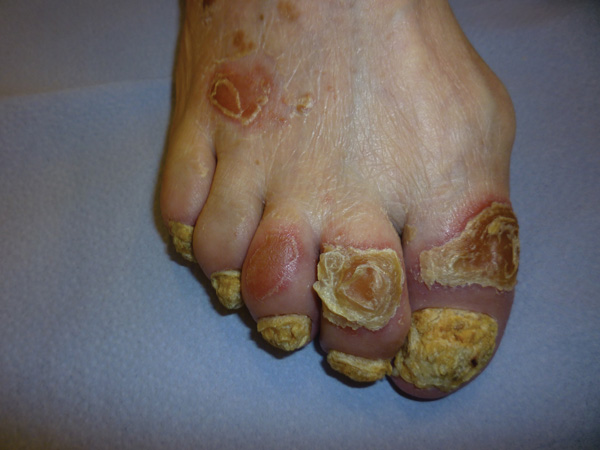
If there is significant skin or nail disease (see figure 1, p15), a referral to dermatology is also recommended.
Investigations
Diagnosis of PsA can be made on clinical grounds but blood tests and radiographs are performed routinely to aid diagnosis.
Checking inflammatory markers (CRP, ESR) can be helpful although these are only raised in approximately half of PsA patients so a normal result does not exclude the disease. Rheumatoid factor and anti-CCP antibodies should be checked to exclude rheumatoid arthritis. These can be particularly helpful where there is uncertainty about whether the diagnosis is rheumatoid arthritis or PsA.
X-rays of the hands and feet (even if the feet are asymptomatic) are helpful to look for any early signs of bony damage. Radiologists can often identify typical features on x-rays to support a diagnosis of PsA such as erosions, pencil-in-cup deformities and juxta-articular new bone formation.
Rheumatologists are now increasingly using other imaging techniques to look for joint, spine or entheseal inflammation including ultrasound and MRI. In the case of suspected spinal involvement, imaging is required to make a diagnosis. Initially an x-ray of the sacro-iliac joints (SIJs) should be performed to look for sclerosis, erosions or fusion of the joints. If this is normal but there is a high clinical suspicion, then an MRI of the SIJs and spine should be performed.
Treatment
Input from the multidisciplinary healthcare team is key to provide education and advice regarding the diagnosis. This should include support from specialist rheumatology nurses, physiotherapy and occupational therapy to provide specific support and education to patients. In axial disease in particular, physiotherapy plays a key role in maintaining spinal mobility and function. A recent systematic review of treatments for psoriatic disease has been performed by an international research group2 who have now published treatment guidelines based on their findings (see box 3).
NSAIDs
Initial therapy for PsA should include NSAIDs to ease pain and stiffness. There are a few reports of psoriasis flare with NSAIDs but the majority of patients tolerate them well. Local injections of corticosteroids are recommended for peripheral arthritis (given intra-articularly) and dactylitis (usually by injection into the flexor tendon or adjacent joints).
DMARDs
Disease-modifying anti-rheumatic drugs (DMARDs) are routinely used to treat all aspects of psoriatic disease, except spinal disease where they have no efficacy. In peripheral arthritis, DMARDs have some moderate evidence of efficacy and methotrexate, sulfasalazine, leflunomide and ciclosporin are routinely used. They are also sometimes used for the treatment of enthesitis and dactylitis although there is no data to support this. Methotrexate has additional advantages as it has also been proven to be efficacious in the treatment of skin psoriasis.
Prescribing of DMARDs and biologics should be initiated by a specialist.
Biologics
Tumour necrosis factor (TNF) α blockers have been shown to be effective in patients resistant to standard DMARDs and to have large effect sizes. They have also shown clear evidence of reduction of structural damage progression in peripheral joint disease that has not been clearly demonstrated with traditional DMARDs.
In the UK, TNFα blockers are used for peripheral arthritis following guidance from NICE which recommends these drugs for patients who have failed to respond to at least two standard DMARDs (through intolerance or inefficacy) and who have active disease with at least three tender and three swollen joints.3,4 Evidence from large randomised controlled trials (RCTs) for all of these drugs has shown equivalent efficacy in peripheral arthritis and therefore all three TNFα blockers (infliximab, etanercept and adalimumab) are recommended for use.
TNFα blockers also have evidence of efficacy in other aspects of psoriatic disease. They are recommended for use by NICE for resistant skin psoriasis based on the results of large RCTs. Although they have not been specifically evaluated in axial PsA, all three of the TNFα blockers have demonstrated significant efficacy in AS. The consensus of the GRAPPA group is that similar treatment responses are evident in axial PsA. In addition to these indications, there is evidence from the large RCTs undertaken in peripheral arthritis and from subsequent studies that the TNFα blockers are also effective at treating nail psoriasis, enthesitis and dactylitis.
Conclusion
PsA is an underrecognised form of inflammatory arthritis with considerable potential for joint damage, impaired function and reduced quality of life. The key to recognition is a high index of suspicion in patients with known psoriasis and thorough clinical assessment for psoriasis in those with arthralgia. The availability of traditional treatments and newer therapies in PsA should ensure a positive and improved outcome for patients with this disease.
REFERENCES
1 Taylor W, Gladman D, Helliwell P et al. Classification criteria for psoriatic arthritis: development of new criteria from a large international study. Arthritis Rheum 2006; 54(8): 2665-73
2 Kavanaugh AF, Ritchlin CT, Committee GTG. Systematic review of treatments for psoriatic arthritis: an evidence based approach and basis for treatment guidelines. J Rheumatol 2006; 33(7): 1417-21
3 National Institute for Clinical Excellence. TA104. Etanercept and infliximab for the treatment of psoriatic arthritis NICE. London. 2006
4 National Institute for Clinical Excellence. TA125. Psoriatic arthritis (moderate to severe) - adalimumab. NICE. London. 2007
USEFUL INFORMATION
The Arthritis Research Campaign provides publications and support for patients and medical practitioners, available from the website or by post.
Arthritis Research Campaign
Copeman House
St Mary's Court
St Mary's Gate
Chesterfield
Derbyshire
S41 7TD
Tel: 0870 850 5000 (UK only)
or +44 (0)1246 558033
Fax: +44 (0)1246 558007
The Psoriasis and Psoriatic Arthritis Alliance (PAPAA) is a patient support group providing online information and a regular magazine for members.
PAPAA
PO Box 111
St Albans
Herts
AL2 3JQ
Tel: 01923 672837
Fax: 01923 682606
ARTICLE IN PDF
 Download this article in PDF format
EXTERNAL WEBLINKS
NICE Evidence
PubMed
Osteoarthritis general practice