SEARCH

Mitchell K, Nix K, Passmore P, Kane JPM. Optimising the recognition of Lewy body dementia. Practitioner May 2022;266(1858):11-15
Optimising the recognition of Lewy body dementia
25 May 2022
AUTHORS
Dr Kathryn Mitchell MB BCh BAO DipMenH MRCPsych, Psychiatry Registrar ST5, Northern Ireland Medical and Dental Training Agency, Belfast, UK
Dr Kevina Nix MA (Cantab) MB BChir MRCPsych, Old Age Psychiatry Consultant, Belfast Health and Social Care Trust, Belfast, UK
Professor Peter Passmore BSc MB BCh MD FRCP(Lond, Glasg) FRCPI, Professor of Ageing and Geriatric Medicine, Centre for Public Health, Queen’s University Belfast, Belfast, UK
Dr Joseph PM Kane MB BCh BAO PhD MRCPsych, Clinical Lecturer, Centre for Public Health, Queen’s University Belfast, Belfast, UK
Acknowledgment
The authors would like to thank Dr Ben Dilworth MRCGP, GP, Belfast Health and Social Care Trust, for his helpful advice in writing this article.
Competing interests: None
Article
Lewy body dementia (LBD) is a heterogeneous condition that is often difficult to treat. It comprises Parkinson’s disease dementia, in which the cognitive and functional symptoms of dementia arise in the context of established Parkinson’s disease, and dementia with Lewy bodies where parkinsonism may develop concurrently with, or within a year of, dementia diagnosis. Both conditions are characterised by the same neuropathological mechanism; the cerebral aggregation of misfolded alpha-synuclein protein. LBD represents around 5% of dementia cases seen in clinical services; however, a large proportion of additional cases probably go undetected or are misdiagnosed. It is associated with higher rates of neuropsychiatric symptoms, inpatient admission and carer stress, as well as shorter survival, than other dementia subtypes. Accurate recognition can help guide clinicians towards specific treatment strategies and help avoid neuroleptic sensitivity. A definite diagnosis can only be determined at post mortem, but the presence of two or more core clinical features confers a probable diagnosis in patients with a dementia syndrome, with excellent sensitivity and good specificity. Core clinical features are: fluctuating cognition with pronounced variations in attention and alertness; recurrent visual hallucinations; REM sleep behaviour disorder; one or more features of spontaneous parkinsonism. Recurrent visual hallucinations occur in up to 80% of patients. A clinical history, including collateral history, is critical in the diagnosis. Assessment should include questions aimed at detecting each core symptom.
Lewy body dementia (LBD) is a heterogeneous condition that is often difficult to treat. It comprises Parkinson’s disease dementia (PDD), in which the cognitive and functional symptoms of dementia arise in the context of established Parkinson’s disease, and dementia with Lewy bodies (DLB) where parkinsonism may develop concurrently, or within a year of, dementia diagnosis.1
Both conditions are characterised by the same neuropathological mechanism; the cerebral aggregation of misfolded alpha-synuclein protein.2 Although the distinction between PDD and DLB is arbitrary, it is useful in understanding how patients experience their illness, and in determining the services in which they are likely to be treated.
Presentation
LBD represents approximately 5% of dementia cases seen in clinical services,3 but it is likely that a large proportion of additional cases go undetected or are misdiagnosed.4
It is important to make an accurate diagnosis. DLB is associated with higher rates of neuropsychiatric symptoms, inpatient admission5 and carer stress,6 as well as shorter survival, than seen in other dementia subtypes. Accurate recognition can help guide clinicians towards specific treatment strategies and help avoid the neuroleptic sensitivity that can occur in LBD.
As patients with PDD are often already under the care of specialist services at the point of diagnosis, this article will focus on the diagnostic features of DLB.
Before diagnosis with DLB (or any dementia subtype), the patient must first meet criteria for a dementia syndrome, a progressive cognitive decline of sufficient magnitude to interfere with normal social or occupational functions, or with usual daily activities.7
The cognitive domains affected can help point towards subtype. Patients with Alzheimer’s disease (AD) present classically with impairment in short-term memory and verbal fluency, while those with DLB are more likely to describe deficits in attention e.g. losing their train of thought, visuospatial ability e.g. misjudging distances and executive functioning (judgement, abstract thought and sequencing) e.g. mixing up the steps when making a cup of tea. Difficulty driving can be an indicator of impairment in all three domains.2
Although the Mini Mental State Examination (MMSE) measures attentional ability with the ‘serial sevens’ task (Folstein), only one point corresponds to visuospatial ability (the intersecting pentagons task), and none relate to executive functioning. As such, the MMSE may not detect the cognitive deficits in DLB with sufficient sensitivity. Similarly, tools such as the GPCOG and 6CIT may fail to identify cognitive impairment associated with LBD.
If clinical history is suggestive of a non-amnestic cognitive profile, an alternative cognitive screening tool, such as the Montreal Cognitive Assessment (MoCA) should be considered.
A definite diagnosis of DLB can only be determined by post mortem examination, but the presence of two or more core clinical features of DLB confers a probable DLB diagnosis in patients with a dementia syndrome8 (see box 1) with excellent sensitivity and good specificity.9
Core clinical features
• Fluctuating cognition with pronounced variations in attention and alertness
• Recurrent visual hallucinations
• Rapid eye movement (REM) sleep behaviour disorder (RBD)
• One or more features of spontaneous parkinsonism
A diagnosis of probable DLB can also be made in the presence of one clinical feature and a positive biomarker. A possible DLB diagnosis can be made when a single core clinical feature has been detected. Assessment of each core symptom is therefore critical to detection. These symptoms may also dictate the service to which patients are referred; those with visual hallucinations may be referred to psychiatry while patients with parkinsonism are directed towards neurology or geriatric medicine services. As a result, patients with DLB represent a heterogeneous population that can present accessing a range of services, potentially contributing to delays in diagnosis.3
Neuropsychiatric symptoms
Recurrent visual hallucinations occur in up to 80% of patients with DLB. Although classically described as detailed hallucinations, taking the form of children or animals, in clinical practice they can take any form at all. Hallucinations experienced in DLB are more consistent and persistent than those seen in delirium.2,7
It is important to ascertain that the spontaneous features of parkinsonism are not secondary to the prescription of antidopaminergic medications (such as metoclopramide) or stroke. Only one of Parkinson’s disease’s cardinal features (bradykinesia, rest tremor or rigidity) is required as a core clinical feature.7
Fluctuations in attention and arousal are difficult to distinguish from those that occur in delirium and interrater reliability among clinicians is poor. Episodes may last from minutes to days and range from mild variations in cognition and functioning to complete marked deterioration in arousal.
Unlike the sundowning effect seen in AD and other dementia subtypes, no diurnal pattern in fluctuation of episode occurrence is observed in DLB. Unlike seizures, caregivers can often interrupt these episodes of fluctuating cognition, for instance by calling the patient by his/her name to elicit a verbal response. Frustratingly for some caregivers, periods of lucidity can occur in high salience activities such as visiting the GP surgery or engaging with cognitive testing.10
RBD has only recently been included as the fourth core clinical feature in DLB diagnostic criteria.8 It constitutes recurrent dream enactment and chasing or attacking themes are especially common.7 RBD symptoms can precede DLB diagnosis by around ten years; 80% of individuals with RBD in the absence of dementia will develop a neurodegenerative disease within ten years.11
Screening tools for RBD are accurate and easily administered by a bed partner, see table 1. As patients will not remember the dreams which they are enacting, a collateral history from a bed partner, who may complain about being struck during the episode, is crucial in recognition.
Supportive clinical features
In addition to these core clinical features, there are also several supportive clinical features that are common in DLB and contribute to assessment, but because of their limited specificity cannot contribute directly to diagnosis.7
They are nonetheless important to recognise as many are treatable.
These include orthostatic hypotension and autonomic dysfunction, falls, constipation, urinary incontinence, hyposmia, micrography, restless legs, apathy, agitation, psychosis, and depression.
Assessment and investigation
Clinical assessment for any dementia subtype should follow the framework recommended by NICE, including the use of screening blood tests and assessment for reversible causes.12
NICE also recommends the use of CT and MRI, which although helpful in identifying vascular pathology and other processes, do not provide signs contributing to diagnosis.12
As discussed above, consideration should be given to screening tools other than the MMSE, such as the MoCA.
A thorough clinical history, including collateral history, is critical in the diagnosis of DLB. Assessment should include questions aimed at detecting each core symptom.
Diagnostic toolkit
Use of the diagnostic toolkit developed as part of the NIHR Improving the Diagnosis And Management Of Neurodegenerative Dementia of Lewy body type (DIAMOND Lewy) study operationalises diagnostic criteria through a series of questions.8
Introduction of the toolkit into secondary care services was associated with a significant increase in DLB diagnosis.13 The toolkit integrates validated questionnaires for some symptoms, such as the Mayo Sleep Inventory for RBD.14 An abbreviated assessment of parkinsonism, using the 5-point UPDRS8 is also embedded within the toolkit.
A shorter alternative to the DIAMOND Lewy toolkit is the Lewy Body Composite Risk Score, which can be provided by the patient or a caregiver and brought to the assessment. If three or more positive responses to the questions within the scale have been reported this distinguishes DLB from AD with 94% accuracy.15
Biomarkers
DLB diagnostic criteria also include three indicative biomarkers that can directly contribute to diagnosis.7
Of these, only FP-CIT single photon emission computed tomography (SPECT) scan (DaTSCAN) is routinely available in NHS practice.
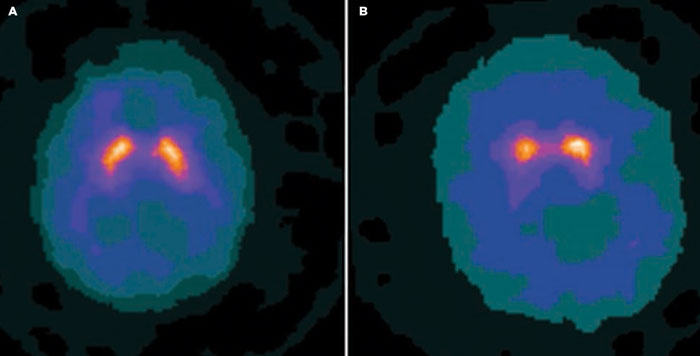
FP-CIT measures the integrity of presynaptic dopamine terminals, which undergo degeneration in PD and DLB. The resulting loss of activity in the basal ganglia in DLB leads to loss of the comma sign observed in healthy individuals (see figure 1). FP-CIT can distinguish DLB from AD with a sensitivity of 78% and specificity of 90%.16
Around one quarter of patients with DLB will never develop sufficient striatal degeneration to produce an abnormal FP-CIT; and vascular Parkinson’s disease, Parkinson’s plus syndromes and frontotemporal dementia can all produce false-positive FP-CIT findings.
The use of the other indicative biomarkers, cardiac scintigraphy, and polysomnography (PSG) are restricted to a handful of centres in the NHS but are widely used in other countries. Cardiac scintigraphy detects noradrenergic cardiac activity, thought to be compromised in DLB by the presence of myocardial Lewy body pathology.17 PSG measures muscle tone and EEG electroencephalic activity in RBD. Both have practical advantages over FP-CIT but are not supported by the same level of neuropathological validation.
Comprehensive assessment should not only inform diagnosis and investigation, but also the risk profile and its management. In particular, the attentional and visuospatial difficulties associated with LBD should encourage exploration of the patient’s driving status. The Royal College of Psychiatrists has produced a report and flowchart providing advice on how to manage driving in the context of dementia.18
Management
The common neuropathological mechanisms shared by PDD and DLB support similar approaches to their management. Although no disease modifying therapies are yet available in the treatment of LBD, pharmacological and non-pharmacological approaches to individual symptoms have been established by a consensus of experts as part of the DIAMOND Lewy programme.1
Clinical introduction of the resulting management toolkit was associated with improvements in global outcomes and carer stress when investigated as part of a cluster randomised trial.19
The full toolkit is available at https://research.ncl.ac.uk/diamondlewy/ Selected symptom groups are discussed below.
Pharmacological treatment
Acetylcholinesterase inhibitors rivastigmine and donepezil are the agents most frequently prescribed to patients with DLB and are recommended by NICE.1,13 Neither are licensed yet for DLB however, both drugs are associated with a modest reduction in carer burden and improvement in functioning,1 with greater effect sizes seen in DLB than AD, owing to the cholinergic insufficiency associated with the former.
They are generally well tolerated but nausea, vomiting, and anorexia are the most common side effects. They are contraindicated in patients with persistent bradycardia, heart block or unexplained syncope.
Oral rivastigmine produces side effects more commonly than donepezil, but its prescription as a patch is associated with fewer gastrointestinal side effects and improved concordance.1
Memantine, an NMDA antagonist, is recommended as a second-line treatment if cholinesterase inhibitors are contraindicated or not tolerated,12 and is associated with global improvements in neuropsychiatric symptoms in DLB. Dosing should be adjusted if there is renal impairment, and its use is cautioned in epilepsy.
Neuropsychiatric symptoms (hallucinations, systematised delusions, apathy and depression) are among the most challenging to manage in LBD and although not necessarily requiring treatment, often require referral to psychiatry of old age services.
If pharmacological intervention is required because of distress or increasing risk, rivastigmine can diminish visual hallucinations and should be trialled before antipsychotic therapy.
If dopaminergic medications are prescribed, reduction in dose of these medications should be explored.
LBD is associated with a risk of severe neuroleptic sensitivity, which occurs in approximately a third of patients.20 This can manifest in symptoms ranging from an increase in parkinsonism to severe global impairment and neuroleptic malignant syndrome.12
Antipsychotics should therefore be prescribed as a last resort in LBD, and prescription should be initiated by specialist secondary care services.12 Risperidone is licenced for non-cognitive symptoms of dementia but in clinical practice low doses of quetiapine and clozapine are increasingly preferred as they have a lower extrapyramidal side effect profile.
Non-pharmacological strategies
Non-pharmacological approaches to these symptoms should be explored wherever possible. These include alterations in the immediate environment e.g. reducing visual stimuli such as hanging coats or clutter to reduce the chance of misinterpretations, removing netted curtains, and ensuring uniform lighting in the room to reduce shadows. Although no specific non-pharmacological treatments for apathy or depression in LBD are recommended,1 general strategies for the treatment of these symptoms in dementia such as cognitive reminiscence therapy, music therapy and art therapy may be helpful.12
Sleep hygiene should be encouraged in RBD, and measures such as placing the bed on the floor, removing objects nearby and putting padding around firm objects should be explored. Partners may have to sleep separately. Melatonin is recommended and well tolerated,1,19 but like its alternative clonazepam, requires more research into its efficacy.
GPs should be vigilant for sleep apnoea in LBD and consider referral to the appropriate secondary care service if suspected.
Managing supportive clinical features
Supportive clinical features will often present in primary care requiring treatment. Anaemia (particularly low ferritin < 50 µg/ml), diabetes and renal dysfunction should be excluded in patients with LBD who present with restless legs syndrome. Dopamine replacement therapy and gabapentin should be trialled with caution given their side effect profiles.19
Non-pharmacological approaches to autonomic dysfunction (such as the use of compression hosiery, increased fluid intake and raising the head of the bed in orthostatic hypotension) should be explored prior to any pharmacological treatments, and the possibility of iatrogenic aetiology should always be explored. Gastrointestinal dysfunction can respond to adoption of small frequent low-fat meals, as well as post prandial walking.
Regular, prompted voiding can be helpful in urinary incontinence but mirabegron and intravesical botulinum toxin should be favoured over anticholinergic agents such as oxybutynin and tolterodine when medication is required.
Similarly anticholinergic medications should be avoided in sialorrhoea; instead, clonidine and glycopyrrolate should be considered.
Laxatives such as senna, bisacodyl, sodium docusate or macrogol are recommended in constipation.
DLB support groups and local dementia navigators are able to provide holistic advice, support and education to patients and carers.
Conclusions
The assessment and management of LBD can be challenging and any patient with suspected DLB should be referred to a specialist dementia service. However, the breadth of symptoms associated with LBD, and the treatments which they indicate, should prompt consideration of LBD in any clinical setting, including general practice. Both diagnostic criteria and open access clinical tools are effective, evidence-based, and practicable.
Patients with LBD can present with a range of cognitive, motor, neuropsychiatric, sleep and autonomic symptoms, each of which should prompt consideration of non-pharmacological options prior to adoption of pharmacological strategies.
Where drug treatments are required, the avoidance of serious adverse effects is a primary concern. This is particularly the case in the prescription of antipsychotic medications, which should be a last resort and be prescribed under specialist supervision only.
REFERENCES
1 Taylor JP, McKeith IG, Burn DJ et al. New evidence on the management of Lewy body dementia. Lancet Neurol 2020;19(2):157-69
2 Arnaoutoglou NA, O’Brien JT, Underwood BR. Dementia with Lewy bodies — from scientific knowledge to clinical insights. Nat Rev Neurol 2019;15(2):103-12
3 Kane JPM, Surendranathan A, Bentley A et al. Clinical prevalence of Lewy body dementia. Alzheimer’s Res Ther 2018;10(1):1-8
4 Surendranathan A, Kane JPM, Bentley A et al. Clinical diagnosis of Lewy body dementia. BJPsych Open 2020;6(4):1-8
5 Mueller C, Perera G, Rajkumar AP et al. Hospitalization in people with dementia with Lewy bodies: frequency, duration, and cost implications. Alzheimer’s Dement 2018;10:143-52
6 Lee DR, McKeith I, Mosimann U et al. Examining carer stress in dementia: the role of subtype diagnosis and neuropsychiatric symptoms. Int J Geriatr Psychiatry 2013;28(2):135-41
7 McKeith IG, Boeve BF, Iranzo A et al. Diagnosis and management of dementia with Lewy bodies: Fourth consensus report of the DLB Consortium. Neurology 2017;89:88-100
8 Thomas AJ, Taylor JP, McKeith I et al. Revision of assessment toolkits for improving the diagnosis of Lewy body dementia: the DIAMOND Lewy study. Int J Geriatr Psychiatry 2018;33(10):1293-1304
9 Rizzo G, Arcuti S, Copetti M et al. Accuracy of clinical diagnosis of dementia with Lewy bodies: a systematic review and meta-analysis. J Neurol Neurosurg Psychiatry 2018;89(4):358-66
10 Matar E, Shine JM, Halliday GM, Lewis SJG. Cognitive fluctuations in Lewy body dementia: towards a pathophysiological framework. Brain 2020;143(1):31-46
11 Postuma RB, Iranzo A, Hu M et al. Risk and predictors of dementia and parkinsonism in idiopathic REM sleep behaviour disorder: a multicentre study. Brain 2019;142(3):744-59
12 National Institute for Health and Care Excellence. NG97. Dementia: assessment, management and support for people living with dementia and their carers. NICE. London. 2018 www.nice.org.uk/guidance/ng97
13 Surendranathan A, Kane J, Bentley A et al. Introduction of an assessment toolkit associated with increased rate of DLB diagnosis. Alzheimer’s Res Ther 2021;13(1):1-8
14 Boeve BF, Molano JR, Silber MH. Validation of the Mayo Sleep Questionnaire to screen for REM sleep behavior disorder in an aging and dementia cohort. Sleep Med 2011;12(5):445-53
15 Galvin JE. Improving the clinical detection of Lewy body dementia with the Lewy body composite risk score. Alzheimer’s Dement 2015;1(3):316-24
16 McKeith I, O’Brien J, Walker Z et al. Sensitivity and specificity of dopamine transporter imaging with 123I-FP-CIT SPECT in dementia with Lewy bodies: a phase III, multicentre study. Lancet Neurol 2007;6(4):305-13
17 Kane JPM, Roberts G, Petrides GS et al. 123I-MIBG scintigraphy utility and cut-off value in a clinically representative dementia cohort. Park Relat Disord 2019;62:79-84
18 Royal College of Psychiatrists. Driving with dementia or mild cognitive impairment: Consensus guidelines for clinicians. 2018;1-32 www.bgs.org.uk/sites/default/files/content/resources/files/2019-01-11/Driving with dementia or MCI - Consensus guidelines for clinicians 11.1.19.pdf
19 O’Brien JT, McKeith IG, Thomas AJ et al. Introduction of a management toolkit for Lewy body dementia: a pilot cluster-randomized trial. Mov Disord 2021;36(1):143-51
20 Ballard C, Grace J, Mckeith I, Holmes C. Neuroleptic sensitivity in dementia with Lewy bodies and Alzheimer’s disease. Lancet 1998;351:1032-33
ARTICLE IN PDF
 Download this article in PDF format
EXTERNAL WEBLINKS
For patients
The Lewy Body Society Support for people affected by LBD and their caregivers
For healthcare professionals
Free online course to improve understanding of the presentation, symptoms, challenges, and current research in LBD, and other dementia subtypes
Neurology Academy
Two-day Lewy Body Masterclass in the diagnosis and management of LBD, suitable for GPs https://neurologyacademy.org/events/course/lbmc1-lewy-body-masterclass