Umbilical hernia
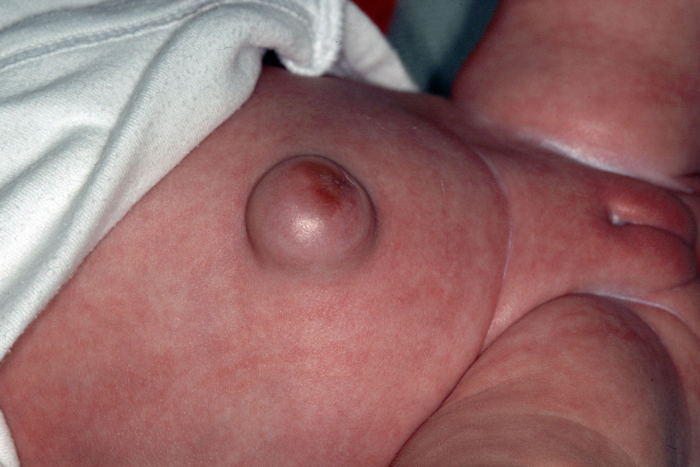
Umbilical hernias may develop at any age. In older people, they usually result from increased intra-abdominal pressure, through lifting, constipation or weight gain. In infants, they appear in the first few weeks of life through the area of weakness in the anterior abdominal wall. Most umbilical hernias are quite small and easily reducible, with obstruction and strangulation occurring only very rarely. When the defect is ≤ 2 cm in diameter 90% of hernias will close without treatment by the age of three. Larger hernias can be repaired by suturing the defect or by insertion of a mesh, usually at six weeks of age.
Umbilical granuloma
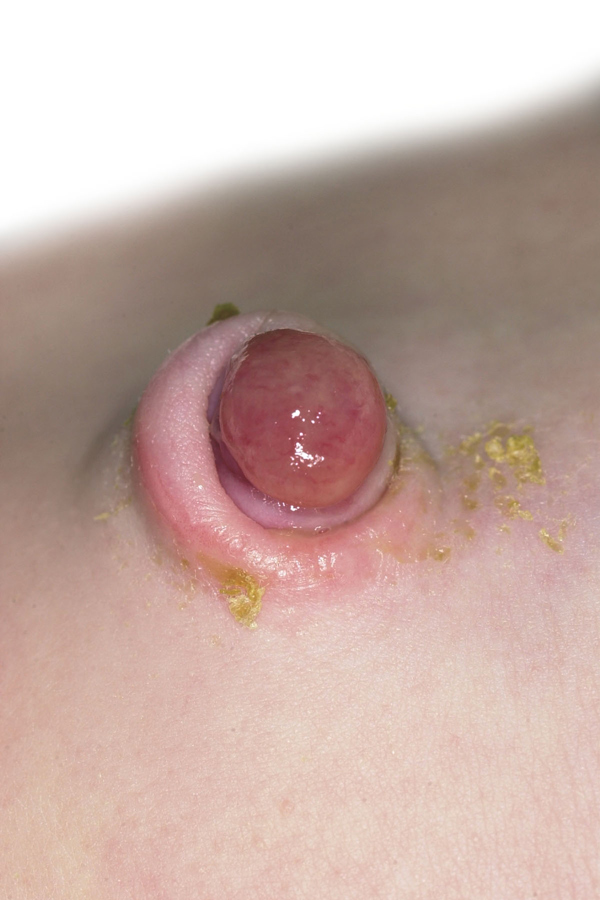
The umbilical cord normally separates one to eight weeks after being cut at delivery. After separation granulation tissue, consisting of fibroblasts and capillaries, may persist at the site producing an umbilical granuloma which can grow up to 1 cm in diameter. Granulomas can be treated with topical application of silver nitrate which cauterises the tissue and will gradually reduce it. Multiple applications are usually required.
Sucking blisters
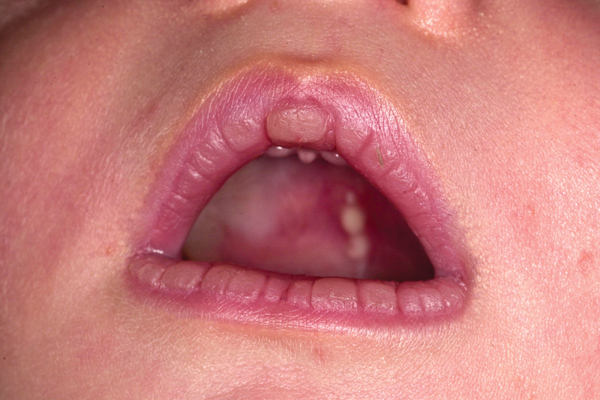
Sucking blisters develop on the lips of babies under the age of six months as a result of vigorous sucking on either the breast, bottle or a part of their own body such as the fingers or hands. Occasionally sucking blisters can be present at birth and arise through sucking in utero. Parents can be reassured that the blisters are not a sign of any underlying condition and that their presence does not mean that the baby isn't getting enough food. The blisters do not usually interfere with a baby's ability to feed and no treatment is necessary
Infantile eczema
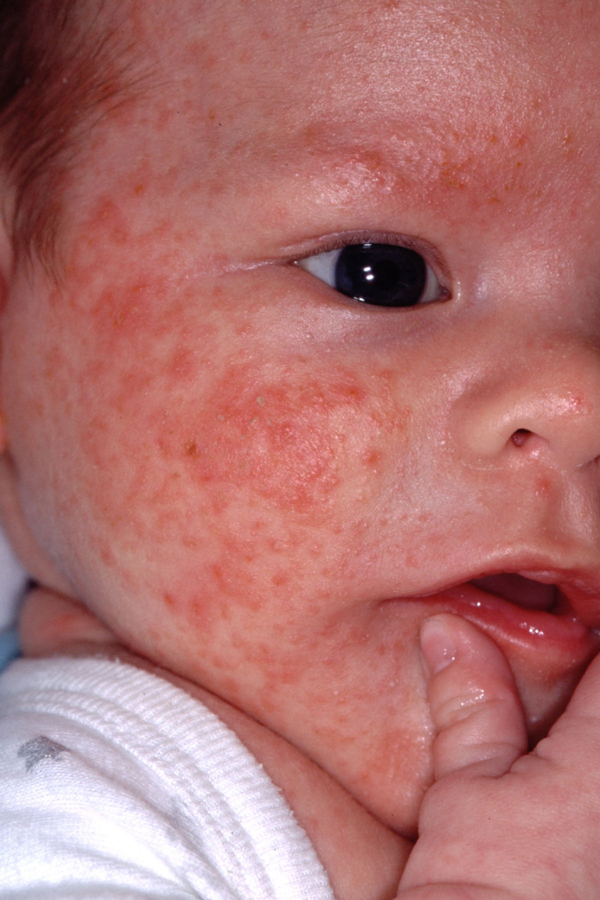
Infantile eczema is common in infants under the age of 12 months and most babies will be affected at some time. Whereas in older children atopic eczema usually develops in the creases, in infants the cheeks are more commonly affected and other areas may be spared. The eczema usually presents with red, dry scaly patches which may be excoriated. Parents may be anxious and ask whether the eczema is likely to persist into later life and it is important to educate them about the condition. Bad prognostic factors are: early onset; strong family history; and severe eczema at an early age. Regular emollients and bath additives are the mainstay of treatment, with topical steroids in more persistent or severe cases. Where secondary bacterial infection is suspected a course of oral antibiotics may be required.
Napkin dermatitis
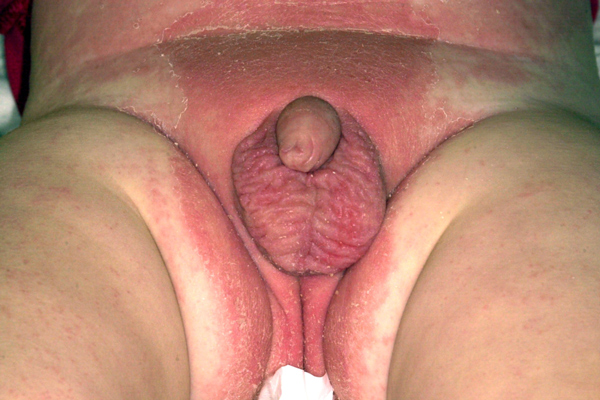
Napkin dermatitis is a form of irritant dermatitis caused by prolonged contact of urine, faeces or irritant topical preparations with the skin. It is relatively common, and can be distressing to the infant. This condition only affects the area of skin in contact with the irritant, so typically the creases and skin beyond the nappy will be spared. It is important to explain to parents and carers about the aetiology of the condition and the importance of regular nappy changes. It can be treated by applying zinc oxide paste which acts as an antiseptic and has a low risk of allergy.
Candida albicans infection
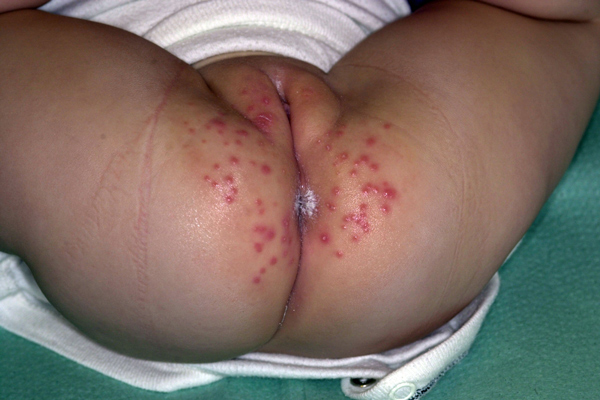
Candida albicans is a common yeast which thrives in moist warm areas making a nappy the perfect environment. Candida albicans infection should be suspected in any nappy rash which lasts more than three days and is the cause in up to 75% of such cases. It is more common after antibiotic use and presents with redness and pain especially when the affected area comes in contact with urine or faeces. Unlike irritant dermatitis, the rash will extend into the creases and may extend beyond the area covered by the nappy. A topical antifungal, such as clotrimazole, should be applied at every nappy change.
 Download this article in PDF format