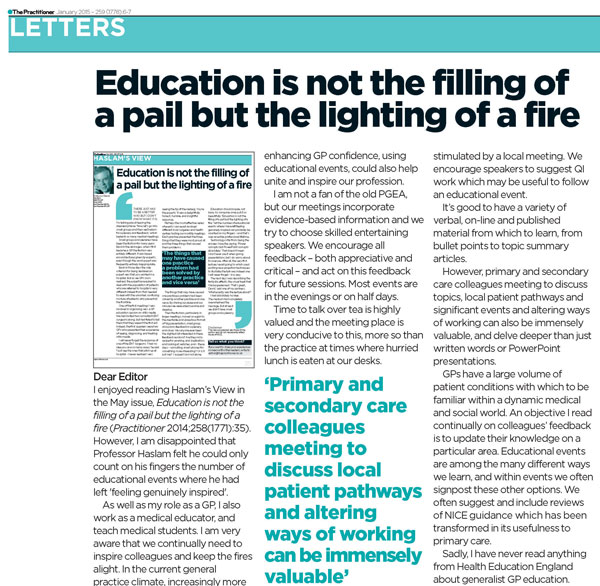
Dear Editor
I enjoyed reading Haslam’s View in the May issue, Education is not the filling of a pail but the lighting of a fire (Practitioner 2014;258(1771):35). However, I am disappointed that Professor Haslam felt he could only count on his fingers the number of educational events where he had left 'feeling genuinely inspired'.
As well as my role as a GP, I also work as a medical educator, and teach medical students. I am very aware that we continually need to inspire colleagues and keep the fires alight. In the current general practice climate, increasingly more is expected of us and we spend a significant amount of time in front of our computers and less time discussing cases. Our role has evolved as well, as Professor Amanda Howe says ‘GPs are experts in whole person medicine’.
Surely education, with the opportunity to share and learn together, is one of the most important tools to inspire and revive our profession and enhance patient care. Collaborative learning and enhancing GP confidence, using educational events, could also help unite and inspire our profession.
I am not a fan of the old PGEA, but our meetings incorporate evidence-based information and we try to choose skilled entertaining speakers. We encourage all feedback – both appreciative and critical – and act on this feedback for future sessions. Most events are in the evenings or on half days.
Time to talk over tea is highly valued and the meeting place is very conducive to this, more so than the practice at times where hurried lunch is eaten at our desks.
I also speak at an annual sixth form conference for students considering the health professions. Just by talking through your patient experiences during a surgery you can capture their imagination. Each year sixth formers tell me they did not realise the variety of patients, with complex medical and social conditions, GPs see on a daily basis.
As an appraiser, I often find GPs cite Quality Improvement work stimulated by a local meeting. We encourage speakers to suggest QI work which may be useful to follow an educational event.
It’s good to have a variety of verbal, on-line and published material from which to learn, from bullet points to topic summary articles.
However, primary and secondary care colleagues meeting to discuss topics, local patient pathways and significant events and altering ways of working can also be immensely valuable, and delve deeper than just written words or PowerPoint presentations.
GPs have a large volume of patient conditions with which to be familiar within a dynamic medical and social world. An objective I read continually on colleagues’ feedback is to update their knowledge on a particular area. Educational events are among the many different ways we learn, and within events we often signpost these other options. We often suggest and include reviews of NICE guidance which has been transformed in its usefulness to primary care.
Sadly, I have never read anything from Health Education England about generalist GP education.
For the future of primary care and our patients, the important issue of ongoing generalist GP education needs to be raised at a national level.
Education has been a highlight of my career, and is now one of my main roles. I often bring tips back to help my patients.
A favourite is an introduction to shared decision making, learning to work with patients using tools such as decision aids and option grids to help them focus on their goals and make informed decisions.
Last year, all the leads for education provider organisations in our deanery jointly won an award from the Severn Deanery School of Primary Care for innovation in GP training and teaching, an award of which we are extremely proud.
We can make a difference, working collaboratively, with education.
We need to share how we can do this positively, not filling pails but to light the many more fires from school students onwards through their medical careers, to help inspire GPs for the future and to enhance the care of our patients.
With the rugby and cricket world cups coming up this year, (which will be much discussed over tea breaks at meetings as well!) I smiled reading Haslam’s View in December The healing power of the magic sponge (Practitioner 2014;258(1777):35).
For me The Practitioner remains a valued educational publication ‘Supporting general practitioners for 147 years.’ Let’s help education triumph this year too.
Dr Nicole Howse, GP and Programme Director, Bath GP Education Research Trust, Bath, UK
• Professor Haslam replies
This may surprise you, but I am delighted at your response and agree with every word.
The point I was making is the importance of stimulation, and variety, and new approaches to education – and that sadly far too many educational events are just ‘more of the same’.
I am also really pleased that you have been inspired by meetings you have been to, and that you have such a passion for education.
I have spent my life trying to promote the value and values of generalism, and feel greatly reassured by your response.
My key message was that inspiration and stimulation are infinitely more important than the simple provision of facts. On this I know we both agree.
Professor David Haslam, Chair, NICE, London, UK
 Download this article in PDF format