Dear Editor
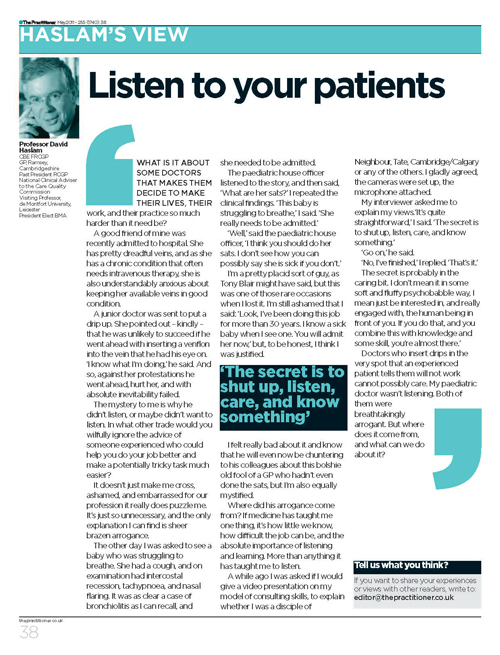
In his column in the May issue ‘Listen to your patients' (Practitioner 2011;255 (1740):38) Professor David Haslam tells the story of a young doctor who persuaded a doubting patient to allow him to try to cannulate a vein which she thought unsuitable for the purpose.
The attempt failed. Haslam states that the only explanation he can find for the attempt is ‘sheer, brazen arrogance', and that the patient's advice on the cannulation site was wilfully ignored.
Haslam could conceivably be right, but it would be interesting to have the young doctor's account of the circumstances. For example, were there other available sites among, what Haslam describes as, the patient's ‘pretty dreadful veins'? Was there any pressing urgency which might have influenced the decision to make an attempt in unpromising circumstances?
Could a more senior colleague have been more successful, and if so, was one available? Was there any potential for benefit to the patient or the service if the attempt had succeeded such as a day less in hospital?
Who decided that this patient, with a known venous access problem, would be left to an inexperienced member of the team? And what did the doctor say to the patient when the cannulation failed?
Later in the same article Haslam gives his highlights from a conversation with a junior hospital doctor about admitting a baby with breathing difficulties. The junior asks for the baby's oxygen saturation, and Haslam does not answer the question but orders the junior to admit the child, going on to muse on the ‘arrogance' of this junior as well.
I strongly suspect that Haslam did not have equipment to measure gas saturations in a baby to hand at the time of the conversation - very few GPs would have a paediatric oximeter. I think it would have been better if he had simply pointed this out. After all, it does not seem that the junior was refusing to assess the baby unless Haslam provided a figure for oxygen saturation.
I am a very average doctor, and not everything I have done in my clinical career went well. I don't know how many doctors get by without ever making a mistake, but I am not of their number.
Each time my limitations as a clinician have let one of my patients down I have felt absolutely terrible, and there are incidents which still haunt me over three decades after they happened.
The realities of patient care bring us up against our own limitations time and again in our careers; the good doctor learns quickly how to protect his or her patients from those limitations. Sometimes the learning experience is merely embarrassing, sometimes it is heartbreaking.
Haslam refers to his 35 years in practice, and the biography under his picture at the top of the article indicates teaching responsibilities and a role in the setting of standards widely across the NHS. I find it worrying that such a person places the worst possible construction on the events he describes, namely that the two junior doctors whom he criticises were ‘breathtakingly arrogant', and that he does not indicate any willingness to consider any other explanation.
Dr James Barbour
GP Belfast
- The author replies
It's always good to get feedback, and I absolutely understand the points you have made. In my quarter of a million consultations, there have been plenty that in retrospect make me cringe, where I got plenty of things wrong.
There hasn't been a single day in my career when I haven't had a twinge of anxiety on going to work in the morning in case I discover that someone has been admitted, or even worse, because I made a wrong judgement. But I honestly can't ever believe that, at any stage of my career if a patient said to me ‘I wouldn't use that vein doctor, it never works,' that I would press on regardless. Why on earth would any doctor do that?
You ask what the junior doctor's view would have been. It's a good point, and I am hugely supportive and understanding of the pressures on young doctors. But try as I might, being as sympathetic and empathetic as I might, I simply can't understand why he didn't listen to the patient.
I know the patient concerned well.
I know the hospital well. And I've watched the doctors there on many occasions. Most are superb - but a few really are arrogant, and I won't flinch from using the word.
My article was simply about my puzzlement that some doctors exude such certainty that they are right, when most of us know just how ridiculously complex this job is.
My position isn't one of knowing best. It's one of knowing that I often don't know best, and am grateful when someone - a patient, a colleague - wants to make it just a little easier. And as I asked, why wouldn't you want to make a difficult task a little easier?
Professor David Haslam
GP Ramsey, Cambs, Past President RCGP, President Elect BMA Download this article in PDF format