SEARCH

O’Sullivan M, Overton C. Managing debilitating menopausal symptoms. Practitioner 2016;260(1791):17-21
Managing debilitating menopausal symptoms
21 Mar 2016
AUTHORS
Dr Marie O’Sullivan MB ChB, Specialist Registrar in Obstetrics & Gynaecology
Mrs Caroline Overton MBBS MD FRCOG FHEA, Consultant Gynaecologist & Subspecialist in Reproductive Medicine & Laparoscopic Surgery, St Michael’s University Hospital, Bristol, UK
Article
Abstract
Severity and duration of menopausal symptoms varies markedly. Eight out of ten women experience symptoms and on average these last four years, with one in ten women experiencing symptoms for up to 12 years. A recent study found that women whose vasomotor symptoms started before the menopause suffered longest, median 11.8 years. Women whose hot flushes and night sweats started after the menopause had symptoms for a median of 3.4 years. Menopausal symptoms can begin years before menstruation ceases. Menopausal status needs to be evaluated based on history and symptoms. Testing for FSH levels should only be considered in women aged 40-45 with menopausal symptoms or those under 40 with suspected early menopause. In general, the benefits of short-term HRT outweigh the risks in the majority of symptomatic women, especially in those under 60. There is no evidence that HRT confers any cardiovascular protection (or harm) or protection against the development of dementia. Cardiovascular risk should be assessed. Women with cardiovascular disease are not necessarily unsuitable for HRT but need their cardiovascular health optimised. In those women with a high risk of venous thromboembolism a thrombophilia screen should be considered (although even if this is negative, it does not absolve risk). If there is a history of arterial disease a lipid profile should be considered. If there is a high risk of breast cancer, counsel the woman with regards to her risk and consider referring for mammography.
Most women will experience some menopausal symptoms. The severity and duration of these symptoms can vary markedly between individuals.
Around eight out of ten women will experience symptoms and on average these last four years, with one in ten women experiencing symptoms for up to 12 years. Hence it is important to take an individualised approach to their assessment and management. Women tend to seek medical advice when their symptoms start to affect their ability to function at home or work and/or affect relationships. Common menopausal symptoms are listed in table 1.1
Avis and colleagues analysed data on 1,449 women with frequent vasomotor symptoms who took part in the Study of Women's Health across the Nation, an observational study from the USA.2 All reported having frequent hot flushes and night sweats for at least six days in the past two weeks. These symptoms lasted for a median total duration of 7.4 years, but generally the earlier symptoms started the longer they continued.
Those women whose vasomotor symptoms started before the menopause suffered longest, median 11.8 years. Women whose hot flushes and night sweats started after the menopause fared better reporting symptoms with a median of 3.4 years’ duration.
Black women reported the longest duration of symptoms (median 10.1 years). Japanese and Chinese women suffered the shortest length of time (median 4.8 and 5.4 years, respectively). Among White women 6.5 years was the median duration, and among Hispanic women it was 8.9 years.
Assessment
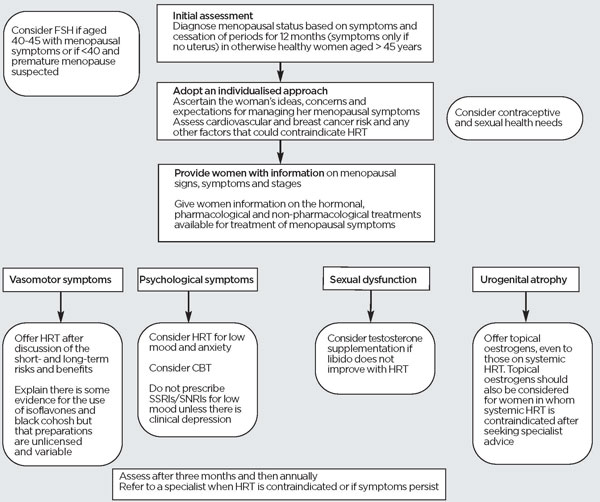
It is important to gauge the severity of the woman’s symptoms and establish which she finds most bothersome so that treatment can be tailored to the individual once the options have been discussed, see figure 1.
Menopausal symptoms can begin months or even years before menstruation ceases. Menopausal status needs to be evaluated based on history and symptoms. The perimenopause can be diagnosed on the basis of symptoms and irregular periods in women with a uterus, and symptoms alone in women who have had a hysterectomy. Testing for FSH levels should only be considered in women aged 40-45 with menopausal symptoms or those under 40 with suspected early menopause.3 Postmenopausal status can be diagnosed in women who are not on hormonal contraception who have not had a period for 12 months.
Management
Hormone replacement therapy
In general, the benefits of short-term HRT outweigh the risks in the majority of symptomatic women, especially in those under the age of 60.
There is currently no evidence that HRT confers any cardiovascular protection (or harm) or protection against the development of dementia although some women feel that HRT helps with their cognition.
Cardiovascular risk should be assessed. Women with cardiovascular disease are not necessarily unsuitable for HRT but need their cardiovascular health optimised. In those women with a high risk of venous thromboembolism (VTE) a thrombophilia screen should be considered (although even if this is negative, it does not absolve risk).
If there is a history of arterial disease a lipid profile should be considered.
If there is a high risk of breast cancer, counsel the woman with regards to her risk and consider referring for mammography.1
HRT can be started without examination or investigation unless there are concerns about gynaecological cancers (sudden change in menstrual pattern, post-coital bleeding, intermenstrual bleeding, history or strong family history of gynaecological cancers).
In the 1970s, it was believed that HRT offered protection against heart disease and cognitive decline. Following the publication of findings from the Million Women’s study in 2003,6 it was recognised that there was a significant breast cancer risk with continuing treatment and the health benefits were less than previously thought. This large UK study found that use of HRT by women aged 50-64 over the previous decade had resulted in an estimated 20,000 extra cases of breast cancer, 15,000 associated with oestrogen-progestagen combined HRT.
The risks of HRT are listed in table 2, and the risk of breast cancer with various forms of HRT in table 3.
Without HRT, symptoms tend to improve over five to ten years. Although HRT can ameliorate menopausal symptoms, on stopping therapy the symptoms can return.
Patches are used continuously starting within five days of menstruation (or at any time if periods have stopped or are infrequent). Patches should be removed after three to four days (or once a week in the case of the seven-day patch) and replaced with a fresh patch on a slightly different site. Recommended sites are clean, dry, unbroken areas of skin on the trunk below the waistline. Patches should not be applied on or near the breasts or under the waistband. If a patch falls off in the bath, the woman should allow the skin to cool before applying a new patch.
• Tablets can be started on day one of the period (or at any time if periods have stopped or are infrequent). For women with a uterus, progestogen is required to prevent endometrial hyperplasia and possible transformation to cancer.
Progestogen appears to be a tumour promoter, particularly with respect to the breast. It can be delivered by the following routes:
• Orally for 14 days every month
• Orally for 14 days every three months
• Orally as a daily tablet or capsule
• Transdermally as a patch
• As an IUS
HRT does not provide contraception and a woman is potentially fertile for two years after her last menstrual period if she is under 50 and for one year if she is over 50. A woman who is under 50 and has a low VTE risk can use a low-oestrogen combined oral contraceptive pill to provide both relief of menopausal symptoms and contraception.
Consider stopping the contraceptive pill at the age of 50, as there may be a more suitable alternative e.g. the progestogen-only pill. If any potentially fertile woman needs HRT, non-hormonal contraceptive measures, such as condoms, are needed if she is sexually active.
HRT should be stopped immediately if any of the following occur:
• Sudden severe chest pain (even if not radiating to the left side)
• Sudden breathlessness (or cough with bloodstained sputum)
• Severe stomach pain
• Unexplained swelling or severe pain in the calf of one leg
• Serious neurological defects including: unusual severe, prolonged headache especially if this is the first time, or getting progressively worse; sudden, partial or complete loss of vision; sudden disturbance of hearing; other perceptual disorders; dysphasia; or bad fainting attack; collapse; first unexplained epileptic seizure or weakness; motor disturbances; very marked numbness suddenly affecting one side or one part of the body
• Hepatitis, jaundice, liver enlargement
• Raised blood pressure - systolic > 160 mmHg or diastolic > 95 mmHg
• Prolonged immobility after surgery or leg injury
• Detection of a risk factor that contraindicates treatment
Reported side effects of HRT include:
• Nausea, vomiting, abdominal cramps
• Bloating and weight changes
• Breast enlargement and tenderness
• Premenstrual-like syndrome
• Sodium and fluid retention
• Cholestatic jaundice
• Glucose intolerance
• Altered blood lipids– may lead to pancreatitis, rashes
• Chloasma
• Changes in libido, depression, mood changes
• Headache, migraine, dizziness
• Leg cramps (rule out venous thrombosis)
• Vaginal candidiasis
• Contact lenses may irritate
• Transdermal delivery systems may cause contact sensitisation (possible severe hypersensitivity reaction on continued exposure)
• Headache has been reported on vigorous exercise
Other treatments
Despite evidence supporting the safety profile of HRT, not all women wish to use it. This has led to the ongoing pursuit of alternative treatments outlined in table 4.
Traditional HRT helps symptoms in 80-90% of women compared with 50-60% of women on alternative treatment.7 Many alternative therapies interact with other medication and there is a lack of data on potential adverse effects. GPs should inform women that alternative medicines do not undergo the same regulations and licensing as pharmacological drugs.
Ovarian production of sex steroid hormones continues to some degree after the menopause, consequently those that undergo bilateral oophorectomy often suffer more with low libido.
Tibolone is a synthetic steroid with oestrogenic, progestogenic and androgenic properties. It is sometimes recommended for younger women, especially those with low libido.
A Cochrane review concluded that tibolone was not as effective as combined HRT at reducing vasomotor symptoms but did reduce vaginal bleeding.9
If HRT does not improve libido, NICE recommends that supplementation with topical testosterone may be considered although it is unlicensed for this use and the evidence base is not strong. It could be prescribed on a trial basis as an option for improving low sexual desire when HRT is not effective.3
A petit pois sized amount of gel should be applied to clean, dry unbroken skin. There have been reports of localised hypertrichosis, so women should apply the gel on areas where hair growth is less critical e.g. the lower leg. There is no evidence that testosterone increases breast cancer risk.8 Side effects of acne and hirsutism are related to dose and duration of use and usually resolve once treatment is discontinued.
Once HRT is started, women should be assessed at three months to determine whether HRT is effective and to check for side effects. Thereafter, women should be reviewed annually.
Referral
Women should be referred to a specialist if HRT does not relieve symptoms or side effects are a problem.
Referral should also be considered if there is uncertainty as to the best HRT or if there are contraindications to HRT such as oestrogen-dependent cancer,a history of breast cancer, active thrombophlebitis, active or recent arterial thromboembolic disease (e.g. angina or myocardial infarction), venous thromboembolism, recurrent thromboembolism (unless already on anticoagulant treatment), thrombophilic disorder, liver disease (where liver function tests have failed to return to normal), Dubin-Johnson syndrome and Rotor syndrome (or monitored closely), untreated endometrial hyperplasia, undiagnosed vaginal bleeding.
Conclusion
The perimenopause can be a distressing and debilitating time for some women. The latest evidence supports the use of HRT for many women, if they wish to use it and women should be supported in making an informed choice.
Further research is needed to assess the efficacy and safety of alternative therapies. Specialist referral pathways should be in place for complex patients and where first-line therapies have failed or there are contraindications to HRT.
REFERENCES
1 NICE Clinical Knowledge Summaries http://cks.nice.org.uk/menopause. Last revised October 2015
2 Avis NE, Crawford SL, Greendale G et al. Study of Women's Health Across the Nation. Duration of menopausal vasomotor symptoms over the menopause transition. JAMA Intern Med 2015;175(4):531-97
3 National Institute for Health and Care Excellence. NG23. Menopause: diagnosis and management. NICE. London. 2015 www.nice.org.uk/guidance/ng23
4 Panay P, Hamoda H, Arya R and Savvas M on behalf of The British Menopause Society and Women’s Health Concern. The 2013 British Menopause Society & Women’s Health Concern recommendations on hormone replacement therapy. Menopause Int published online 23 May 2013
5 Writing group for the Women’s Health Initiative Investigators. Risks and benefits of estrogen plus progestin in healthy postmenopausal women: principal results from the Women’s Health Initiative randomised controlled trial. JAMA 2002;288:321–33
6 Beral V. Million Women Study Collaborators. Breast cancer and hormone-replacement therapy in the Million Women Study. Lancet 2003;362(9382):419-27 Erratum in Lancet 2003;4;362(9390):1160
7 Royal College of Obstetricians and Gynaecologists. Alternatives to HRT for the management of symptoms of the menopause. Scientific Impact Paper No. 6. RCOG. London. 2010
8 British Society for Sexual Medicine. 2010. Guidelines on the management of sexual problems in women: the role of androgens. http://bssmorguk.ipage.com/wp-content/uploads/2017/05/UK_Guidelines_Androgens_Female_2010.pdf
9 Formoso G, Perrone E, Maltoni S et al. Short and long term effects of tibolone in postmenopausal women. Cochrane Database Syst Rev 2012 Feb 15;2:CD008536. doi: 10.1002/14651858.CD008536.pub2
ARTICLE IN PDF
 Download this article in PDF format
PRESET SEARCHES
PubMed
NICE Evidence search
Update on reference 9
Short-term and long-term effects of tibolone in postmenopausal women. Cochrane Database Syst Rev. 2016 Oct 12;10:CD008536
EXTERNAL WEBLINKS
The British Menopause Society
We welcome your feedback
If you wish to comment on this article or have a question for the authors, write to: [email protected]