SEARCH

Bedoya-Ronga A, Currie I. Improving the management of urinary incontinence. Practitioner 2014;258 (1769):21-24
Improving the management of urinary incontinence
20 Mar 2014
AUTHORS
Dr Alvaro Bedoya-Ronga MRCOG, Specialist Registrar in Obstetrics & Gynaecology
Mr Ian Currie FRCOG, Consultant Gynaecologist, Stoke Mandeville Hospital, Aylesbury, UK
Article
Urinary incontinence (UI) is the complaint of any involuntary loss of urine.1 This is a symptom-based definition set out by the International Continence Society (ICS) and the International Urological Association.
Urinary incontinence is a common condition that is likely to be under-reported because of embarrassment and the misconception that it is a normal component of aging. UI is more common in women than men and its frequency increases with age, parity, high BMI, and associated comorbidities.
In the UK, the prevalence is estimated to be 17-40%,2,3 and rates are higher in the elderly.
The social and psychological repercussions of UI are important, as it can have a very detrimental effect on the quality of life of these patients.
Primary care
GPs are key in the detection and management of urinary tract pathology. Women often wait several years before seeking help for incontinence. Routine enquiry by GPs about urinary incontinence or bladder complaints is likely to increase the early detection of these problems, improving patients’ quality of life.
A well structured community referral system and network provides these patients with the necessary support and expertise.
Physiotherapists, continence advisers and specialist nurses also have a central role. Women are often uncertain about how to do pelvic floor exercises correctly and may need instruction or reassurance. Likewise patients may also need advice on bladder retraining.
Assessment
The diagnosis of UI is based on history, basic investigations and examination. The updated NICE guideline, published in September 2013, highlights the importance of taking a good history; being guided by the patient's symptoms and the effect on their quality of life.4 It recommends the use of bladder diaries and routine digital pelvic floor assessment.
Most cases will fall into the categories of stress UI, overactive bladder (OAB) and mixed UI, see box 1.
History
The history should include the circumstances in which the incontinence occurs, the duration and how it affects the patient’s quality of life.
Stress UI is associated with an increase in abdominal pressure.
Ask the patient:
• Do you leak when coughing, sneezing or during physical activity?
OAB is associated with urgency, frequency and nocturia. OAB symptoms are often excerbated by caffeinated drinks, red wine and acidic or spicy food.
Ask the patient:
• Do you go to the toilet every 1, 2 or 3 hours?
• Do you have urgency?
• Do you have an accident if you have to hold on?
• If so, how many accidents do you have in a week?
• Do you have to wear pads?
• If so, how many do you change a day?
• Is this affecting your social and personal life?
• On a scale of one to ten how much is your incontinence bothering you?
When there is an acute onset of UI, a full neurological examination is needed. Any new medication should be reviewed.
Restricted mobility, cognitive impairment and depression also need to be excluded as causes of UI.
Examination
The initial assessment should include enquiring for symptoms of urinary tract infection and carrying out a urine dipstick test,6 see table 1.
At examination the patient should ideally have a comfortably full bladder.
Abdomen
• Exclude a large pelvic-abdominal mass. Any pelvic mass warrants an urgent two-week referral. An ultrasound scan will be needed but should not delay the referral
• Exclude palpable bladder post micturition
Vulva-vagina
• Inspection, assess for atrophic vaginitis and prolapse
• Speculum, assess for prolapse
• Bimanual, assess for masses
• Digital examination, assess pelvic floor muscle contraction using the Oxford scale (1-5/5)
The bladder diary provides a functional assessment of the bladder capacity; it should be completed for at least three days, including a normal working day and a normal resting day.
Treatment
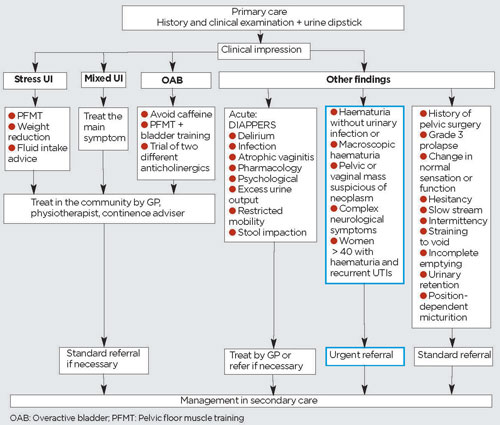
Patients should be managed by a multidisciplinary team involving the GP, community continence adviser, specialist physiotherapist and/or specialist nurse, see figure 1.
General measures include:
• Fluid intake limited to 1.5-2 L/day4
• Weight reduction for patients who have a BMI ≥ 30
• In those with cognitive impairment, timed voiding can be used to reduce the number of episodes of UI4
Stress incontinence
• Pelvic floor muscle training (PFMT). At least eight contractions performed three times per day
• Educational leaflets4
• Supervised PFMT for at least 3 months4
• Management of other exacerbating conditions such as constipation, and smoking cessation.
When standard PFMT has not produced a satisfactory result, other therapies to maximise pelvic floor strength can be tried such as: biofeedback PFMT, electrical stimulation or weighted vaginal cones.
These measures are generally undertaken under the supervision of the community continence adviser, specialist nurse or physiotherapist.
Overactive bladder
• Caffeinated beverages should be restricted or stopped
• Bladder retraining for a minimum of six weeks
• Avoidance of drinking four hours before sleep will help manage OAB symptoms6
When conservative measures for OAB are unsuccessful, the next step
is pharmacological treatment, see table 2.4
Review co-existing medical conditions, along with the concurrent use of other medications.
Antimuscarinics have similar side-effects reported and tolerability varies between patients. Before commencing medication, discuss the likelihood of success and associated side effects.4 Inform the patient that the treatment effect may take up to four weeks.4 Two different antimuscarinics should be tried before referral to secondary care.4 Oxybutynin immediate release should not be offered to frail older women because it has an increased side effect profile.4
Follow-up should be offered four weeks after commencing a new drug, either face to face or by telephone.4
It is important to assess the patient’s satisfaction with, and the effectiveness and tolerability of, the treatment. An increase in dose needs to be considered if the effect is suboptimal, or changing to a second antimuscarinic if there are intolerable side effects or no improvement.
NICE recommends that the selection of a second antimuscarinic should be based on the lowest acquisition cost and transdermal medication should be offered if women are unable to tolerate oral medication.4
Mirabegron is the first in a new class of drugs, the beta-3-adrenoceptor agonists. It can be used when antimuscarinics are either contraindicated or have failed to achieve satisfactory symptom relief or when intolerable side effects are reported.
Patients on long-term treatment need yearly review, patients over 75 should be reviewed every six months.4
Mixed UI
The predominant symptoms should be treated. When stress UI predominates, NICE recommends considering conservative management of OAB including drugs before offering surgery.4
The prognosis will depend on the cause, the patient’s expectations and the desired outcome.
Stress UI
PFMT alone can improve symptoms of stress incontinence by 56-75%, but appears to be less effective in the long term and depends on good compliance.5
OAB
PFMT can improve OAB symptoms by up to 55%.6 Antimuscarinics can produce long-term symptom improvement of 60-70%,7 but side-effects are common and can affect compliance.
Referral
Involving a skilled continence nurse or dedicated pelvic physiotherapist will improve care and can reduce referrals to secondary care.
Timely review of the response to conservative and pharmacological measures provides an opportunity to assess the patients’ satisfaction with current treatment and determine whether they should be referred for further treatment.
Patients should be referred when conservative measures have failed.
For stress UI, referral is indicated after failure of PFMT. For OAB, referral should be offered when the response to two drugs has not been satisfactory, or the patient wishes to discuss further options.
Patients with other types of urinary incontinence should be managed as shown in the algorithm in figure 1.
Secondary care
Urodynamic studies are normally carried out before deciding the best management option. The following approaches are used for stress UI: synthetic mid-urethral slings, autologous rectus fascial slings, open colposuspension, and intramural bulking agents.
In cases where the patient is unfit for surgery or declines a non-surgical treatment an alternative is duloxetine with PFMT. This has a high risk of adverse effects and is therefore not generally tolerated or prescribed.
For OAB symptoms intravesical injection of botulinum toxin A or percutaneous sacral nerve stimulation can be used.
REFERENCES
1 Abrams P, Cardozo L, Fall M et al. The standardisation of terminology of lower urinary tract function: Report from the Standardisation Sub-committee of the International Continence Society. Neurourol Urodyn 2002;21:167-178
2 Irwin DE, Milsom I, Hunskaar S et al. Population-based survey of urinary incontinence, overactive bladder and other lower urinary tract symptoms in five countries: results of the EPIC study. Eur Urol 2006;50(6):1306-14
3 Hunskaar S, Lose G, Sykes D et al. The prevalence of urinary incontinence in women in four European countries. BJU Int 2004;93(3):324-30
4 National Institute for Health and Care Excellence. CG171. Urinary incontinence: the management of urinary incontinence in women. NICE. London. 2013
5 Felicissimo MF, Carneiro MM, Saleme CS et al. Intensive supervised versus unsupervised pelvic floor muscle training for the treatment of stress urinary incontinence: a randomized comparative trial. Int Urogynaecol J 2010;21(7):835-40
6 Castro RA, Arruda RM, Zanetti MR et al. Single-blind, randomized, controlled trial of pelvic floor muscle training, electrical stimulation, vaginal cones, and no active treatment in the management of stress urinary incontinence. Clinics (Sao Paulo) 2008;63(4):465-72
7 Alhasso AA, McKinlay J, Patrick K et al. Anticholinergic drugs versus non-drug active therapies for overactive bladder syndrome in adults.Cochrane Database Syst Rev 2006;18(4): CD003193
ARTICLE IN PDF
 Download this article in PDF format
PRESET SEARCHES
Immediate CPD prompts
These handy templates* prompt immediate drafting of personal learning, reflection and planning. Save your record straight into your personal development folder on your device or Cloud storage system.
*Adobe reader needed for iPad
EXTERNAL WEBLINKS
The International Continence Society
Email: [email protected]
International Urogynecological Association
PubMed
NICE evidence - a select database by NICE
British National Formulary
Urinary infrequency enuresis incontinence
Preset searches from key journals
British Journal of General Practice
Incontinence
British Medical Journal
Incontinence
New England Journal of Medicine
Urinary incontinence