SEARCH

McEwan M, Day A, Girling J. GPs have key role in identifying women at risk of pre-eclampsia. Practitioner March 2022;266(1856):11-14
GPs have key role in identifying women at risk of pre-eclampsia
25 Mar 2022
AUTHORS
Mr Michael McEwan BSc MBBS MRCOG, Specialist Registrar in Obstetrics and Gynaecology
Miss Andrea Day MBBS MRCOG, Locum Consultant in Obstetrics and Gynaecology
Miss Joanna Girling MA MRCP FRCOG Consultant in Obstetrics and Gynaecology
West Middlesex University Hospital, Chelsea and Westminster Hospital NHS Foundation Trust, London, UK
Competing interests: None
Article
Pre-eclampsia is an important cause of maternal morbidity and mortality. It is a multisystem disorder of pregnancy characterised by new onset hypertension after 20 weeks’ gestation, usually accompanied by proteinuria. Women with either one high risk factor or two or more moderate risk factors for the development of pre-eclampsia should take 75-150 mg of aspirin daily from 12 weeks’ gestation until delivery. If a urine dipstick is positive for protein, the amount should be quantified: a protein: creatinine ratio ≥ 30 mg/mmol is abnormal. There should be a high index of suspicion for pre-eclampsia if there is biochemical disturbance consistent with the diagnosis or evidence of fetal growth restriction when plotted on a customised growth chart. Women with severe hypertension (≥ 160/110 mm Hg), new onset hypertension with ≥ 1+ proteinuria or any red flag symptoms should be referred for urgent obstetric review (within 4 hours). Women with new isolated non severe hypertension or ≥ 1+ proteinuria should be referred for obstetric review, ideally within 24 hours. On discharge from hospital, women who are taking antihypertensive medication should have their BP measured every 1-2 days for 2 weeks until it has normalised. Women should see their GP 2 weeks postnatally to assess the need for ongoing antihypertensive treatment. BP, urinary protein and blood results (if previously abnormal) should be reviewed by their GP or hospital specialist at 6-8 weeks after birth.
Pre-eclampsia is an important cause of maternal morbidity and mortality.1
The incidence of pre-eclampsia is around 4% and is thought to be increasing.2
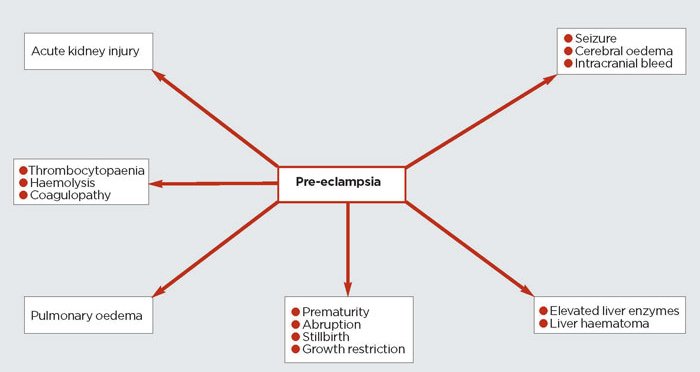
It is a multisystem disorder of pregnancy characterised by new onset hypertension after 20 weeks’ gestation, usually accompanied by proteinuria.3 Other clinical features will depend on the systems involved (see figure 1).
The exact pathophysiology is not known but is thought to be a multifactorial interplay between the placenta and the maternal immune system.4
Risk factors
Women with risk factors for pre-eclampsia should take 75-150 mg of aspirin from 12 weeks’ gestation until the birth of the baby, see table 1.
There is some evidence that vitamin D supplementation in pregnancy has a role in the prevention of pre-eclampsia.
Chronic hypertension
Women with a diagnosis of chronic hypertension should have easy access to reliable contraception and be offered referral for prepregnancy counselling with a specialist in hypertensive disorders in pregnancy should they wish to conceive.5
If this has not already been carried out, women with chronic hypertension who are planning a pregnancy should be investigated for secondary causes of hypertension prior to conception.
Women taking angiotensin converting enzyme inhibitors (ACEi), angiotensin 2 receptor blockers (ARB) or diuretics should be advised to stop these medications within two days of confirmation of pregnancy as there is evidence of a risk of teratogenesis, and should be offered a suitable alternative, such as labetalol, nifedipine or methyldopa.5,6 Women should be encouraged to maintain a healthy weight, stop smoking and remain active.
There is a physiological fall in blood pressure (BP) of 15-20 mmHg during the first trimester of pregnancy, which is sustained until a return towards normal occurs in the third trimester. Therefore, women on antihypertensives may need to reduce the dose in early pregnancy. Furthermore, if the BP appears to be ‘normal’ at booking, the patient may in fact have chronic hypertension and may need treatment and close monitoring.
Pregnant women with chronic hypertension who are not already receiving antihypertensive medication should be offered treatment if they have a sustained systolic BP ≥ 140 mmHg or diastolic ≥ 90 mmHg. The treatment target should be ≤ 135/85 mmHg.
Assessment
All women should be assessed for pre-eclampsia at every visit from 20 weeks’ gestation. This should include: BP; urine dipstick for protein; fetal heart rate and from 26 weeks’ gestation, symphyseal-fundal height (plotted on a customised growth chart).
If urine dipstick is positive for protein, the amount should be quantified. The traditional 24-hour urine collection has been superseded by a measurement of protein: creatinine ratio on a spot urine sample with the result available the same day; values ≥ 30 mg/mmol are classed as abnormal.5 Once significant proteinuria has been confirmed, it is not usually necessary for the test to be repeated.
Other biochemical features that may be suggestive of pre-eclampsia include a rise in creatinine to ≥ 90 µmol/L; a fall in platelet count to below 150 x 109/L or a rise in serum alanine transaminase to above 70 IU/L.5
Women should also be assessed for other signs and symptoms of pre-eclampsia (see red flags below).
Red flag symptoms include:
• Headache
• Vomiting
• Visual disturbance
• Epigastric pain
• Sudden onset swelling
• Shortness of breath
• Hyperreflexia
Referral
Women with severe hypertension (≥ 160/110 mmHg), new onset hypertension with ≥ 1+ proteinuria or any red flag symptoms should be referred for urgent obstetric review (within 4 hours). Those presenting with new isolated non severe hypertension or ≥ 1+ proteinuria should be referred for obstetric review, ideally within 24 hours.
Diagnosis
Traditionally, the diagnosis of pre-eclampsia was made only once a combination of hypertension and proteinuria had been confirmed. However, it is increasingly recognised that pre-eclampsia can present in the absence of significant proteinuria.3
There should be a high index of suspicion for pre-eclampsia in women presenting beyond 20 weeks’ gestation with new onset, or deterioration, of chronic hypertension without proteinuria, if there is biochemical disturbance consistent with the diagnosis (see above) or evidence of fetal growth restriction. These women should be referred for obstetric input in order to consider further investigations regarding a possible diagnosis of pre-eclampsia.
Testing for placental growth factor (PlGF) is often done as a point of care test with the result available within an hour. The PELICAN trial demonstrated that this is a reliable rule-out test7 and the PARROT trial showed that PlGF can predict those women that are at high risk of requiring early delivery and can aid decisions regarding place of care and level of monitoring.8
PlGF testing reduces the time to diagnosis of pre-eclampsia and the incidence of adverse maternal outcomes.8 NICE recommends using this as a one-off test between 20 and 35 weeks’ gestation.9
The PARROT-2 trial is currently underway to ascertain whether serial measurement could be of clinical benefit.10
For women in whom pre-eclampsia has been diagnosed, NICE recommends validated risk stratification scores (fullPIERS and PREP-s)5,11,12 in secondary care for predicting maternal adverse outcomes in early onset pre-eclampsia and helping to time delivery, although unlike PlGF testing, these risk scores do not predict fetal outcome.
Management
NICE guidance on the management of pre-eclampsia is summarised in table 2. There are regional differences in approach, most commonly regarding place of care. Many units routinely admit all patients with pre-eclampsia because of concerns about rapid deterioration, specifically placental abruption, eclampsia and intracranial haemorrhage (the main mechanism of maternal death in the context of pre-eclampsia).13
NICE recommends admitting women at high risk of adverse events, those with severe hypertension or where there are other concerns for the wellbeing of the woman or baby.5
For BP control, NICE currently recommends treatment if BP remains ≥ 140/90 mmHg with labetalol first line; nifedipine second line if labetalol is not suitable; methyldopa as a third option depending on the side effect profile and the woman’s preference.5
The Giant PANDA trial is currently underway to compare nifedipine with labetalol for the treatment of hypertension in pregnancy.14
Delivery of the baby is the only ‘cure’ for confirmed pre-eclampsia, and is recommended if there are serious maternal or fetal concerns, or by 37 weeks’ gestation if mother and baby seem well (or when the diagnosis is made, if later).3,5
Prior to 34 weeks’ gestation, expectant management is recommended because of the increased risk of the consequences of prematurity including respiratory distress syndrome and necrotising enterocolitis.15
In the absence of definite fetal or maternal indications for delivery, there is some debate regarding the timing of birth between 34 and 37 weeks’ gestation. The PHOENIX trial16 demonstrated a significant reduction in adverse maternal outcomes with increased chance of vaginal birth without long-term neonatal morbidity (albeit with a small increased risk of neonatal unit admission) for women randomised to delivery at diagnosis compared with expectant management. The authors conclude that this should be discussed with the woman to determine the optimum timing of birth.
Postnatal care and follow-up
Women with pre-eclampsia may have a prolonged postnatal inpatient stay and will only be discharged once BP is < 150/100 mmHg, blood results are stable or improving, and they have no symptoms of pre-eclampsia.
Women who did not require antenatal antihypertensive treatment should be offered treatment if their BP is persistently ≥ 150/100 mmHg.
If women are not breastfeeding, treatment of BP should follow the recommendations in the NICE guidance on hypertension in adults.17 In women who are breastfeeding, enalapril, amlodipine, or atenolol are used as once daily medications.
Women with pre-eclampsia will usually be prescribed low molecular weight heparin for prevention of venous thromboembolism and be offered reliable contraception to start in the immediate postnatal period.18 On discharge, a written care plan should be provided including the following details:5
• Provision of follow-up care, including medical review and repeat blood tests
• Frequency of BP monitoring
• Thresholds for reducing or stopping treatment (usually 130/80 mmHg)
• Indications for referral to primary care for BP review
• Self-monitoring for symptoms
Women who are taking antihypertensive medication should have their BP measured every 1-2 days for two weeks until it has normalised. Women should see their GP two weeks postnatally to review BP and assess the need for ongoing antihypertensive treatment. This is also a good opportunity to discuss postnatal contraception if this has not been initiated prior to hospital discharge.
Women should have their BP, urinary protein and blood results (if previously abnormal) reviewed by their GP or hospital specialist at 6-8 weeks after birth.6 Women with persistently abnormal renal function or laboratory proven proteinuria at 3 months postnatal should be referred for an assessment for chronic kidney disease.5
Pre-eclampsia can occasionally present de novo in the first two postnatal weeks and may be atypical.19 Women with severe hypertension or red flags presenting should be referred for urgent obstetric review in hospital (within 4 hours).
Long-term complications
Women should be informed of their risk for pre-eclampsia recurrence and their lifetime cardiovascular risks at medical follow-up. Overall, women with pre-eclampsia have a risk of recurrence of 16%, however, the risk is 33% in those who deliver before 34 weeks’ gestation and 23% for those who deliver between 34 and 37 weeks.5
Approximately 2% of women with pre-eclampsia will go on to develop chronic hypertension.5 They are twice as likely to die from a cardiovascular cause and have a 2- to 3-fold increased risk of a major cardiovascular event such as myocardial infarction or stroke.5 Pregnancy is therefore an excellent opportunity to counsel and support women to manage their modifiable cardiovascular risk factors, and to initiate appropriate ongoing monitoring.
Pre-eclampsia also increases risk in the offspring: in utero exposure to hypertension increases the risk of hypertension in adulthood by 2.5 times.20
Conclusion
Although maternal mortality from pre-eclampsia has been reduced dramatically from the levels seen in the 1970s,13 it remains a common condition with a high burden of maternal and neonatal morbidity.
Novel methods of risk stratification such as angiogenic biomarker measurement show promise for improved diagnosis, and there is an increasing evidence base for BP control, place of care and timing of birth.
Primary care has an important role to play in pregnancy planning, early identification of at-risk women, detection of hypertensive disorders in pregnancy and short- and long-term postnatal follow-up of women with pre-eclampsia.
REFERENCES
1 Knight M, Bunch K, Tuffnell D et al. Saving lives, improving mothers’ care: lessons learned to inform maternity care from the UK and Ireland confidential enquiries into maternal deaths and morbidity 2016-18
2 US Preventive Services Task Force. Screening for preeclampsia: US Preventive Services Task Force Recommendation Statement. JAMA 2017;317(16):1661-67
3 Gestational hypertension and preeclampsia: ACOG Practice Bulletin, Number 222. Obstet Gynecol 2020;135:e237-e260
4 Monte S. Biochemical markers for prediction of preclampsia: review of the literature. J Prenat Med 2011;5:69-77
5 National Institute for Health and Care Excellence. NG133. Hypertension in pregnancy: diagnosis and management. NICE. London .2019 www.nice.org.uk/guidance/ng133
6 Vasilakis-Scaramozza C, Aschengrau A, Cabral HJ et al. Antihypertensive drugs and the risk of congenital anomalies. Pharmacotherapy 2013;33:476-82
7 Chappell LC, Duckworth S, Seed PT et al. Diagnostic accuracy of placental growth factor in women with suspected preeclampsia. Circulation 2013;128:2121-31
8 Duhig KE, Myers J, Seed PT et al. Placental growth factor testing to assess women with suspected pre-eclampsia: a multicentre, pragmatic, stepped-wedge cluster-randomised controlled trial. Lancet 2019;393:1807-18
9 National Institute for Health and Care Excellence. PlGF-based testing to help diagnose suspected pre-eclampsia (Triage PlGF test, Elecsys immunoassay sFlt-1/PlGF ratio, DELFIA Xpress PlGF 1-2-3 test, and BRAHMS sFlt-1 Kryptor/BRAHMS PlGF plus Kryptor PE ratio www.nice.org.uk/guidance/dg23 [Last accessed 15 Jan 2022]
10 PARROT-2 Follow on study assesses impact of PlGF tests. Action on pre-eclampsia, https://action-on-pre-eclampsia.org.uk/parrot-2-follow-on-study-assesses-impact-of-plgf-tests/ [Last accessed 15 Jan 2022)
11 Ukah UV, Payne B, Hutcheon JA et al. Assessment of the fullPIERS risk prediction model in women with early-onset preeclampsia. Hypertension 2018;71:659-65
12 Thangaratinam S, Allotey J, Marlin N et al. Prediction of complications in early-onset pre-eclampsia (PREP): development and external multinational validation of prognostic models. BMC Med 2017;15:683
13 Conti-Ramsden F, Knight M, Green M et al. Reducing maternal deaths from hypertensive disorders: learning from confidential inquiries. BMJ 2019; l230
14 www.birmingham.ac.uk/documents/college-mds/trials/bctu/giant-panda/giant-panda-protocol-v1.1-2020-01-11-final-29.03.21.pdf [Last accessed 15 Jan 2022]
15 Churchill D, Duley L, Thornton JG, et al. Interventionist versus expectant care for severe pre‐eclampsia between 24 and 34 weeks’ gestation. Cochrane Database Syst Rev 2018. CD003106.pub3
16 Chappell LC, Brocklehurst P, Green ME et al. Planned early delivery or expectant management for late preterm pre-eclampsia (PHOENIX): a randomised controlled trial. Lancet 2019;394:1181-90
17 National Institute for Health and Care Excellence. NG136. Hypertension in adults: diagnosis and management. NICE. London. 2019 www.nice.org.uk/guidance/ng136 [Last accessed 18 Jan 2022]
18 Faculty of Sexual and Reproductive Healthcare of the Royal College of Obstetricians and Gynaecologists. FSRH Clinical Guideline: Contraception after pregnancy. RCOG FSRH. 2017, amended 2020. www.fsrh.org/standards-and-guidance/documents/contraception-after-pregnancy-guideline-january-2017/ [Last accessed 17 Jan 2022]
19 Yancey LM, Withers E, Bakes K et al. Postpartum preeclampsia: emergency department presentation and management. J Emerg Med 2011;40:380-84
20 Davis EF, Lewandowski AJ, Aye C et al. Clinical cardiovascular risk during young adulthood in offspring of hypertensive pregnancies: insights from a 20-year prospective follow-up birth cohort. BMJ Open 2015;5:e008136
ARTICLE IN PDF
 Download this article in PDF format
EXTERNAL WEBLINKS
For healthcare professionals
NICE
NG133. Hypertension in pregnancy: diagnosis and management
For patients
Support and information for those affected by pre-eclampsia
Best Use of Medicines in Pregnancy
Patient information leaflets