SEARCH

Day A, Hollamby S, Girling J. GPs have a key role in the management of miscarriage. Practitioner March 2021;265(1846):11-15
GPs have a key role in the management of miscarriage
22 Mar 2021
AUTHORS
Ms Andrea Day MBBS MRCOG, Locum Consultant Obstetrician and Gynaecologist
Ms Suzanne Hollamby MBBS FRCOG, Consultant Gynaecologist
Ms Joanna Girling MA MRCP FRCOG, Consultant Obstetrician and Gynaecologist, Chelsea and Westminster Hospital NHS Foundation Trust, London, UK
Competing interests: None
Article
First trimester miscarriage is common affecting up to one in four pregnancies. While some women will experience bleeding and pain, others have no symptoms and are given the diagnosis at their 12-13 week booking scan. In 50-85% of cases the cause is due to a spontaneous chromosomal abnormality, most commonly trisomy. Women should be offered a choice of expectant, medical or surgical management. NICE recommends expectant management for 7-14 days first line for all women, but also advises that other options should be explored for women with: an increased risk of haemorrhage or its effects; evidence of infection; a previous adverse and/or traumatic experience associated with pregnancy or expectant management is unacceptable to the woman. Medical management involves administration of misoprostol, as a single dose vaginally or sublingually. Women should be advised to seek medical attention if heavy bleeding persists, significant pain is not relieved with simple analgesia, or they feel unwell with dizziness, fever or have any other reasons for concern. Many women suffer from psychological sequelae including PTSD, anxiety and depression following pregnancy loss. GPs should offer a follow-up appointment to all women who have had a miscarriage to: discuss any questions the woman has regarding her miscarriage; assess the woman’s psychological wellbeing and offer counselling if appropriate. If the woman has had 3 or more miscarriages, a referral to the recurrent miscarriage clinic should be made.
Miscarriage is a common complication in early pregnancy, affecting up to one in four pregnancies.1 Early pregnancy is defined as less than 13 completed weeks of pregnancy.
While some women with miscarriage will experience the symptoms of bleeding and pain, others will have no symptoms and are given the diagnosis at their booking scan at 12-13 weeks.
In 50-85% of cases the cause is due to a spontaneous chromosomal abnormality, most commonly trisomy.1 Other causes include genetic abnormalities and defects in the development of the placenta or embryo.
It is now recognised that as well as the physical pain and bleeding, many women suffer from psychological sequelae including post-traumatic stress disorder (PTSD). Women describe a range of feelings such as grief, guilt, devastation, heartbreak, disbelief, numbness.
Women are likely to present in primary care needing referral to an early pregnancy unit with symptoms, andalso with possible physical and psychological complications following a miscarriage.
Vaginal bleeding in early pregnancy
Vaginal bleeding in early pregnancy is common, non-specific and does not always signify pregnancy loss. Nevertheless, it is the most common sign of miscarriage and therefore a cause for concern, more so when it is heavier than a normal period, lasts for more than 24 hours and is accompanied by cramping abdominal pain. Clinical history and physical examination should be undertaken to rule out other causes of vaginal bleeding and to determine the urgency of referral. It is important to establish the woman’s cervical smear history as abnormal vaginal bleeding can also be a symptom of a cervical malignancy and this can easily be overlooked.
Abdominal examination may reveal tenderness or an enlarged uterus caused by, for example, fibroids or a pregnancy of greater than 13 weeks’ gestation. Speculum or vaginal examination are not needed routinely. However, in a woman with cardiovascular instability, removing any tissue protruding through the cervix with sponge forceps can improve symptoms immediately.
An open cervix is suggestive of an incomplete miscarriage and referral should be expedited, the urgency of referral will depend on the clinical picture and services available. If the patient has not had a previous smear or is not up to date with her smears, has had previous cervical treatment and bleeding persists, a speculum examination should be performed to rule out a cervical polyp or cervical malignancy.
Women with an ectopic pregnancy can also experience vaginal bleeding and symptoms that mimic a miscarriage and therefore a high index of suspicion is essential. A possible diagnosis of ectopic pregnancy should always be considered, particularly if the bleeding is accompanied by new onset of abdominal or pelvic pain or there are non-specific symptoms such as gastrointestinal and urinary symptoms, rectal pressure, dizziness, shoulder tip pain, fainting or syncope.2-5
Have a high index of suspicion in women who report a last menstrual period 2-3 weeks before a positive pregnancy test and continue to have light vaginal bleeding. Often these women have mistaken vaginal bleeding due to an ectopic pregnancy as menstruation. These patients need same day referral to an early pregnancy unit or out of hours service. In addition, some women who present with bleeding may not know they are pregnant, so a low threshold for considering pregnancy is important especially in women with erratic menses.
NICE recommends expectant management in the primary care setting for women at less than six weeks’ gestation who have painless bleeding and no risk factors for an ectopic pregnancy.4 NICE advises performing a repeat urine pregnancy test after 7-10 days if bleeding settles or a review and referral if there is pain, persistent bleeding or the test is still positive.
Ultrasound is the gold standard for the diagnosis of miscarriage and other early pregnancy complications and a referral to an early pregnancy unit (or out of hours gynaecology service if this is not available) is recommended for women with bleeding and pain; the urgency will depend on the clinical situation. The vast majority of women with vaginal bleeding in early pregnancy will progress to have a normal pregnancy6 and counselling should be tailored accordingly.
Risk factors
Several factors can increase the risk of miscarriage, but often the cause is unclear and likely to be multifactorial:
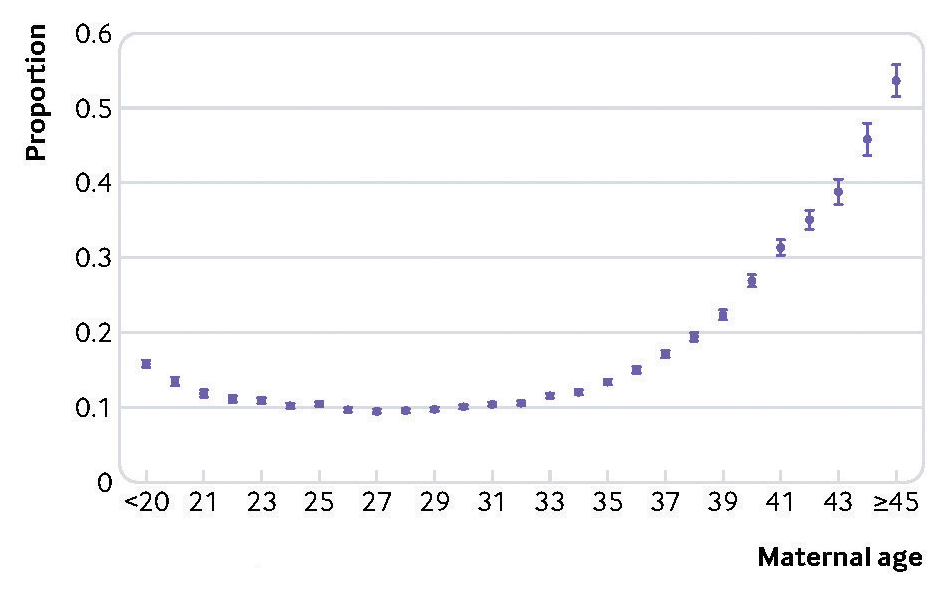
• Age: The incidence of fetal loss increases with maternal age, the risk being lowest in women aged 25-29 (10%), and rises rapidly after the age of 30, reaching 53% in women aged 45 and over,7 see figure 2. Paternal age, especially above 40 is also associated with increased risk although the association is less pronounced8
• Previous miscarriage
• Lifestyle factors such as smoking, alcohol and illicit drug use
• BMI either raised or low9
• Chronic conditions when control is not optimal, e.g. diabetes, epilepsy, Graves’ disease, inflammatory bowel disease.
If a woman has had three or more consecutive miscarriages (termed recurrent miscarriage), other causes such as antiphospholipid syndrome, uterine anomalies, and genetic abnormalities need to be considered.
Referral
Any pregnant woman with heavy vaginal bleeding who is haemodynamically unstable with signs of shock such as pallor, tachycardia or hypotension should be transferred immediately to the nearest emergency department, alerting the out of hours gynaecology team as resuscitation and urgent surgical intervention may be indicated.
For those less urgent symptomatic patients who are haemodynamically stable, it is important to ascertain if an ultrasound has already been performed and an ectopic pregnancy has been excluded. If the patient has not had a scan in this pregnancy, an urgent referral directly to an early pregnancy unit should be made.
However, if the woman has significant pain, there is evidence of infection or the early pregnancy unit is closed, a referral to the gynaecology on call team should be considered, in case she has an ectopic pregnancy rather than a miscarriage or sepsis from which the patient may deteriorate quickly.
While the patient is waiting for a review in the early pregnancy unit, safety netting with advice on when to attend the emergency department is essential, such as pain not relieved with simple analgesia, soaking through one or more sanitary pads every hour, feeling unwell or developing a temperature.
If the patient has had a scan confirming an intrauterine pregnancy, the need for review and referral should be individualised. It is important to ascertain the date of the scan, gestation, presence and amount of bleeding and risk factors for miscarriage. If pregnancy viability was uncertain and she presents with light bleeding, the woman should be advised to contact the early pregnancy unit but it is unlikely they will bring follow-up forward unless there are any other clinical concerns, since there are clear timelines for clarification of viability by ultrasound scan.
If a live embryo has been seen in this pregnancy, risk of fetal loss is low, reported to be 2-9%,10,11 and so a repeat scan may not always be a priority and awaiting the dating scan could be considered.
For asymptomatic women who have a history of previous pregnancy loss or recurrent miscarriage or those women who have had a sudden loss of pregnancy symptoms, a non-urgent referral can be made. Understandably, couples are very anxious in this situation, and a reassurance scan is usually offered at 7-8 weeks’ gestation.
Consultation time, support, counselling and follow-up are an essential part of the management of women with recurrent pregnancy loss.12 The PRISM trial has demonstrated that in this subgroup of women, progesterone treatment (400 mg vaginal capsules, twice daily) until 12 weeks may have a substantial benefit and should be considered for those who present with vaginal bleeding and have an ongoing pregnancy. There was a very small improvement in outcome for those who had one or two miscarriages and therefore this is not routinely advised.13
Confirming diagnosis
The current nomenclature used to describe first trimester miscarriage is summarised in table 1.
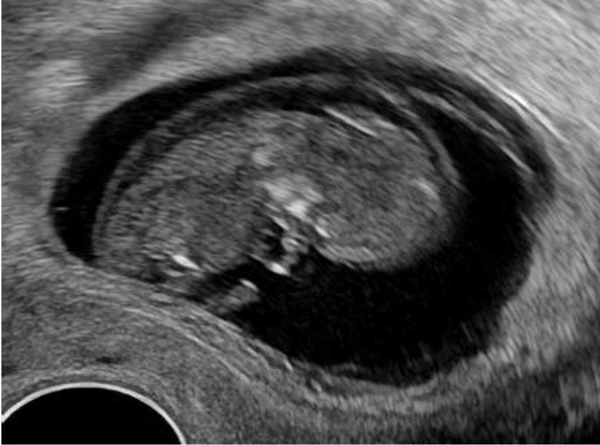
The ultrasound landmarks and criteria used by early pregnancy units for diagnosing a miscarriage, including the minimum time period needed before a follow-up scan are shown in table 2.
The gold standard is transvaginal ultrasound (TVS), however, sometimes, a transabdominal scan is performed for women with an enlarged uterus, a gestation of more than 10 weeks’ or if a TVS is unacceptable to the woman. The limitations of this approach need to be explained and a minimum follow-up of 14 days may be necessary to make a diagnosis of miscarriage.
Miscarriage should only be diagnosed when it is certain that the pregnancy is not ongoing. Early pregnancy units follow strict ultrasound criteria and have policies in place (including a second opinion) to avoid diagnostic errors, as a misdiagnosis can have catastrophic consequences. Common pitfalls in the diagnosis of miscarriage include:
• Miscalculating gestational age, especially in women who: are uncertain of their last menstrual period, have irregular cycles, have been using hormonal contraception within 3 months or are lactating
• Erroneously applying the ultrasound criteria and mistakenly diagnosing a miscarriage:
— Using the gestation sac diameter (≥ 25 mm) in the presence of an embryo
— Incorrectly labelling a chorionic bump as an embryo that measures ≥ 7 mm
— Incorporating a subchorionic haematoma as part of a gestational sac
• Missing an ectopic pregnancy due to:
— Not scanning the adnexa
— Wrongly presuming the pregnancy tissue has passed and diagnosing a complete miscarriage after an episode of heavy bleeding without a previous scan that confirms an intrauterine pregnancy
— Erroneously reporting fluid in the uterine cavity (which can be seen in ectopic pregnancy and is known as a pseudosac) as a gestational sac
— Incorrectly assuming pregnancy tissue low in the uterine cavity is due to an inevitable miscarriage rather than a scar ectopic and the tissue is in fact implanted in the caesarean section scar
• Failing to understand that fibroids or an enlarged uterus may make the scan and its interpretation challenging and a small sac of an early intrauterine pregnancy or an ectopic pregnancy can be missed.
Management
Management of women with a diagnosis of first trimester miscarriage can be expectant, medical or surgical. Women are asked to make an informed choice between these options as all are thought to be safe and effective. NICE recommends expectant management for 7-14 days as first-line management for all women,4 but also advises that other options should be explored if:
• The woman is at increased risk of haemorrhage or its effects (for example, she is in the late first trimester, has a coagulopathy or is unable to have a blood transfusion)
• There is evidence of infection
• She has had a previous adverse and/or traumatic experience associated with pregnancy (for example, stillbirth, miscarriage or antepartum haemorrhage)
• Expectant management is unacceptable to the woman
Medical management should be offered if:
• Expectant management is unsuccessful
• Bleeding persists after 14 days and there is ultrasound evidence of retained products of conception
• The woman opts for medical management to expedite the process and there are no contraindications.
Surgical management should be offered if:
• Expectant or medical management is unsuccessful
• The patient opts for this approach to expedite the process
• There are any signs of infection
• Trophoblastic disease is suspected
• The likelihood of haemorrhage is high
• The patient has a medical condition that warrants a surgical approach or her ability to withstand haemorrhage is reduced.
Standard practice for medical management of miscarriage in the UK is to offer misoprostol, a synthetic prostaglandin analogue, as a single dose given vaginally or sublingually in an inpatient or outpatient setting.
Recently, a large randomised double-blind, placebo-controlled trial, the MifeMiso trial reported that a combined approach giving oral mifepristone (an antiprogesterone thought to potentiate the effects of misoprostol) 2 days before misoprostol for women with a missed miscarriage, achieved higher success rates and less need for surgery.14 Side effects of these drugs need to be considered, the most common ones reported include nausea and vomiting, diarrhoea, headache and fever.15,16
Success of non-surgical options is high, however, the rates vary depending on the type of miscarriage, length of follow-up and presence of vaginal bleeding. In women with an incomplete miscarriage, the success rate is high, around 80%, and there is no significant difference between expectant and medical management in the rate of complete miscarriage or unplanned surgical intervention.17
For women who have a missed miscarriage, medical management is reported to be more effective (55-87%) compared with expectant management (29-42%).18,1
During the counselling of women who opt for these non-surgical options, it is important to explain to patients what to expect. They need to have pain relief, and antiemetics, at home and be made aware that they need to seek medical attention if heavy bleeding persists, significant pain is not relieved with simple analgesia or if they are feeling unwell with dizziness, fever or have any other reasons for concern. It is important to give patients written information and signpost them to available resources online (see External weblinks).
Early pregnancy units will follow up these women and confirm resolution of symptoms and clearance of hCG with a urine pregnancy test 2-3 weeks later after the bleeding has stopped.
If bleeding persists after 14 days, or the test is still positive after resolution of symptoms, or treatment has been unsuccessful, patients should be reassessed and further management individualised.
Surgical management of miscarriage can be carried out under general anaesthesia or in the outpatient setting with local anaesthesia, availability and indications vary between units. Emergency or semi-elective evacuation under general anaesthesia is the primary treatment of choice for those women who are bleeding heavily and are haemodynamically unstable, have a septic miscarriage, there is suspicion of a molar pregnancy, if it is the patient’s preference or there is a prolonged pregnancy loss to procedure time.
Manual vacuum aspiration under ultrasound guidance and local anaesthesia is becoming more acceptable to patients and is recognised to be an effective and safe way of treating miscarriage while avoiding the risks of general anaesthesia.19
Rhesus-negative women undergoing any surgical procedure for miscarriage should be given anti-D 250 IU intramuscularly. This is usually arranged by the hospital prior to discharge.20
Hysteroscopic resection of retained products is considered as an alternative surgical option, however there are no randomised controlled trials.21 It can be considered in some cases as an alternative but this should be decided on an individual case basis. It is mostly done when surgical management has failed and there is a small volume of localised pregnancy tissue remaining and the time from the end of pregnancy is significant.
Products of conception retrieved should be sent off to histopathology as part of the management of women with early pregnancy complications to help confirm the diagnosis of a miscarriage and rule out a molar pregnancy.
In women who are eligible for cytogenetic testing (such as women having their third or more consecutive loss), pregnancy products need to be sent in a second container without formalin. This should be recognised and considered when counselling patients for management.
Potential complications
Potential complications of first trimester miscarriage include:
• Severe haemorrhage and consequently unplanned surgical intervention
• Infection and sepsis in 2-3% of cases22
• Incomplete miscarriage
• Psychological sequelae:
A recent UK prospective cohort study23 found that 1 month after early pregnancy loss, 29% of women met criteria for PTSD, 24% for anxiety and 11% for depression. After 9 months, the proportions affected had fallen to 18%, 17% and 6% respectively. It is important to try to identify these women in primary care, so that their needs can be addressed early as depression and anxiety can have a significant impact on their quality of life and subsequent pregnancies
• Intrauterine adhesions (Asherman’s syndrome): these are frequently encountered after a miscarriage although more than half are mild with unknown clinical relevance. Recurrent miscarriage and dilatation and curettage procedures however, have been identified as increasing the risk.24
Follow-up
Pregnancy loss has a significant psychological impact. Therefore, a follow-up appointment should be offered to all women after an early pregnancy loss4 and referral to a specialist should be organised for those with significant symptoms.
NICE recommends that all women who have had a miscarriage should be followed up by their GP to discuss any questions the woman has regarding her miscarriage; assess the woman’s psychological wellbeing and offer counselling if appropriate; and ensure that all Rhesus-negative women who have had a surgical procedure have received anti-D immunoglobulin.25
If the woman does not want to conceive in the near future, contraception should be started to avoid an unplanned pregnancy. Further information on contraception after a miscarriage can be found in the Faculty of Sexual and Reproductive Healthcare guideline on contraception after pregnancy.27
If the woman does want to conceive, optimising her health and wellbeing prior to conception may include weight optimisation, smoking cessation, and rubella vaccination. All women should start folic acid before conception, 400 micrograms daily for most women, increased to 5 mg daily for those with a BMI 30 or more, and those at higher risk of having a baby with a neural tube defect such as women with diabetes or those taking antiepilepsy medication.
Women with chronic medical conditions should ensure that they are in the best health and taking the safest medications to achieve this and may benefit from a prepregnancy consultation with an expert in this area.
If the woman has had three or more miscarriages, a referral to the recurrent miscarriage clinic should be organised for further investigations as counselling, lifestyle changes and treatment (required in a minority) can make a huge difference. It is important also to reassure women who have had a miscarriage that it is likely that they will have a normal subsequent pregnancy.
Conclusion
Most commonly the cause of miscarriage is a random unidentified genetic abnormality in the embryo.
Healthcare professionals have a vital role in optimising the health and wellbeing of women who have suffered a miscarriage, monitoring closely those women who are at higher risk of miscarriage, ruling out other conditions that can mimic a miscarriage (i.e. ectopic pregnancy) and recognising and referring appropriately those women with life-threatening complications.
The management options are aimed at expediting the process, and ideally, the patient should be able to make an informed choice regarding her preferred approach. However, we recommend surgical management for women who have, or are at risk of, significant bleeding, have signs of infection or are suspected to have trophoblastic disease.
Providing information, empathy and support throughout is an essential part of the management of couples with a pregnancy loss.
REFERENCES
1 Jurkovic D, Overton C, Bender-Atik R. Diagnosis and management of first trimester miscarriage. BMJ 2013;346(7913):1-7
2 Huchon C, Panel P, Kayem G et al. Is a standardized questionnaire useful for tubal rupture screening in patients with ectopic pregnancy? Acad Emerg Med 2012;19(1):24-30
3 Crochet JR, Bastian LA, Chireau MV. Does this woman have an ectopic pregnancy? The rational clinical examination systematic review. JAMA 2013;309(16):1722-29
4 National Institute for Health and Care Excellence. NG126. Ectopic pregnancy and miscarriage: diagnosis and initial management. NICE. London. 2019
5 Knight M, Nair M, Tuffnell D et al. Saving lives, improving mothers’ care: Surveillance of maternal deaths in the UK 2012-14 and lessons learned to inform maternity care from the UK and Ireland Confidential Enquiries into Maternal Deaths and Morbidity 2009-14. National Perinatal Epidemiology Unit. Oxford. 2016
6 Hasan R, Baird DD, Herring AH et al. Association between first-trimester vaginal bleeding and miscarriage. Obstet Gynecol 2009;114(4):860-67
7 Magnus MC, Wilcox AJ, Morken NH et al. Role of maternal age and pregnancy history in risk of miscarriage: Prospective register based study. BMJ 2019;364:1869
8 du Fossé NA, van der Hoorn MLP, van Lith JMM et al. Advanced paternal age is associated with an increased risk of spontaneous miscarriage: A systematic review and meta-analysis. Hum Reprod Update 2020;26(5):650-69
9 Lashen H, Fear K, Sturdee DW. Obesity is associated with increased risk of first trimester and recurrent miscarriage: matched case-control study. Hum Reprod 2004;19(7):1644-46
10 Johns J, Jauniaux E. Threatened miscarriage as a predictor of obstetric outcome. Obstet Gynecol 2006;107(4):845-50
11 Tong S, Kaur A, Walker SP et al. Miscarriage risk for asymptomatic women after a normal first-trimester prenatal visit. Obstet Gynecol 2008;111(3):710-14
12 Royal College of Obstetricians and Gynaecologists. The investigation and treatment of couples with recurrent first-trimester and second-trimester miscarriage. RCOG Green-top Guideline No 17. 2011;(17):1-18
13 Coomarasamy A, Harb HM, Devall AJ et al. Progesterone to prevent miscarriage in women with early pregnancy bleeding: The PRISM RCT. Health Technol Assess 2020;24(33):1-70
14 Chu JJ, Devall AJ, Beeson LE et al. Mifepristone and misoprostol versus misoprostol alone for the management of missed miscarriage (MifeMiso): a randomised, double-blind, placebo-controlled trial. Lancet 2020;396(10253):770-78
15 Kovavisarach E, Jamnansiri C. Intravaginal misoprostol 600 μg and 800 μg for the treatment of early pregnancy failure. Int J Gynecol Obstet 2005;90(3):208-12
16 BNF 80 (British National Formulary). BNF September 2020
17 Kim C, Barnard S, Neilson JP et al. Medical treatments for incomplete miscarriage. Cochrane Database Syst Rev 2017;2013(3)
18 Bagratee JS, Khullar V, Regan L et al. A randomized controlled trial comparing medical and expectant management of first trimester miscarriage. Hum Reprod 2004;19(2):266-71
19 Sharma M. Manual vacuum aspiration: an outpatient alternative for surgical management of miscarriage. Obstet Gynaecol 2015;17(3):157-61
20 Qureshi H, Massey E, Kirwan D et al. BCSH guideline for the use of anti-D immunoglobulin for the prevention of haemolytic disease of the fetus and newborn. Transfus Med 2014;24(1):8-20
21 Hooker AB, Aydin H, Brölmann HAM, Huirne JAF. Long-term complications and reproductive outcome after the management of retained products of conception: A systematic review. Fertil Steril 2016;105(1):156-164.e2
22 Trinder J, Brocklehurst P, Porter R et al. Management of miscarriage: expectant, medical, or surgical? Results of randomised controlled trial (miscarriage treatment (MIST) trial). BMJ 2006;332(7552):1235-38
23 Farren J, Jalmbrant M, Falconieri N et al. Posttraumatic stress, anxiety and depression following miscarriage and ectopic pregnancy: a multicenter, prospective, cohort study. Am J Obstet Gynecol 2020;222(4):367. e1-367.e22
24 Hooker AB, Lemmers M, Thurkow AL et al. Systematic review and meta-analysis of intrauterine adhesions after miscarriage: Prevalence, risk factors and long-term reproductive outcome. Hum Reprod Update 2014;20(2):262-78
25 National Institute for Health and Care Excellence. Clinical knowledge summaries. Miscarriage: management. NICE. London. 2020 cks.nice.org.uk/topics/miscarriage/management
26 Jauniaux E, Johns J, Burton GJ. The role of ultrasound imaging in diagnosing and investigating early pregnancy failure. Ultrasound Obstet Gynecol 2005;25(6):613-24
27 Faculty of Sexual and Reproductive Healthcare. FSRH Clinical Guideline: Contraception after pregnancy. FSRH. 2017 Updated 2020
 Download this article in PDF format