SEARCH

Practitioner 2011; 255 (1737): 19-22
Managing patients on dialysis in the community
22 Feb 2011
AUTHORS
Dr Jennifer A McCaughan MRCP Specialty Registrar in Nephrology
Dr Aisling E Courtney FRCP Consultant Nephrologist
Regional Nephrology Unit, Belfast City Hospital, Belfast
Article
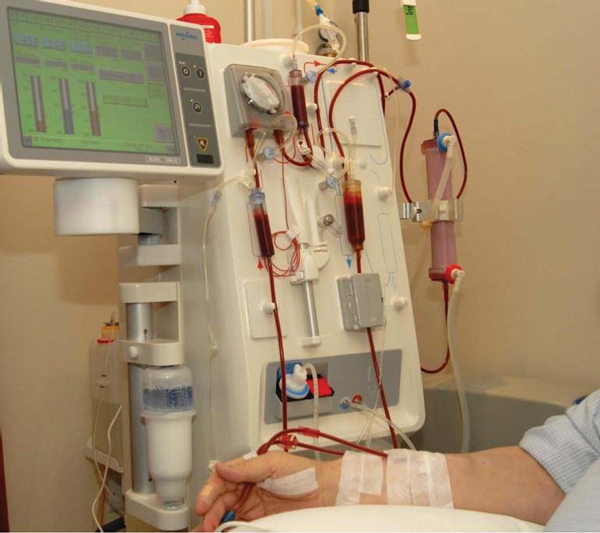
There are approximately 50,000 people in the UK on renal replacement therapy (RRT) and this number is increasing each year.1 In an average GP practice there will be one or two patients currently on RRT and a larger number with progressive chronic kidney disease who will reach end stage renal disease (ESRD). The options for RRT are kidney transplantation, haemodialysis (HD), see figure 1, or peritoneal dialysis (PD). The management of an individual with ESRD may involve all of these modalities during the course of their lifetime.
For many patients with ESRD, treatment at home allows greater flexibility and independence than can be facilitated by inpatient HD. Others value the security of receiving their RRT in a hospital environment and would resent the intrusion of dialysis into their home life. All patients appreciate early information about the options for RRT so that they and their family can make an informed decision about the best treatment for them.2 The aim is to provide personalised information to patients at least three months before they need to begin RRT.3
Peritoneal dialysis
PD can be broadly categorised into two types: continuous ambulatory peritoneal dialysis (CAPD) and automated peritoneal dialysis (APD), although some dialysis regimens use a combination of these approaches. In the combination model, most dialysis occurs at night via APD but one or more manual exchanges are carried out during the day to allow extra fluid and solute removal.
CAPD involves the continuous presence of dialysis fluid within the peritoneal cavity and usually three to four exchanges of fluid daily carried out by the patient.
To drain the dialysis fluid from the abdomen the patient unscrews the cap at the end of the PD catheter and connects it to an empty bag. Fluid drains out under gravity. A bag with clean fluid is hooked up to a stand or placed in an elevated position, the end is connected to the PD catheter and the fluid flows into the abdomen again under gravitational pull.
Maintaining sterility throughout is essential and the process may take 30 to 60 minutes.
A degree of manual dexterity is needed and the ability to handle 2 kg bags of fluid. Clearly for people to do this in the middle of their working day is at best inconvenient, but may be impossible depending on their employment and facilities.
In APD, there are more frequent exchanges (typically overnight) which are controlled by a programmable machine, and often fluid is deliberately left in the abdomen during the day to allow further dialysis. Patients attach themselves to the machine in the evening and detach themselves in the morning.
Each PD patient has a personalised prescription depending on their body mass, residual renal function and the physical properties of their peritoneal membrane.
Most dialysis centres have a dedicated PD team involving nephrologists, specialist nurses and professionals trained in the implantation of PD catheters. These are inserted into the peritoneum preferably at least two weeks before PD is commenced. This can be done under local or general anaesthesia and is normally a day procedure.4 The PD catheter lies within the pelvis and can be easily visualised on an abdominal X-ray (see figure 2).
Once the catheter is inserted patients need to undergo a period of training in the techniques of PD facilitated by specialist nursing staff. Some modifications in the home may be required for the storage and subsequent safe disposal of fluid.
The contraindications to PD are:
- an inability to carry out the procedure because of physical, psychological or social issues
- being unsuitable for a PD catheter placement usually as a result of previous abdominal surgery
- loss of peritoneal function due to previous abdominal pathology or long duration of previous PD.
In the first case, difficulties may be overcome with help from family or health professionals; this is known as assisted PD. Assistants undergo the same training as independent PD patients in the technique of preparing PD fluid, using the PD catheter and identifying problems.
A good urine output is desirable as patients may struggle to attain adequate fluid removal otherwise.
Benefits
PD is an effective dialysis therapy which may be tailored to suit each patient's work and family commitments. It can be an ideal therapy for independent individuals who can learn the technique and are motivated to take responsibility for their own health. Additionally, it allows more freedom to travel than HD as the equipment is portable.
PD however does have a limited lifespan. The peritoneal membrane alters with exposure to dialysis fluid and achieving adequate dialysis becomes more challenging. Urine output often decreases over time and it may be necessary to switch to HD to allow removal of fluid and solute. Additionally, the risk of developing encapsulating sclerosing peritonitis increases with time spent on PD. This is a life-threatening complication associated with bowel obstruction and malabsorption.
On average patients can have approximately four years of successful PD before needing to switch to an alternative mode of RRT.
Complications
The common complications associated with PD are listed in table 1. Patients usually contact their PD team directly when problems develop and advice from the local nephrology unit should be available 24 hours a day.
Home haemodialysis
In home haemodialysis (HHD), the entire process takes place in the patient's home and is initiated and managed by the patient.
The patient assesses their need for fluid removal, prepares the machine, establishes access to their circulation (normally by needling their AVF) and self-administers the required drugs.
HHD is organised by hospital-based HD units and currently 2% of the HD population dialyse at home.1 For HHD to be successful, a patient must undertake training in an HD centre where they learn how to programme and prepare the machine, to needle their own AVF, to manage complications and to carry out HD sessions independently.
The frequency of HHD varies between patients from four to six times a week. Some patients dialyse overnight, nocturnal HHD, but others find it impossible to sleep when dialysing.
The patient's home is adapted as necessary for HD and water purification equipment, electrical provision and appropriate water supply. Specialist nurses review the patient at home and are usually the first point of contact if problems arise.
Initially, these reviews are very frequent and involve supervision of the HD technique but the need for regular specialist nurse intervention declines as the patient becomes increasingly skilled and confident at HHD.
The length of time necessary for patients to master PD and HD techniques varies hugely and depends upon each individual's motivation, dexterity and ability to remember and implement complex instructions.
Who is suitable for HHD?
HHD is an option for any motivated patient who can learn the necessary skills to manage their own HD and deal with the potential complications. It is an increasingly popular choice for young, independent individuals but HHD is only suitable for a select population of those with ESRD. Many people are limited by lack of manual dexterity or are unable to master the technique. Others are anxious about encountering difficulties with their treatment on their own.
Benefits
The strongest clinical argument for choosing HHD is the ability to provide longer and more regular HD sessions. Daily HD results in an improvement
in blood pressure control, solute clearance and anaemia management, and thus confers a significant survival benefit to patients.5,6 One study has reported that the survival of patients on nocturnal HD was comparable with that of patients who had received a deceased donor kidney transplant.7 HHD patients consistently score better on quality of life assessments than their counterparts who receive inpatient HD.
Complications
Common problems encountered on HD are listed in table 2, p20. Each HHD patient has access to 24-hour clinical and technical support and will be registered with water, electricity and telephone providers.8
Conclusion
Home dialysis therapies allow patients a freedom and independence which is curtailed by thrice weekly inpatient HD. All patients with ESRD should be empowered to decide which form of RRT is best for them and their choice facilitated wherever possible.
Patients who carry out home dialysis are an admirable group who generally lead productive and independent lives despite having ESRD.
While both PD and HHD are organised by nephrology units, the support of the primary care team is invaluable to enable patients to undergo these therapies successfully in the community.
Common non-renal problems include increased cardiovascular risk in all patients with ESRD. Patients will benefit from active management of risk factors.
These patients are also relatively immunosuppressed and therefore more prone to infection.
Constipation is a very common problem for those on PD and they may seek help for this from their primary care team.
Some patients become psychologically fatigued by home dialysis, particularly after years of treatment. They may present to their GP with symptoms of depression or anxiety.
Open and free communication between the primary care team and the dialysis team is encouraged and a joint approach will provide the best outcome for patients.
Acknowledgement
The authors thank Dr Mairead Finn for her helpful critique of the manuscript.
REFERENCES
1 UK Renal Registry Annual Report 2009 www.renalreg.com/Reports/2009.html
2 Lee A, Gudex C, Povlsen JV et al. Patients' views regarding choice of dialysis modality. Nephrol Dial Transplant 2008;23:3953-9
3 Planning, Initiating and Withdrawal of Renal Replacement Therapy Guidelines. The Renal Association 2009 www.renal.org/clinical/GuidelinesSection/Guidelines.aspx
4 Peritoneal Access Guidelines. The Renal Association 2009 www.renal.org/clinical/GuidelinesSection/Guidelines.aspx
5 Walsh M, Culleton B, Tonelli M et al. A systematic review of the effect of nocturnal haemodialysis on blood pressure, left ventricular hypertrophy, anaemia, mineral metabolism and health related quality of life. Kidney Int 2005;67(4):1500-8
6 Kjellstrand CM, Buoncristiani U, Ting G et al. Short daily haemodialysis: survival in 415 patients treated for 1006 patient years. Nephrol Dial Transplant 2008;23:3283-9
7 Pauly RP, Gill S, Rose CL et al. Survival among nocturnal home haemodialysis patients compared to kidney transplant recipients. Nephrol Dial Transplant 2009;24:2915-9
8 Improving Choice for Kidney Patients: Five STEPS toolkit to Home Haemodialysis. NHS Kidney Care www.kidneycare.nhs.uk/
USEFUL INFORMATION
NHS Kidney Care
www.kidneycare.nhs.uk
Kidney Patient Guide
www.kidneypatientguide.org.uk/site/pdanim.php
Edinburgh Renal Unit
www.edren.org
ARTICLE IN PDF
 Download this article in PDF format