SEARCH

Allan CE, Valkanova V, Ebmeier KP. Depression in older people is underdiagnosed. Practitioner 2014; 258 (1771):19-22
Depression in older people is underdiagnosed
22 May 2014
AUTHORS
Dr Charlotte E. Allan MRCPsych, Clinical Academic Lecturer
Dr Vyara ValkanovaMRCPsych, ST4 in Psychiatry
Professor Klaus P. Ebmeier MD, Professor of Old Age Psychiatry
Department of Psychiatry, University of Oxford, Oxford, UK
Article
Depression is more common in old age than dementia,1 yet is underdiagnosed and undertreated. The reasons for this may relate to the overlap of presenting symptoms with ‘normal’ distress, which can make a diagnosis difficult, or to a lack of recognition of the importance of the condition by clinicians, patients and their families.
Regardless of age, depression can present with low mood in addition to other biological changes e.g. in sleep and appetite, and psychological changes e.g. low self-esteem and guilt, see table 1. However, it is important to recognise that patients may not always present in such a typical way. Other presenting features that may indicate depression include anxiety, a preoccupation with somatic symptoms, and a change in function, with reduced interest in previously enjoyed activities.2,3 Changes in cognitive performance, particularly reduced executive function, e.g. planning activities, and poor attention and memory may be prominent,4 and this can lead to difficulty distinguishing depression from dementia.
Risk factors
Patients with a previous history of depression and anxiety disorders are at increased risk of depression in later life. Age-related disabilities and changes to physical health are major risk factors for depression in older people. Vascular diseases, including stroke, myocardial infarction and diabetes increase the risk of depression, both through direct effects on the brain and the psychological effects of suffering a major illness.5-7 Likewise, dementia is a risk factor for the development of depression.8
While biological factors are predominant, psychological factors such as loneliness and loss of a valued role, as well as social factors related to retirement, bereavement and reduced independence may all increase the risk for depressive disorder.9-12 In later onset depression, genetic risk factors are less relevant and possibly different from those in younger people.13,14
Assessment
Because of the frequency of putative reasons for distress in old age, consideration of depressive illness as a differential diagnosis is important. Thereafter, assessment and diagnosis are largely based on a careful history. This should focus on eliciting current features of depression, which have been present for at least two weeks, and are associated with a significant change in function, see table 1.
Screening tools for depression can be useful to identify key symptoms and to quantify their severity, both aspects that will guide further investigation and management.
The screening tools available range from a set of very simple questions to more complex, detailed assessments, some are available in electronic format.
The commonly used Patient Health Questionnaire (PHQ-9), is a clinician administered tool that assesses all DSM-IV inclusion criteria for major depressive disorder as well as including an additional item assessing psychosocial impairment.15
Self-administered questionnaires include the General Health Questionnaire (GHQ),16 the Centre for Epidemiological Studies Depression rating scale (CES-D)17,18 and the Geriatric Depression Scale.19,20
If depression is suspected, it is important to exclude organic disorders that may mimic symptoms of depressive disorder, including anaemia, B12 and folate deficiency and hypothyroidism.
Cognitive assessment in depression is more difficult; a patient with depression is likely to show impaired cognitive assessment scores with significant overlap in scores with mild cognitive impairment and even dementia.
Where there is doubt over the diagnosis, a trial of antidepressant treatment can be undertaken with cognitive assessment repeated at a later stage, alternatively a referral to old age psychiatry services may be appropriate.
Management
Various interventions are effective and the choice is guided by patient preference, as well as the duration and previous course of illness, past response to treatment, comorbidities and likelihood of adherence and potential adverse effects.19,21
Management involves a stepped care framework where the least intrusive, most effective intervention is provided first. However, slavish adherence to this principle should be discouraged. GPs should have ready access to the patient’s past history, so that mild symptoms can be readily identified as precursors of an episode of more severe illness, warranting a more energetic treatment approach, particularly if this treatment has been successful in the past.
In mild depression, general advice on sleep hygiene and getting more structure into the day, together with active monitoring is recommended. Befriending may also be helpful.22
These services are generally provided by charities such as Age UK. They offer telephone services or regular one-to-one visits from a volunteer to the older person’s home. Referrals can be made via different routes, including self-referral, referral from family members or healthcare professionals.
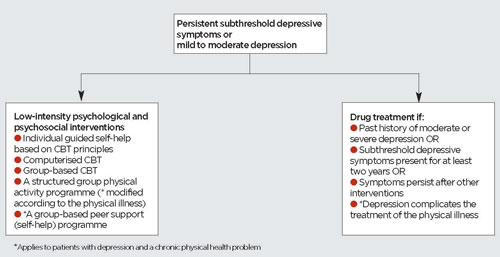
In patients with sub-threshold depressive symptoms and mild to moderate depression one or more of the low-intensity psychological interventions should be offered.
There is good evidence for the effectiveness of psychological interventions in older people, including CBT, problem solving therapy and behavioural activation.23-27
Many older people resist the use of antidepressants and express a preference for a psychological treatment.28 Despite this, the evidence shows that older people are less likely to be referred to specialist psychological services, compared with younger people.29 Exercise is also recommended as a treatment. For patients with depression and chronic physical illness, the programme should be modified according to their needs.21 Antidepressants should not be prescribed routinely for mild depression, see figure 1.19
When the response to initial interventions is inadequate, or in people with moderate and severe depression, an antidepressant or a high-intensity psychological intervention should be considered, see figure 2. Antidepressants are effective in older people, and the principles of prescribing are the same as those for younger people.19,30,31
NICE guidelines suggest that a generic SSRI should be first-line treatment. It is important to inform patients about the discontinuation effects of antidepressants at the beginning of the treatment. Choice of antidepressant should be guided by comorbidities which are common in older patients, as well as the side-effect profile. Sertraline and citalopram are preferred drugs in people with chronic physical illness because they have a lower propensity for interactions.
One antidepressant should be tried for at least four weeks, before switching to another SSRI or an antidepressant from a different class, e.g. mirtazapine or venlafaxine. Although in old age there is a greater vulnerability to side-effects, see table 2, and the rate of metabolism is altered, it is important to use therapeutic doses of antidepressants. The treatment should be continued for at least six months (preferably at least two years) and should be stopped gradually.
In those who have had recurrent depression, long-term treatment for relapse prevention is recommended. For treatment-resistant depression, augmentation with lithium or an antipsychotic or the addition of a second antidepressant is recommended, but this usually requires consultation with a psychiatrist.19
If the response to either pharmacological or psychological intervention is inadequate, combining antidepressants with CBT should be considered. In moderate to severe depression associated with a chronic physical illness and functional impairment collaborative care may be effective. In this approach the case manager will provide long-term co-ordination of care and liaise with the GP and mental health services.21,32
Referral
Most patients with depressive disorders are treated in primary care. Referral to specialist mental health services, old age psychiatry or single point of entry, is indicated, in the following situations:
• Diagnostic difficulty e.g. differentiating between depression and cognitive impairment
• Poor response to treatment
• Psychotic symptoms
• Significant psychiatric comorbidity
• Risk of self-neglect or suicide
In the case of poor response to treatment, it is important to consider compliance, concurrent medication, comorbidities (e.g. optimal control of symptoms and signs of physical illness), continuing psychosocial stressors such as bereavement and loneliness, excessive alcohol consumption and onset of dementia before referring to specialist services.
While recognising such factors and treating them, as far as possible, to remove causes and confounders, the specific treatment of depressive disorders should remain a priority.
The presence of understandable triggers and causes should not deter GPs from offering treatment, as long as the symptoms are pervasive and continuously persist beyond two weeks. Depression in older age responds to treatment just as it does in younger patients, if anything, the risk of relapse is higher, and continuous prophylactic treatment is more likely to be necessary.
REFERENCES
1 World Health Organization Mental health action plan 2013-2020. WHO. Geneva. 2013
2 Allan CL, Ebmeier KP. Review of treatment for late-life depression. Advances in Psychiatric Treatment 2013;19(4):302-9
3 Alexopoulos GS, Kelly RE Jr. Research advances in geriatric depression. World Psychiatry 2009;8(3):140-9
4 Herrmann LL, Goodwin GM, Ebmeier KP. The cognitive neuropsychology of depression in the elderly. Psychol Med 2007;37(12):1693-702
5 O'Donnell MJ, Xavier D, Liu L et al. Risk factors for ischaemic and intracerebral haemorrhagic stroke in 22 countries (the INTERSTROKE study): a case-control study. Lancet 2010;376(9735):112-23
6 Kendler KS, Gardner CO, Fiske A, Gatz M. Major depression and coronary artery disease in the Swedish twin registry: phenotypic, genetic, and environmental sources of comorbidity. Arch Gen Psychiatry 2009;66(8):857-63
7 Valkanova V, Ebmeier KP. Vascular risk factors and depression in later life: a systematic review and meta-analysis. Biol Psychiatry 2013;73(5):406-13
8 Nilsson FM, Kessing LV, Sorensen TM et al. Enduring increased risk of developing depression and mania in patients with dementia. J Neurol Neurosurg Psychiatry 2002;73(1):40-4
9 Kivela SL, Luukinen H, Koski K et al. Early loss of mother or father predicts depression in old age.
Int J Geriatr Psychiatry 1998;13(8):527-30
10 Steunenberg B, Beekman AT, Deeg DJ et al. Mastery and neuroticism predict recovery of depression in later life. Am J Geriatr Psychiatry 2007;15(3):234-42
11 Steptoe A, Marmot M. Burden of psychosocial adversity and vulnerability in middle age: associations with biobehavioral risk factors and quality of life. Psychosom Med 2003;65(6):1029-37
12 Schwarzbach M, Luppa M, Sikorski C et al. The relationship between social integration and depression in non-demented primary care patients aged 75 years and older. J Affect Disord 2013;145(2):172-8
13 Brodaty H, Peters K, Boyce P et al. Age and depression. J Affect Disord 1991;23(3):137-49
14 Schoevers RA, Beekman AT, Deeg DJ et al. Risk factors for depression in later life; results of a prospective community based study (AMSTEL).
J Affect Disord 2000;59(2):127-37
15 Spitzer RL, Williams JB, Kroenke K et al. Utility of a new procedure for diagnosing mental disorders in primary care. The PRIME-MD 1000 study. JAMA 1994;272(22):1749-56
16 Goldberg D. The Detection of Psychiatric Illness by Questionnaire. Oxford University Press. Oxford. 1972
17 Head J, Stansfeld SA, Ebmeier KP et al. Use of self-administered instruments to assess psychiatric disorders in older people: validity of the General Health Questionnaire, the Center for Epidemiologic Studies Depression Scale and the self-completion version of the revised Clinical Interview Schedule. Psychol Med 2013:1-8
18 Radloff LS. The CES-D Scale: A Self-Report Depression Scale for Research in the General Population. Applied Psychological Measurement 1977;1(3):385-401
19 National Institute for Health and Clinical Excellence. CG90. The treatment and management of depression in adults. NICE. London. 2009
20 Yesavage JA, Brink TL, Rose TL et al. Development and validation of a geriatric depression screening scale: a preliminary report. J Psychiatr Res 1982;17(1):37-49
21 National Institute for Health and Clinical Excellence. CG91. Depression in adults with a chronic physical health problem: treatment and management. NICE. London. 2009
22 Mead N, Lester H, Chew-Graham C et al. Effects of befriending on depressive symptoms and distress: systematic review and meta-analysis. Br J Psychiatry 2010;196(2):96-101
23 Oxman TE, Sengupta A. Treatment of minor depression. Am J Geriatr Psychiatry 2002;10(3):256-64
24 Laidlaw K, Davidson K, Toner H et al. A randomised controlled trial of cognitive behaviour therapy vs treatment as usual in the treatment of mild to moderate late life depression. Int J Geriatr Psychiatry 2008;23(8):843-50
25 Serfaty MA, Haworth D, Blanchard M et al. Clinical effectiveness of individual cognitive behavioral therapy for depressed older people in primary care: a randomized controlled trial. Arch Gen Psychiatry 2009;66(12):1332-40
26 Cuijpers P, van Straten A, Smit F. Psychological treatment of late-life depression: a meta-analysis of randomized controlled trials. Int J Geriatr Psychiatry 2006;21(12):1139-49
27 Kiosses DN, Alexopoulos GS. Problem-Solving Therapy in the Elderly. Curr Treat Options Psychiatry 2014;1(1):15-26
28 Givens JL, Datto CJ, Ruckdeschel K et al. Older patients' aversion to antidepressants. A qualitative study. J Gen Intern Med 2006;21(2):146-51
29 Kendrick T, Dowrick C, McBride A et al. Management of depression in UK general practice in relation to scores on depression severity questionnaires: analysis of medical record data. BMJ 2009;338:b750
30 Wilson K, Mottram P, Sivanranthan A, Nightingale A. Antidepressant versus placebo for depressed elderly. Cochrane Database Syst Rev 2001(2):CD000561
31 Nelson JC, Delucchi KL, Schneider LS. Moderators of outcome in late-life depression: a patient-level meta-analysis. Am J Psychiatry 2013;170(6):651-9
32 Unutzer J, Katon W, Callahan CM et al. Collaborative care management of late-life depression in the primary care setting: a randomized controlled trial. JAMA 2002;288(22):2836-45
33 World Health Organization;. International Statistical Classification of Diseases and Related Health Problems 10th Revision (ICD-10) Version for 2010. WHO. 2010
34 American Psychiatric Association Diagnostic and Statistical Manual of Mental Disorders (DSM-IV). Fourth edn. APA. Washington, DC. 1994
ARTICLE IN PDF
 Download this article in PDF format
PRESET SEARCHES
Immediate CPD prompts
These handy templates* prompt immediate drafting of personal learning, reflection and planning. Save your record straight into your personal development folder on your device or Cloud storage system.
*Adobe reader needed for iPad
EXTERNAL WEBLINKS
The NICE guidelines on depression (CG90 and CG91) are available on the website.
Royal College of Psychiatrists