SEARCH

Valkanova V, Rhodes F, Allan CL. Diagnosis and management of autism in adults. Practitioner 2013; 257 (1761):13-16
Diagnosis and management of autism in adults
23 May 2013
AUTHORS
Dr Vyara Valkanova BSc (Hons) MD, Associate Clinical Fellow, Department of Psychiatry
Ms Fiona Rhodes BA (Hons), Fifth Year Medical Student, Jesus College
Dr Charlotte L Allan MBChB (Hons) MRCPsych, Clinical Research Fellow, Department of Psychiatry, University of Oxford, Oxford, UK
Article
Adults with autism can be significantly disadvantaged in many aspects of life including employment, social relationships, physical and mental health.1 Recognition of the importance of identifying, assessing and managing adults with autism is increasing, particularly with the publication of recent NICE guidelines.2 It is vital for adults of all ages, including older people,3 to be accurately diagnosed in order to receive appropriate management.
Autism affects 1.1% of the adult population.4 The spectrum of symptoms is wide. Some individuals have above average intelligence and are fully independent, while others have limited independence because of a learning disability.
Developmental delay is a core feature, and autism is usually diagnosed in childhood.5 However, the diverse clinical spectrum makes early diagnosis difficult, especially if good language and cognitive skills help the child to develop coping strategies. Hence high-functioning individuals with autism, Asperger’s syndrome, may remain undiagnosed until adulthood.6
Symptoms and signs
GPs should suspect autism if patients present with the signs and symptoms listed in table 1.
Diagnostic complexity is significantly increased when autism coexists with other mental disorders. Learning disability is the most common, and is present in up to 60% of people with autism,7 however, depression, social anxiety, obsessive compulsive disorder and attention deficit hyperactivity disorder (ADHD) may also be found.
Depression and anxiety may occur due to the psychological and social consequences of autism, while common aetiological factors relating to neurodevelopmental disorders, may predispose to ADHD.
Autism is a lifelong condition characterised by difficulties in two core dimensions:
• Problems in social communication
• Strongly repetitive behaviour, resistance to change or restricted interests
People with autism show symptoms from both core dimensions and the difficulties in these two domains can be manifest in multiple ways, see table 2.
Assessment
Careful consideration of core signs and symptoms is the first step in assessment see table 1. It may be necessary to make adjustments to the physical environment, and to the duration and pacing of the assessment.2
A collateral history should identify early developmental and behavioural problems in different settings i.e. at home, in education or employment.2 Sensory and gastrointestinal problems are very common, and should be asked about. Up to 90% of adults with autism without a learning disability are hyper- or hyposensitive to sound, light, colour, smell or taste.8 Almost half of adults with autism and a learning disability suffer from gastrointestinal disorders.9
Further investigations help to determine which patients should be referred to specialist services for a comprehensive assessment.
The Autism-Spectrum Quotient (AQ-10) is a 10-item questionnaire for people with suspected autism.10
The advantage of using this in primary care is that it provides a time-efficient, structured way of ascertaining key symptoms and clearly signals those who should be referred for further assessment. It is freely available online (http://guidance.nice.org.uk/CG142/AQ10Test/pdf/English).
Biological tests e.g. hearing, sight and electroencephalography, genetic tests and neuroimaging should not be used during the initial assessment, and are rarely needed as part of a comprehensive assessment.2
Confirming diagnosis
Patients should be referred if autism is suspected clinically. The AQ-10 provides useful additional information to support referral; those who score above six should be referred.10 The AQ-10 requires a patient to be able to read and write, and therefore is not appropriate for those with a moderate or severe learning disability. Where this is the case, referral should be based on a brief assessment only: if a patient has two or more behaviours suggestive of autism, see table 3 then referral is appropriate.2
A diagnosis of autism should be confirmed by a specialist multidisciplinary team.2 The assessment should include a detailed developmental history and information about current and past behaviour, see table 4.
This information will usually require a collateral history from someone who knows the patient well. Careful observation is needed to assess the core signs of autism, particularly patterns of social interaction.
The use of formal assessment tools which cover multiple domains including social interaction, communication, and imaginative use of materials, may aid the diagnosis, particularly in complex cases, see table 5.
However, all assessment tools have major limitations and should only be used in conjunction with a detailed clinical history.11
The results of the assessment should be communicated clearly to the patient, ideally with the support of a friend, family member or carer. If a diagnosis of autism is made, clinicians should do a risk assessment and formulate risk and crisis management plans. These should include details of the roles and responsibilities of both the specialist team and primary care team in managing crisis situations.
The role of the GP in a crisis situation will vary depending on the needs of the individual, and may include, acting as the first point of contact (particularly out of hours), assisting the patient in contacting the specialist team, and, if appropriate, ensuring prompt prescription of medications.
If there is disagreement about the diagnosis, a GP could consider obtaining a second opinion. This may be useful, if a patient has complex physical or psychiatric comorbidities, or if local teams lack sufficient expertise in adults with autism.
Management
Psychosocial interventions
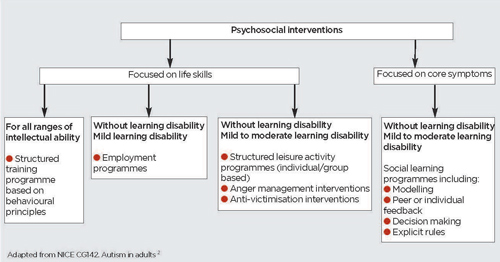
For adults with autism a group-based or individual social learning programme to improve social interaction is recommended.2 This should include modelling, decision making, strategies for dealing with socially difficult situations and peer or individual feedback. Training in life skills is recommended for adults with all ranges of intellectual ability, who
need help with activities of daily living. This consists of structured training programmes based on behavioural principles. For higher functioning individuals structured leisure activity programmes, and anger management may be beneficial, see figure 1.
Adults with autism have high levels of unemployment,12 and employment programmes have been successfully used to support people in obtaining or maintaining employment. Programmes typically include assistance with written applications, interviews, identification of appropriate roles and employer education and support. Prospects, run by the National Autistic Society, placed 68% of clients in work, the majority on permanent contracts, with high client and employer satisfaction and significant job retention at eight year follow-up.13
Biological treatments
Further research into the use of antidepressants in managing the core symptoms of autism is needed, and their use is not currently recommended by NICE.2
There is promising trial evidence that fluoxetine significantly improves repetitive behaviours compared with placebo, and is well tolerated.14 However, interpretation of this study and trials of other SSRIs are limited by small sample sizes and use of scales not validated in autism.
Biomedical interventions that are not recommended for the core symptoms of autism are listed in table 6.
Challenging behaviour
Before considering any psychosocial or pharmacological intervention for challenging behaviour, an assessment should be made of factors that may be triggering or maintaining the behaviour, including any physical symptoms, coexisting mental disorders and the physical or social environment.2
First-line treatment should focus on psychosocial interventions relevant to unmet needs, triggers and reinforcements of the challenging behaviour, and a complete evaluation of the behaviour, the individual and their environment.2
Intervention strategies should clearly identify target behaviour, desired outcomes, and a timescale for assessment of efficacy and modification. Any intervention should be focused on overall quality of the patient’s life.
Second-line treatments may include medication such as antipsychotic drugs. These should be used in conjunction with a psychosocial intervention.2 Antipsychotics should not be used first line, unless the patient’s behaviour is so dangerous that it precludes the use of psychosocial or other interventions. Antipsychotics should be prescribed by a specialist and should be discontinued if there is no clinically important response by six weeks. Anticonvulsants should not be used routinely for challenging behaviour.
Coexisting disorders
NICE recommendations are available for coexisting mental disorders,2 however, it may be helpful to seek advice from a specialist autism team to discuss how to adapt management.
When considering any pharmacological treatment, low doses should be used and attention should be given to the potential for greater sensitivity to any side effects and idiosyncratic responses.
Primary care team support
An understanding of autism and the difficulties it poses is central to offering appropriate support to patients and their families.
A significant proportion of adults with autism experience social and economic exclusion, and are unable to access the support they need to live independently.2 They are also at increased risk of other mental and physical disorders, and are less likely to report these.
People with autism, and if appropriate their carers, should have the opportunity to be involved in making informed decisions about their care, in partnership with healthcare professionals.2 It is helpful to consider the impact of the practice environment, including noise, proximity of others and time pressure. It is likely to take longer to establish a rapport; so it may help to use factual language, visual aids, written information and to avoid abstract terms.
Families of adults with autism provide much of the care and support, and are often crucial in the success of interventions. They should be offered an assessment of their own needs, including psychological, social and emotional support, respite care, emergency plans and planning of future care,2 and signposting to relevant organisations.
REFERENCES
1 Howlin P, Moss P. Adults with autism spectrum disorders. Can J Psychiatry 2012;57(5):275-83
2 National Institute for Health and Clinical Excellence. CG142. Autism: recognition, referral, diagnosis and management of adults on the autism spectrum. NICE. London. 2012
3 Mukaetova-Ladinska EB, Perry E, Baron M, Povey C. Ageing in people with autistic spectrum disorder. Int J Geriatr Psychiatry 2012;27(2):109-18. doi: 10.1002/gps.2711. Epub 2011/05/04
4 Brugha T, Cooper SA, McManus S. Estimating the prevalence of autism spectrum conditions in adults: Extending the 2007 Adult Psychiatric Morbidity Survey. The Health and Social Care Information Centre. London. 2012
5 Frith U. Autism: Explaining the Enigma. Blackwell. Oxford. 1989
6 Attwood T. Asperger’s Syndrome: A Guide for Parents and Professionals. Jessica Kingsley. London. 1997
7 Baird G, Simonoff E, Pickles A et al. Prevalence of disorders of the autism spectrum in a population cohort of children in South Thames: the Special Needs and Autism Project (SNAP). Lancet 2006;368(9531):210-5. Epub 2006/07/18
8 Crane L, Goddard L, Pring L. Sensory processing in adults with autism spectrum disorders. Autism 2009;13(3):215-28
9 Galli-Carminati G, Chauvet I, Deriaz N. Prevalence of gastrointestinal disorders in adult clients with pervasive developmental disorders. J Intellect Disabil Res 2006;50(Pt 10):711-8
10 Allison C, Auyeung B, Baron-Cohen S. Toward brief “Red Flags” for autism screening: The Short Autism Spectrum Quotient and the Short Quantitative Checklist for Autism in toddlers in 1,000 cases and 3,000 controls [corrected]. J Am Acad Child Adolesc Psychiatry 2012;51(2):202-12 e7. Epub 2012/01/24
11 Stoesz BM, Montgomery JM, Smart SL, Hellsten LA. Review of five instruments for the assessment of Asperger's disorder in adults. Clin Neuropsychol 2011;25(3):376-401. Epub 2011/03/11
12 Barnard J, Harvey V, Potter D, Prior A. Ignored or Ineligible? The Reality for Adults with Autism Spectrum Disorders. National Autistic Society. London. 2001
13 Howlin P, Alcock J, Burkin C. An 8 year follow-up of a specialist supported employment service for high-ability adults with autism or Asperger syndrome. Autism 2005;9(5):533-49. Epub 2005/11/17
14 Hollander E, Soorya L, Chaplin W et al. A double-blind placebo-controlled trial of fluoxetine for repetitive behaviors and global severity in adult autism spectrum disorders. Am J Psychiatry 2012;169(3):292-9. Epub 2011/12/24
15 Baron-Cohen S, Wheelwright S, Robinson J, Woodbury-Smith M. The Adult Asperger Assessment (AAA): a diagnostic method. J Autism Dev Disord 2005;35(6):807-19. Epub 2005/12/07
16 Lord C, Pickles A, McLennan J et al. Diagnosing autism: analyses of data from the Autism Diagnostic Interview. J Autism Dev Disord 1997;27(5):501-17. Epub 1997/12/24
17 Lord C, Risi S, Lambrecht L et al. The autism diagnostic observation schedule-generic: a standard measure of social and communication deficits associated with the spectrum of autism. J Autism Dev Disord 2000;30(3):205-23. Epub 2000/10/31
18 Gillberg C, Gillberg C, Rastam M, Wentz E. The Asperger Syndrome (and high-functioning autism) Diagnostic Interview (ASDI): a preliminary study of a new structured clinical interview. Autism 2001;5(1):57-66. Epub 2001/11/16
ARTICLE IN PDF
 Download this article in PDF format
EXTERNAL WEBLINKS
NICE
For healthcare professionals
NICE CG142. Autism: recognition, referral, diagnosis and management of adults on the autism spectrum
For carers
NICE CG142. Diagnosing, supporting and caring for adults with autism
National Autistic Society