SEARCH

Allan CL, Behrman S, Ebmeier KP. Primary care management of patients who self-harm. Practitioner 2012–; 256 (1751):19-22
Primary care management of patients who self-harm
22 May 2012
AUTHORS
Dr Charlotte L Allan MBChB (Hons) MRCPsych, ST4 in Old Age Psychiatry, Oxford Deanery, Oxford, UK
Dr Sophie Behrman BA BM BCh CT1 in Psychiatry, Oxford Deanery, Oxford, UK
Professor Klaus P. Ebmeier MD, Professor of Old Age Psychiatry, University of Oxford, Oxford, UK
Article
Self-harm is best defined as ‘any act of self-poisoning or self-injury carried out by an individual irrespective of motivation’.1, 2 With a 10.5% lifetime risk, self-reported self-harm is common in the community: 5.6% have made a suicide attempt. Self-harm without lethal intent is slightly less common at 4.9%.3
A significant proportion of self-harm episodes are without suicidal intent. Although these episodes may signal the wish to die, they primarily communicate distress and the need for help, or they may generate immediate relief from an unpleasant emotional state or an overwhelming situation.1
The most obvious path to identifying patients who self-harm in general practice is by asking the relevant questions if they appear depressed or have the risk factors mentioned below.
• Have you ever made an attempt to take your life, by taking an overdose of tablets or in some other way?
• Have you ever deliberately harmed yourself in any way but not with the intention of killing yourself?
In particular, it is important to consider the risk of self-harm in patients with past psychiatric illness, such as alcohol misuse, depression, schizophrenia, bipolar disorder or personality disorder.1
Risk factors
Self-harm can occur at any age but is most common in young people. A school-based survey of 6,000 pupils aged 15-16 years in England suggested a rate of 13.2% of self-harm overall.4
Being female may be a generic risk factor for self-harm. If asked in a household survey,3 women are more likely than men to have thought about suicide (19.2% of women vs 14.0% of men). As with suicidal thoughts, suicide attempts are more common in women than in men (6.9% compared with 4.3%). However, there is no significant difference in the overall prevalence of reported self-harm between men and women. Young women were more likely than young men to report having ever deliberately self-harmed: 17.0% of women aged 16-24 reported this behaviour, compared with 7.9% of men in the same age group.3
Prior self-harm is the key risk factor both for repeated self-harm and also for subsequent suicide. The presence of depressive symptoms predicts repeated self-harm, as does any history of psychiatric illness. There is evidence to suggest that being unemployed and registered sick are also associated with higher risk of repetition.1
Increased risk of completed suicide is associated with previous self-harm, with high suicidal intent, i.e. the expressed intent to die and not be discovered.1 Men are at a higher risk of suicide following self-harm. Although antidepressants are a first-line treatment for patients with suicidal ideation as part of depression, there is some evidence that for certain subgroups of patients they raise the frequency of suicidal ideation and self-harm 5,6 (see box 1).
Assessment
Assessment of self-harm (actual or planned) should include details of pre-planning (e.g. stockpiling medication, preventing discovery) and final acts (e.g. leaving a note), the event itself, what happened afterwards (e.g. help-seeking behaviour), as well as broader psychosocial risk factors (see box 2).1
Careful assessment will not only inform the risk assessment and management plan, but also provides an opportunity to develop a rapport and empathy with the distressed patient. Objective evidence about the severity of the incident (what happened, how did it happen) in addition to the patient’s own perception of whether it was intended as a lethal act helps to inform the risk assessment.
Patients should be asked to reflect on the episode of self-harm to consider whether they regret it, or whether it is something they are likely to repeat. Those with continuing feelings of hopelessness and suicidal intent are at greater risk. Social circumstances may aggravate or alleviate risk of suicide.1
Patients should be screened for depression, anxiety, psychosis and history of self-harm. Past medical history is relevant since physical illness and substance misuse raise the risk, and those on certain medications including opioid analgesia and insulin may have practical means for suicide at their disposal.
Referral
Patients with low-risk self-harm behaviour can be managed within primary care if they can give an assurance that they are able to keep themselves safe and an appropriate, supportive management plan can be implemented.
Psychological support available within primary care may provide patients with the chance to explore triggers for self-harm, and to develop harm-reduction strategies. Problem-solving therapy and interpersonal therapy, if available, may be particularly useful.7
Referral to secondary care community mental health teams should be considered for patients who present in primary care with a history of self-harm and a risk of repetition.1
Red flags that should prompt referral are listed in box 3. Patients with continuing thoughts or serious intent of self-harm, where supportive or protective factors cannot be identified, may need urgent referral to secondary care. The same applies to those who have used, or plan to use, dangerous methods of self-harm. Patients who present following an overdose should be advised to attend A&E for physical investigations and toxicology screens, in addition to psychiatric assessment.
Prediction of further episodes of self-harm is notoriously difficult. In conjunction with a psychosocial assessment, some clinicians may find the use of standardised rating scales, such as the SAD PERSONS scale8 a useful way to identify patients who warrant referral and further assessment (see box 4). If in doubt, clinicians should involve the local community mental health team or refer to the emergency department for advice, or to arrange urgent psychiatric assessment (depending on local referral pathways).9
Management
Developing a rapport with the patient through the assessment, listening to their concerns and making attempts to offer a mutually acceptable plan is more likely to lead to favourable outcomes and the patient engaging with services.9
Research into therapies has been limited to small trials recruiting subpopulations of patients.7 In 2000 a Cochrane review10 found insufficient evidence to draw robust conclusions and recommended larger trials of promising interventions. Other authors recommend considering endpoints other than a reduction in self-harm behaviour and widening the methodological approach to research, including qualitative or cohort study designs.7
Patients who frequently self-harm often feel mistreated by healthcare professionals.11 The latter may harbour negative attitudes12 and feel uncomfortable and inadequately trained.13
Recommendations for changes to clinical practice have largely been instigated by patient groups. These include:
• attempts to understand the individual’s self-harming behaviour
• adopting a non-judgmental approach
• accepting the patient and their distress. Contracts with patients requiring them early on not to attempt to self-harm again are sometimes unhelpful and may actually lead to further self-harm.14
The immediate risk to the patient’s physical health and the potential need for monitoring or medical treatment of self-poisoning or surgical intervention require attention. The clinician should err on the side of caution if the extent of self-poisoning is not known, and consult with an emergency department consultant, or access information via the TOXBASE online resource for poisons information and initiation of treatment, if working in a more remote setting.9
There is currently insufficient evidence to recommend any pharmacological prevention of self-harming in the short- 10 and long-term.1 Problem-solving therapy (a short psychological therapy designed to equip patients to deal with day-to-day problems better) showed promising results when compared with placebo10 but larger studies are required to corroborate findings.
Dialectical behaviour therapy (DBT) is a relatively new therapy designed to treat patients with borderline personality disorder; this therapy combines a psycho-education programme, aspects of cognitive behaviour therapy and mindfulness. DBT has been effective in reducing self-injury behaviour in adolescents15 and adults with borderline personality disorder16 but further large-scale studies are required to confirm this finding.
NICE recommends a short course (3-12 sessions) of a psychological intervention structured for people who self-harm.1 This recommendation is based on limited clinical evidence suggesting a reduction of repetition of self-harm episodes following psychological interventions, but the studies are too heterogeneous to calculate any meaningful risk reduction ratio. The recommendation is further substantiated by health economic evidence, but again the data are of doubtful significance.
Many self-harm episodes are triggered by life events and psychosocial stressors,17 such as housing, relationship, employment or financial problems. Although, an initial treatment plan is unlikely to resolve these issues, acknowledging the patient’s stressors and documenting them in a care plan or letter as issues to be dealt with in the future can improve communication between healthcare professionals18 and ensure the patient feels their problems have been acknowledged.
Efforts to improve engagement with services following an episode of self-harm are important and emergency contact cards are a potentially beneficial intervention.10
Refusing treatment
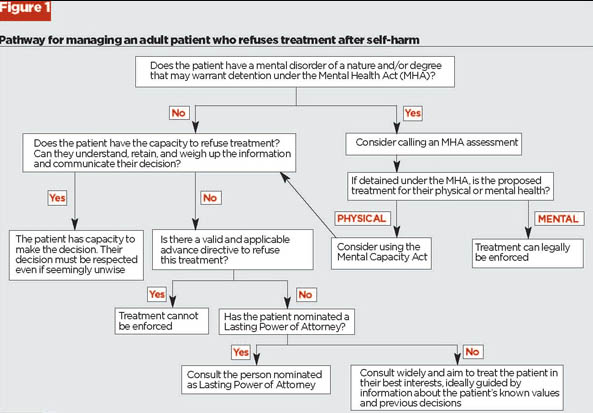
The fine details of the Mental Health Act19 and the Mental Capacity Act20 are beyond the scope of this article, but a basic pathway of how to use English legislation to manage an adult patient who refuses treatment is outlined in figure 1.
The case of Kerrie Wooltorton21 made headlines in 2007, after she was deemed to have capacity to refuse treatment following ingestion of antifreeze ‘in full knowledge of the consequences,’ and died as a result. Such cases are ethically and legally challenging for all concerned, but fortunately are rare.1
Follow-up
It is important that any underlying mental disorder is adequately followed up and treated;1 particular efforts should be made to encourage patients to address alcohol and substance misuse behaviour, as intoxication is associated with impulsivity and therefore increased risk of further self-harming behaviour.
NICE recommends that a care plan for longer-term treatment be drawn up with the patient and reviewed at least annually.1 For some patients it is unrealistic to stop self-harming when it may be the only coping mechanism they can effectively use; in such situations, harm minimisation,1 distraction techniques or safer methods of self-harming can be taught.22 There is no evidence to support such techniques, so NICE labels them as tentative recommendations.
The role of the GP in caring for patients who self-harm depends very much on the extent of the self-harm and underlying mental disorder. Houston sees the role of the GP in particular as providing long-term continuity of care, and having a holistic awareness of a patient’s life events enabling discussion of the patient’s emotional problems at an early stage with the aim of intervening before a crisis.23
Following an episode of self-harm the GP can offer assessment and practical support, for example, monitoring type and quantity of medication prescribed,1 and signposting or referral where relevant. Equally important, GPs are ideally placed to support patients and their families following self-harm through an understanding and nonjudgmental approach which aims to alleviate distress.
REFERENCES
1 National Institute for Health and Clinical Excellence. CG 133. Self-harm: longer-term management. NICE. London. 2011
2 Kendall T, Taylor C, Bhatti H et al. Guideline Development Group of the National Institute for Health and Clinical Excellence. Longer term management of self harm: summary of NICE guidance. BMJ 2011;343:d7073
3 McManus S, Meltzer H, Brugha T et al. Adult Psychiatric Morbidity in England, 2007: Results of a Household Survey; 2009 www.ic.nhs.uk/pubs/psychiatricmorbidity07
4 Lawton K, Rodham K. By Their Own Hand: Deliberate Self-Harm and Suicidal Ideas in Adolescents. Jessica Kingsley. London. 2006
5 Stone M, Laughren T, Jones ML et al. Risk of suicidality in clinical trials of antidepressants in adults: analysis of proprietary data submitted to US Food and Drug Administration. BMJ 2009;339:b2880
6 Martinez C, Rietbrock S, Wise L et al. Antidepressant treatment and the risk of fatal and non-fatal self harm in first episode depression: nested case-control study. BMJ 2005;330(7488):389-95
7 Kapur N. Management of self-harm in adults: which way now? Br J Psychiatry 2005;187:497-9
8 Patterson WM, Dohn HH, Bird J, Patterson GA. Evaluation of suicidal patients: the SAD PERSONS scale. Psychosomatics 1983;24(4):343-5, 8-9
9 National Institute for Health and Clinical Excellence. CG16. Self-harm: The short-term physical and psychological management and secondary prevention of self-harm in primary and secondary care. NICE. London. 2004
10 Hawton K, Townsend E, Arensman E et al. Psychosocial versus pharmacological treatments for deliberate self harm. Cochrane Database Syst Rev 2000(2):CD001764
11 Thompson A. Wounds that never heal. Community Care [Internet]. 1999 26/04/2012. www.communitycare.co.uk/Articles/18/11/1999/3807/Wounds-that-never-heal.htm
12 Saunders KE, Hawton K, Fortune S, Farrel S. Attitudes and knowledge of clinical staff regarding people who self-harm: a systematic review. J Affect Disord 2011; 23(5): 386-90
13 Gibb SJ, Beautrais AL, Surgenor LJ. Health-care staff attitudes towards self-harm patients. Aust NZ J Psychiatry 2010;44(8):713-20
14 Bird L, Faulkner A. Suicide & Self-harm. The Mental Health Foundation. London. 2000 www.mentalhealth.org.uk/content/assets/PDF/publications/suicide-self-harm.pdf?view=Standard
15 Fleischhaker C, Bohme R, Sixt B et al. Dialectical Behavioral Therapy for Adolescents (DBT-A): a clinical trial for patients with suicidal and self-injurious behavior and borderline symptoms with a one-year follow-up. Child Adolesc Psychiatry Ment Health 2011;5(1):3
16 Linehan MM, Heard HL, Armstrong HE. Naturalistic follow-up of a behavioral treatment for chronically parasuicidal borderline patients. Arch Gen Psychiatry 1993;50(12):971-4
17 Haw C, Hawton K. Life problems and deliberate self-harm: associations with gender, age, suicidal intent and psychiatric and personality disorder. J Affect Disord 2008;109(1-2):139-48
18 Royal College of Psychiatrists. CR158. Self-harm, suicide and risk: helping people who self-harm. Final report of a working group 2010; www.rcpsych.ac.uk/files/pdfversion/CR158.pdf
19 Department of Health. Code of Practice Mental Health Act 1983. The Stationery Office. London. 2008 www.dh.gov.uk/en/Publicationsandstatistics/Publications/PublicationsPolicyAndGuidance/DH_084597
20 House of Commons. Mental Capacity Act 2005. House of Commons. London. 2005
21 McLean SAM. Live and let die. BMJ 2009;339 b4112
22 Staying safe - Harm Minimisation. selfharmcouk: www.selfharm.co.uk/get/staying_safe/harm_minimisation
23 Houston K, Haw C, Townsend E, Hawton K. General practitioner contacts with patients before and after deliberate self harm. Br J Gen Prac 2003;53(490):365-70
ARTICLE IN PDF
 Download this article in PDF format
EXTERNAL WEBLINKS
For healthcare professionals
NICE guidelines on self-harm (CG16 and CG133)
NHS evidence
For patients
Royal College of Psychiatrists
www.rcpsych.ac.uk/mentalhealthinfo/problems/depression/self-harm.aspx
National Self Harm Network
www.nshn.co.uk/index.htmlthesite.org
www.thesite.org/healthandwellbeing/mentalhealth/selfharm
Recover your life