SEARCH

Practitioner 2011; 255 (1740):21-25
Raising standards of care for patients with depression
25 May 2011
AUTHORS
Dr Phillip Bland BA BM BCh MRCGP DRCOG
GP with an interest in mental health
Dalton-in-Furness
Article
Depression is a common disorder. The 2007 household survey of adult psychiatric morbidity in England found that the point prevalence rates for ICD-10 depressive episode and ICD-10 mixed anxiety and depressive disorder (see table 1, p22) were 2.3% and 9.0% respectively.1 Worldwide, the pooled annual prevalence rate for DSM IV major depression is 4.1%.2
Depression impairs occupational and social functioning, and has a significant impact on quality of life. Adults in the UK with a diagnosis of either ICD-10 depressive episode or ICD-10 mixed anxiety and depressive disorder were estimated to have taken more than a quarter (9% and 20% respectively) of the total number of days of sickness absence in one year.3
Few patients receive effective treatment. There are four reasons for this:
- failure to seek help (40% don't attend)
- failure of GPs to recognise depression (30-50% of cases)
- non-adherence or early cessation of treatment (only about 25% of patients complete a six-month course of antidepressant treatment)
- lack of treatment efficacy (50% with moderate depression don't respond to initial treatment).
Although there is a high rate of spontaneous recovery among those with mild depression, between one- and two-thirds of primary care patients with major depression have not fully recovered 12 months later. The main reason for this is that only about one in ten patients receive effective treatment.4
Aims of the quality standard
It is therefore welcome that the NHS Outcomes Framework has identified ‘Enhancing quality of life for people with mental illness' as a key improvement area.5 The NICE quality standard on depression in adults, published in March,6 is intended to facilitate this by providing a definition of high quality care. The proportion of people with mental illness in employment, compared with the population as a whole, will be used as an outcome indicator.
The quality standard is intended to:
- inform patients of the standard of care which they can expect
- define aspirational standards for clinical governance
- enable commissioners to commission high quality care
It comprises 13 quality statements (see table 2), largely derived from the NICE clinical guidelines on depression (CG90)7 and depression in adults with a chronic physical health problem (CG91).8 For each statement, there is a corresponding quality measure.
Implementing the quality statements
1 Assessment
Accurate assessment is vital if we are to make an appropriate choice of treatment. I think we should also take into consideration comorbid anxiety, previous history of depression, and the illness trajectory.
2 Practitioner competence
This does not specify the form of supervision, but it is possible that commissioning groups may wish to monitor the performance of their member practices.
3 Recording health outcomes
The key phrase here is that we should ‘use the findings to adjust delivery of interventions.' An American primary care study found that treatment adjustment among nonresponsive patients was one of the indicators for which the quality of care was low.9
4 Low-intensity interventions
Low-intensity interventions are an attractive option in patients with chronic conditions, where they may facilitate adjustment, but none of them are recommended as routine treatments in the British Association for Psychopharmacology (BAP) guideline.10 CCBT appears to be more effective for anxiety than for depression;11 the evidence for bibliotherapy comes mainly from small studies which recruited highly motivated, well educated participants;12 and exercise therapy only shows a moderate, nonsignificant effect if methodologically flawed trials are excluded from the analysis.13
5 Antidepressants for persistent subthreshold depressive symptoms or mild depression
We should only consider antidepressants for patients who have not responded to a low-intensity intervention, or who have:
- a previous history of moderate or severe depression
- dysthymia (subthreshold depression of ≥ 2 years' duration)
- mild depression complicating the care of a chronic condition
There are good reasons for this:
- Antidepressants are little better than placebo in short duration mild depression10
- There is a high rate of spontaneous recovery during the first two to three months
- Patients prefer psychological treatments14
- There is a risk of side effects and drug interactions, particularly among elderly patients and those with chronic conditions.
However, the drug-placebo difference may be greater for patients who have not spontaneously recovered after two to three months.10 A UK open label pragmatic RCT found that treatment with an SSRI plus supportive care was more effective than supportive care alone for patients with mild to moderate depression of at least eight weeks' duration (NNT=6).15 The BAP guideline recommends that antidepressants should be considered for subthreshold or mild depression which persists for more than two to three months.10
6 Moderate to severe depression (no chronic condition)
The additional benefit from psychotherapy is modest (NNT=8) and may result from greater adherence to treatment rather than a genuine therapeutic effect.16
7 & 8 Moderate and severe depression respectively + chronic condition
Table 3 summarises the differences between the NICE 7,8 and BAP10 guidelines.
9 Collaborative care (chronic condition)
The effect size for collaborative care is small,17 it is expensive and it is unlikely to be feasible in most UK settings. NICE restricts it to nonresponsive patients with moderate to severe depression, although a recent American study reported a moderate effect size plus improved chronic disease control for patients with milder depression (mean PHQ-9 =14.7) and poorly controlled diabetes and/or CHD.18
10 Continuing antidepressants
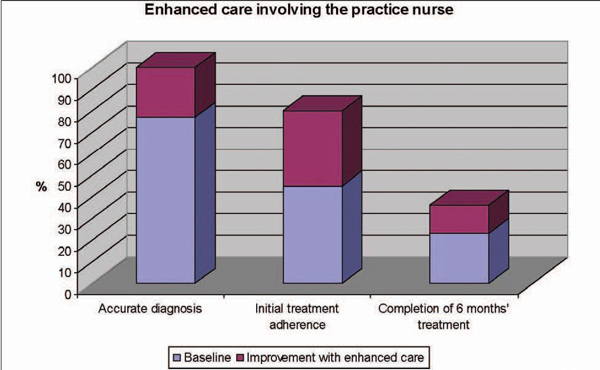
The risk of relapse is highest during the first six months, and antidepressants decrease the odds of relapse by about 70%.10 The key quality measure is the proportion of patients benefiting from antidepressants who remain on them for at least six months after remission. In my opinion, if we wish to improve this, we will need to provide some form of enhanced care (see box 1). I found that only 23% of our patients completed six months' treatment with antidepressants, which improved to 36% following introduction of shared care with the practice nurse (see figure 1).19
11 Reassessing people prescribed antidepressants
Telephone follow-up by a healthcare assistant is a cost-effective way of ensuring structured follow-up, it improves medication adherence and has an effect size comparable with that reported for collaborative care.20
12 Lack of response to initial treatment
Enhanced care facilitates identification of nonresponders and treatment adjustment.
13 Residual symptoms or risk of relapse
It has been suggested that full recovery should be defined not only by the absence of residual symptoms which impair functioning, but also by the presence of psychological well-being.21
It is important to note that all of the NICE quality measures are process measures. In the management of depression, the quality of the therapeutic relationship is of great importance: the patients of therapists who are warm and empathic improve significantly and substantially more than the patients of therapists who are not empathic.22 Outcome measures will reflect differences in therapeutic skill, process measures will not.23
Implications for practice
Diagnosis
Not only do we need to distinguish subthreshold depression from major depression, but we should also attempt to grade the severity of major depression. This is very difficult. It is impossible to set precise boundaries and we should guard against assuming that a particular severity measure score should automatically imply a specific treatment. The PHQ-9 overestimates depression severity 24 and is not a substitute for clinical judgement.
The DSM IV criteria define major depression. The PHQ-9 is based on these criteria but counts symptoms if they are present on more than half the days whereas the definition of major depression requires them to be present on nearly every day. If the score is 15 or greater this suggests that a clinical diagnosis of major depression is likely to be correct, whereas a score of 10-14 is borderline.
Acute treatment
Given the categorical uncertainty and the lack of agreement between the NICE and BAP guidelines, I would advocate a flexible approach. For mild depression of less than eight weeks' duration, we should try to avoid the use of antidepressants. I think we should offer patients a choice between low-intensity interventions and watchful waiting, which must include structured follow-up and active monitoring of symptoms.
Patients should be reviewed at regular intervals of between two and four weeks, either face to face or by telephone. We should monitor depression symptoms and the degree of functional impairment e.g. using the PHQ-9, we should ask about suicidal ideation, we should encourage self-management activities, and we may wish to provide brief CBT or problem solving therapy.
If the depression persists for longer than eight weeks, it is reasonable to offer antidepressant treatment.
For moderate depression, I think we should offer a choice of antidepressants alone, CBT/IPT alone or combination treatment. In the case of the latter, we should make it clear that only one in eight patients will derive additional benefit.
Patients with severe depression should be offered combination treatment.
Follow-up
We should review patients regularly at intervals of between two and four weeks during the first three months of antidepressant treatment. This is in order to:
- monitor depression symptoms
- monitor drug side effects
- identify patients at risk of suicide
- encourage medication adherence and self-management activities
- identify nonresponders and adjust their treatment
The QOF indicator 5 (which replaces indicator 3) records the percentage of patients who have had a further assessment of severity 4-12 weeks after the initial assessment, see box 2. Although this allows considerable flexibility with regard to the timing of reassessment, both NICE and the BAP recommend 6-8 weeks as the optimum time for assessing initial treatment response: if there is no response by this time, there is only a 20% chance of remission at 12 weeks.10
We should continue to provide regular follow-up after the first three months. It is important to identify patients at increased risk of relapse, which may be indicated by:
- residual symptoms with functional impairment
- lack of psychological well-being
- two or more recent episodes with significant functional impairment
- multiple previous episodes
- a history of severe, prolonged or treatment resistant episodes
We should advise these patients to continue antidepressant treatment for at least two years and should recommend referral for appropriate psychological interventions.
Conclusion
Most patients with depression do not receive effective treatment, and it is welcome that depression in adults should be among the first dozen NICE quality standards. If the standard is followed, patients will benefit from:
- reduced prescribing of antidepressants to those who will not benefit
- increased access to psychological interventions
- increased support through structured monitoring and active follow-up
- reduced risk of chronic relapsing depression
However, the standard assumes a categorical certainty which does not exist in practice, the statements do not reflect the limitations of the evidence base and it is a pity that they fail to emphasise the importance of patient choice.
REFERENCES
1 McManus S, Meltzer H, Brugha T et al. Adult psychiatric morbidity in England, 2007: results of a household survey. NHS Information Centre for Health and Social Care. 2009. www.ic.nhs.uk/pubs/psychiatricmorbidity07
2 Waraich P, Goldner EM, Somers JM et al. Prevalence and incidence studies of mood disorders: a systematic review of the literature. Can J Psychiatry 2004;49:124-38
3 Das-Munshi J, Goldberg D, Bebbington P et al. Public health significance of mixed anxiety and depression: beyond current classification. Br J Psychiatry 2008;192:171-7
4 Gilchrist G, Gunn J. Observational studies of depression in primary care: what do we know? BMC Family Practice 2007;8:28 doi:10.1186/1471-2296-8-28
5 Department of Health. The NHS Outcomes Framework 2011/12. London. DH. 2010
6 National Institute for Health and Clinical Excellence. Quality standard on depression in adults. NICE. London. 2011
7 National Institute for Health and Clinical Excellence. CG90. Depression: the treatment and management of depression in adults (update). NICE. London. 2009
8 National Institute for Health and Clinical Excellence. CG91. Depression in adults with a chronic physical health problem: treatment and management. NICE. London. 2009
9 Hepner KA, Rowe M, Rost K et al. The effect of adherence to practice guidelines on depression outcomes. Ann Intern Med 2007;147:320-9
10 Anderson IM, Ferrier IN, Baldwin RC et al. Evidence-based guidelines for treating depressive disorders with antidepressants. A revision of the 2000 British Association for Psychopharmacology guidelines. J Psychopharmacol 2008;22:343-96
11 Spek V, Cuijpers P, Nyklicek I et al. Internet-based cognitive behaviour therapy for symptoms of depression and anxiety: a meta-analysis. Psychol Med 2007;37:319-28
12 Anderson L, Lewis G, Araya R et al. Self-help books for depression: how can practitioners and patients make the right choice? Br J Gen Pract 2005;55:387-92
13 Mead GE, Morley W, Campbell P et al. Exercise for depression. Cochrane Database of Systematic Reviews 2009, Issue 3. Art. No.:CD004366. DOI: 10.1002/14651858.CD004366.pub4
14 Prins MA, Verhaak PF, Bensing JM et al. Health beliefs and perceived need for mental health care of anxiety and depression: the patient's perspective explored. Clin Psychol Rev 2008;28:1038-58
15 Kendrick T, Chatwin J, Dowrick C et al. Randomised controlled trial to determine the clinical effectiveness and cost-effectiveness of selective serotonin reuptake inhibitors plus supportive care, versus supportive care alone, for mild to moderate depression with somatic symptoms in primary care: the THREAD (THREshold for AntiDepressant response) study. Health Technol Assess 2009;13(22):iii-xi, 1-159
16 Pampallona S, Bollini P, Tibaldi G et al. Combined pharmacotherapy and psychological treatment for depression. A systematic review. Arch Gen Psychiatry 2004;61:714-9
17 Gilbody S, Bower P, Fletcher J et al. Collaborative care for depression: a cumulative meta-analysis and review of longer-term outcomes. Arch Intern Med 2006;166:2314-21
18 Katon WJ, Lin EHB, von Korff M et al. Collaborative care for patients with depression and chronic illnesses. N Engl J Med 2010;363:2611-20
19 Bland PM. Practice nurse input improves care of depressed patients. Guidelines in Practice 2001;4(6):75-81
20 Genischen J, von Korff M, Peitz M et al. Case management for depression by health care assistants in small primary care practices. Ann Intern Med 2009;151:369-78
21 Fava GA, Ruini C, Belaise C. The concept of recovery in major depression. Psychol Med 2007;37:307-17
22 Burns DD, Auerbach A. Therapeutic empathy in cognitive behavioural therapy: does it really make a difference? In Salkovskis PM (ed). Frontiers of Cognitive Therapy. Guilford Press. New York. 1996
23 Mant J. Process versus outcome indicators in the assessment of quality of health care. Int J Qual Health Care 2001;13(6):475-80
24 Cameron IM, Crawford JR, Lawton K et al. Psychometric comparison of PHQ-9 and HADS for measuring depression severity in primary care. Br J Gen Pract 2008;58:32-6
25 Gunn J, Diggens J, Hegarty K et al. A systematic review of complex system interventions designed to increase recovery from depression in primary care. BMC Health Serv Res 2006 ;6:88-doi:10.1186/1472-6963-6-88
USEFUL INFORMATION
The following organisations have produced helpful information leaflets for patients:
The Royal College of Psychiatrists
www.rcpsych.ac.uk/mentalhealthinfoforall/problems/depression.aspx.
Patient.co.uk
www.patient.co.uk.showdoc/23068720/
NICE
NICE has published versions of its guidance for patients:
CG90 Depression in adults: understanding NICE guidance
CG91 Depression with a chronic physical health problem: understanding NICE guidance
 Download this article in PDF format