SEARCH

Practitioner 2010; 254 (1729): 19–22
Managing bipolar disorder in primary care
28 May 2010
AUTHORS
Professor Klaus P. Ebmeier MD
Foundation Professor of Old Age Psychiatry, University of Oxford
Article
Bipolar disorder is relatively common, at least twice as common as schizophrenia, and eminently treatable. It is also perfectly suited to the well established outpatient model practised in general practice and psychiatry,1 although perhaps less well suited to the ‘new ways of working' widely promoted within mental health trusts.2 However, bipolar disorder has a lower profile within research, clinical psychiatry, and also sometimes in general practice.1 Serious and enduring mental illness tends to be equated with schizophrenia or even dementia, and the new community-based mental health services are designed to deal with these two chronic illnesses which require continuous, but relatively low-intensity support.
The NICE guideline on bipolar disorder3 recommends that all GP practices should include people with a diagnosis of bipolar disorder on their case register of people with severe mental illness. Bipolar disorder is also included in the QOF (see box 1, p20).
Diagnosis
One reason for misdiagnosis of bipolar disorder is that it is not possible to exclude a bipolar diagnosis categorically if there are only symptoms of depression.4 This means that all depressed patients may turn out to be bipolar; about 10% ultimately present with symptoms of mania.4 Most patients will have had a (hypo)manic episode by their 30s.
While 15-17% of people in the community suffer from depression,5 the lifetime prevalence of bipolar affective disorder proper is 1%, with a further 1.2% presenting with milder hypomanic symptoms (so-called bipolar II disorder), and an additional 2-3% with bipolar disorder not otherwise specified.6 Relaxing diagnostic symptom criteria increases the frequency of depressed patients who develop symptoms of mania for any length of time to 50%.4 While such ‘bipolar spectrum disorder' is of great theoretical and clinical relevance, evidence for treatment efficacy is mainly available for bipolar I disorder. This evidence can only be transferred for use in bipolar II disorder with some caution. The clinical demarcation between the two is somewhat fuzzy: for example, varying thresholds for inpatient admission or for defining functional impairment may shift the boundary between the two.
The diagnostic symptoms of bipolar I and bipolar II disorder are listed in table 1, above. If a manic episode has been present during the history, the diagnosis is bipolar disorder in the narrow sense of the term (bipolar I).
If there has been a hypomanic episode, the diagnosis is bipolar II disorder. The presence of depressive episodes in the history of the illness is common, but not obligatory to arrive at the diagnosis. Nevertheless, the lifetime course of the illness tends to be dominated by depressive episodes: half the time is estimated to be spent in the euthymic (well) state, 12% in a manic state and 38% in a depressed state.4 As the presence of manic or hypomanic symptoms in the past has important implications for appropriate treatment, any depressed patient should be asked about periods in the past when (s)he has been elated in mood, found it unnecessary to sleep, talked a lot, spent excessive amounts of money etc. (see table 1, above).
Treatment options
Treatment for bipolar disorder has to be divided into:
- treatment of mania
- treatment of bipolar depression
(i.e. depressive syndrome with a history of previous mania)
- prophylaxis of mood swings in either direction
Specifically, antidepressant treatments are unlikely to help manic symptoms, at worst they can precipitate or aggravate them. Antimanic treatments are unlikely to help symptoms of depression. An exception to this rule would be a genuine mood stabiliser such as lithium8 which treats and prevents mood swings in either direction.
Table 2, above, lists the evidence-based treatment options available.
Monitoring
Patients with bipolar disorder usually require long-term medication together with regular monitoring of symptoms, medication effects and side effects. Supportive educational interventions (to explain the medication plan, sleep hygiene, self-monitoring of mental state, identification and monitoring of ‘relapse signatures' etc.) will also be required.
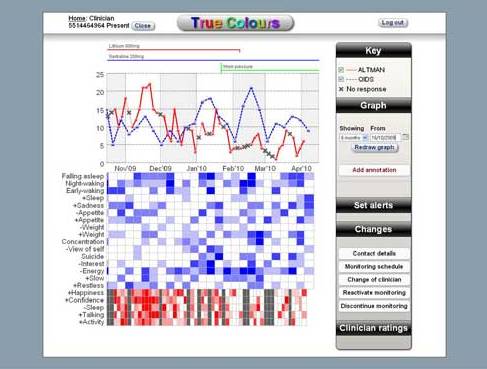
The most intense, but by no means most expensive, form of outpatient monitoring involves the patient recording their mood over the week and transmitting the results to their doctor by SMS. The doctor will be able to display the current mood profiles together with previous symptom profiles on request (see figure 1, True Colours Version 2, p19). The project has been rolled out within the Oxfordshire and Buckinghamshire MHT (for further details see Useful information box on p22).
The NICE guideline gives detailed advice about initiating and monitoring drugs used in bipolar disorder.3 The most important procedures unique to bipolar disorder relate to lithium monitoring: lithium has a plasma half-life of about 12 hours with a narrow therapeutic window. Serum levels should be checked one week after any dose change or interventions that may affect lithium levels (e.g. starting ACE inhibitors, NSAIDs or diuretics), and as soon as possible after any evidence of toxicity, such as gastrointestinal symptoms, increased tremor and other neurological symptoms, or conditions that affect electrolyte and lithium kinetics (change in sodium balance, or symptoms suggesting abnormal renal or thyroid function). Otherwise, and after stabilisation at the desired serum level, serum lithium levels should normally be monitored every 3 months, possibly more often in older patients and those with renal problems. Thyroid and renal function tests should be done every 6 months or more often if there is evidence of impaired renal function.
Patients with bipolar disorder should have an annual physical health review. This will include monitoring:
- weight gain caused by lithium, atypical antipsychotics, antidepressants, oedema, hypothyroidism or overeating
- lipid levels, including cholesterol in all patients over 40 even if there is no other indication of risk
- plasma glucose levels
- smoking status
- alcohol use
- blood pressure.3
In special situations, such as treatment resistance, deteriorating renal function, or unexpected pregnancy, advice from relevant specialists may be necessary.3
The clinician should also be aware of, and be able to advise the patient on, the restrictions imposed on driving by the DVLA.11 In particular, manic and hypomanic patients must cease driving during the acute illness.
Re-licensing can be reconsidered, if the patient:
- remains well and stable for at least 3 months
- is compliant with treatment
- has regained insight
- is free from adverse effects of medication which would impair driving
- can provide a favourable specialist report.11
Conclusion
Bipolar disorder has been described as the heartland of psychiatry.1 It is a disorder during which patients are intermittently severely ill and unable to function in their normal environment, but they usually return to their normally functioning self. While the extremes of symptoms and experiences require intensive specialist care, the overall success of management will depend on an informed and complementary interaction between primary and secondary care.
REFERENCES
1 Goodwin GM, Geddes JR. What is the heartland of psychiatry? Br J Psychiatry 2007; 191: 189-91
2 Department of Health. DoH Guidance. New ways of working for everyone - Developing and sustaining a capable and flexible workforce HMSO. London. 2007
3 National Collaborating Centre for Mental Health for National Insitute for Health and Clinical Excellence. The management of bipolar disorder in adults, children and adolescents, in primary and secondary care. National Clinical Practice Guideline Number 38. The British Psychological Society and Gaskell. London. 2006
4 Goodwin GM, Anderson I, Arango C et al. ECNP consensus meeting. Bipolar depression. Nice, March 2007. Eur Neuropsychopharmacol 2008; 18: 535-49
5 Ebmeier KP, Donaghey C, Steele JD. Recent developments and current controversies in depression. Lancet 2006; 367: 153-67
6 Merikangas KR, Akiskal HS, Angst J et al. Lifetime and 12-month prevalence of bipolar spectrum disorder in the National Comorbidity Survey replication. Arch Gen Psychiatry 2007; 64: 543-52
7 American Psychiatric Association. Diagnostic and Statistical Manual for Mental Disorders (DSM-IV). American Psychiatric Association.Washington, DC. 1994
8 Goodwin GM, Malhi GS. What is a mood stabilizer? Psychol Med 2007; 37: 609-14
9 Goodwin GM. Evidence-based guidelines for treating bipolar disorder: revised second edition-recommendations from the British Association for Psychopharmacology.
J Psychopharmacol 2009; 23: 346-88
10 Geddes JR, Goodwin GM, Rendell J et al. Lithium plus valproate combination therapy versus monotherapy for relapse prevention in bipolar I disorder (BALANCE): a randomised open-label trial. Lancet 2010; 375: 385-95
11 Drivers Medical Group. At a glance guide to the current Medical Standards of Fitness to Drive. Driver and Vehicle Licensing Agency. Swansea. 2010. Available from: www.dft.gov.uk/dvla/medical/ataglance.aspx
USEFUL INFORMATION
For doctors
Further information about True Colours is available from the True Colours Office, University of Oxford, Department of Psychiatry, Warneford Hospital, Oxford OX3 7JX, tel: 01865 613167 (answer phone out of hours), email: [email protected]
For patients
MDF The Bipolar Organisation
Bipolar Scotland
NIMH
www.nimh.nih.gov/health/publications/bipolar-disorder/complete-index.shtml
Rethink
www.rethink.org/about_mental_illness/index.html
Royal College of Psychiatrists
www.rcpsych.ac.uk/mentalhealthinfoforall/problems/bipolarmanicdepression/bipolardisorder.aspx
SANE
ARTICLE IN PDF
 Download this article in PDF format