SEARCH

Mohan N, Cairns R, Passmore AP, Kane JPM. Assessing and managing depression in patients with dementia. Practitioner June 2022;266(1859):15-18
Assessing and managing depression in patients with dementia
24 Jun 2022
AUTHORS
Dr Niranjana Mohan MD MRCPsych, Core Trainee (CT3), Northern Ireland Medical and Dental Training Agency, Belfast, UK
Dr Rebecca Cairns BSc(MedSci) MBChB MSc(ClinEd) MRCPsych, Consultant in Psychiatry of Old Age, Belfast Health and Social Care Trust, Belfast, UK
Professor Anthony Peter Passmore MD FRCP (Lond, Glasg) FRCPI, Professor of Ageing and Geriatric Medicine, Centre for Public Health, Queen’s University Belfast, Belfast, UK
Dr Joseph PM Kane MB BCh BAO PhD MRCPsych, Clinical Lecturer, Centre for Public Health, Queen’s University Belfast, Belfast, UK
Competing interests: None
Article
The relationship between depression and dementia is complex. Depression appears to be an independent risk factor for incident dementia, conferring a two-fold increase in dementia risk. Depression may represent an early sign or prodromal feature of dementia. The association between depression and dementia appears to strengthen as the interval between the two disorders shortens. Depression may also be a consequence of dementia. It is difficult to determine whether this represents a biological sequela of neurodegeneration, or a psychological response to cognitive and functional impairment or associated social factors such as a move to residential care. Assessment of depression in older people with dementia can be challenging. Individuals with dysphasia may struggle to express their thoughts and feelings, in which case there should be a greater focus on changes in behaviour, such as tearfulness, irritability, seclusion, or disengagement from hobbies and activities. Somatic symptoms such as fatigue, sleep disturbance, and GI discomfort are more common in older people with depression than in their younger counterparts; and although investigations for other causes should be pursued, the possibility of depression should be borne in mind. When making a diagnosis of depression in older patients it is important to screen for an underlying physical condition, in particular endocrine disorders, occult malignancy and nutritional deficiencies.
Depressive symptoms are common in later life.1 Depression is associated with higher relapse rates, and a more protracted course, than depression in individuals in midlife.1,2
There are currently 900,000 people in the UK, and 50 million people worldwide, living with dementia.3,4 Although characterised by a progressive decline in functional and cognitive ability, it is the neuropsychiatric symptoms associated with dementia, such as depression, that correlate most closely with rates of carer stress.5
Dementia and depression
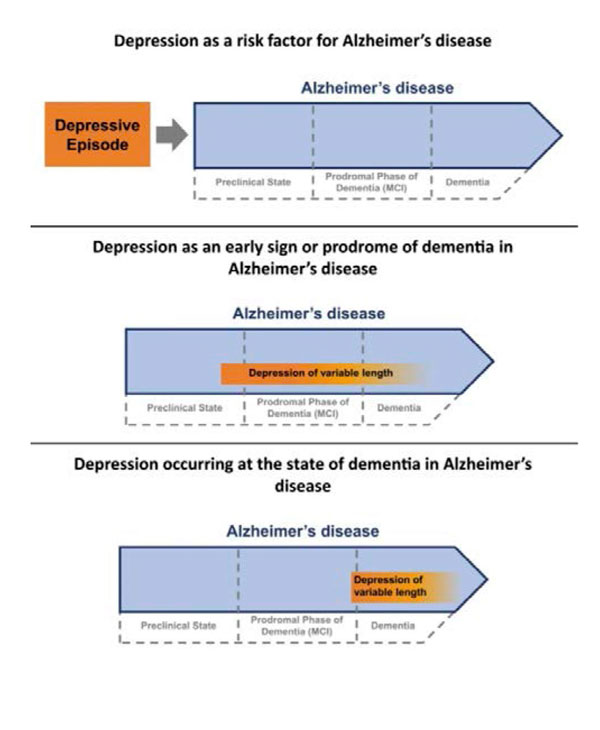
An association between depression and dementia has long been observed, but the relationship between the disorders is complex (see figure 1).6
Depression appears to be an independent risk factor for incident dementia, conferring a two-fold increase in dementia risk.7 This risk is not confined to depression in older age.
Individuals with depression in both the Framingham Heart Study (mean age at baseline 71.5 ± 8 years) and the Baltimore Longitudinal Cohort of Aging (mean age at baseline 55.5 ± 18.8 years) were more likely to have been diagnosed with dementia over follow-up periods lasting 17 and 24 years, respectively.8
As a potentially modifiable risk factor, depression has been cited as an important focus for dementia prevention.9
Depression can represent an early sign or prodromal feature of dementia. Since neuropathological substrates of many dementia subtypes, such as Alzheimer’s disease (AD), can be detected in the brains of affected patients ten years or more before clinical presentation, non-cognitive presentations, such as depressive illness have been hypothesised as a harbinger of eventual dementia. The association between depression and dementia appears to strengthen as the duration between the two disorders shortens.10 Depressive symptoms in cognitively healthy individuals recruited to the Italian Longitudinal Study on Aging were predictive of global cognitive decline and episodic memory disturbances within four years.11
Depression may also be a consequence of dementia. It is difficult to determine whether this represents a biological sequela of neurodegeneration, or a psychological response to cognitive and functional impairment or associated social factors such as a move to residential care. Rates of depression in people with mild, moderate and severe dementia often exceed those in cognitively healthy older people.12
In the case of dementia with Lewy bodies, the second most common form of neurodegenerative dementia,13,14 depression is integrated into the clinical diagnostic criteria for the disease.14
There is also a possibility that dementia and depression, as two prevalent and multifactorial disorders, may independently coexist through common combinations of biological, psychological, cultural, and social risk factors. Many of these risk factors, such as social isolation, medical comorbidities and sensory impairment, are themselves associated with age. This appears less likely as new epidemiological evidence regarding the relationship between depression and dementia, such as that described above, emerges.
The proposed biological mechanisms underpinning depression are complex and poorly understood, and discussion of these is beyond the scope of this article. Some proposed models of depression do share characteristics commonly implicated in neurodegenerative disease, such as vascular injury,15 inflammation,16 and elevated glucocorticoid production.17
As dementia represents a heterogeneous group of disorders, each with different pathophysiological mechanisms, it is unlikely that any single process, or group of processes, is responsible for depressive illness in the context of neurodegenerative disease.
Uncertainty over the nature of the relationship between depression and dementia has led to a reduction in the use of the term pseudodementia.18 Psychiatric disorders, depression included, are often associated with cognitive symptoms in older people, and can therefore be mistaken for the symptoms of neurodegenerative disease. It nevertheless remains a valid construct; a systematic review of 18 studies, comprising 284 participants, found that 53% of patients with pseudodementia did not meet criteria for dementia at follow-up.18 This potential for reversibility of cognitive symptoms supports the practice of assessing all patients with suspected dementia for depressive illness prior to any diagnosis.19
Diagnosing depression in the context of dementia
The diagnostic criteria for depression do not vary with age or dementia diagnosis. In order to fulfil core ICD-10 criteria for depression, patients must have any two of the following symptoms: depressed mood, loss of interest and enjoyment, and reduced energy for at least a period of 2 weeks (see table 1).4 Episodes are usually classified according to their severity (mild, moderate, or severe) on the basis of the number of symptoms as well as the degree of functional impairment.4
Assessment of depression in older people with dementia can be challenging, particularly as presentation may be less typical than in younger adults. Individuals with dysphasia may struggle to express their thoughts and feelings during assessment. In such cases, there should be a greater focus on changes in behaviour, such as tearfulness, irritability, seclusion, or disengagement from hobbies and activities.19 Collateral history is crucial. Somatic depressive symptoms (such as gastrointestinal discomfort, fatigue and sleep disturbance) are more commonly seen in older people with depression than in their younger counterparts,20 and although investigations into other causes of such symptoms should be pursued, the possibility that they represent depressive illness should continue to be borne in mind. When making a diagnosis of depression in older patients it is important to screen for an underlying physical condition, in particular endocrine disorders, occult malignancy and nutritional deficiencies.
Assessment is further complicated by the prevalence of apathy in neurodegenerative disorders. Defined as the absence of feeling, motivation, emotion, interest or concern,21 apathy in dementia is often confused with depression in the context of dementia and it can be difficult to differentiate between them because of the overlap in core symptoms.22
Apathy can coexist with depression, but can also appear independently, manifested as lack of motivation or interest, a lack of concern about personal problems, or an absence of emotional response to positive or negative personal events. Apathy tends to respond less favourably than depression to pharmacological therapy.22
Depression rating scales in dementia
Validated rating scales can be useful as part of a systematic approach to the assessment of depression in people with dementia. Such scales do not, however, replace clinical assessment; they do not assess risk, or account for marked sensory or language impairment.
The two most frequently used scales in research studies are the 15-point Geriatric Depression Scale (GDS-15)23 and the Cornell Scale for Depression in Dementia (CSDD). The GDS-15 is a self-rated scale initially designed for depression screening in populations without dementia. The CSDD was designed for patients with dementia, requiring two semi-structured interviews with the informant and the patient.
The main disadvantage in the primary care setting is the time required to administer these instruments; although the 4-point and 5-point versions of GDS (GDS-4, GDS-5) are much briefer, estimates of their sensitivity and specificity are heterogeneous, and the evidence generally low in quality.24 The authors would therefore recommend that while rating scales provide helpful frameworks for assessment, they should not be used routinely in primary care.
Managing depression in patients with dementia
Pharmacological treatments
There are several important considerations when prescribing pharmacological treatments in patients with dementia.
Clinical trials of antidepressants have historically failed to include older adults, use rating scales designed for younger adults and caution should be employed when generalising data to older populations.
Recent systematic reviews of antidepressants for depressive disorder in older adults have included 15 or fewer randomised controlled trials (RCTs).25,26 Several of these RCTs have investigated tricyclic antidepressants (e.g. amitriptyline, clomipramine), which can exacerbate cognitive impairment through their anticholinergic effects,19 and therefore should be avoided if possible in individuals with dementia. Other RCTs have been adjudged to be of low or moderate quality.25
The response rates to antidepressants in these RCTs vary considerably,26 and some meta-analyses report no benefit of antidepressant therapy over placebo in older adults,27 and that the risk of adverse events outweighed the benefits.
A recent Cochrane review of antidepressants for depression in dementia concluded that little or no effect was observed on the only measure of efficacy for which high quality evidence was available (depression rating scale scores).28
NICE guidelines advise that antidepressant therapy should not be offered to manage mild to moderate depression in people with dementia, ‘unless indicated for a pre-existing severe mental health problem’.19
GPs will be aware of the many pitfalls encountered in prescribing for older people including polypharmacy, adverse events, drug interactions and falls; all of these are encountered with antidepressants.29
In rare cases where the benefits of pharmacological therapy are felt to outweigh the risks, choice of individual agents should involve discussion with the patient and caregiver regarding the side effect profile and treatment targets. Referral to the local psychiatry of old age service should be considered. Doses should ‘start low and go slow’ and there should be a low threshold for cessation if side effects emerge or no benefit is seen.
Non-pharmacological interventions
Given the limitations of pharmacological therapy, NICE guidelines for dementia advocate consideration of psychological therapies for the treatment of mild to moderate depression.19
A recent Cochrane review of 24 studies assessing the clinical effectiveness of psychological therapies for depression and anxiety in dementia found that cognitive behaviour therapies reduce depressive symptoms more than treatment as usual and increase rates of remission, albeit with small effect sizes noted.30
They may also improve quality of life and activities of daily living when compared with treatment as usual or active control (such as non-structured non-pharmacological contact e.g. attention from staff or social contact).
There were insufficient data on interpersonal therapy and mindfulness-based cognitive therapy from which to draw conclusions.
Other non-pharmacological interventions have shown promise in the management of depression in dementia, particularly those more accessible to patients with cognitive impairment, and arguably easier to deliver at a service or community level.
Cognitive stimulation therapy, defined as activities and discussions aimed at general enhancement of cognitive and social functioning, is associated with improved quality of life in participants with dementia.31 Cognitive stimulation therapy is offered on a group basis by 96% of UK memory clinic services, and on an individual basis in 53% of services.32
Music-based therapies have demonstrated benefits in depression scores and quality of life,31 while other non-pharmacological interventions, such as light therapy, occupational therapy, massage therapy or exercise programmes, while not supported by comparable bodies of evidence for efficacy, are well tolerated.
Referral to day centres for people with dementia may be a useful way for patients to access non-pharmacological interventions.
These ‘social prescribing’ opportunities can help facilitate social engagement and can build peer support networks as well as potentially alleviate symptoms.33
Conclusion
Although the relationship between the two conditions is poorly understood, depression is common in patients with dementia and significantly impacts on the quality of life of those affected. The risk:benefit ratio does not generally favour pharmacological therapy, but social prescription and structured psychological therapies, which appear to be associated with less risk, are recommended.
REFERENCES
1 Zenebe Y, Akele B, W/Selassie M, Necho M. Prevalence and determinants of depression among old age: a systematic review and meta-analysis. Ann Gen Psychiatry 2021;20(1):55
2 Mitchell AJ, Subramaniam H. Prognosis of depression in old age compared to middle age: a systematic review of comparative studies. Am J Psychiatry 2005;162(9):1588-1601
3 Agüera-Ortiz L, García-Ramos R, Grandas Pérez F et al. Depression in Alzheimer’s disease: a Delphi consensus on etiology, risk factors, and clinical management. Front Psychiatry 2021;12:638651
4 World Health Organization. The ICD-10 classification of mental and behavioural disorders: clinical descriptions and diagnostic guidelines. World Health Organization. 1992
5 Shim SH, Kang HS, Kim JH, Kim DK. Factors associated with caregiver burden in dementia: 1-year follow-up study. Psychiatry Investig 2016;13(1):43-49
6 Dafsari FS, Jessen F. Depression - an underrecognized target for prevention of dementia in Alzheimer’s disease. Transl Psychiatry 2020;10(1):1-3
7 Ownby RL, Crocco E, Acevedo A et al. Depression and risk for Alzheimer disease: systematic review, meta-analysis, and metaregression analysis. Arch Gen Psychiatry 2006;63(5):530-38
8 Bennett S, Thomas, A. Depression and dementia: cause, consequence or coincidence? Maturitas 2014;79(2): 184-90
9 Livingston G, Huntley J, Sommerlad A et al. Dementia prevention, intervention, and care: 2020 report of the Lancet Commission. Lancet 2020;396(10248):413-46
10 Brommelhoff JA, Gatz M, Johansson B et al. Depression as a risk factor or prodromal feature for dementia? Findings in a population-based sample of Swedish twins. Psychol Aging 2009;24(2):373-84
11 Panza F, Frisardi V, Capurso C et al. Late-life depression, mild cognitive impairment, and dementia: possible continuum? Am J Geriatr Psychiatry 2010;18(2):98-116
12 Varghese M, Muliyala K. The complex relationship between depression and dementia. Ann Indian Acad Neurol 2010;13(Suppl 2):S69-73
13 Kane JP, Surendranathan A, Bentley A et al. Clinical prevalence of Lewy body dementia. Alzheimer’s Res Ther 2018;10(1):1-8
14 McKeith IG, Boeve BF, Dickson DW et al. Diagnosis and management of dementia with Lewy bodies: Fourth consensus report of the DLB Consortium. Neurology 2017;89(1):88-100
15 Barnes DE, Alexopoulos GS, Lopez OL et al. Depressive symptoms, vascular disease, and mild cognitive impairment: findings from the Cardiovascular Health Study. Arch Gen Psychiatry 2006;63(3):273-79
16 Leonard BE. Inflammation, depression and dementia: are they connected? Neurochem Res 2007;32(10):1749-56
17 Köhler S, Thomas AJ, Lloyd A et al. White matter hyperintensities, cortisol levels, brain atrophy and continuing cognitive deficits in late-life depression. Br J Psychiatry 2010;196(2):143-49
18 Connors MH, Quinto L, Brodaty H. Longitudinal outcomes of patients with pseudodementia: a systematic review. Psychol Med 2019;49(5):727-37
19 National Institute for Health and Care Excellence NG97. Dementia: assessment, management and support for people living with dementia and their carers. NICE. London. 2022 [Last accessed 6 June 2022] www.nice.org.uk/guidance/ng97
20 Hegeman JM, Kok RM, Van der Mast RC, Giltay EJ. Phenomenology of depression in older compared with younger adults: meta-analysis. Br J Psychiatry 2012;200(4):275-81
21 Mann RS. Differential diagnosis and classification of apathy. Am J Psychiatry 1990;147(1):22-30.
22 Starkstein SE, Ingram L, Garau ML, Mizrahi R. On the overlap between apathy and depression in dementia. J Neurol Neurosurg Psychiatry 2005;76(8):1070-74
23 Sheikh JI, Yesavage JA. Geriatric Depression Scale (GDS): recent evidence and development of a shorter version. Clin Gerontol 1986;5:165-73
24 Brañez-Condorena A, Soriano-Moreno DR, Navarro-Flores A et al. Accuracy of the Geriatric Depression Scale (GDS)-4 and GDS-5 for the screening of depression among older adults: a systematic review and meta-analysis. PloS One 2021;16(7):e0253899
25 Tham A, Jonsson U, Andersson G et al. Efficacy and tolerability of antidepressants in people aged 65 years or older with major depressive disorder–a systematic review and a meta-analysis. J Affect Disord 2016;205:1-12
26 Wilson K, Mottram PG, Sivananthan A, Nightingale A. Antidepressants versus placebo for the depressed elderly. Cochrane Database Syst Rev 2001(1):CD000561
27 Holper L. Optimal doses of antidepressants in dependence on age: combined covariate actions in Bayesian network meta-analysis. EClinicalMedicine 2020;18:100219
28 Dudas R, Malouf R, McCleery J, Dening T. Antidepressants for treating depression in dementia. Cochrane Database Syst Rev 2018;8(8):CD003944
29 Woolcott JC, Richardson KJ, Wiens MO et al. Meta-analysis of the impact of 9 medication classes on falls in elderly persons. Arch Int Med 2009;169(21):1952-60
30 Orgeta V, Leung P, del-Pino-Casado R et al. Psychological treatments for depression and anxiety in dementia and mild cognitive impairment. Cochrane Database System Rev 2022;4(4)CD009125
31 Kishita N, Backhouse T, Mioshi E. Nonpharmacological interventions to improve depression, anxiety, and quality of life (QoL) in people with dementia: an overview of systematic reviews. J Geriatr Psychiatry Neurol 2020;33(1):28-41
32 Royal College of Psychiatrists. Memory Services National Accreditation Programme MSNAP. 2022 [Last accessed 6 June 2022] www.rcpsych.ac.uk/improving-care/ccqi/quality-networks-accreditation/memory-services-national-accreditation-programme-msnap
33 Watt J, Goodarzi Z, Veroniki A et al. Comparative efficacy of interventions for reducing symptoms of depression in people with dementia: systematic review and network meta-analysis. BMJ 2021;n532
ARTICLE IN PDF
 Download this article in PDF format