SEARCH

McNaughten B, Bourke TW. Optimising the management of bronchiolitis in infants. Practitioner 2015; 259 (1784):13-15
Optimising the management of bronchiolitis in infants
05 Aug 2015
AUTHORS
Dr Benjamin McNaughten MB BCh BAO MRCPCH, Paediatric Registrar
Dr Thomas W Bourke MD MRCPCH, Consultant Paediatrician
Royal Belfast Hospital for Sick Children, Belfast, UK
Article
Bronchiolitis is the most common lower respiratory tract infection in young children. Approximately one third of all infants will be affected, the vast majority of whom are managed in primary care.
Around 2-3% of children require admission to hospital. Admission rates are highest in infants less than three months old and those with underlying comorbidities. Bronchiolitis shows a seasonal pattern with peak incidence occurring in the winter resulting in enormous pressures on healthcare resources.1,2,3,4
Treatment strategies in bronchiolitis remain a topic of significant debate with enormous variations in practice demonstrated throughout the UK and beyond.1,2,5 Although there is now a significant body of research into this condition very few studies have been conducted in primary care which carries the greatest burden of this disease.
Presentation and diagnosis
Bronchiolitis typically affects children in the first year of life peaking between three and six months of age. Infants presenting with bronchiolitis will have a coryzal prodrome lasting one to three days before developing a persistent cough. It is also common for children to have an associated fever and reduced feeding. Very young infants may present with apnoeic episodes. Symptoms normally peak between days three to five of the illness.1,2,3,4
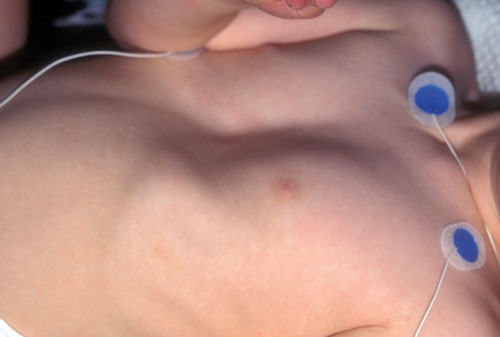
On clinical examination there will be evidence of increased work of breathing such as tachypnoea, indrawing/recession (see figure 1), head bobbing, grunting, nasal flaring or tracheal tug. Auscultation typically reveals wheeze and/or crepitations throughout both lung fields.1,4
The recent NICE guidelines1 recommend that a positive diagnosis should be made in the presence of typical clinical features, see table 1. Laboratory or other testing is of no value in confirming the diagnosis. Consider pneumonia if the fever is greater than 39° C or the chest signs are persistently focal.1 NICE recommends the use of pulse oximetry in primary care if it is available and the clinician has been appropriately trained.
Referral criteria
The majority of children with bronchiolitis do not need to be referred to secondary care and can be managed safely at home. Table 2, below, lists the criteria for immediate referral to hospital recommended by NICE. This should usually be by dialling 999 for an ambulance. The guidelines also recommend considering referral to hospital if the child has any of the following:
• A respiratory rate > 60 breaths/minute
• Difficulty with breastfeeding or inadequate oral fluid intake (50-75% usual volume)
• Clinical dehydration
When deciding whether to refer, consider risk factors for severe disease such as chronic lung disease, haemodynamically significant congenital heart disease, age under three months, premature birth, neuromuscular disorders or immunodeficiency.1
Also take account of factors which may affect parents’ ability to look after a child such as social circumstances or their ability to identify deterioration.1
When sending a child home key safety information should be provided, see table 3. NICE reviewed the literature to try to establish what levels of oral intake should be used for referral, admission and discharge criteria and how best to identify this but no useful evidence was found. The guidelines give a range of intake from 50 to 75% and we need to use our clinical judgment about each individual patient. It is important to inform parents that the cough can persist for up to three weeks in many patients.1
Primary care management
Treatment of bronchiolitis consists largely of supportive management although there remain wide variations in clinical practice.1,2,5
Bronchodilators such as salbutamol and ipratropium bromide have often been tried as therapies because of the clinical similarity with asthma. However, the respiratory distress in bronchiolitis is caused by mucosal oedema and secretions rather than bronchoconstriction. These treatments have been extensively studied and have never been shown to produce any sustainable or clinically important benefits in bronchiolitis and should not be used.1
There is often concern that we are being presented with a child with early onset asthma rather than bronchiolitis who might benefit from these treatments. The NICE guidelines point out that this is rare in younger children (less than one year) but should be considered if there is recurrent episodic wheezing and a strong history of atopy.
Nebulised therapies such as adrenaline and hypertonic saline have been considered because of their potential to reduce mucosal oedema and secretions. None of these treatments has been shown to produce consistent or clinically important improvements in children with bronchiolitis.1,2
Most recently the SABRE trial, a large high quality multicentre UK study of hypertonic saline in 317 inpatients with bronchiolitis failed to show any benefit.6 NICE felt that this evidence outweighed a few small earlier studies which seemed to suggest some benefit from hypertonic saline.
Other treatments considered by NICE included antibiotics, inhaled and systemic corticosteroids and montelukast. There is no evidence to support any of these treatments in bronchiolitis and hence they should not be used.
Nasal drops or home nasal suction were not studied by NICE. Another systematic review noted no useful studies of either treatment so could not draw any conclusions.2
In primary care therefore the treatment options are very limited.
The criteria for referral highlighted in table 1, should be sought. When discharging a child home information should be provided on the red flag features, table 2.
There is no evidence to make any recommendations as to what fluid advice is most appropriate when sending a child home, however, most clinicians recommend small amounts of fluid frequently.
In secondary care the mainstay of treatment remains supportive care. Suction should be administered if the respiratory distress is felt to be caused by upper airway secretions. Oxygen should be administered when saturation is persistently below 92%. Fluid should be administered through an enteral tube if oral intake is inadequate.1
Conclusion
Bronchiolitis is a very common and sometimes serious illness in young children. It represents a large burden on primary care resources especially in the winter months.
Treatment options are limited. The only current vaccine is a monoclonal antibody palivizumab. This is expensive and requires monthly injections so is reserved only for those children with significant comorbidity.
There is a novel treatment using nanotechnology to target the RSV virus in phase I clinical trials but even if effective it is likely to be some time before this treatment is available.
The recently published NICE guidelines provide a clear description of the typical clinical features based on a robust review of the evidence.1 If these features are present clinicians should have the courage to make a positive diagnosis without the need for further investigations. Evidence-based criteria are provided to assist in identifying the sickest children requiring referral to secondary care. The important red flag features are described and should be discussed with parents when sending a child home. A greater understanding of the clinical presentation and these evidence-based criteria should aid in improving the management of bronchiolitis.
REFERENCES
1 National Institute for Health and Care Excellence. NG9. Bronchiolitis in children. NICE. London. 2015
2 Bourke T, Shields M. Bronchiolitis. BMJ Clin Evid 2011;2011:0308
3 Budhiraja, S, Verma R, Shields M. The management of acute bronchiolitis in infants. Paediatr Child Health 2013;23(7)296-300
4 Smyth RL, Openshaw PJ. Bronchiolitis. Lancet 2006;368:312-322
5 Bialy L, Smith M, Bourke T, Becker L. The Cochrane Library and bronchiolitis: an umbrella review. Evid Based Child Health 2006;1(4):939-47
6 Everard M, Hind D, Ugonna K et al. SABRE: a multicentre randomised control trial of nebulised hypertonic saline in infants hospitalised with acute bronchiolitis. Thorax 2014;69:1105-12
ARTICLE IN PDF
 Download this article in PDF format
PRESET SEARCHES
PubMed
NICE evidence search
Immediate CPD prompts
These handy templates* prompt immediate drafting of personal learning, reflection and planning. Save your record straight into your personal development folder on your device or Cloud storage system.
*Adobe reader needed for iPad