SEARCH

Practitioner 2011; 255 (1741):19-22
Diagnosing and managing food allergy in children
22 Jun 2011
AUTHORS
Dr Edward Holloway MBBS BSc MRCPCH, Specialist Registrar in Paediatric Allergy
Dr Adam Fox MA (Hons) MB BS MSc FRCPCH DCH FHEA Dip Allergy, Consultant Paediatric Allergist
Ms Roisin Fitzsimons RN BSc Dip HE, Clinical Nurse Specialist Paediatric Allergy
Department of Paediatric Allergy, St Thomas' Hospital, London
Article
The past few decades have seen a huge rise in allergic disease. Recent studies suggest that the prevalence of food allergy in children in the UK is now around 5%.1
The number of children put on restricted diets by their parents because of presumed allergy is likely to be much higher. A recent population-based study in the Isle of Wight found that 33% of mothers thought their child had had an allergic reaction to food by the age of three.1
Accurate diagnosis of food allergy is essential in order to ensure that the correct foods are carefully avoided while safe foods are not excluded unnecessarily.2 Examples of common food allergens are listed in table 1.
Central to the successful diagnosis of food allergy is an understanding of the two main mechanisms involved.
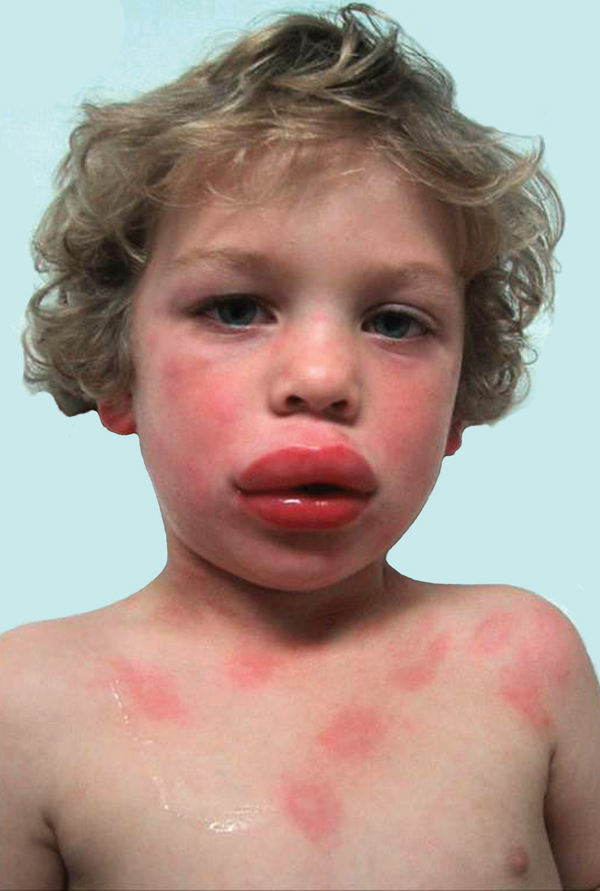
Easier to recognise are IgE-mediated (immediate type) reactions which are the result of mast cell degranulation leading to histamine release.3 The typical signs of lip swelling and urticaria (see figure 1, above) and possible progression to respiratory compromise (anaphylaxis) are usually clearly described, occurring within minutes of exposure to the problem food.
The second type of allergic reaction to food is a non IgE-mediated (delayed type) response. This tends to start two to six hours, occasionally longer, after exposure and cause less specific signs/symptoms which are less obviously allergic in origin. These include eczema or gastrointestinal symptoms such as gastro-oesophageal reflux, diarrhoea or persistent crying.
Both these types of reaction are explored in the following two cases.
Case 1
An eight-month-old girl is brought to the surgery with a history of an acute reaction after having a mouthful of scrambled egg. She had previously tolerated cake made with eggs.
Within a few minutes of eating the egg she developed swollen lips and had hives on her face and chest. She was taken by ambulance to hospital from where she was discharged after being given oral chlorphenamine.
She has had a background of eczema since four months of age.
Diagnosis
The NICE guideline on food allergy in children divides symptoms into IgE- and non IgE-mediated responses according to the system affected, see table 2.
With the presence of a clear history of urticaria and lip swelling, this is a typical history for an IgE-mediated allergic response, especially as it occurred immediately after exposure to a common food allergen which had not been tolerated in the plain form in the past. In the case of egg allergy, it is common for children to tolerate well cooked egg, as in this case, as the cooking process denatures the allergenic proteins.4 These children can be advised to eat baked egg but avoid plain/uncooked forms.
The recent NICE guideline advises that where an immediate type allergic reaction is suspected on clinical history, allergy testing should be performed to confirm the diagnosis. This could involve either skin prick testing or specific IgE blood tests (previously known as RAST). Both tests can help confirm a food allergy.3 However, the results must be interpreted in the context of the clinical history.
Although the size of the allergy test response indicates the probability of allergy being present, it does not relate to the severity of reactions that may occur.
It may also be important to test for other foods that may be a problem so, for example, in this case, testing for allergy to peanut would be advisable as 20-30% of children who are allergic to egg also have peanut allergy.5
In this case, the skin test response to egg was 4 mm. In the context of the history of clinical reactivity, this confirms egg allergy. The peanut skin prick test was 8 mm - large enough to suggest strongly (>95% positive predictive value3) allergy to peanut so a presumptive diagnosis could be made without any clear history of previous exposure. This child should therefore also be told to avoid peanut indefinitely unless future skin prick tests are negative and the child is shown to have outgrown the allergy.
Alternative methods currently marketed commercially for use in the diagnosis of allergy have no scientific validity. These include IgG testing, Vega testing and kinesiology. The NICE guideline is quite explicit that these have no place in allergy diagnosis.
Management
The mainstay of management is allergen avoidance, which requires education and advice from a registered dietician. The child and carers also need to know how to recognise and treat any future allergic reactions. This child is at risk of having further reactions, the severity of which cannot be accurately predicted and thus there should be a written emergency plan in place. The plan should include advice to take a
fast-acting antihistamine,6 e.g. chlorphenamine if any accidental exposure and reactions occur.
IgE-mediated reactions are unpredictable but some children seem to be at particular risk of having severe reactions. Where there is a history of anaphylactic reaction or ongoing asthma, adrenaline auto-injectors should be prescribed as these are the major risk factors for future severe reactions.
Nut allergy, which is known to cause the majority of anaphylactic reactions, living far away from medical help and high parental anxiety are all relative indications for adrenaline auto-injector prescription, see table 3. When prescribed, it is advisable that children have two devices to hand at all times6 i.e. two at school and two at home.
It is essential that training on how and when to use the adrenaline auto-injectors is given as well as a written emergency plan.
In this particular case it is worth bearing in mind that 80% of children who have both egg allergy and eczema will develop respiratory allergy such as asthma later in childhood7 so she may also need prescriptions for adrenaline auto-injectors in the future, if not now.
It is essential to keep a close eye on the control of asthma in children with food allergy as they are more likely to have severe asthma attacks and undertreated asthma can predispose to more severe allergic reactions, if they occur.
It should also be noted that egg allergy is not a contraindication to MMR vaccination and no special precautions are required. The MMR vaccine is grown on chick fibroblasts so the hen's egg protein content in the vaccine is negligible and the MMR vaccine has now been deemed safe for administration in primary care to children who are allergic to egg.8
Referral
NICE advises that referral to secondary care should be considered in the following cases of suspected IgE-mediated food allergy:
- confirmed IgE-mediated food allergy and concurrent asthma
- allergic reaction involving systemic response
- more than one food allergen involved
- confusion over diagnosis
Prognosis
Egg allergy is outgrown in 68% of children by their 16th birthday.9 Most improvement is seen in the first few years so regular or intermittent repeat allergy testing can be useful to help identify those children who are outgrowing their allergy. Tolerance can be confirmed with a careful exposure to the food under medical supervision in a hospital setting. Peanut allergy is only outgrown in 20% of patients.
Case 2
A mother brings her breast-fed five-month-old child to her local surgery for follow-up. He has previously been diagnosed with troublesome gastro-oesophageal reflux disease (GORD) and mild eczema.
His mother noticed a deterioration when she started to introduce additional formula feeds from three months. He is described as ‘a miserable baby' who has a very poor sleep pattern and ‘lots of colic'. He has never had any symptoms of urticaria/lip swelling/breathing difficulties.
His mother asks for referral to ‘a specialist' for allergy tests as she suspects the formula milk is a problem.
Discussion points
GORD and eczema are common diseases of infancy which may be related to allergy. An allergy-focussed clinical history is required to obtain the information that may point to food allergy as the underlying cause.
Non IgE-mediated food allergy is most common in early infancy although it often goes undiagnosed for an extended period. The most common causes are milk and soya, and less often egg and wheat.
A past medical or family history of atopy increases the likelihood that chronic symptoms such as reflux may be related to food allergy. The association between increased exposure and worsening symptoms is also important. The presence of clusters of symptoms in different systems e.g. eczema and reflux, also increase the likelihood of underlying food allergy.
If a careful history raises the suspicion of non IgE-mediated allergy then there is no value in IgE allergy tests. The diagnosis of non IgE-mediated food allergy relies on a two-stage process:
1 Strict exclusion of suspected allergen(s) - only one at a time
2 Re-challenge with suspected allergen(s), one at a time, to see if symptoms recur
In the above case, a period of safe exclusion of cow's milk protein (CMP) to see if there is improvement of symptoms is required in the first place. In the case of CMP allergy the infant should have a trial of four to six weeks on a CMP-free diet with extensively hydrolysed formula or amino acid formula.
In the case of a breast-fed infant, his mother should exclude all dairy products from her diet for the same period. This requires the guidance of an experienced dietician.
The second stage of re-challenging with CMP, often resisted by parents, to demonstrate a recurrence of symptoms is important for this child as non-specific symptoms such as colic, eczema etc may simply have resolved with time.
Given that CMP allergy affects infants at a crucial stage in development, prompt diagnosis and exclusion of CMP has an important role in helping these infants to thrive and bond effectively. In some cases of suspected or proven non IgE-mediated food allergy referral to a secondary care setting should be considered. These include:
- faltering growth
- more than one allergen involved
- atopic eczema resistant to routine treatment
- cases of allergic enterocolitis
- confusion over diagnosis
Prognosis
In non IgE-mediated allergy, the prognosis is good with the majority of infants outgrowing allergy to milk, wheat, soya or egg by school age. Given the lack of a diagnostic investigation, a reasonable approach to ongoing management is to advise parents to re-introduce the allergen to the child's diet every six months to see if tolerance has been achieved.
Conclusion
These cases illustrate common presentations of childhood food allergy. Careful documentation using a targeted and thorough history usually makes it possible to distinguish suspected IgE-mediated allergy from non IgE-mediated.
Investigations should be tailored to the suspected mechanism of allergy i.e. allergy tests for suspected IgE-mediated allergy and exclusion/re-introduction diets for non IgE-mediated allergy.
Once diagnosed, management requires allergen avoidance guided by a dietician together with education in recognising and treating reactions appropriate to the underlying mechanism.
Food allergy is commonly outgrown so regular reassessment is essential both to monitor for tolerance and also to look for development of allergic comorbidities.
REFERENCES
1 Venter C, Pereira B, Voight K et al. Prevalence and cumulative incidence of food hypersensitivity in the first 3 years of life. Allergy 2008;63(3):354-9
2 Noimark L, Cox H. Nutritional problems related to food allergy in childhood. Pediatr Allergy Immunol 2008;19:188-95
3 du Toit G, Santos A, Roberts G et al. The diagnosis of IgE-mediated food allergy in childhood. Pediatr Allergy Immunol 2009;20:309-319
4 Romeira AM, Pires G, Gaspar A et al. Egg Allergy - to be or not to be boiled. Allergy 2003;58:533-4
5 Fox AT, Sasieni P, du Toit G et al. Household peanut consumption as a risk factor for the development of peanut allergy. J Allergy Clin Immunol 2009; 123(2):417-23
6 Muraro A, Roberts G, Clark A et al. The management of anaphylaxis in childhood: Position paper of the European Academy of Allergology and Clinical Immunology. Allergy 2007;62:857-71
7 Tariq SM, Matthews SM, Hakim EA et al. Egg allergy in infancy predicts respiratory allergic disease by 4 years of age. Pediatr Allergy Immunol 2000; 11(3):162-7
8 Clark AT, Skypala I, Leech S et al. British Society for Allergy and Clinical Immunology guidelines for the management of egg allergy. Clin Exp Allergy 2010:40:1116-29
9 Savage JH, Matsui EC, Skripak JM et al. The natural history of egg allergy. J Allergy Clin Immunol 2007;120(6):1413-7
FURTHER READING
National Institute for Health and Clinical Excellence. CG116: Food allergy in children and young people. NICE. London. 2011
British Society for Allergy and Clinical Immunology (BSACI) guidelines: www.bsaci.org
European Academy of Allergy & Clinical Immunology (EAACI) position papers: www.eaaci.net
Boyce JA, Assa'ad A, Burks AW et al. Guidelines for the diagnosis and management of food allergy in the United States: summary of the NIAID-sponsored expert panel report. Nutrition Research 2011; 31(1): 61-75
Fiocchi A, Brozek J, Schünemman H et al. World Allergy Organization (WAO) Diagnosis and Rationale for Action against Cow's Milk Allergy (DRACMA) Guidelines. Pediatr Allergy Immunol 2010; 21(S21):1-125
du Toit G, Meyer R, Shah N et al. Identifying and managing cow's milk protein allergy. Arch Dis Child 2010;95(5):134-44
 Download this article in PDF format