SEARCH

Ramphul M, Gaillard EA. Diagnosis and management of acute asthma in children. Practitioner June 2021;265(1849):17-21
Diagnosis and management of acute asthma in children
25 Jun 2021
AUTHORS
Dr Manisha Ramphul MBBS MRCPCH PGcert (med ed) Paediatric Respiratory Registrar, Department of Paediatric Respiratory Medicine, Leicester Children’s Hospital, University Hospitals Leicester, Leicester, UK
Dr Erol A Gaillard PhD MRCPCH, Associate Professor in Child Health and Honorary Consultant in Paediatric Respiratory Medicine, Department of Paediatric Respiratory Medicine, Leicester Children’s Hospital, and University of Leicester, Department of Respiratory Sciences, Leicester NIHR Biomedical Research Centre, Leicester, UK
Competing interests
Dr Erol Gaillard has undertaken consultancy work for Boehringer Ingelheim with fees paid to the institution (University of Leicester), and received investigator led research grants from Chiesi, Gilead, and Circassia, and undertaken research collaboration with Medimmune.
Dr Manisha Ramphul has no competing interests
Article
Asthma affects 1.1 million children in the UK, and up to 50% experience asthma exacerbations each year. Preschool children have the highest rate of acute wheezing episodes of all age groups with asthma, nearly four times higher than those aged five to 17 years.Acute asthma attacks are the result of bronchoconstriction and airway oedema. A previous asthma attack is the most important risk factor for future episodes. Modifiable risk factors include poor symptom control, suboptimal treatment regimens, over-reliance on SABAs and poor adherence to preventer therapy. Viral respiratory tract infections, especially rhinovirus type 4, are powerful triggers of asthma and wheeze in susceptible children. Other triggers include exposure to indoor allergens such as house dust mites, moulds and pet fur, and outdoor aeroallergens such as pollens. Exposure to cigarette and vape smoke are powerful and avoidable triggers. Air pollution can also lead to asthma attacks requiring hospitalisation. Attempting a peak expiratory flow measurement can be very useful in children aged five years and over when the child presents with an exacerbation. It helps grade the severity of the attack and supports making a correct diagnosis especially when performed before and after salbutamol. Following an attack all children should receive asthma education as well as an updated personalised asthma action plan. Patients and/or parents must be able to demonstrate correct use of inhalers. A GP review should be carried out within two working days of an asthma attack.
Asthma attacks are one of the most common reasons for emergency primary CARE or hospital visits in children.1,2
Asthma affects 1.1 million children in the UK, and up to 50% experience asthma exacerbations each year.3
Most of these cases are managed in primary care. However, around 25,000 children are admitted to hospital with asthma annually.4
Preschool children under the age of five years have the highest rate of acute wheezing episodes of all age groups with asthma, nearly four times higher than those aged five to 17 years.5
Wheeze is produced by airflow turbulence heard during expiration. When airway obstruction worsens, wheeze may also be heard in inspiration, but in severe obstruction it may be absent.
Wheezing can occur with a variety of acute childhood respiratory conditions, other than asthma, see table 1. There are many causes of wheeze in preschool children and this age group is particularly challenging to assess. Recurrent episodes of wheezing are especially common in children born prematurely.
A rhinovirus respiratory infection is by far the most common reason for acute wheezing in preschool children. Importantly, wheezing in this age group responding to short-acting beta2-agonists (SABAs) should be considered a form of asthma.
Asthma is characterised by airway inflammation and hyper-responsiveness to a variety of triggers. Acute asthma attacks result from bronchoconstriction and airway oedema and are characterised by wheeze, chest tightness, worsening cough, shortness of breath, and rapid breathing.
Risk factors
The greatest risk factor for an asthma attack in children is a previous asthma attack.6 Two or more emergency department visits or hospitalisations for asthma in the past year and any history of intensive care admission increase the risk of a future attack.7
Modifiable risk factors include poor symptom control, suboptimal treatment regimens, over-reliance on SABAs and poor adherence to preventer therapy.8 Obesity is associated with a slightly increased risk of asthma attacks.6
Identifying triggers
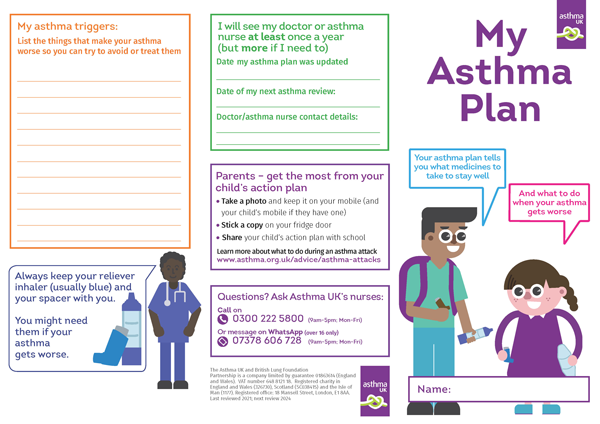
It is important to identify allergenic or non-allergenic asthma triggers for each child and note them in the child’s asthma action plan, see figure 1.9 NICE recommends the use of skin prick tests for aeroallergens or specific IgE tests to identify asthma triggers, after a formal diagnosis has been made.10
Viral respiratory tract infections, especially rhinovirus type 4, are powerful triggers of asthma and wheeze in susceptible children and these are difficult to avoid.11 Asthma attacks may be triggered by exposure to indoor allergens such as house dust mites, moulds and pet fur, and outdoor aeroallergens such as pollens. Although dust mites may trigger asthma attacks, elimination of dust mites may not be effective.12 Pets, including dogs and cats can trigger asthma attacks in sensitised subjects,13 but avoidance may be a difficult and sensitive matter for families.
Tree and grass pollens can lead to seasonal asthma attacks in sensitised individuals.14 Limiting outdoor exposure in the spring and summer may be helpful in some cases. Initiating antihistamine treatment a month before the start of the season may also help.15
Cigarette and vape smoke are powerful and avoidable triggers of wheezing and asthma. The current National Asthma and COPD Audit Programme (NACAP)16 recommends that healthcare professionals reviewing patients with acute asthma ask about smoking and cigarette smoke exposure in the home and offer appropriate advice. Helping parents understand the detrimental effects on their child’s asthma control is key in encouraging them to give up smoking.17 Exposure to air pollution can also lead to asthma attacks requiring hospitalisation.18
Clinical signs of an asthma attack
Younger children may have intercostal and subcostal recessions and tracheal tugging. Older children tend to use their sternocleidomastoid muscles. Severe breathlessness, including inability to complete sentences, is a worrying sign of severe asthma. Auscultation of the chest may reveal wheezing or decreased air entry or a silent chest depending on the severity of the attack. Vital signs often reveal tachypnoea, tachycardia and oxygen saturation < 94% on pulse oximetry in severe attacks.
Attempting a peak expiratory flow (PEF) measurement can be very useful in children aged five years and over when the child presents with an exacerbation. It helps grade the severity of the attack and supports making a correct diagnosis especially when performed before and after salbutamol. The PEF measurement expressed as a percentage of the child’s previous best value is most useful.
Management
Asthma attacks are classified as mild, moderate, severe or life-threatening depending on the clinical features. The treatment of acute asthma is detailed in the BTS/SIGN 2019 guidelines19 and depends on the severity of the asthma attack (see figure 2).
Oxygen therapy
Children with an oxygen saturation < 94% should be given high-flow oxygen via a tight-fitting face mask or nasal cannula to achieve saturation levels of 94-98%.19
If GPs do not have oxygen or the appropriate mask/cannula available, for example during out of hours, they should call an emergency ambulance straightaway. Even if arterial oxygen saturation improves after a nebuliser, the child needs to be monitored, which is best done in hospital rather than in an out-of-hours emergency GP setting.
Bronchodilators
Inhaled SABAs such as salbutamol are the first-line treatment for acute asthma in children. A metered dose inhaler + spacer is the preferred option in children with mild to moderate asthma,20 but nebulisation may be used instead. It is important to remember that 10 puffs of salbutamol are the equivalent of a nebuliser dose. Salbutamol dosing should be individualised to the patient according to the severity of the asthma attack, see box 1.
For patients experiencing a mild attack, 200-400 µg (2-4 puffs) may be sufficient and can be increased to 10 puffs if needed. The child should be reassessed after 30 minutes, with the potential to repeat the treatment.
In a child with a severe asthma attack, intensive salbutamol nebulisation, every 20 minutes within the first hour, is usually effective at improving the child’s respiratory distress. In case of hypoxia, oxygen-driven nebulisation is recommended, while awaiting ambulance transfer to hospital.
The anticholinergic ipratropium bromide produces a slower bronchodilator response than a SABA, but the combination of the two produces a synergistic effect. Ipratropium bromide should be given early to treat children with a poor response to a SABA.21 It can be administered up to every 20 minutes within the first hour usually as a combination nebulisation with a SABA. Although this treatment is useful to ameliorate the attack the child is still likely to need transfer to hospital via ambulance.
Corticosteroids
Early administration of systemic corticosteroids, either as prednisolone or dexamethasone, is advised for school-age children with a moderate or severe asthma attack.
Repeated courses of systemic corticosteroids are usually a sign that the asthma is poorly managed and this needs to be addressed once the child has recovered from the asthma attack. Repeated use of systemic steroids should prompt a referral to a paediatrician with an interest in asthma.
In children under the age of five years, recommendations relating to systemic corticosteroids are more complex. Two large randomised controlled trials have shown limited effectiveness of systemic corticosteroids in this age group.22,23 There are growing concerns regarding the use of frequent courses of oral steroids in younger children where the benefit remains uncertain. A Danish cohort study, involving 291 children, found a significant association between cumulative inhaled corticosteroid exposure during the first six years of life and high BMI at age six.24
Systemic corticosteroids should be avoided in children of preschool age with mild attacks of wheezing.
Safety netting
Children with a mild attack and those with a moderate attack who show a good response to initial treatment can then be managed at home on a maximum of 6 puffs of salbutamol every 4 hours with a spacer and a salbutamol weaning plan. As described above, some children may require a short course of oral corticosteroids, for example prednisolone for 3-5 days.
Following an asthma attack asthma education is mandatory for all children because this reduces asthma-related readmissions,25 unscheduled GP reviews and days off school, and improves the child’s quality of life.26 Children and/or their parents must be able to demonstrate appropriate use of inhalers and have an updated personalised asthma action plan.
If symptoms recur or persist, emergency medical advice should be sought.
Referral
Children with a severe attack and those responding poorly to initial treatment should be referred to hospital.
Hospital admission should also be considered in the following situations:19
• An attack occurring in late afternoon or at night
• Concerns over the parents’ ability to cope at home
• Recent hospital admission or previous severe attack
Follow-up
The BTS/SIGN guidelines and the NICE quality standards recommend a GP review within two working days of an asthma attack.19,27
This follow-up after an asthma attack is crucial because it provides the opportunity to review the background controller medication, ensure that the child has returned to baseline in terms of clinical symptoms and reinforce the key aspects of asthma education in a more controlled setting. It is also a good opportunity to answer any questions that the child and/or parents may have and is a key component of preventing asthma deaths.28
The following essential points should be addressed with the child and parents during the post attack asthma review:
• Education about asthma and disease management
• A review of the maintenance anti-inflammatory treatment
• A review and advice on adherence to preventer medication
• Checking and improving the inhaler technique with the use of a spacer, and encouraging self-monitoring with a peak flow meter where appropriate
• Completing an updated personalised written asthma action plan
• Helping the family identify and avoid triggers
• Tackling modifiable factors, including parental smoking
The National Review of Asthma Deaths (NRAD) report Why asthma still kills found that in more than 60% of asthma deaths, potentially preventable factors were identified.28 A key recommendation from the report is for practices ‘to adopt a system of establishing the risk profile of a patient and put a treatment plan in place that is appropriate to their risk profile’.
GPs should consider referral to a secondary care asthma clinic if the child has had two attacks or more in the past year. Any child with life-threatening features seen in hospital should also have a secondary care follow-up.
Prevention of future asthma attacks
Optimal treatment of chronic asthma is the most effective way of reducing the risk of future attacks; this involves stepping up to the adequate dose of inhaled corticosteroids and/or other controller medication. Children will require regular asthma reviews to gauge the baseline symptom control and response to medication.
It is important to check inhaler technique at each visit. Good inhaler technique is vital to prevent future asthma attacks. International studies, including studies from the UK, have consistently shown that the majority of asthma patients including children have poor inhaler technique.29,30 There is excellent guidance on inhaler technique including helpful video materials on the Asthma UK website to share with families and children (see Useful information box, below).
It is vital to communicate effectively with patients and/or their parents, to enable them to understand the importance of good compliance with therapy. Poor adherence to treatment can be identified through a thorough history and examining prescribing records. Prescribing records may provide an approximation of adherence, although cashing a prescription does not necessarily mean that the medication has been taken appropriately.
More objective ways of monitoring adherence being developed include electronic apps and electronic monitoring devices.30 Currently, these electronic devices are predominantly used in research settings.
After a proven asthma attack, it is essential for GPs to code the diagnosis as asthma and place children diagnosed with asthma on the practice asthma register to ensure that families are invited for an annual asthma review.
A thorough annual asthma review in primary care is vital to identify those children at risk of future asthma attacks.31
Conclusion
Asthma attacks in children are often preventable. Following up children immediately after an attack provides an opportunity to educate children and their families, review asthma medications, adherence and inhaler technique, and identify and modify risk of future asthma attacks.
REFERENCES
1 Asthma UK. www.asthma.org.uk/about/media/facts-and-statistics [Last accessed 3 June 2021]
2 Julious SA, Horspool MJ, Davis S et al. Open-label, cluster randomised controlled trial and economic evaluation of a brief letter from a GP on unscheduled medical contacts associated with the start of the school year: the PLEASANT trial. BMJ Open 2018;8(4):e017367
3 Turner SW, Murray C, Thomas M et al. Applying UK real-world primary care data to predict asthma attacks in 3776 well-characterised children: a retrospective cohort study. NPJ Prim Care Respir Med 2018;28(1):28
4 NHS England. NHS warning to parents as ‘asthma season’ hits. www.england.nhs.uk/2019/09/nhs-warning-to-parents-as-asthma-season-hits/ [Last accessed 3 June 2021]
5 Bloom CI, Nissen F, Douglas IJ et al. Exacerbation risk and characterisation of the UK’s asthma population from infants to old age. Thorax 2018;73(4):313
6 Buelo A, McLean S, Julious S et al. At-risk children with asthma (ARC): a systematic review. Thorax 2018;73(9):813
7 Belessis Y, Dixon S, Thomsen A et al. Risk factors for an intensive care unit admission in children with asthma. Pediatr Pulmonol 2004;37(3):201-09
8 Fuhlbrigge AL, Kitch BT, Paltiel AD et al. FEV1 is associated with risk of asthma attacks in a pediatric population. J Allergy Clin Immunol 2001;107(1):61-67
9 Gautier C, Charpin D. Environmental triggers and avoidance in the management of asthma. J Asthma Allergy 2017;10:47-56
10 National Institute for Health and Care Excellence. NG80. Asthma: diagnosis, monitoring and chronic asthma management. NICE. London. 2017 Updated 2021 www.nice.org.uk/guidance/ng80 [Last accessed 17 June 2021]
11 Song DJ. Rhinovirus and childhood asthma: an update. Korean J Pediatr 2016;59(11):432-39
12 Mendy A, Wilkerson J, Salo PM et al. Endotoxin clustering with allergens in house dust and asthma outcomes in a U.S. national study. Environ Health 2020;19(1):35
13 Nilsson OB, van Hage M, Grönlund H. Mammalian-derived respiratory allergens – implications for diagnosis and therapy of individuals allergic to furry animals. Recomb Allerg Methods 2014;66(1):86-95
14 Beier J, Beeh KM, Kornmann O et al. Dissimilarity between seasonal changes in airway responsiveness to adenosine-5’-monophosphate and methacholine in patients with grass pollen allergic rhinitis: relation to induced sputum. Int Arch Allergy Immunol 2003;132(1):76-81
15 Randall KL, Hawkins CA. Antihistamines and allergy. Aust Prescr 2018;41(2):41-45
16 National Asthma and COPD Audit Programme. www.nacap.org.uk/nacap/welcome.nsf/vwFiles/COPD-AA-2020/$File/NACAP_AACOPD_Org_Audit_National_Report_2020_5.1.pdf?openelement . [Last accessed 3 June 2021]
17 Turner S, Mackay D, Dick S et al. Associations between a smoke-free homes intervention and childhood admissions to hospital in Scotland: an interrupted time-series analysis of whole-population data. Lancet Public Health 2020;5(9):e493-e500
18 Zheng X, Ding H, Jiang L et al. Association between air pollutants and asthma emergency room visits and hospital admissions in time series studies: a systematic review and meta-analysis. PloS One 2015;10(9):e0138146-e0138146
19 Scottish Intercollegiate Guidelines Network. SIGN 158 British guideline on the management of asthma. SIGN. Edinburgh. 2019 www.sign.ac.uk [Last accessed 3 June 2021]
20 Cates CJ, Welsh EJ, Rowe BH. Holding chambers (spacers) versus nebulisers for beta-agonist treatment of acute asthma. Cochrane Database Syst Rev 2013;2013(9):CD000052
21 Griffiths B, Ducharme FM. Combined inhaled anticholinergics and short-acting beta2-agonists for initial treatment of acute asthma in children. Cochrane Database Syst Rev 2013;(8):CD000060
22 Wallace A, Sinclair O, Shepherd M et al. Impact of oral corticosteroids on respiratory outcomes in acute preschool wheeze: a randomised clinical trial. Arch Dis Child 2021;106(4):339
23 Panickar J, Lakhanpaul M, Lambert PC et al. Oral prednisolone for preschool children with acute virus-induced wheezing. N Engl J Med 2009;360(4):329-38
24 Kunøe A, Sevelsted A, Chawes BL et al. Associations between inhaled corticosteroid in the first 6 years of life and obesity related traits. Am J Respir Crit Care Med Published online 11 May 2021
25 Coffman JM, Cabana MD, Halpin HA, Yelin EH. Effects of asthma education on children’s use of acute care services: a meta-analysis. Pediatrics 2008;121(3):575-86
26 Wolf F, Guevara J, Grum C et al. Educational interventions for asthma in children. Cochrane Database Syst Rev 2002;(4):CD000326
27 National Institute for Health and Care Excellence. QS25. Quality standards: asthma www.nice.org.uk/guidance/qs25/chapter/quality-statements . [Last accessed 3 June 2021]
28 Levy ML. The national review of asthma deaths: what did we learn and what needs to change? Breathe 2015;11(1):14-24
29 Levy ML, Dekhuijzen PN, Barnes PJ. Inhaler technique: facts and fantasies. A view from the Aerosol Drug Management Improvement Team (ADMIT). NPJ Prim Care Respir Med 2016;Apr 21;26:16017
30 Morton RW, Elphick HE, Craven V et al. Aerosol therapy in asthma-why we are failing our patients and how we can do better. Front Pediatr 2020;8:305
31 Levy ML, Fleming L. Asthma reviews in children: what have we learned? Thorax 2020;75(2):98
ARTICLE IN PDF
 Download this article in PDF format
PRESET SEARCHES
Asthma UK professional resources
Videos to talk through inhaler technique with patients
Action plans for adults
Action plans for children
Non-English action plans
Filling in an asthma plan with a patient
EXTERNAL WEBLINKS
Asthma UK
Advice on inhaler technique
Written advice and videos to help children use their inhalers correctly
www.asthma.org.uk/advice/child/medicines/help
Child asthma action plan
Copies of the template can be downloaded