SEARCH

Tur C, Thompson AJ. Early accurate diagnosis crucial in multiple sclerosis. Practitioner 2015;259 (1785):21-27
Early accurate diagnosis crucial in multiple sclerosis
24 Sep 2015
AUTHORS
Dr Carmen Tur, MD MSc PhD
Neurologist and Honorary Clinical Associate, National Hospital for Neurology and Neurosurgery, Queen Square, Clinical Research Associate and Postdoctoral ECTRIMS Fellow, MS Queen Square Centre, UCL Institute of Neurology, London, UK
Professor Alan J Thompson, FMedSci FRCP FRCPI
Garfield Weston Professor of Clinical Neurology & Neurorehabilitation, Dean of the Faculty of Brain Sciences, School of Life & Medical Sciences, Honorary Consultant Neurologist, National Hospital for Neurology and Neurosurgery, Queen Square, London, UK
Article
In around 85% of cases, multiple sclerosis (MS) starts with an acute neurological episode, a clinically isolated syndrome, which is considered to be the first clinical episode of relapsing-remitting MS (RRMS). It is characterised by the presence of acute relapses, after which there is normally good functional recovery. About 15-20 years after symptom onset, most patients develop secondary progressive MS, characterised by a gradual and irreversible neurological decline. MS affects women more frequently than men, with a ratio of 2-3:1. In RRMS the disease generally starts in the late 20s. Symptom onset in those with primary progressive MS occurs around the age of 40. Clinical relapses in RRMS reflect acute inflammation in the CNS, resulting in specific clinical syndromes including optic neuritis, myelitis, brainstem/cerebellum syndrome and supratentorial syndrome. In progressive MS, progression generally presents with gradual loss of power in the lower limbs, which may be asymmetric. It is often accompanied by sensory disturbances in the lower limbs, bladder and bowel symptoms. Investigations need to rule out conditions that can mimic an inflammatory-demyelinating disease of the CNS and determine the presence of dissemination in space and dissemination in time of the inflammatory-demyelinating disease. There is no confirmatory test for MS and it remains essentially a clinical diagnosis.
Multiple sclerosis (MS) is an inflammatory-demyelinating disease of the CNS. It is the most frequent disabling neurological disease among young adults, affecting 2.3 million people worldwide.1 Around 100,000 people2 in the UK have MS, giving an average prevalence of 1.5/1,000 (varying from 1.2/1,000 in England and Wales to 1.9/1,000 in Scotland).3
In about 85% of cases, MS starts with an acute neurological episode, a clinically isolated syndrome (CIS), considered to be the first clinical episode of relapsing-remitting MS (RRMS). It is characterised by the presence of acute relapses, after which there is normally a good functional recovery.4
About 15-20 years after symptom onset, most patients develop secondary progressive MS (SPMS), characterised by a gradual and irreversible neurological decline.5 Although relapses can still be present in SPMS, the accrual of disability is typically independent of any relapses. In about 15% of cases, MS starts with progressive neurological deterioration, i.e. primary progressive MS (PPMS).6
MS affects women more frequently than men, with a ratio of 2-3:1.7,8 Age at disease onset varies depending on the type of MS. In RRMS the disease generally starts in the late 20s. Symptom onset in those with PPMS occurs around the age of 40.5,8 Once progression starts, the overall rate of neurological decline is similar for both SPMS and PPMS. Yet this progression rate may vary greatly between individuals and predicting which patients will follow a more rapid accrual of disability is still a challenge.
Recently, the International Advisory Committee on Clinical Trials in Multiple Sclerosis has re-examined the MS disease phenotypes.9 Although the main phenotype categories have not changed, these are now described in terms of the amount of disease activity observed, either inflammatory activity, i.e. presence of relapses and/or active lesions on MRI or neurodegenerative activity, i.e. disease progression. The goal of treatment in MS should be to prevent all disease activity.
The cause of MS is unknown. It is believed that a combination of risk factors can trigger an autoimmune response against the CNS leading to the development of MS. Risk factors can be either genetic or environmental and include a past history of infection by Epstein-Barr virus,10 high latitude/low solar exposure and low vitamin D levels,11 smoking,12 and obesity in adolescence.13
Clinical guidelines have been published by NICE,3 and the Association of British Neurologists (ABN) has produced guidance on the use of disease-modifying treatments in MS.14
Presentation
Symptoms in relapsing-remitting MS
Clinical relapses reflect acute inflammation in the CNS, resulting in specific clinical syndromes:
Optic neuritis (ON): Acute inflammation of the optic nerve, generally unilaterally, presents with retroocular pain on eye movements, blurred vision, and colour vision impairment, i.e. dyschromatopsia. Recovery of visual function after ON may be incomplete and does not directly depend on the severity of initial visual loss.15
Myelitis: Acute inflammation of the spinal cord generally presents with unilateral sensory or motor symptoms in one or two limbs. It can also present with a sensation of ‘an oppressive band’ in the trunk or an acute pain of neuropathic nature throughout the back triggered by cervical flexion (Lhermitte’s sign). Bladder and bowel disturbances such as urge incontinence may also be present.4
Brainstem/cerebellum syndrome: Acute inflammation of the mesencephalon, pons, medulla oblongata, or cerebellum. Usual presentations include: diplopia, dysarthria, facial weakness or hypoesthesia, trigeminal neuralgia, lack of coordination in the upper limbs, or balance problems. Paroxysmal symptomatology, such as paroxysmal dysarthria, due to (aberrant) ephaptic transmission, can also occur in brainstem syndromes.4
Supratentorial syndrome: Less commonly, acute inflammation of the cerebral hemispheres may present with aphasia or cognitive dysfunction if the lesion involves the cortex, or, more frequently, with a hemimotor/ hemisensory syndrome secondary to a subcortical lesion. Characteristically, only large supratentorial lesions will result in clinical symptoms, as opposed to lesions in other parts of the CNS.4
Symptoms in progressive MS(SPMS and PPMS)
Progression generally presents with gradual loss of power in the lower limbs, which may be asymmetric. It is often accompanied by sensory disturbances in the lower limbs, bladder and bowel symptoms. Upper limbs are generally affected at a later stage. Progressive loss of coordination in the lower or upper limbs can also occur. In the later stages of the condition, progressive dysarthria and difficulty swallowing may occur, the latter being potentially life-threatening if not managed effectively.16 Finally, there are all pervasive, interactive symptoms that can appear at any stage, notably fatigue, depression, pain and cognitive dysfunction.4,16,17
When a patient presents with a clinical syndrome compatible with a CIS, they should be referred promptly to a neurologist. An accurate and early diagnosis of MS is a priority for patients with this condition.18
Investigations need to:
• Rule out conditions that can mimic an inflammatory-demyelinating disease of the CNS
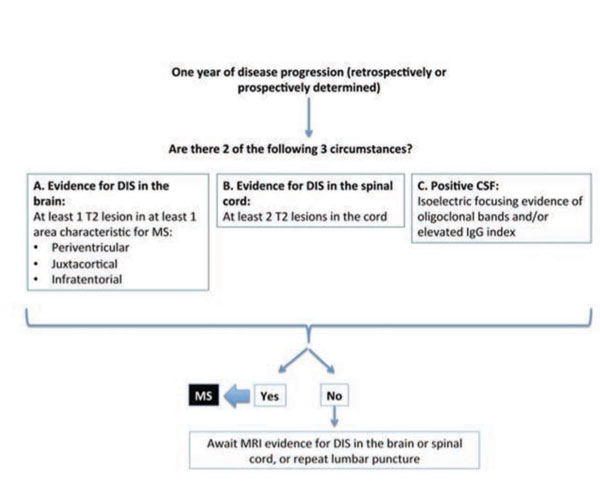
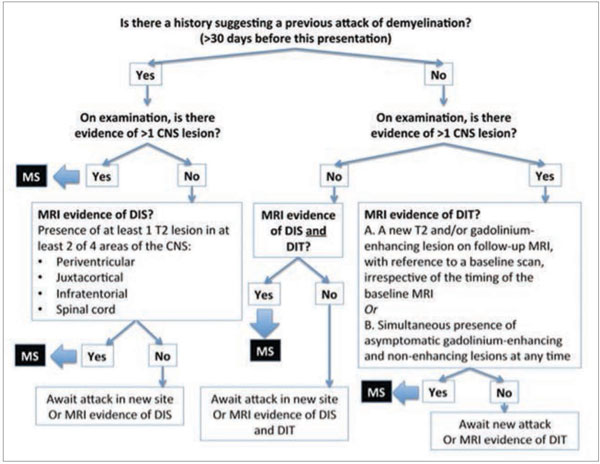
• Determine the presence of dissemination in space (DIS) and dissemination in time (DIT) of the inflammatory-demyelinating disease, the mainstays of the diagnosis of MS.19
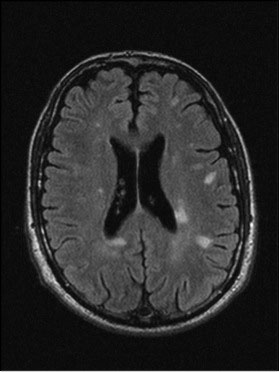
MRI of the brain and spinal cord: MS lesions are typically located in the periventricular and juxtacortical white matter regions, brainstem, cerebellum, and spinal (preferentially cervical) cord. MS lesions tend to be small and ovoid in shape, see figure 1). Gadolinium (Gd) contrast may be administered to assess disruption of the blood-brain barrier, which reflects acute inflammation.
High lesion loads are associated with a greater risk of having a second relapse (in patients with a CIS), and a greater risk of future progression of disability.7
CSF examination: In MS, there is typically production of immunoglobulins within the CNS, known as oligoclonal bands (OB). Normally, these OB are absent in peripheral blood, causing a blood-CNS mismatch, relatively specific to this disease, although it can be seen in quite a few other immunological conditions. The presence of OB in the CNS (together with their absence in serum) has been associated with a worse prognosis.7,20
Visual, sensory, and brainstem evoked potentials: Prolonged latencies in evoked potentials (and other neurophysiology tests) are indicative of demyelinating damage in the pathway explored. Visual evoked potentials (VEPs) are the most robust and clinically useful. Abnormally prolonged latencies in VEPs have been strongly associated with the presence of demyelination,21 have been used to support the diagnosis of MS,22,23 and are related to a worse prognosis.24
Diagnosis
There is no confirmatory test for MS and it remains essentially a clinical diagnosis. Yet the exclusion of other conditions25 (see table 1) together with the fulfilment of current diagnostic criteria19 (see figures 2 and 3) allows the diagnosis of MS to be made with relative certainty. However, the diagnosis must always be revisited if unexpected symptoms appear.25 In these cases, it may be that this is an unusual symptom for MS, the underlying condition is not MS or the patient has an additional condition.
A recent systematic review has shown that some conditions, such as meningiomas, possibly urinary system cancers, inflammatory bowel disease, irritable bowel syndrome, epilepsy, and several psychiatric conditions may be more frequent in those with MS than in the general population.26 MS may reduce longevity, possibly in relation to the presence of comorbidities, especially psychiatric disorders.27
Management
Management in MS is based on education, prevention, a multidisciplinary approach and self-management. Education is key as without a firm knowledge and understanding of their condition, patients will not be empowered to play an active role in its management. Patients should be encouraged to take regular exercise and adhere to a healthy diet. Regular exercise is particularly important for long-term mobility in MS.3
NICE guidelines do not recommend omega-3 or omega-6 fatty acid supplements, which had been suggested to be associated with better outcomes in MS, as there is insufficient evidence of their benefit. Similarly, there is not enough evidence that vitamin D supplements can improve relapses or disability in MS. Some studies have recently suggested that sodium chloride in the diet may worsen MS pathology,28 although no recommendations have yet been made. There is increasing evidence supporting a harmful effect of smoking on progression of disability in MS, and there is a clear recommendation to advise patients not to smoke.3
Disease modifying drugs
Preventing worsening in MS includes strategies to change the disease course, i.e. disease modifying drugs (DMDs), which should be preceded by an accurate and early diagnosis. It may also include strategies to address specific symptoms in MS.29 DMDs can only be prescribed in relapsing forms of MS (RRMS and SPMS with the presence of relapses), since they have only proved effective in reducing the number of relapses.
No treatment has proved effective in delaying, let alone stopping, the gradual neurological decline that characterises progressive MS.
Recently, the range of DMDs has broadened and they are usually divided into first- and second-line treatments.
First-line DMDs: These include beta-interferon (administered sc every other day or im weekly), and sc glatiramer acetate (daily or three times per week).30
The new oral drugs BG-12 (dimethyl fumarate, twice daily)31,32 and teriflunomide (once daily)33,34 are also considered first-line DMDs.
They have all proved effective in reducing the number of relapses, around 30% for the interferons and glatiramer acetate,35 and around 40-50% for the new oral drugs.31-34
Importantly, beta-interferons, glatiramer acetate, and teriflunomide are able to delay a second attack if given to CIS patients at high risk of a further attack (i.e. high lesion load).36,37 At present, NHS England, based on the criteria outlined in the ABN guidelines,38 recommends first-line DMDs for RRMS with at least two relapses over the past two years.30
Beta-interferons can be prescribed within the first two years after a CIS if there is a high risk of developing further relapses, i.e. high lesion load and evidence of continuing disease activity on MRI.30
The main side effects of first-line DMDs include:
• Flu-like symptoms (beta-interferon)
• Immediate post-injection reaction including vasodilatation, chest pain, dyspnoea, palpitations, and tachycardia (glatiramer acetate)
• Mild-moderate lymphopenia and elevated liver enzymes (beta-interferon, dimethyl fumarate, and teriflunomide)
• Flushing and gastrointestinal events (dimethyl fumarate)
• Hair loss, peripheral neuropathy, and elevated blood pressure (teriflunomide).
Second-line DMDs: These generally include iv natalizumab (administered monthly),39,40 oral fingolimod (daily),41,42 and iv alemtuzumab (for five consecutive days initially, and for three consecutive days one year later).43-45 They have all proved effective in reducing the number of relapses by around 55-70%.
Usually, second-line DMDs are recommended when, despite the use of DMDs, the relapse rate is equal to, or higher than, that prior to DMD treatment. In particular, the presence of at least two relapses over the previous year together with MRI evidence of inflammatory activity while on first-line treatment indicates the need to consider a second-line option.30
However, all three drugs may be prescribed first line under certain circumstances. Natalizumab and alemtuzumab can be prescribed in patients with active MS, also called rapidly evolving severe relapsing remitting MS, i.e. if they have had at least two relapses over the past year together with MRI evidence of disease activity, even if they are not on any DMD.30 Oral fingolimod, can be prescribed as an alternative to natalizumab in patients at high risk of progressive multifocal leukoencephalopathy (PML).30,46
The main side effects of second-line DMDs include the following:
Fingolimod: Bradycardia and other heart conduction abnormalities, lymphopenia, macular oedema, elevated liver enzymes, and elevated blood pressure.
Natalizumab: Immunogenicity (antibodies against the drug) and PML– the risk increases if the patient has received immunosuppressants in the past, has been on natalizumab treatment for more than two years, and has prior exposure to the John Cunningham virus.
Alemtuzumab: Marked perfusion reaction with nausea and vomiting, marked lymphopenia, high risk of viral infections, and secondary autoimmunity, especially affecting the thyroid, platelets and kidneys.
Recently, the ABN has suggested that all DMDs be divided into two broad categories, based on their efficacy.14 Category 1 drugs (moderate efficacy) include sc and im beta-interferon, sc glatiramer acetate, oral teriflunomide, oral dimethyl fumarate, and oral fingolimod.
Category 2 drugs (high efficacy) include iv natalizumab and iv alemtuzumab.
In general, the most recent recommendations by the ABN are similar to those currently proposed by NHS England, although the ABN encourages early treatment.14
With respect to SPMS, the treatment criteria for those relapsing forms would be similar to RRMS. For non-relapsing SPMS, as for PPMS, no treatment has been recommended.
DMD stopping criteria are not as straightforward as starting criteria, since it is extremely difficult to know when a treatment is not helping any more in a particular case. In general, it is accepted that the presence of intolerable side effects, the development of SPMS without relapses, and the confirmation of a pregnancy are situations where DMDs should be stopped. In some cases though, a neurologist may suggest that a woman with MS remains on DMD therapy throughout pregnancy.
Men receiving any of the DMDs whose partners are trying to conceive should discuss this with their MS nurse or neurologist.
Monitoring
Safety monitoring for DMDs must be carried out in specialised MS centres. In general, it includes regular blood tests and other investigations aimed at ruling out drug-specific side effects. Annual MRI brain scans are generally recommended as well, to monitor both safety and treatment efficacy.14
If a patient with MS presents to their GP with symptoms suggestive of a relapse, it is important to check the concomitant presence of an infection, such as urinary tract infection or chest infection, and treat it if necessary.
Steroid treatment (usually 0.5 g oral methylprednisolone per day for five consecutive days, or 1 g iv methylprednisolone per day for three-five consecutive days) may be administered when there is a disabling clinical relapse. Steroids may shorten the recovery time but there is no firm evidence that they improve outcomes.3
Symptomatic treatment includes both pharmacological and non-pharmacological approaches.29
Over time, the number of interacting symptoms tends to increase. NICE guidelines recommend comprehensive annual assessments by healthcare professionals with expertise in MS, focusing on mobility and balance, including falls, the need for mobility aids, including wheelchair assessment, use of arms and hands, and muscle spasms and stiffness.3
NICE also recommends the use of coordinated multidisciplinary approaches that involve consultant neurologists, MS nurses, physiotherapists and occupational therapists, speech and language therapists, psychologists, dietitians, social care and continence specialists, and GPs.3 Self-management strategies are vital and the patient should be at the centre of all decision making.
As regards pregnancy, there is no contraindication to pain relief or cesarean delivery, and MS is not thought to be associated with an elevated risk for any pregnancy complications, with the exception perhaps of low birthweight babies in women on beta-interferon (for newer drugs, i.e. fingolimod, natalizumab, teriflunomide, dimethyl fumarate and alemtuzumab, the information is limited).47
Women with MS should discuss with their healthcare professional the increased risk of relapses at three-six months after childbirth, although it should be made clear that the risk of progression of disability is not increased in women who have children. Other general aspects must also be discussed, including long-term prospects in relation to overall MS prognosis.3
The role of the GP
GPs have a crucial role in referring patients with symptoms suggestive of MS to specialised MS centres. This can lead to early diagnosis and treatment. A recent survey by the MS Society suggests that there is still a lot to be done to raise awareness of the condition.18
Once the disease has been diagnosed, GPs should encourage patients to adopt a healthy lifestyle and to develop self-management strategies. NICE recommends regular comprehensive assessments, and GPs should be able to liaise with reference MS teams and to identify new needs, of any kind, that the patient with MS may have. GPs may play a key role in MS drug compliance, together with MS specialist nurses.
Organisations such as the MS Society and MS Trust (see External weblinks) can provide valuable resources for both GPs and patients. Greater participation of the patient in the management of their condition increases their chances of successfully coping with the disease.
REFERENCES
1 Browne P, Chandraratna D, Angood C et al. Atlas of Multiple Sclerosis 2013: A growing global problem with widespread inequity. Neurology 2014;83:1022-24
2 Mackenzie IS, Morant SV, Bloomfield GA et al. Incidence and prevalence of multiple sclerosis in the UK 1990-2010: a descriptive study in the General Practice Research Database. J Neurol Neurosurg Psychiatry 2014;85:76-84
3 National Institute for Health and Care Excellence. CG186. Multiple Sclerosis: Management of multiple sclerosis in primary and secondary care. NICE. London. 2014
4 Miller DH, Chard DT, Ciccarelli O. Clinically isolated syndromes. Lancet Neurol 2012;11:157-69
5 Compston A, Coles A. Multiple sclerosis. Lancet 2008;372:1502-17
6 Thompson AJ, Montalban X, Barkhof F et al. Diagnostic criteria for primary progressive multiple sclerosis: a position paper. Ann Neurol 2000;47:831-35
7 Tintore M, Rovira A, Rio J et al. Defining high, medium and low impact prognostic factors for developing multiple sclerosis. Brain 2015;138:1863-74
8 Scalfari A, Neuhaus A, Daumer M et al. Age and disability accumulation in multiple sclerosis. Neurology 2011;77:1246-52
9 Lublin FD, Reingold SC, Cohen JA et al. Defining the clinical course of multiple sclerosis: the 2013 revisions. Neurology 2014;83:278-86
10 Lucas RM, Hughes AM, Lay ML et al. Epstein-Barr virus and multiple sclerosis. J Neurol Neurosurg Psychiatry 2011;82:1142-48
11 Simpson S Jr, Blizzard L, Otahal P et al. Latitude is significantly associated with the prevalence of multiple sclerosis: a meta-analysis. J Neurol Neurosurg Psychiatry 2011;82:1132-41
12 Hernan MA, Olek MJ, Ascherio A. Cigarette smoking and incidence of multiple sclerosis. Am J Epidemiol 2001;154:69-74
13 Munger KL, Chitnis T, Ascherio A. Body size and risk of MS in two cohorts of US women. Neurology 2009;73:1543-50
14 Scolding N, Barnes D, Cader S et al. Association of British Neurologists: revised (2015) guidelines for prescribing disease-modifying treatments in multiple sclerosis. Pract Neurol 2015;15:273-79
15 Toosy AT, Mason DF, Miller DH. Optic neuritis. Lancet Neurol 2014;13:83-99
16 Rovaris M, Confavreux C, Furlan R et al. Secondary progressive multiple sclerosis: current knowledge and future challenges. Lancet Neurol 2006;5:343-54
17 Miller DH, Leary SM. Primary-progressive multiple sclerosis. Lancet Neurol 2007;6:903-912
18 MS Society. MS Priority Setting Partnership. Voting survey results 2013
19 Polman CH, Reingold SC, Banwell B et al. Diagnostic criteria for multiple sclerosis: 2010 revisions to the McDonald criteria. Ann Neurol 2011;69:292-302
20 Kuhle J, Disanto G, Dobson R et al. Conversion from clinically isolated syndrome to multiple sclerosis: A large multicentre study. Mult Scler 2015;21:1013-24
21 Asselman P, Chadwick DW, Marsden DC. Visual evoked responses in the diagnosis and management of patients suspected of multiple sclerosis. Brain 1975;98:261-82
22 McDonald WI, Compston A, Edan G et al. Recommended diagnostic criteria for multiple sclerosis: guidelines from the International Panel on the diagnosis of multiple sclerosis. Ann Neurol 2001;50:121-27
23 Polman CH, Reingold SC, Edan G et al. Diagnostic criteria for multiple sclerosis: 2005 revisions to the "McDonald Criteria". Ann Neurol 2005;58:840-46
24 Fuhr P, Borggrefe-Chappuis A, Schindler C, Kappos L. Visual and motor evoked potentials in the course of multiple sclerosis. Brain 2001;124:2162-68
25 Miller DH, Weinshenker BG, Filippi M et al. Differential diagnosis of suspected multiple sclerosis: a consensus approach. Mult Scler 2008;14:1157-1174
26 Marrie RA, Cohen J, Stuve O et al. A systematic review of the incidence and prevalence of comorbidity in multiple sclerosis:overview. Mult Scler 2015;21:263-81
27 Scalfari A, Knappertz V, Cutter G et al. Mortality in patients with multiple sclerosis. Neurology 2013;81:184-92
28 Kleinewietfeld M, Manzel A, Titze J et al. Sodium chloride drives autoimmune disease by the induction of pathogenic TH17 cells. Nature 2013;496:518-22
29 Thompson AJ, Toosy AT, Ciccarelli O. Pharmacological management of symptoms in multiple sclerosis: current approaches and future directions. Lancet Neurol 2010;9:1182-99
30 NHS England. Clinical Commissioning Policy: Disease Modifying Therapies for Patients with Multiple Sclerosis. 2014
31 Gold R, Kappos L, Arnold DL et al. Placebo-controlled phase 3 study of oral BG-12 for relapsing multiple sclerosis. N Engl J Med 2012;367:1098-1107
32 Fox RJ, Miller DH, Phillips JT et al. Placebo-controlled phase 3 study of oral BG-12 or glatiramer in multiple sclerosis. N Engl J Med 2012;367:1087-97
33 O’Connor P, Wolinsky JS, Confavreux C et al. Randomized trial of oral teriflunomide for relapsing multiple sclerosis. N Engl J Med 2011;365:1293-1303
34 Confavreux C, O'Connor P, Comi G et al. Oral teriflunomide for patients with relapsing multiple sclerosis (TOWER): a randomised, double-blind, placebo-controlled, phase 3 trial. Lancet Neurol 2014;13:247-56
35 National Institute for Health and Clinical Excellence CG32. Beta interferon and glatiramer acetate for the treatment of multiple sclerosis. NICE. London. 2002
36 Tintore M. Rationale for early intervention with immunomodulatory treatments. J Neurol 2008;255 Suppl 1:37-43
37 Miller AE, Wolinsky JS, Kappos L et al. Oral teriflunomide for patients with a first clinical episode suggestive of multiple sclerosis (TOPIC): a randomised, double-blind, placebo-controlled, phase 3 trial. Lancet Neurol 2014;13:977-86
38 Association of British Neurologists. Revised (2009) Guidelines for Prescribing in Multiple Sclerosis. 2009
39 Polman CH, O'Connor PW, Havrdova E et al. A randomized, placebo-controlled trial of natalizumab for relapsing multiple sclerosis. N Engl J Med 2006;354:899-910
40 Miller DH, Khan OA, Sheremata WA et al. A controlled trial of natalizumab for relapsing multiple sclerosis. N Engl J Med 2003;348:15-23
41 Kappos L, Radue EW, O'Connor P et al. A placebo-controlled trial of oral fingolimod in relapsing multiple sclerosis. N Engl J Med 2010;362:387-401
42 Cohen JA, Barkhof F, Comi G et al. Oral fingolimod or intramuscular interferon for relapsing multiple sclerosis.
45rN Engl J Med 2010;362:402-15
43 Cohen JA, Coles AJ, Arnold DL et al. Alemtuzumab versus interferon beta 1a as first-line treatment for patients with relapsing-remitting multiple sclerosis: a randomised controlled phase 3 trial. Lancet 2012;380:1819-28
44 Coles AJ, Fox E, Vladic A et al. Alemtuzumab versus interferon beta-1a in early relapsing-remitting multiple sclerosis: post-hoc and subset analyses of clinical efficacy outcomes. Lancet Neurol 2011;10:338-48
45 Coles AJ, Twyman CL, Arnold DL et al. Alemtuzumab for patients with relapsing multiple sclerosis after disease-modifying therapy: a randomised controlled phase 3 trial. Lancet 2012;380:1829-39
46 Tur C, Montalban X. Natalizumab: risk stratification of individual patients with multiple sclerosis. CNS Drugs 2014;28:641-48
47 Amato MP, Portaccio E. Fertility, pregnancy and childbirth in patients with multiple sclerosis: impact of disease-modifying drugs. CNS Drugs 2015;29:207-20
48 Lucio AC, D’Ancona CA, Lopes MH et al. The effect of pelvic floor muscle training alone or in combination with electrostimulation in the treatment of sexual dysfunction in women with multiple sclerosis. Mult Scler 2014;20:1761-68
ARTICLE IN PDF
 Download this article in PDF format
CLICK ON IMAGES
PRESET SEARCHES
Immediate CPD prompts
These handy templates* prompt immediate drafting of personal learning, reflection and planning. Save your record straight into your personal development folder on your device or Cloud storage system.
*Adobe reader needed for iPad
EXTERNAL WEBLINKS
The organisation also has a website to aid patients in decision making