SEARCH

Govenden D, Serpell M. Improving outcomes for chronic pain in primary care. Practitioner 2014;258 (1774):13-17
Improving outcomes for chronic pain in primary care
23 Sep 2014
AUTHORS
Dr Daniel Govenden MB ChB FRCA FCAI, Pain fellow
Dr Mick Serpell FRCA FFPMRCA, Consultant and Senior Lecturer, University Department of Anaesthesia, Pain Research Office, Gartnavel General Hospital, Glasgow, UK
Article
Although the patient’s goal is often complete pain relief, this is rarely a realistic outcome, so the role of the physician in managing chronic pain involves optimising pain relief as far as possible. Careful explanation and education may be needed to enable the focus to shift from cure to better management of pain, and improvement of function and quality of life. Chronic pain is defined as pain continuing beyond the normal time for tissue healing. Pain may be broadly classified on the basis of mechanism, as neuropathic, nociceptive or mixed. A thorough biopsychosocial assessment is essential so that an individualised multidisciplinary approach to management can be developed. The aims of assessment of chronic pain are to rule out any underlying serious pathology, identify the pain mechanism and identify and evaluate risk factors that contribute to chronicity. SIGN emphasises the need for a multidisciplinary team approach to improve outcomes, and highlights five broad categories of care: supported self-management, drug treatment, psychologically-based interventions, physical therapies and complementary therapies. Exercise, regardless of its type and the source of pain, is recommended for the management of chronic pain. In chronic low back pain, exercise therapy can improve strength and range of motion across joints, cardiorespiratory fitness and sense of wellbeing. Pain management programmes reduce anxiety and depressive symptoms, increase function and improve mood. They may be considered in patients with poor functional capacity, pain-related social and occupational problems and in cases where other management strategies have failed.
Chronic pain is a complex, multifaceted and often poorly understood condition that inflicts a significant clinical, economic and social burden on society.
Prevalence across Europe is 19% with 40% of patients reporting inadequate treatment of their pain.1 The patient’s goal is often complete pain relief. This is rarely a realistic outcome, so the role of the physician involves optimising pain relief as far as possible. Careful explanation and education may be needed to enable the focus to shift from cure to better management of pain, and improvement of function and quality of life. A thorough biopsychosocial assessment is essential so that an individualised multidisciplinary approach to management can be developed.
Classification
Chronic pain is defined as pain continuing beyond the normal time for tissue healing, this is often quoted as > 12 weeks for study purposes.2 The International Association for the Study of Pain (IASP) taxonomy of chronic pain describes more than 750 pain states.3 Presentation will therefore vary profoundly. One study found that across Europe back pain/low back pain was identified as the most common site of pain with arthritis/osteoarthritis and disc herniation as the most common pathological causes.1
Pain may be broadly classified on the basis of mechanism as neuropathic, nociceptive or mixed. It can be further grouped by site or pathology for a more functional classification, see table 1. There may be some overlap between pain states.
Assessment
The aims of assessment are to:
• Rule out any underlying serious pathology or disease process that requires treatment
• Identify the pain mechanism, its severity, location and impact on the patient. This is important both for initiating the correct treatment and also for tracking patient progress
• Identify and evaluate risk factors that contribute to chronicity.
This is performed in the context of a biopsychosocial assessment.
History
A thorough history and focused clinical examination form the basis of this assessment and will inform further investigation and management. See box 1.
Assessment tools can provide a validated, standardised method of establishing a baseline, identifying risk factors for persistent pain or tracking patient progress. Examples include multidimensional assessment tools such as the Brief Pain Inventory5 or more specific assessments such as the Keele STartBack tool for classifying back pain patients into low-, medium- or high-risk of chronicity, in order to direct optimal management.6
Examination
Clinical examination of patients will depend on the presentation.
Evidence of any serious pathology should always be excluded.
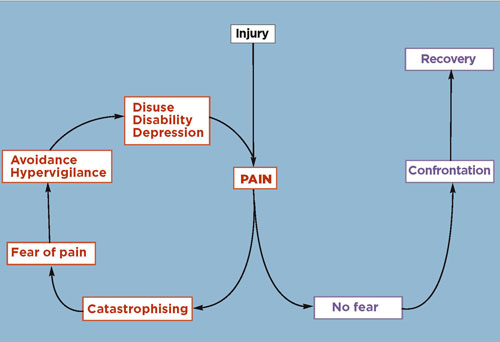
It is important to establish the patient’s range of movement and gauge functional ability. Evidence of abnormal pain behaviours may be observed such as hypervigilance, and fear avoidance. These are among the most important risk factors for chronicity, see figure 1.
Management
Management plans should be entered into with the agreement of the patient. Providing a summary of key points and goals may help to engage the patient and improve compliance.
SIGN guidance on the management of chronic pain, published last December, emphasises the need for a multidisciplinary team approach to improve outcomes, and highlights five broad categories of care: supported self-management, pharmacological management, psychologically-based interventions, physical therapies and complementary therapies.8
Supported self-management programmes are structured educational courses delivered by lay people. They can take a range of different formats including one-to-one or group sessions, e-learning or posted educational materials. They are community based and may provide a cost-effective means of producing modest short-term benefits in patients’ pain intensity and function.
The NHS. UK website has a livewell section that includes advice on pain, and provides links to self-management programmes, with information for healthcare professionals and patients. (www.nhs.uk/Livewell/Pain/Pages/10painself-helptips.aspx )
Healthcare professionals should be proactive in introducing the concept to patients and provide support.
Self-care extends beyond structured educational programmes and can include any interaction where a patient learns a skill and then practises it.
A recent systematic review on complementary therapy found evidence to support yoga and tai chi as part of an integrated medical approach.9
In addition to the above, signposting to local support services should be considered. Pain Association groups, education classes, step out initiatives and sensory art programmes are among a myriad of resources that may be available locally and form part of a self-supported care programme.
Acupuncture delivered by trained practitioners is safe, and may provide short-term relief of pain in chronic knee pain, and osteoarthritis.10 There is no evidence to suggest benefit from herbal remedies.
Exercise, regardless of its type and the source of pain, is recommended for the management of chronic pain. However advice alone is insufficient and methods to aid compliance should be employed. This includes individualised exercises in small groups, graded activity, or supplementary educational materials.
In chronic low back pain exercise therapy can improve strength and range of motion across joints, cardiorespiratory fitness and sense of wellbeing. High quality trial data is lacking but randomised controlled trials have suggested improvements in pain and function extending from medium to long term.11,12 The key factors in improved effectiveness of exercise are duration, and frequency. This appears consistent regardless of the type of exercise performed.13
In fibromyalgia patients, aerobic exercise has shown a reduction in pain, fatigue and depression and improvement in health-related quality of life and physical fitness.14,15
There is evidence that yoga and tai chi help to improve pain and disability in chronic arthritis.9
Pharmacological therapy
General principles
• Variation between individuals in pharmacokinetics, pharmacodynamics and pharmacogenetics leads to unpredictable responses to drug therapies. Hence it is reasonable to consider alternative agents from the same class of drugs if patients fail to tolerate, or have inadequate analgesia from, a prescribed drug
• An understanding of treatment response times will aid patient compliance and provide a realistic time frame to allow adequate dose titration
• In nociceptive pain states follow the WHO 3 Step analgesic ladder
Paracetamol
Paracetamol shows most appreciable benefits in combination with tramadol or codeine for chronic low back pain.
It has a favourable side effect profile compared with NSAIDs.
NSAIDs
NSAIDs form the mainstay of pain control for many conditions with an inflammatory component e.g. arthritis, and have modest benefits in nociceptive non-specific low back pain,16 however GI upset, renal failure or cardiovascular complications may limit their use in certain patient populations. Consider PPI cover for long-term use and high- risk patients.
Topical agents
Lidocaine patches are licensed for post-herpetic neuralgia but can be useful for other neuropathic pain conditions such as peripheral neuropathies or overlying a surgical scar site.
Topical NSAIDs are superior to rubefacients containing salicylates17 and have proven benefit in reducing pain in patients with chronic musculoskeletal conditions, NNT= 6.18
Topical capsaicin creams act via activation of TRPV1 receptors to deplete substance P in pain transmission pathways. They are available in 0.025%, 0.075% and 8% forms. There is low level evidence for the use of the weaker creams in the treatment of neuropathic pain.19
However, there have been trials showing benefit of 0.025% capsaicin in arthritis.20 In patients with post-herpetic neuralgia and HIV neuropathy there is evidence to support the use of an 8% capsaicin patch.21 This should be administered by trained staff in specialist clinics and should be considered only after other therapies have failed.
Antidepressants
Tricyclic antidepressants (amitryptiline, nortriptyline and imipramine), are the most effective analgesics, NNT= 3-4.5,22,23 but serotonin-noradrenaline reuptake inhibitors (duloxetine, venlafaxine) are also useful, NNT= 5,22 and often better tolerated. They enhance descending inhibitory pathways by increasing both noradrenaline and serotonin neurotransmitter concentration. Selective serotonin reuptake inhibitors (fluoxetine, paroxetine) are less effective, NNT= 11.22
Antiepileptics
Gabapentin and pregabalin (NNT= 6-8)24 inhibit excitatory voltage-gated calcium channels resulting in an increased threshold for depolarisation and reduced electrical activity. Carbamazepine and sodium valproate are also sometimes used and inhibit voltage-gated sodium channels. Combination therapy is effective in neuropathic pain but because of the heterogeneity between studies there are no recommendations for specific drug combinations.25
Opioids
Strong and weak opioids have moderate evidence of efficacy in the management of chronic low back pain and osteoarthritis.26 Regular assessment of patients on strong opioids is mandatory and practitioners should look for evidence of drug misuse at review. Response to treatment and side effects will vary and it may be necessary to rotate between classes of opioid. No additional benefit is seen from short-acting opioids in elderly patients on long-acting opioids. The potential for adverse effects should be discussed with patients along with an agreed period for a trial of opioids.
Psychological and physical therapies
These range in complexity from simple explanation, reassurance, and advice from the doctor or nurse, to short group-based education classes, one-on-one clinical psychology input, culminating in pain management programmes (PMP).
Progressive relaxation therapy and mindfulness meditation are useful as part of a holistic treatment approach in chronic pain. Despite low quality evidence these interventions promote self-efficacy, are safe and relatively low in cost.
Pain management programmes
PMP are multidisciplinary resources that introduce patients to a range of coping strategies over an 8-12 week period in group-based sessions. They include psychology, physiotherapy, medical therapy and patient education. These outpatient programmes require commitment and ability to travel. Patients undergo a thorough assessment for suitability by PMP practitioners.
The programmes reduce anxiety and depressive symptoms, increase function and improve mood. PMP may be considered in the following cases:
• Poor functional capacity
• Pain-related social and occupational problems
• Failure of other management strategies
Other therapies
Individual psychological assessment, encompassing a range of psychological therapies including acceptance and commitment therapy, cognitive behaviour therapy and solution focussed therapy are available but often only accessible via secondary care services. These are helpful for patients who are struggling to cope with their pain and are not adjusting to life with chronic pain.
Physical therapies form a key component in patient rehabilitation. Structured programmes aim to reinforce positive messages around pacing and graded exercise, and improve strength and function.
Physiotherapists are trained in manual therapy as well as stabilisation exercises and movement facilitation which are recommended therapies in chronic neck and back pain.8 Specialist chronic pain physiotherapy services are available through secondary care.
Low level laser therapy (LLLT) is subject to conflicting evidence with systematic reviews giving inconsistent findings.27, 28 It has a good safety profile and may provide benefit in neck and knee pain. LLLT should be considered where other therapies have failed.
Despite a lack of strong evidence for the use of TENS it is accepted that side-effects of treatment are rare 29 and it may provide benefit in chronic pain and painful diabetic neuropathy.30 The short-term benefits may improve patients’ pain and mobility and allow them to engage with other therapies.
Care pathways
The British Pain Society has developed five evidenced-based care pathways or maps,31 allowing individualised patient care for:
• Initial assessment and early management of pain
• Low back and radicular pain
• Chronic pelvic pain
• Chronic widespread pain (including fibromyalgia)
• Neuropathic pain
The maps can also form the basis for educational and commissioning materials. SIGN has produced pathways for: chronic pain assessment, early management and care planning; neuropathic pain; and strong opioid prescription.8
Referral
National guidelines suggest the following key criteria for referral to secondary care:8
• Treatment failure after a trial of four drugs for neuropathic pain
• Opioid dose greater than 180 mg per day or oral morphine equivalent
• Inadequate response to nonspecialist management
Referral to specialist pain services should occur when patients are experiencing significant pain and distress despite adherence to guidelines and a multidisciplinary team approach.
Conclusion
Chronic pain is a complex problem that represents a major burden to primary care services. Successful management will only be achieved with a multidisciplinary approach based on a thorough biopsychosocial assessment. Because of the complexity of these cases it is recommended this takes place over several consultations. There should be emphasis on supported care pathways and non-medical management. Regular assessment is mandatory. New national guidance and care pathways should aid in the development of individualised care plans and onward referral criteria.
REFERENCES
1 Breivik H, Collett B, Ventafridda V et al. Survey of chronic pain in Europe: prevalence, impact on daily life, and treatment. Eur J Pain 2006;10(4):287-333
2 Turk DC, Okifuji A. Pain terms and taxonomies. In Loeser D, Butler SH, Chapman JJ et al. Bonica’s management of pain (3rd edn) pp.18-25 2001. Lippincott Williams & Wilkins. Philadelphia. 2001
3 Merskey H, Bogduk N (Eds). Classification of chronic pain, 2nd edn. IASP Press. Seattle. 1994
4 Holmes A, Christelis N, Arnold C. Depression and chronic pain. MJA 2012; 1 Suppl 4:17-20
5 Cleeland CS, Ryan KM. Pain assessment: global use of the Brief Pain Inventory. Ann Acad Med Singapore 1994;23(2):129-38
6 Hill JC, Dunn KM, Lewis M et al. A primary care back pain screening tool: identifying patient subgroups for initial treatment. Arthritis Rheum 2008;59(5):632-41
7 Vlaeyen J W, Linton SJ. Fear-avoidance and its consequences in chronic musculoskeletal pain: A state of the art. Pain 2000;85(3):317-332
8 Scottish Intercollegiate Guidelines Network. SIGN 136. Management of chronic pain. A national clinical guideline. SIGN. Healthcare Improvement Scotland. Edinburgh. 2013 www.sign.ac.uk/pdf/SIGN136.pdf
9 Lee C, Crawford C, Schoomaker E; Active Self-Care Therapies for Pain (PACT) Working Group.
Movement therapies for the self-management of chronic pain symptoms. Pain Med 2014 Apr;15 Suppl 1:S40-53. doi: 10.1111/pme.12411
10 Lam M, Galvin R, Curry P. Effectiveness of acupuncture for nonspecific chronic low back pain: a systematic review and meta-analysis. Spine 2013;1538 (24):2124-38
11 Niemisto L, Lahtinen-Suopanki T, Rissanen P et al.
A randomized trial of combined manipulation, stabilizing exercises, and physician consultation compared to physician consultation alone for chronic low back pain. Spine 2003;28:2185-91
12 Frost H, Klaber Moffett JA, Moser JS, Fairbank JC. Randomised controlled trial for evaluation of fitness programme for patients with chronic low back pain.
BMJ 1995;310:151-154
13 Ferreira ML, Smeets RJ, Kamper S et al. Can we explain heterogeneity among randomized clinical trials of exercise for chronic back pain? A meta-regression analysis of randomized controlled trials. Phys Ther 2010;90(10):1383-403
14 Ramel J, Bannuru R, Griffith M, Wang C. Exercise for fibromyalgia pain: A meta-analysis of randomized controlled trials. Curr Rheumatol Rev 2009;5(4):188-93
15 Häuser W, Klose P, Langhorst J et al. Efficacy of different types of aerobic exercise in fibromyalgia syndrome: a systematic review and meta-analysis of randomised controlled trials. Arthritis Res Ther 2010;12(3) R79
16 Kuijpers T, Van Middelkoop M, Rubinstein SM et al.
A systematic review on the effectiveness of pharmacological interventions for chronic non-specific low-back pain. Eur J Spine 2011;20(1):40-50
17 Matthews P, Derry S, Moore RA, McQuay HJ. Topical rubefacients for acute and chronic pain in adults. Cochrane Database Syst Rev 2009 Jul 8;(3): CD007403.doi: 10.1002/14651858
18 Derry S, Massey T, Moore RA, McQuay HJ. Topical NSAIDs for chronic musculoskeletal pain in adults. Cochrane Database Syst Rev 2012 Sep 12;9:CD007400. doi: 10.1002/14651858
19 Derry S, Moore RA. Topical capsaicin (low concentration) for chronic neuropathic pain in adults. Cochrane Database Syst Rev 2012 Sep 12;9:CD010111
20 De Silva V, El-Metwally A, Ernst E et al. Arthritis Research UK Working Group on Complementary and Alternative Medicines. Evidence for the efficacy of complementary and alternative medicines in the management of osteoarthritis: a systematic review. Rheumatology 2011;50(5):911-20
21 Derry S, Sven-Rice A, Cole P et al. Topical capsaicin (high concentration) for chronic neuropathic pain in adults. Cochrane Database Syst Rev 2013, Issue 2
22 Saarto T, Wiffen PJ. Antidepressants for neuropathic pain: A Cochrane Review. J Neurol Neurosurg Psychiatry 2010;81:1372-1373
23 Moore RA, Derry S, Aldington D et al. Amitriptyline for neuropathic pain and fibromyalgia in adults. Cochrane Database Syst Rev 2012;Dec 12;12:CD008242
24 Moore R, Wiffen PJ, Derry S et al. Gabapentin for chronic neuropathic pain and fibromyalgia in adults. Cochrane Database Syst Rev DOI:10.1002/14651858. CD0079382014
25 Chaparro LE, Wiffen PJ, Moore RA, Gilron I. Drug combinations for chronic neuropathic pain in adults. Cochrane Datbase Syst Rev 2012 Jul DOI:10.1002/ 14651858.CD008943
26 Chaparro L, Furlan AD, Deshpande A et al. Opioids for the treatment of chronic low-back pain. Cochrane Database Syst Rev 2013 Apr. DOI:10.1002/14651858. CD004959
27 Fulop AM, Dhimmer S, Deluca JR et al. A meta-analysis of the efficacy of laser phototherapy on pain relief. Clin J Pain 2010;26:729–736
28 Ay S, Dogan SK, Evcik D. Is low- level laser therapy effective in acute or chronic low back pain? Clin Rheumatol 2010 29; 905–910
29 Irvine M, Patil V. Transcutaneous electrical nerve stimulation. Continuing Education in Anaesthesia, Critical Care and Pain 2009;9(4):130-5
30 Dubinsky RM, Miyasaki J. Assessment: efficacy of transcutaneous electric nerve stimulation in the treatment of pain in neurologic disorders (an evidence-based review): report of the Therapeutics and Technology Assessment Subcommittee of the American Academy of Neurology. Neurology 2010;74(2):173-6
31 The British Pain Society, Pain Asssessment and management pathways. bps.mapofmedicine.com/ evidence/bps/index.html
ARTICLE IN PDF
 Download this article in PDF format
PRESET SEARCHES
Immediate CPD prompts
These handy templates* prompt immediate drafting of personal learning, reflection and planning. Save your record straight into your personal development folder on your device or Cloud storage system.
*Adobe reader needed for iPad