SEARCH

Lewis G, Serpell M, Paisley P. Optimising the management of neuropathic pain. Practitioner September 2019;263(1829):11-15
Optimising the management of neuropathic pain
25 Sep 2019
AUTHORS
Dr Grant Lewis MBChB FRCA, ST5 Anaesthetics, Department of Anaesthesia, Queen Elizabeth University Hospital, Glasgow, UK
Dr Mick Serpell MBChB FCPodS ECFMG FRCA FFPMRCA, Consultant in Anaesthesia and Pain Medicine, Department of Anaesthesia, Queen Elizabeth University Hospital, Glasgow, UK Senior Lecturer, University of Glasgow, Glasgow, UK
Dr Peter Paisley MBChB MSc FRCA, Consultant in Anaesthesia and Pain Medicine, Department of Anaesthesia, Queen Elizabeth University Hospital, Glasgow, UK
Competing interests: Dr Mick Serpell has received honoraria from Astellas, Grünenthal, NAPP and Pfizer for speaking at meetings. Dr Grant Lewis and Dr Peter Paisley have no competing interests.
Article
Abstract
Neuropathic pain is defined as ‘pain that is caused by a lesion or disease of the somatosensory nervous system.’ Common peripheral causes of neuropathic pain are diabetic neuropathy, trigeminal neuralgia, postherpetic neuralgia, radicular pain, chemotherapy-induced neuropathy, neuropathy secondary to tumour infiltration, and injury to nerves from trauma, surgery or electric shock. Conditions affecting the CNS such as stroke, spinal cord injury and multiple sclerosis may cause central neuropathic pain. It is important to have a low threshold of suspicion in patients with conditions associated with neuropathic pain such as diabetes and shingles. During assessment it is vital to determine not only whether there is a neuropathic element to the pain but also whether this is alone or combined with a nociceptive component. Neuropathic pain may be constant or intermittent, spontaneous or provoked and is typically described as shooting, stabbing, like an electric shock, burning, tingling, tight, numb, prickling or itching. The International Association for the Study of Pain (IASP) pain grading system is a simple way of determining the likelihood of a neuropathic component. If the history suggests a relevant neurological lesion or disease and the patient describes pain in an anatomically plausible distribution of a nerve, neuropathic pain is ‘possible’; it is ‘probable’ if there are corresponding examination findings in that same distribution and ‘definite’ if there is a confirmatory diagnostic test.
Neuropathic pain has been defined by the International Association for the Study of Pain (IASP) as ‘pain that is caused by a lesion or disease of the somatosensory nervous system.’1
Neuropathic pain is not one disease entity but rather a number of diseases or lesions with a cluster of symptoms and signs, where understanding of the pathophysiology is evolving.2 It differs from nociceptive pain with respect to aetiology, symptoms and signs, and treatment options.3 The causes of neuropathic pain range from damage to peripheral nerve pathways at the level of peripheral nociceptors to abnormalities in the cortical neurones in the brain.
Central neuropathic pain is caused by a lesion or disease of the central somatosensory nervous system (secondary and tertiary afferents in the spinal cord and supraspinal structures). Peripheral neuropathic pain is caused by a lesion or disease of the peripheral somatosensory nervous system (primary afferents, from nociceptor to dorsal horn of the spinal cord).
Central neuropathic pain should not be confused with the central sensitisation that can occur in the transition of acute to chronic pain.
Peripheral neuropathic pain can be caused by a wide variety of conditions, for example, diabetic neuropathy, trigeminal neuralgia, postherpetic neuralgia, radicular pain, chemotherapy-induced neuropathy, neuropathy secondary to tumour infiltration, and injury to nerves from trauma, surgery or electric shock. Conditions affecting the CNS such as stroke, spinal cord injury and multiple sclerosis may cause central neuropathic pain.4 The prevalence of specifically diagnosed neuropathic pain as described is 1-2% of the general population. However, a much larger proportion of the population (8%) have chronic pain with neuropathic pain type symptoms that do not fulfill the criteria to be diagnosed as neuropathic pain. This group has been labelled as POPNO (pain of predominantly neuropathic origin). It is thought appropriate that this group is managed in the same way as formally diagnosed neuropathic pain.5 The diversity of symptoms and underlying mechanisms make the management of neuropathic pain challenging.6
Diagnosis
Diagnosis is often very reliant on the history and clinical examination. It is important to have a low threshold of suspicion in patients with conditions associated with neuropathic pain. Neuropathic pain has been reported in 16-26% of patients with diabetes,7,8 8% of all patients who have suffered from shingles in the previous three months9 (40% in patients aged over 50 and 75% in those over 75 respectively10), and 10-50% of patients following surgery.11 It is also estimated to occur in 12% of patients undergoing common procedures such as caesarean section and as many as 35% of hernia repairs,12,13 although this may be an overestimate as not all chronic postsurgical pain is neuropathic in nature.
Assessment
When assessing patients it is important to determine not only whether there is a neuropathic element to the pain but also whether this is alone or in combination with a nociceptive component. Neuropathic pain may be constant or intermittent, spontaneous or provoked and is typically described as shooting, stabbing, like an electric shock, burning, tingling, tight, numb, prickling or itching.14
The nature of the pain, location, temporal profile, and any exacerbating factors should be ascertained. It is also important to try to elucidate the disease process or event that triggered the pain. Functional limitation due to pain should be assessed, as well as the psychological impact, and also any comorbidities.
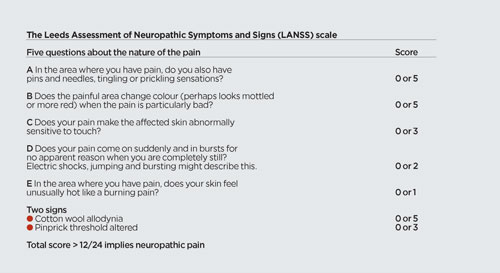
The Leeds Assessment of Neuropathic Symptoms and Signs (LANSS) scale,15 (see table 1) gives a dimensionless score for the pain out of 24, with a score > 12 suggesting a neuropathic component is likely (80% sensitivity and > 90% specificity). The Brief Pain Inventory or the Short-Form 36 can also be used.
Within the confines and time pressures of primary care, many of the neuropathic pain scoring tools can be cumbersome for the clinician not accustomed to their routine use. It may be more beneficial, and simpler, to use the IASP criteria of ‘possible’, ‘probable’ and ‘definite’ neuropathic pain.
This classifies the pain depending on whether the patient has a history of a relevant neurological lesion or disease and describes pain in an anatomically plausible distribution of a nerve, has corresponding findings on examination in that same distribution, and then a confirmatory diagnostic test to satisfy those three definitions in sequence respectively. Using carpal tunnel syndrome as an example, a patient describing pain in the distribution of the median nerve (possible neuropathic pain) having examination findings such as Phalen’s or Tinel’s sign in that distribution (probable neuropathic pain), and then having confirmation by formal nerve conduction studies (definite neuropathic pain).
Examination
Examination should start as soon as the patient enters the consulting room and should continue during the history taking. If any discrepancy is noticed between what the clinician observes initially and during the ensuing formal examination this should alert them to the possibility of a functional element or conversion syndrome, although this is uncommon.16
Following general and neurological examination the area affected by the pain should be investigated using an unaffected body part as the control.
The sensory response to cotton wool, pinprick, temperature and vibration should be assessed to help identify the positive and negative signs found in neuropathic pain, see table 2.17
Specific tests such as straight leg raising (for lumbar/sacral radiculopathy) or Tinel’s test (for carpel tunnel syndrome) can also be used.16
Detailed management of specific conditions such as low back pain, peripheral neuropathy and facial pain is outside the scope of this article but can be found in the literature.18-22
There are no conclusive investigations that can prove the diagnosis, any investigation which demonstrates an underlying disorder associated with neuropathic pain supports the diagnosis. Laboratory investigations such as nerve biopsy, evoked potentials, quantitative sensory testing, and confocal corneal microscopy, are primarily research tools and not routinely used in clinical practice.16
Management
Neuropathic pain is persistent in many cases. As it is not always possible to cure the underlying disease or lesion causing the neuropathic pain completely, the aim of treatment is management rather than cure.14,23 It often fails to respond to conventional analgesia such as paracetamol and NSAIDs. Furthermore, the mainstays of pharmacological treatments, e.g. anticonvulsants and antidepressants, are associated with potential adverse effects. No single drug works for all patients and treatment needs to be individualised.23
Multidisciplinary team (MDT) assessment and management in a specialist pain clinic may be required in order to achieve optimal analgesic response and rehabilitation. This will enable access to specialist pain physiotherapists, pain psychologists and education classes and pain management programmes. Patients with chronic neuropathic pain have higher anxiety and depression scores, and a greater likelihood of sleep disturbances, when compared with those with non-neuropathic chronic pain.24
Pain management programmes generally comprise a course of 10-12 sessions run on an outpatient basis, with input from the psychology, medical, nursing and physiotherapy services focusing on non-pharmacological coping strategies for dealing with persistent pain and improving sleep, mood and quality of life as a result. There are also specific programmes for certain conditions and programmes for inpatients with significant disability.
Over recent years the categorisation of some commonly used pain drugs has been changed with both tramadol (2014) and gabapentinoids (2019) now listed as Schedule 3 controlled drugs. It is worth noting that the NICE guidelines only recommend the use of tramadol as a short-term rescue medication in neuropathic pain.25 NICE does not define the duration of short-term use for tramadol. However, the authors consider it would usually entail 2-4 weeks of treatment. Advice can be sought by phone from the pain clinic if the patient is still waiting to be seen. If GPs choose to prescribe opioids, they should follow guidelines from the British Pain Society (rcoa.ac.uk/faculty-of-pain-medicine/opioids-aware).
NICE recommends referral to a pain management specialist in the following cases: severe pain; pain with a significant impact on function or sleep; patients whose underlying health condition has deteriorated.25 The provision of specialist pain services in some areas of the UK is such that GPs are often required to undertake the initial months of treatment.
Pharmacological treatment
Regular clinical review to assess the effect of any new medication on the patient’s pain, function, and psychological state, and the presence of side effects and the need for continuation of therapy is essential. It is important to advise the patient on dosage titration and the titration process and that regular review possibly including a trial cessation of therapy is mandatory.25 It is also paramount to explain that treatment does not work immediately; it commonly takes weeks to titrate up to an effective dose, with an effective treatment being considered as a 30% reduction in pain score and/or improved function.23
First-line medications include amitriptyline, gabapentin, pregabalin and duloxetine, except in trigeminal neuralgia, see table 3. (In trigeminal neuralgia, carbamazepine is used first line with specialist referral if this fails.27)
If there is no improvement in pain or function it is important not to continue treatment. Compliance should always be checked before making changes to treatment.23 If treatment fails with first-line therapy, NICE advises careful discontinuation and a trial of one of the other three drugs.25
NICE does not currently recommend any combination treatments for neuropathic pain owing to the lack of trial evidence comparing the clinical and cost effectiveness and tolerability of different drug combinations.25 However, combination therapy of an antidepressant with an anticonvulsant may be advocated. This requires gradual titration of the second drug once the first drug dose is optimised. Analgesic efficacy is increased with combination therapy but so are side effects. Hence, it is only an option for patients who tolerate the drugs well.28 Further details and suggested doses for these medications are listed in table 3.
Guidance for the prescription of opioids is available from the British Pain Society.29 Their use for patients with non-malignant pain remains controversial as neuroendocrine and immune modulatory side effects are being increasingly recognised alongside the characteristic side effects of tolerance, addiction and dependence.
The authors are not aware of any significant trial evidence greater than six months duration, that would advocate initiating step 3 opioids for non-malignant chronic neuropathic pain. There are some patients who following specialist assessment may benefit, but this would need to be after a formal opioid trial with predetermined endpoints that are assessed at regular review.
Topical treatment
Capsaicin cream can be used for patients with localised neuropathic pain as an additional therapy, starting with the 0.075% formulation. It is important to warn patients that they may experience a sensation of burning and itching that frequently subsides with ongoing use.25
Lignocaine 5% plasters are only licensed for postherpetic neuralgia but are occasionally used as an off-licence prescription for neuropathic pain. These plasters are also listed on PrescQIPP DROP-List, as there are cheaper and safer alternatives30 and because of this NICE recommends that they should not be used in primary care.29 It is our practice to advise patients to cut the plaster if needed and apply it to the painful sites for a trial period of four weeks to establish whether it is effective for that individual. Using the patch continuously for 36 of the initial 48 hours of treatment can reduce the pain from repeated application and removal.
Refractory pain
NICE does not advocate the use of further pharmacological treatment such as step 3 opioids, cannabinoids, lamotrigine, lacosamide, imipramine or nortriptyline in a non-specialist setting.25 When initial treatments have failed, and if the criteria previously mentioned have not already been met, then referral to a pain specialist is warranted. In the pain clinic the patient will undergo a full biopsychosocial assessment and an individualised management plan will be drawn up.
Treatment with an 8% capsaicin patch, a single patch applied for an hour by a healthcare professional, can provide pain relief for more than three months. Titration of antidepressants to analgesic benefit, or cautious prescription of an opioid trial with close assessment of any resultant improvement in function and defined goal setting as outlined above, may be considered. The patient’s requirement for specialist pain physiotherapy or psychology will also be evaluated. Neuromodulation with a spinal cord stimulator or intrathecal drug delivery system may be considered for certain clinical conditions such as failed back surgery syndrome and complex regional pain syndrome.
Conclusion
Neuropathic pain is a complex condition that affects the quality of life of many patients and can be difficult to treat effectively. Currently, the recommended first-line treatments are amitriptyline, duloxetine, pregabalin and gabapentin. Patients who receive pharmacotherapy for neuropathic pain may not experience pain relief but the aim is to improve overall function and quality of life with an MDT approach.
Novel treatments currently being investigated for the management of neuropathic pain include acetyl-L-carnitine (ALC), alpha-lipoic acid, cannabinoids, botulinum toxin, and angiotensin receptor antagonists.31
In a randomised controlled trial (RCT) involving 1,257 patients, ALC was shown to reduce pain and promote nerve fibre regeneration in those with diabetic neuropathy.32 Topical clonidine reduced painful diabetic neuropathy compared with placebo in an RCT of 179 patients.33
Additionally, there are new voltage-gated sodium channel blockers that are receptor specific and may have less risk of cardiac, motor and CNS adverse effects34,35 and a new selective angiotensin type 2-receptor antagonist, EMA401, has been investigated in trials including one that focused on treating patients with postherpetic neuralgia.36
Personalised pain therapy is another approach that can provide patients with the most effective treatment for neuropathic pain. The phenotype-based classification system focuses on categorising patients by mechanisms responsible for neuropathic pain rather than aetiology.34,37 By focusing on patients’ profiles of signs and symptoms, researchers can identify treatment responders. Studies that focus on genetics and subgrouping patients based on their phenotypes may play an important role in the future of personalised pain management for neuropathic pain.34
With improved understanding of the pathophysiology and the development of novel therapies, it is hoped that some of the encouraging results from trials will translate into improved treatment for patients and a reduction in the number of those suffering from refractory pain.
REFERENCES
1 Treede RD, Jensen TS, Campbell JN et al. Neuropathic pain: redefinition and a grading system for clinical and research purposes. Neurology 2008;70:1630-35
2 Murnion B. Neuropathic pain: current definition and review of drug treatment. Australian Prescriber 2018;41:60-63
3 Baron R, Binder A, Wasner G. Neuropathic pain: diagnosis, pathophysiological mechanisms, and treatment. Lancet Neurol 2010;9:807-19
4 Gilron I, Watson CP, Cahill CM et al. Neuropathic pain: a practical guide for the clinician. CMAJ 2006;175:265-75
5 Torrance N, Smith BH, Bennett MI et al. The epidemiology of chronic pain of predominantly neuropathic origin. Results from a general population study. J Pain 2006;7:281-89
6 Beniczky S, Tajti J, Timea VE et al. Evidence-based pharmacological treatment of neuropathic pain syndromes. J Neural Transm 2005;112:735-49
7 Jensen TS, Backonja MM, Hernandez Jimenez S et al. New perspectives on the management of diabetic peripheral neuropathic pain. Diabetes Vasc Dis Res 2006;3:108-19
8 Ziegler D. Painful diabetic neuropathy: treatment and future aspects. Diabetes Metabol Res Rev 2008;24 (Suppl. 1):S52-7
9 Schmader KE. Epidemiology and impact on quality of life of postherpetic neuralgia and painful diabetic neuropathy. Clin J Pain 2002;18:350-54
10 Paisley P, Serpell M. Diagnosis and management of postherpetic neuralgia. Practitioner 2015;259:21-24
11 Shipton E. Post-surgical neuropathic pain. ANZ J Surg 2008;78:548-55
12 Macrae WA. Chronic post surgical pain: 10 years on. Br J Anaesth 2008;101:77-86
13 Aasvang E, Kehlet H. Chronic postoperative pain: the case of inguinal herniorrhaphy. Br J Anaesth 2005;95(1):69-76
14 National Institute for Health and Care Excellence. CG173. (Full guideline) Neuropathic pain - pharmacological management. The pharmacological management of neuropathic pain in adults in non-specialist settings. NICE. London. 2013 (Updated 2017)
15 Bennett M. The LANSS pain scale: the Leeds assessment of neuropathic symptoms and signs. Pain 2001;92:147-57
16 Raja SN, Sommer CL. Pain 2014: Refresher course, 15th World Congress on Pain. IASP Press. Washington DC. 2014
17 Brook P, Connell J, Pickering T. Oxford handbook of pain management. Oxford University Press. 2011
18 Kreiner DS, Hwang SW, Ease JE et al. An evidence-based clinical guideline for the diagnosis and treatment of lumbar disc herniation with radiculopathy. Spine 2014;14:180-91
19 Lee J, Gupta S, Price C et al. Low back and radicular pain: a pathway for care developed by the British Pain Society. Br J Anaesthesia 2013;111:112-20
20 Siccoli MM, Bassetti CL, Sandor PS. Facial pain: clinical differential diagnosis. Lancet Neurol 2006;5:257-67
21 Zakrzewska JM. Differential diagnosis of facial pain and guidelines for management. Br J Anaesth 2013;111:95-104
22 England JD, Asbury AK. Peripheral neuropathy. Lancet 2004;363:2151-61
23 Russel J. Neuropathic pain treatment guidelines. NHS Lanarkshire. https://www.nhslcg.scot.nhs.uk/wp-content/uploads/2019/07/Neuropathic_Pain_Treatment.pdf
24 Brooks KG, Tessler TL. Treatments for neuropathic pain. Pharmaceutical Journal Dec 1 2017. www.pharmaceutical-journal.com/research/review-article/treatments-for-neuropathic-pain/20203641.article
25 National Institute for Health and Care Excellence. CG173. Neuropathic pain in adults: pharmacological management in non-specialist settings. NICE. London. 2014 www.nice.org.uk/guidance/cg173
26 Finnerup NB, Attal N, Haroutounian S et al. Pharmacotherapy for neuropathic pain in adults: a systematic review and meta-analysis. Lancet Neurol 2015;14:162-73
27 Dworkin RH, O’Connor AB, Backonja M et al. Pharmacologic management of neuropathic pain: evidence-based recommendations. Pain 2007;132:237-51
28 Tesfaye S, Wilhelm S. Duloxetine and pregabalin: high-dose monotherapy or their combination? The "COMBO-DN study" - a multinational, randomized, double-blind, parallel-group study in patients with diabetic peripheral neuropathic pain. Pain 2013;154(12):2616-25
29 Stannard C, Chumbley G, Myles J et al. Opioids for persistent pain – good practice. British Pain Society. London. 2010
30 Nascimento OJM, Pessoa BL, Orsini M et al. Neuropathic pain treatment: still a challenge. Neurol Int 2016;8:6322
31 PrescQIPP. Lidocaine plasters bulletin. Available at: www.prescqipp.info
32 Sima AA, Calvani M, Mehra M et al. Acetyl-l-carnitine improves pain, nerve regeneration, and vibratory perception in patients with chronic diabetic neuropathy an analysis of two randomized placebo controlled trials. Diabetes Care 2005;28:89-94
33 Campbell CM, Kipnes MS, Stouch BC et al. Randomized control trial of topical clonidine for treatment of painful diabetic neuropathy. Pain 2012;153:1815-23
34 Colloca L, Ludman T, Bouhassira D et al. Neuropathic pain. Nat Rev Dis Primers 2017;(3):17002
35 Nascimento OJ, Pessoa BL, Orsini M et al. Neuropathic pain treatment: still a challenge. Neurol Int 2016;8(2):6322
36 Rice AS, Dworkin RH, McCarthy TD et al. EMA401, an orally administered highly selective angiotensin II type 2 receptor antagonist, as a novel treatment for postherpetic neuralgia: a randomised, double-blind, placebo-controlled phase 2 clinical trial. Lancet 2014;383(9929):1637-4
37 Finnerup N, Attal N. Pharmacotherapy of neuropathic pain: time to rewrite the rulebook? Pain Manag 2016;6(1):1-3
ARTICLE IN PDF
 Download this article in PDF format
EXTERNAL WEBLINKS
Advice and information for patients and healthcare professionals from patient information leaflets to drug conversion tables