SEARCH

Duncan C, Watson D. Tackling medication overuse headache in primary care. Practitioner Sept 2018;262(1818):17-20
Tackling medication overuse headache in primary care
24 Sep 2018
AUTHORS
Dr Callum Duncan BSc MBChB PhD FRCP, Consultant Neurologist, Aberdeen Royal Infirmary, Aberdeen, UK
Dr David Watson MBChB FRCGP FRCP DRCOG AFOM, GPwSI Headache, Aberdeen, UK
Competing interests: None
Article
Abstract
Medication overuse headache (MOH) affects 1-2% of the population worldwide. It occurs as a complication of the management of primary headache disorders, primarily migraine and tension type headache. MOH does not occur in cluster headache unless there is associated migraine. MOH is defined as headache occurring on 15 or more days per month, that has evolved in association with the frequent use of acute medication over a period of more than 3 months. Normally, it has a chronic migraine pattern i.e. 15 or more headache days per month of which 8 or more fulfil the criteria for migraine. Importantly, not all patients with chronic migraine who frequently use acute treatment have MOH; some have poorly controlled migraine. Any medication used for the acute treatment of headache can cause MOH. In the case of triptans, combination analgesics and opioids, use on 10 or more days per month is considered sufficient to cause MOH, whereas for simple analgesics (aspirin, ibuprofen and paracetamol) the threshold is 15 days per month. The diagnosis of MOH is based on a thorough history which can be aided by the use of headache diaries. Typically, episodic migraine has gradually become chronic migraine in association with increasing acute medication use. It is important to enquire about over the counter medication and where the patient keeps their medication. Medication kept in multiple locations may be an indicator of overuse. The number of days per month on which acute medication is used is more important than the total amount of medication taken.
Medication overuse headache (MOH) is very common affecting 1-2% of the population worldwide.1 It occurs as a complication of the management of primary headache disorders, mainly migraine and tension type headache (TTH).
In the majority of patients this is a complication of migraine2 and patients with MOH often have a chronic migraine pattern which develops from episodic migraine. MOH does not occur in cluster headache unless there is associated migraine.3 In these cases the patient experiences a superimposed migraine headache that worsens but when the causative medication is withdrawn the migraine headache improves leaving the underlying cluster headache.
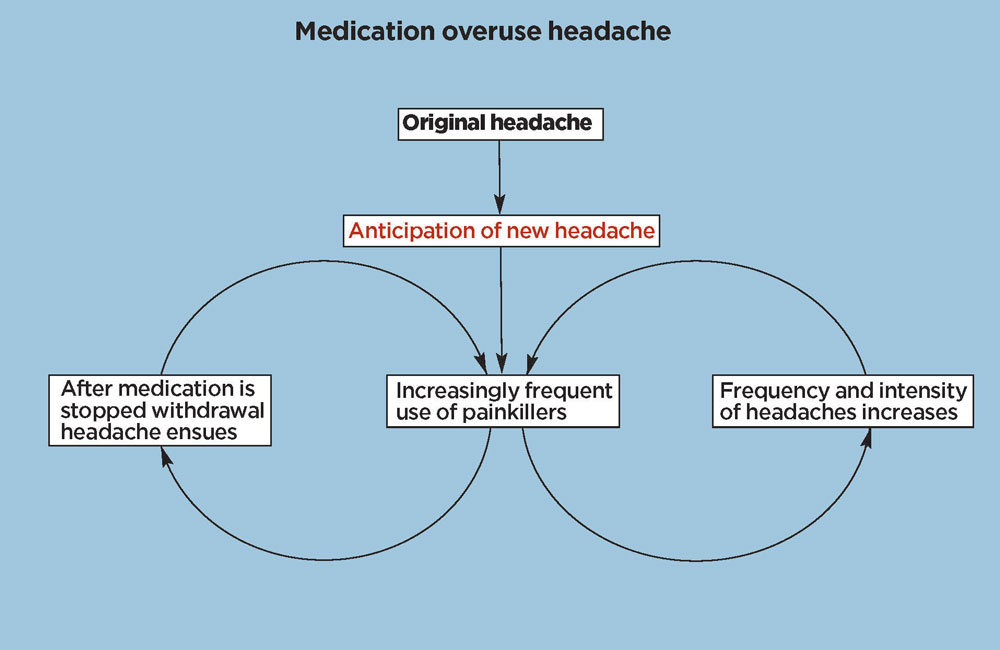
Frequent use of any medication used for the acute treatment of headache can result in MOH.1,2 There is often anticipatory anxiety (taking acute medication because of concern that a headache may start) and the frequency and intensity of headaches increases with increasing medication use. The underlying headache pathways become sensitised and the treatment becomes the cause rather than the cure. A vicious cycle of increased medication use and increasing headache ensues, see figure 1. MOH can also arise when acute medication is used for another painful condition such as rheumatoid arthritis.4 This only occurs in patients where there is a preceding primary headache disorder, usually migraine.
The underlying headache pathways become sensitised and the treatment becomes the cause rather than the cure
MOH is defined as headache on 15 or more days per month that has evolved along with the frequent use of acute medication, for more than three months,5 (see box 1). It normally demonstrates a chronic migraine pattern (15 or more headache days per month of which 8 or more fulfil the criteria for migraine). Importantly, not all patients with chronic migraine who also use acute treatment frequently suffer from MOH; some just have poorly controlled migraine.2
Causative agents
Any medication used for the acute treatment of headache can cause MOH.1,2 For triptans, combination analgesics and opioids 10 or more days use per month is considered sufficient to cause MOH, and for simple analgesics (aspirin, ibuprofen and paracetamol) 15 days per month.5
When prescribing acute treatment, patients should be counselled about the risk of MOH. Patients using frequent combination analgesics and opioids are particularly at risk of MOH and these should be avoided.6
A good rule of thumb is to limit acute treatment to 2 days per week in patients with migraine and TTH.6 This rule does not apply to patients with cluster headache where the safe limit of triptan use is 2 doses per day for injectable sumatriptan and 3 doses per day for nasal zolmitriptan.7
Any medication used for the acute treatment of headache can cause medication overuse headache
Risk factors
MOH occurs in patients with a preexisting tendency to a primary headache disorder, mainly migraine and TTH.
The main risk factors for the development of MOH are frequent use of acute medication and frequent headache (see table 1). The more frequent the headache the more likely it is that the patient will tip over into MOH. Other risk factors include: low socioeconomic status, smoking, high BMI, anxiety or depression, another painful condition and a family history of MOH or substance misuse.1
Diagnosis
MOH should be suspected in any patient frequently using acute medication for headache, including over the counter (OTC) products. It should also be considered in patients with chronic daily headache especially chronic migraine and chronic TTH. Around a third of patients with chronic daily headache (> 15 days/month) have MOH.1
An appropriate neurological examination should include fundoscopy to exclude papilloedema, visual fields, cranial nerves, power and reflexes in the limbs and the Romberg test for balance. Blood pressure (BP) should also be checked. If the BP is very high this can cause headache. If it is low certain medications used to prevent migraine such as beta-blockers and candesartan may lower it further causing postural hypotension.
As mentioned above, MOH is only an issue in cluster headache when the patient also suffers from migraine.3 Patients with cluster headache should be offered an adequate supply of triptans. This should be calculated according to their history of cluster bouts, and based on the manufacturer's recommended maximum daily dose.7
The diagnosis of MOH is based on a thorough history which can be aided by the use of headache diaries.
Typically, chronic migraine has developed gradually from episodic migraine with increasing acute medication use. Patients often underestimate the number of headache days concentrating on significant headache days and an important question to ask is how many completely clear days there are. What initially sounds like episodic migraine may turn out to be chronic migraine.
It is important to ascertain how much acute medication is used and to enquire specifically about OTC medication as patients may only volunteer details about prescribed medication. Another useful question to ask is where acute medication is kept. The more locations (home, work, bag) the more likely that there is medication overuse.
The number of days per month that acute medication is used is more important than the total amount of medication taken, for example paracetamol used once daily is sufficient to cause MOH, whereas paracetamol used 4 times per day 10 days per month is not, see table 2.
Waking up with a headache is a feature that often raises concern about a possible underlying sinister cause for headache. However, this is a common feature of MOH. It is important to consider whether headache on awakening could be due to withdrawal of medication overnight and if the headache improves when the overused medication is taken.
Withdrawal of the overused medication results in improvement in headache frequency in a significant proportion of patients. The International Classification of Headache Disorders previously required improvement in headache frequency following successful withdrawal of the overused medication before the diagnosis could be confirmed. It is now recognised that not all patients improve following medication withdrawal and this criterion has been removed in the latest version.5
The number of days per month that acute medication is used is more important than the total amount of medication taken
Management
It is important to remember that MOH is a risk in any patient using acute treatment for primary headache disorders, particularly migraine and TTH. When prescribing acute therapy, patients should be advised to limit acute treatment to a maximum of 2 days per week,6 see table 3. Combination analgesics and opioids should be avoided.6,7
Once MOH is established the best management strategy is not clear. The available evidence comes from a range of small randomised, controlled trials, non-comparative observational, and retrospective studies.6 Three strategies are recommended:
• Abrupt withdrawal alone either by simple advice or by a structured detoxification programme. Prophylaxis may then be considered after a delay
• Abrupt withdrawal with prophylaxis started immediately
• Initiating prophylaxis without withdrawal
• Opioids should be withdrawn gradually
There are no adequately sized studies that compare strategies. In those studies looking at abrupt withdrawal alone, the length of withdrawal period before starting preventative medication has not been clearly defined.6
Abruptly withdrawing the overused medication is often associated with transient worsening of headache frequency and intensity and patients should be warned to expect this. Other more typical withdrawal symptoms may also occur with opioids or combination analgesics with a high opioid content, but are much less likely with triptans and NSAIDs.1 Withdrawal headache is shortest for triptans and longest for combination analgesics and opioids. It is in the order of weeks. Patients should generally be reassessed after 2 months.
Abrupt withdrawal of the overused medication is often associated with transient worsening of headache frequency
and intensity
In the majority of cases, medication withdrawal can be successfully managed as an outpatient, particularly in patients with uncomplicated MOH.8 There is no evidence to support using prednisolone to aid medication withdrawal.9 Support from a headache specialist nurse can significantly improve success rates.10 For patients with complicated MOH, inpatient withdrawal may be more effective than advice alone or a structured outpatient withdrawal programme.11 Access to inpatient withdrawal is, however, limited in the UK and this is rarely a realistic option outside the larger headache centres.
Following successful withdrawal, previously ineffective preventative treatments may be effective when reintroduced.12 Around 20-40% of patients relapse in the first year, after that relapse is uncommon.1
There is, however, considerable debate as to whether withdrawal is necessary and there are likely to be two groups of patients: those with poorly managed frequent migraine and those who have MOH. Small RCTs have reported a reduction in headache days using topiramate or valproate.6 There are no studies on other oral migraine preventatives.
The use of botulinum toxin as a preventative therapy in chronic migraine was investigated in the PREEMPT studies.13,14 The protocol did not mandate medication withdrawal and post hoc analysis showed no difference in the effectiveness of botulinum toxin A in patients who were and those who were not overusing acute medication.15
Both NICE16 and the Scottish Medicines Consortium17 mandate that medication overuse must be addressed before considering botulinum toxin A, but once addressed botulinum toxin A is equally effective in those with and without successful withdrawal.15,18
The same is likely to be true for the new CGRP monoclonal antibodies of which erenumab was granted a European licence in July though this has not yet been through the approval process for NHS use in the UK.
Referral
It is important to explain to patients that MOH is common and that addressing medication overuse can have a meaningful impact on headache frequency in most cases.
A no fault approach should be adopted and patients encouraged to seek support from family, friends and work colleagues especially in the first two weeks when the headache may get worse.
The majority of patients with MOH can be successfully managed in primary care. The underlying pattern is usually chronic migraine and once medication overuse is addressed this can usually be managed successfully. Patients should be aware that headache does not always improve with medication withdrawal and that appropriately managing the underlying primary headache disorder can be effective
and that MOH often hampers the effectiveness of the standard preventative treatments.
Referral to a neurology or specialist headache clinic should be considered if:
• Appropriate management of MOH has not been successful
• Advice is required about management of the underlying primary headache disorder
• There is concern that there may be an underlying sinister cause
In cases where there is concern about the possibility of an underlying sinister cause, open access imaging may help management. However, all patients who are referred for imaging should be informed that scanning may show incidental abnormalities.19 Studies have shown that any reassurance a patient gets from a normal scan tends to fade by 12 months if the headache is still present.20
REFERENCES
1 Kristoffersen E, Lundqvist C. Medication-overuse headache: epidemiology, diagnosis and treatment. Ther Adv Drug Saf 2014;5(2):87-99
2 Westergaard ML, Hansen EH, Glumer C et al. Definitions of medication-overuse headache in population-based studies and their implications on prevalence estimates: a systematic review. Cephalalgia 2014;34(6):409-25
3 Paemeleire K, Bahra A, Evers S et al. Medication-overuse headache in patients with cluster headache. Neurology 2006;67(1):109-13
4 Bahra A, Walsh M, Menon S, Goadsby PJ. Does chronic daily headache arise de novo in association with regular analgesic use? Headache 2003;43(3):179-90
5 Headache Classification Committee of the International Headache Society (IHS). The International Classification of Headache Disorders, 3rd edition (beta version). Cephalalgia 2013;33(9):629-808
6 Scottish Intercollegiate Guidelines Network. SIGN155. Pharmacological management of migraine. SIGN. Edinburgh. 2018 www.sign.ac.uk/assets/sign155.pdf
7 National Institute for Health and Care Excellence. CG150. Headaches in over 12s: diagnosis and management. NICE. London. 2012 (updated 2015) www.nice.org.uk/guidance/cg150
8 Creac’h C, Frappe P, Cancade M et al. In-patient versus out-patient withdrawal programmes for medication overuse headache: a 2-year randomized trial. Cephalalgia 2011;31(11):1189-98
9 Rabe K, Pageler L, Gaul C et al. Prednisone for the treatment of withdrawal headache in patients with medication overuse headache: a randomized, double-blind, placebo-controlled study. Cephalalgia 2013;33(3):202-07
10 Pijpers JA, Louter MA, de Bruin ME et al. Detoxification in medication-overuse headache, a retrospective controlled follow-up study: Does care by a headache nurse lead to cure? Cephalalgia 2016;36(2):122-30
11 Rossi P, Faroni JV, Tassorelli C, Nappi G. Advice alone versus structured detoxification programmes for complicated medication overuse headache (MOH): a prospective, randomized, open-label trial. J Headache Pain 2013;14:10
12 Zeeberg P, Olesen J, Jensen R. Discontinuation of medication overuse in headache patients: recovery of therapeutic responsiveness. Cephalalgia 2006;26(10): 1192-98
13 Aurora SK, Dodick DW, Turkel CC et al. OnabotulinumtoxinA for treatment of chronic migraine: results from the double-blind, randomized, placebo-controlled phase of the PREEMPT 1 trial. Cephalalgia 2010;30(7):793-803
14 Diener HC, Dodick DW, Aurora SK et al. OnabotulinumtoxinA for treatment of chronic migraine: results from the double-blind, randomized, placebo-controlled phase of the PREEMPT 2 trial. Cephalalgia 2010;30(7):804-14
15 Silberstein SD, Blumenfeld AM, Cady RK et al. OnabotulinumtoxinA for treatment of chronic migraine: PREEMPT 24-week pooled subgroup analysis of patients who had acute headache medication overuse at baseline. J Neurol Sci 2013;331(1-2):48-56
16 National Institute for Health and Care Excellence. TA260. Botulinum toxin type A for the prevention of headaches in adults with chronic migraine. NICE. London. 2012 www.nice.org.uk/guidance/ta260
17 www.scottishmedicines.org.uk Click here
18 Sandrini G, Perrotta A, Tassorelli C et al. Botulinum toxin type-A in the prophylactic treatment of medication-overuse headache: a multicenter, double-blind, randomized, placebo-controlled, parallel group study. J Headache Pain 2011;12(4):427-33
19 Morris Z, Whiteley WN, Longstreth WT et al. Incidental findings on brain magnetic resonance imaging: systematic review and meta-analysis. BMJ 2009;339:b3016
20 Ravesteijn H, Dijk I, Darmon D et al. The reassuring value of diagnostic tests: A systematic review. Patient Educ Couns 2012;86:3-8
ARTICLE IN PDF
 Download this article in PDF format