SEARCH

Bhat S, Serpell M. Managing low back pain in primary care. Practitioner Dec 2018;262(1821):15-18
Managing low back pain in primary care
20 Dec 2018
AUTHORS
Dr Sunny Bhat MBBS MD FRCA, ST6 Anaesthetics/Advance Pain Trainee, Queen Elizabeth University Hospital, Glasgow, UK
Dr Mick Serpell MB ChB FCPodS ECFMG FRCA FFPMRCA, Consultant and Senior Lecturer in Anaesthesia and Pain Medicine, University of Glasgow, Glasgow, UK
Competing interests: Dr Mick Serpell has received honoraria from Astellas, Grünenthal, NAPP and Pfizer for speaking at meetings. Dr Sunny Bhatt has no competing interests
Article
Abstract
Chronic low back pain is a common problem. Lifetime adult prevalence rates vary from 50 to 80%, and around a quarter of adults say they have experienced back pain during the past month. One in 40 report disabling back or neck pain. Each year around 7% of patients consult their GP with back pain. In 65-70% of primary care patients with low back pain there is no known pathoanatomical cause. Their pain is described as nonspecific and is postulated to arise from muscle strain or ligamentous injury. A further 15-20% of patients have mechanical low back pain with an identifiable cause such as degenerative disc or joint disease. The pain may be referred to the hips and legs but this should not be confused with neuropathic radicular pain (sciatica), which has a neuropathic quality, usually radiates distal to the knee and can be accompanied by sensory, motor and reflex deficits. If there are concerns that the patient may have a specific cause for their back pain then appropriate referral or investigation is indicated. Admission or urgent referral to orthopaedics or neurosurgery is required if neural deficit is suspected or severe systemic illness is apparent. Referral to rheumatology or oncology may be appropriate for patients with suspected malignancy, infection, fracture, or an inflammatory disorder such as ankylosing spondylitis. Providing there is no suspicion of serious underlying pathology NICE recommends that GPs should provide patients with information on low back pain with regard to its expected course, the need to remain active, and effective self-management options.
Nonspecific low back pain is defined as tension, soreness and/or stiffness in the back below the ribs and above the inferior gluteal skin crease, for which it is not possible to identify a specific cause.1
Low back pain may be referred out to the hips and legs. This referred leg pain should not be confused with neuropathic radicular pain (sciatica). The latter has a neuropathic quality (sharp, burning, tingling etc) and usually radiates distal to the knee and can be accompanied by sensory, motor and reflex deficits. Sciatica should be managed as neuropathic pain.2
Chronic low back pain is a common problem. Lifetime adult prevalence rates vary from 50% to 80%, and point prevalence rates from 15% to 30%.3 Around a quarter of adults say they have experienced back pain in the past month, with one in 40 reporting disabling back or neck pain.1 Each year around 7% of patients consult their GP with back pain.
A GP with a list of 1,750 patients will typically see at least one patient with low back pain every day.3 In 80-90% of cases of low back pain presenting in primary care the pain is thought to be mechanical in origin. Low back pain is a heterogeneous condition and can originate in the vertebrae, discs, ligaments, facet joints, or paravertebral muscles. In 65-70% of primary care patients with low back pain there is no known pathoanatomical cause. Their pain is described as nonspecific and is postulated to arise from muscle strain or ligamentous injury. A further 15-20% of patients have mechanical low back pain with an identifiable cause such as degenerative disc or joint disease. Table 1 lists the common causes of low back pain.
Assessment
GPs should obtain a focused history and carry out a physical examination.
Mechanical back pain usually presents in patients aged between 20 and 55. The pain is in the lumbosacral region, buttocks and thighs. It is described in nociceptive terms such as dull, aching, pressure, tight etc rather than the neuropathic terms used to describe sciatica. The pain varies with activity and time. The patient normally feels well otherwise. Patients presenting with low back pain secondary to underlying serious pathology (< 1%) may have a history of significant traumatic injury, fever, chills, malaise, night sweats, unexplained weight loss, cancer, intravenous drug use, immuno-suppression, organ transplantation or corticosteroid use.
A comprehensive general physical examination and focused neurological examination should be carried out. This should include assessment of gait, range of spinal motion and degree if any at which the patient feels pain. Palpate for local spinal and paraspinal tenderness, muscles can be tense and tender, but it is unusual for bone to be tender.
Check for passive and active movement of the lower limbs to assess for normal range of motion and muscle strength. A positive straight leg raise test (direct and crossed) can indicate nerve root irritation. Motor and sensory nerve deficits, and reflex deficits (knee L3/4, ankle L5/S1) should be excluded. In particular, it is important to exclude perineal numbness, or bowel and bladder disturbance, which might indicate cauda equina syndrome.
Severity of baseline pain (0 to 10 on the visual analogue scale); functional deficits in physical activity; sleep impairment; and any disturbance in psychological function such as depression or anxiety should be assessed. Several questionnaires are available, such as the Brief Pain Inventory (four questions on pain severity, seven questions on impairment of daily activities), or the Hospital Anxiety and Depression Scale (HADS).
Clinicians should not routinely obtain imaging or other diagnostic tests in patients with nonspecific low back pain.4,5 It is important to ask about, and examine for, red flags to exclude severe pathology (see below).
Yellow flags are psychosocial factors that can predict when a patient may have a poor prognosis for resolution and return to normal function. The use of a risk stratification tool such as STarT Back (see box 1) at first point of contact can help identify those patients who require more intensive physiotherapy and a psychology based approach.6 STarT Back is a prognostic questionnaire that assesses the risk of continuing pain and disability.
The assessment will enable patients to be graded into two broad categories.5
1 Patients with nonspecific low back pain who will respond to simple analgesics, and exercise advice
2 Patients with nonspecific low back pain who are at higher risk of poor recovery, and require more intensive physiotherapy and psychology input
Red flags
If there are concerns that the patient may have a specific cause for their back pain then appropriate referral or investigation is indicated.
Urgent referral to orthopaedics or neurosurgery is required if neural deficit is suspected, or severe systemic illness is apparent, when rheumatology or oncology may be appropriate.
This includes suspected malignancy, infection, fracture, or an inflammatory disorder such as ankylosing spondylitis (prevalence 0.15%).
‘It is important to ask about, and examine for, red flags to exclude severe pathology’
Red flags include the following:
• Weight loss
• Past medical history of malignancy
• Fever
• Signs of systemic inflammatory disease
• Anatomical change
• Possible fracture
• History of trauma
• Cauda equina syndrome
• Neurological signs (radiculopathy)
Management
In 2016, NICE published an evidence-based clinical guideline (NG59) on managing low back pain and sciatica.4
Providing there is no suspicion of serious underlying pathology NICE recommends that GPs should provide patients with information on low back pain with regard to its expected course, the need to remain active, and effective self-management options.
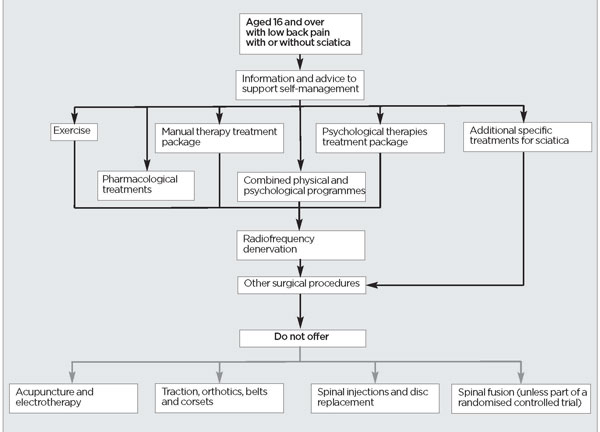
Patients should be encouraged to do exercises such as stretching, strengthening, aerobics, yoga, or tai chi in a group setting as the main component of non-invasive treatment.
‘Manual therapy and psychological approaches should be recommended only alongside an exercise programme’
Manual therapy and psychological approaches should be recommended only alongside an exercise programme.4 NICE does not recommend acupuncture or electrotherapies such as transcutaneous electrical nerve stimulation (TENS), see figure 1.7 Acupuncture has not been shown to produce any treatment specific benefits when compared with sham acupuncture. There is little evidence that TENS confers any additional benefits.
When pain is moderate/severe, then the above approaches should be combined with analgesics such as a short course of NSAIDs, or a weak opioid where an NSAID is ineffective or poorly tolerated. Patients should not be offered paracetamol alone.
Major depression is about four times more common in people with chronic back pain than in the general population.8 Rate of major depression increases in a linear fashion with greater pain severity.9 There is evidence suggesting that treatment of low back pain can improve depressive symptoms and vice versa.10,11
‘There is evidence suggesting that treatment of low back pain can improve depressive symptoms and vice versa’
It is recommended that low back pain and depression be treated as separate and independent entities.12 Initially, an empirical trial of antidepressants is recommended for at least four weeks.
If there is less than a 20% reduction in depressive symptoms, a switch to another antidepressant or the addition of an augmentation agent would be recommended. If there is a 20% or greater reduction of symptoms, the antidepressant should be continued for an additional 4 to 6 weeks until the expected maximal benefits are achieved between 12 and 16 weeks.12
Referral
A combined physical and psychological programme incorporating cognitive behavioural therapy should be considered: in patients with a high risk of poor outcome (as assessed by STarT Back); if after initial treatment recommendations have been tried pain is still significant after three months, or sooner if pain is severe and accompanied by distress or physical impairment. NICE suggests this should preferably be in a group context that takes into account the individual’s specific needs and capabilities.
Patients referred to a chronic pain clinic will undergo a comprehensive holistic assessment. Their medication regimen will be reviewed and adjusted,
if needed, and psychotherapy-based treatments with either individual psychotherapy or group-based pain management programmes may be offered. The pain clinic can also provide radiofrequency medial branch nerve denervation for suitable patients with severe localised facet joint low back pain.
Around 20% of people are still symptomatic and 3% remain off work a year after an episode of low back pain.4 NICE encourages clinicians to consider the risks and benefits of pursuing investigations and continuing treatments where these are of limited benefit. Instead, patients could return to primary care management, with pain clinic support where needed.
REFERENCES
1 Maher C, Underwood M, Buchbinder R. Non-specific low back pain. Lancet 2017;389(10070):736-47
2 Paisley P, Serpell M. Tailor treatment to the patient with neuropathic pain. Practitioner 2016;260(1796):11-15
3 Cohen SP, Argoff CE. Management of low back pain. BMJ 2008;337:2718
4 National Institute for Health and Care Excellence. NG59. Managing low back pain and sciatica in over 16s. NICE. London. 2016 www.nice.org.uk/guidance/ng59
5 Chou R et al. Clinical Guidelines. Diagnosis and treatment of low back pain: A joint clinical practice guideline from the American College of Physicians and the American Pain Society. Ann Intern Med 2007;147:478-91
6 Foster NE, Mullis R, Hill JC et al. Effect of stratified care for low back pain in family practice (IMPaCT Back): a prospective population-based sequential comparison. Ann Fam Med 2014;12:102–11
7 National Institute for Health and Care Excellence. Managing low back pain and sciatica pathway. Updated Oct 2018 https://pathways.nice.org.uk/pathways/low-back-pain-and-sciatica
8 Sullivan MJL, Reesor K, Mikail S, Fisher R. The treatment of depression in chronic low back pain. Pain 1992;50(1):5-13
9 Currie SR, Wang J. Chronic back pain and major depression in the general Canadian population. Pain 2004;107(1-2):54-60
10 Skolasky RL, Riley LH, Maggard AM, Wegener ST. The relationship between pain and depressive symptoms after lumbar spine surgery. Pain 2012;153(10):2092-96
11 Reid MC, Otis J, Barry LC, Kerns RD. Cognitive-behavioral therapy for chronic low back pain in older persons: a preliminary study. Pain Med 2003;4(3):223-30
12 Rush AJ, Polatin P, Gatchel RJ. Depression and chronic low back pain: Establishing priorities in treatment. Spine 2000;25(20):2566-71
ARTICLE IN PDF
 Download this article in PDF format
EXTERNAL WEBLINKS
For healthcare professionals
National Back Pain and Radicular Pain Pathway
For patients
NB website appears to slow to load unusually slowly on 18/1/2019