SEARCH

Gujadhur R, Aning J. Careful assessment key in managing prostatitis. Practitioner 2015; 259 (1781)15-19
Careful assessment key in managing prostatitis
23 Apr 2015
AUTHORS
Mr Rahul Gujadhur MBBS MRCS(Ed) Specialist Registrar in Urology, Northern Deanery, UK
Mr Jonathan Aning BMBS BMedSci DM FRCS(Urol), Consultant Urological Surgeon, Department of Urology, Freeman Hospital, Newcastle Upon Tyne, UK
Article
Abstract
Prostatitis is a common condition estimated to affect up to 30% of men in their lifetime, it is most prevalent in men aged between 35 and 50. Prostatitis is subclassified into: acute bacterial prostatitis, chronic bacterial prostatitis, chronic pelvic pain and asymptomatic inflammatory prostatitis. Acute bacterial prostatitis presents with acute onset pelvic pain which may or may not be related to voiding, lower urinary tract symptoms, sometimes haematuria or haematospermia and systemic symptoms such as fever and rigors. A documented history of recurrent urinary tract infections is the key feature of chronic bacterial prostatitis. Duration of symptoms > 3 months defines chronicity. The key symptom of chronic pelvic pain syndrome is pain. Patients may describe pain during or after ejaculation as their predominant symptom. Clinical assessment includes a thorough history and examination. A digital rectal examination should be performed after a midstream urine (MSU) sample has been collected for urine dipstick, microscopy and culture. The prostate should be checked for nodules. In acute bacterial prostatitis the MSU is the only laboratory investigation required. Chronic pelvic pain syndrome may be multifactorial and part of a more generalised pain disorder. Pelvic floor muscle abnormalities, altered neuroendocrine pathways, chemically induced inflammation, bacterial infection, autoimmune processes, dysfunctional voiding as well intraprostatic ductal reflux mechanisms have all been identified in men with chronic pelvic pain syndrome.
Prostatitis is a common condition estimated to affect up to 30% of men in their lifetime.1-4 It is most prevalent in men aged between 35 and 50 years old and represents a significant health economic burden.5
The term prostatitis is commonly associated with inflammation and infection.6,7 The clinical reality is that prostatitis represents a spectrum of disease processes and symptoms, some of which involve neither infection nor inflammation. Prostatitis can be challenging to diagnose accurately and treat satisfactorily.
Causes
The aetiology of prostatitis may involve infective, anatomical, endocrine, neuromuscular, immunological or psychological factors.9 Although the precise cause of prostatitis is poorly understood; it is thought likely that susceptible men may be exposed to one or more initiating factors which may be either isolated or repetitive events.
NIH Classification
The National Institutes of Health (NIH) classification of prostatitis8 forms the current basis for stratifying disease type and guiding treatment. Prostatitis is subclassified into one of four entities: acute bacterial prostatitis, chronic bacterial prostatitis, chronic pelvic pain and asymptomatic inflammatory prostatitis, see table 1.
The key factor that differentiates prostatitis from other urinary tract infections or urinary tract differential diagnoses is the fact that the symptoms and cause are localised to the prostate gland. In the case of chronic pelvic pain this may be a diagnosis of exclusion.
NIH categories I and II: Acute and chronic bacterial prostatitis
In the presence of documented urinary tract infections the propagated flow of infected urine through the prostate is likely to be the primary aetiology. Common Gram-negative uropathogens are E. coli, proteus and enterococcus. Gram-positive causative organisms are rare although staphylococci and streptococci have been acknowledged in the literature.3,6,7
Sexually transmitted infections such as chlamydia and gonorrhoea are less common but should be considered in patients with risk factors for sexually transmitted diseases (e.g. multiple partners).
Other risk factors for infective aetiology include:
• Indwelling catheters
• Instrumentation of the urinary tract
• Diabetes
• Immunosuppression6,7,10
Recent reports suggest fungi may be causative in the latter group.11
NIH categories III and IV: Chronic pelvic pain syndrome and asymptomatic inflammatory prostatitis
The underlying aetiology in the absence of documented urinary tract infections includes infection but may be more complex. For this reason chronic prostatitis without a documented infective cause has more recently been appropriately redefined as inflammatory or non-inflammatory chronic pelvic pain syndrome.
Various theories have been proposed but the current paradigm is that chronic pelvic pain syndrome may be multifactorial and part of a more generalised pain disorder. Pelvic floor muscle abnormalities, altered neuroendocrine pathways, chemically induced inflammation, bacterial infection, autoimmune processes, dysfunctional voiding as well as intraprostatic ductal reflux mechanisms have all been identified in men with chronic pelvic pain syndrome.2,4,6,7,10
Psychological factors are also acknowledged to play a significant role in chronic pelvic pain syndrome: an increased incidence of the syndrome has been identified in patients with depression, hysteria, somatisation and maladaptative coping mechanisms.12
Patients with prostatitis may present with a variety of symptoms of differing severity. Common presenting symptoms are summarised in box 1, according to NIH classification subtype.
Examination and investigation
A thorough history and examination is an important part of making a clinical diagnosis of prostatitis or chronic pelvic pain. This should include recording the duration of symptoms, an assessment of the degree of bothersome symptoms and a detailed lower urinary tract symptoms review. A full abdominal examination including the scrotum should be performed. Ensure that the bladder cannot be palpated. Vital signs including temperature and blood pressure should be assessed if systemic illness is suspected.
A digital rectal examination (DRE) should be performed after a midstream urine (MSU) sample has been collected for urine dipstick, microscopy and culture. There is no evidence that DRE exacerbates clinical parameters. The prostate should be checked for nodules. A softer than normal, painful prostate may be palpated, however, this is not a definitive diagnostic finding. In acute bacterial prostatitis the MSU is the only laboratory investigation required.
Patients with acute bacterial prostatitis who are systemically unwell (suspected sepsis) or in urinary retention or unable to tolerate oral antibiotics should be referred to urology promptly for hospital admission, review and management.
Sometimes patients may describe symptoms which include red flags for urological malignancies such as haematuria. These patients should be treated for prostatitis but referred for review on the appropriate two week referral pathway.
In patients in whom the differential diagnosis includes chronic bacterial prostatitis or chronic pelvic pain, a definitive diagnosis can only be made with further investigations.
The gold standard investigation for suspected chronic bacterial prostatitis is the Meares-Stamey four glass urine collection technique.15 The aim of this investigation is to evaluate the lower urinary tract to localise the precise location of the infection.
The test involves careful collection of a voided urine specimen. The first 10 ml (VB1) represents the urethral specimen. The voided bladder specimen is similar to a MSU collection (VB2) and represents the bladder urine. Vigorous prostatic massage is then performed with the secretions produced collected representing prostate specific specimens, i.e. expressed prostatic secretions (EPS). The first 10 ml of urine voided after prostatic massage includes any EPS remaining in the prostatic urethra (VB3). The interpretation of the Meares-Stamey test is described in table 2.15
The four glass test is time consuming and more recently a two glass test has gained widespread clinical acceptance to categorise patients with chronic prostatitis. In this test a urine specimen is sent before and after vigorous prostatic massage. The interpretation of the two glass test is described in table 3, above.16-17 Of note, urethral swabs have been demonstrated to be more effective at picking up urethritis than voided urine specimens and may play a role in patients in whom this is suspected.18
NICE guidance currently does not recommend performing prostatic massage in primary care. In acute bacterial prostatitis this is because prostate massage is painful and does not offer additional value to MSU and empirical treatment.19 In chronic bacterial prostatitis and chronic pelvic pain NICE guidance states that prostatic massage is impractical and rarely performed in primary care.
The two or four glass test may therefore be performed as part of the diagnostic work-up in secondary care.20 There is no high quality evidence in the literature that prostatic massage leads to a deterioration in the clinical condition.
Imaging does not have a role in the primary care investigation of patients with prostatitis unless an alternative diagnosis is suspected. The PSA blood test should not be performed when acute bacterial prostatitis is suspected. The PSA in this situation would be artificially elevated and may take several weeks to normalise post infection. In patients with chronic symptoms aged over 50 or those who have risk factors for prostate cancer, who have been appropriately counselled, a PSA should be offered.
NICE guidance recommends referral to a urologist for review following recovery from acute bacterial prostatitis to investigate whether any structural abnormalities are present.
Cystoscopy to evaluate the lower urinary tract is also indicated in men in whom the history suggests the possibility of a diagnosis other than chronic pelvic pain syndrome and justified in men with chronic pelvic pain syndrome who do not respond to standard therapy.21
As part of the review the urologist will evaluate lower urinary tract symptoms and may arrange further urodynamic studies.
Treatment
Only around 10% of patients with acute and chronic bacterial prostatitis will present with a proven urinary tract infection.22 Despite this infection may be the underlying pathology in a significantly higher percentage of patients presenting with prostatitis and for this reason empirical treatment with antibiotics is a reasonable option if prostatitis is suspected clinically and the culture results are negative.
In patients presenting with suspected chronic prostatitis it is imperative to explain that the cause of prostatitis is poorly understood, the treatment is chronic and as such improvements may not be seen till after six months. It is important to highlight that prostatitis is a benign condition and treatment may be about controlling and improving symptoms rather than effecting a cure. Self-help leaflets are available and patients should be encouraged to access them, see External websites. The NIH Chronic Prostatitis Symptom Index is a useful method of monitoring patients’ response to treatment.23
NICE guidance recommends the following treatment in patients with acute bacterial prostatitis:
• Start antibiotic treatment immediately. Antibiotic options include: ciprofloxacin 500 mg bd, ofloxacin 200 mg bd, or trimethoprim 200 mg bd if quinolones are not tolerated or indicated
• Prescribe adequate analgesia: paracetamol and NSAIDs
• Reassess in 24-48 hours — if there is no improvement or deterioration of symptoms refer to urology for admission and further review
• Once the patient has recovered, referral to urology for evaluation of the urinary tract is advisable.
NICE guidance recommends the following treatment in patients with chronic bacterial prostatitis and chronic pelvic pain:
• Prescribe adequate analgesia: paracetamol and NSAIDs for pain
• A single 4-6 week course of antibiotics, if symptoms have been present for less than six months (do not prescribe an alpha-blocker and an antibiotic at the same time). Antibiotic options include: ciprofloxacin 500 mg bd or ofloxacin 200 mg bd, or trimethoprim 200 mg bd, if quinolones are not tolerated or indicated
• Prescribe a stool softener if defecation is painful
• A 4-6 week trial of an alpha-blocker if significant lower urinary tract symptoms
• Consider referral to a urologist in chronic bacterial prostatitis or if the diagnosis is uncertain or the man’s symptoms are severe and/or persist despite management
• If symptoms persist after urological management referral to a chronic pain specialist should be considered
Antibiotic regimens for acute and chronic bacterial prostatitis are shown in table 4.
Complications
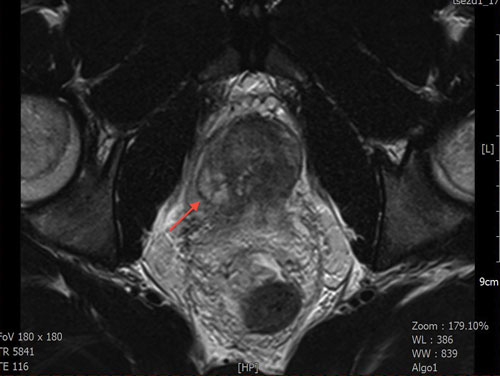
In patients presenting with symptoms consistent with acute bacterial prostatitis, failure of symptoms to improve despite antibiotic treatment may indicate the possibility of a prostatic abscess, see figure 1. This can be confirmed on CT or TRUS scan. Radiological drainage using a perineal approach or transurethral resection are commonly used methods to treat such cases.
Infective and inflammatory processes cause prostatic swelling and oedema resulting in obstruction to urinary flow and patients may present with acute urinary retention and may need suprapubic catheterisation in this situation.
Overall, 10% of men with acute bacterial prostatitis go on to develop chronic bacterial prostatitis and a further 10% develop chronic pelvic pain syndrome.24 Formation of fistulae and osteomyelitis can also occur after acute bacterial prostatitis.6,25
Emerging concepts
Over the past decade there has been renewed interest in the management of prostatitis. The use of validated NIH-CPSI questionnaires in combination with appropriately designed randomised controlled trials continues to inform progress in this field. Treatment remains challenging in chronic prostatitis: recent evidence suggests that multimodal and phenotypically directed methods may offer better outcomes.26,27
The UPOINT classification,28 that categorises chronic pelvic pain syndrome patients into six domains (urinary, psychosocial, organ-specific, infection, neurogenic/systemic and tenderness), is helpful, see table 5.
Future management may shift from monotherapy to multimodal treatment options to achieve more successful outcomes. There is evidence in the literature suggestive that combination treatment with alpha-blockers and antibiotics helps to reduce high recurrence rates.29,30
Optional treatment strategies for refractory cases include intermittent antimicrobial treatment of acute symptomatic episodes, low-dose antimicrobial suppression.
Prostatic massage along with antibiotics has also been used to achieve successful outcomes but evidence is limited. One study has also suggested that frequent ejaculation can achieve the same outcome as prostatic massage.31 Phytotherapeutic agents such as saw palmetto, quercetin (bioflavonoid) and cernilton (pollen extract) look promising but further larger scale randomised trials are required before their use can be promoted.32
The emerging link between chronic pelvic pain syndrome and psychosocial parameters may mean that screening for psychological problems is recommended in the future for this patient group, see table 5.33,34
Conclusion
Prostatitis is made up of a continuum of four distinct diseases (acute bacterial prostatitis, chronic bacterial prostatitis, chronic pelvic pain syndrome and asymptomatic inflammatory prostatitis) that is poorly understood and challenging to manage.
Acute bacterial prostatitis is easier to identify and successfully treat whereas chronic prostatitis and chronic pelvic pain syndrome remain demanding: the multimodal therapy and UPOINT approach show promise.
Further larger scale clinical trials evaluating the efficacy of some options should help manage these conditions better in the near future.
REFERENCES
1 Krieger JN. Classification, epidemiology and implications of chronic prostatitis in North America, Europe and Asia. Minerva Urol Nefrol 2004;56:99-107
2 Tunuguntla HS, Evans CP. Management of prostatitis. Prostate Cancer and Prostatic Dis 2002;(5):172-179
3 Lipsky BA, Byren I, Hoey C. Treatment of bacterial prostatitis. Clin Infect Dis 2010;50(12):1641-52
4 Krieger JN, Ross SO, Riley DE. Chronic prostatitis: epidemiology and role of infection. Urology 2002;60(6 Suppl):8-12
5 Chaeffer AJ. Epidemiology and evaluation of chronic pelvic pain syndrome in men. Int J Antimicrob Agents 2008;31 Suppl 1:S108-111
6 Wein AJ, Kavoussi LR, Novick AC et al. Campbell-Walsh Urology 10th Edition. Elsevier Saunders. Philadelphia. 2012
7 Tanagho E, McAninch JW. Smith’s Urology 17th Edition. Lange Medical. 2008
8 Krieger JN, Nyberg L. Nickel JC. NIH Consensus definition and classification of prostatitis. JAMA 1999;282:236-37
9 Nickel J, et al. Management of men diagnosed with chronic prostatitis/chronic pelvic pain syndrome who have failed traditional management. Rev Urol 2007;9(2):63-72
10 Dickson G. Prostatitis: Diagnosis and treatment. Australian Family Physician 2013;42(4):216-19
11 Truett AA, Crum NF. Coccidioidomycosis of the prostate gland: two cases and a review of the literature. South Med J 2004;97(4):419-22
12 Nickel JC, Tripp DA, Chuai S et al. Psychosocial variables affect the quality of life of men diagnosed with chronic prostatitis/chronic pelvic pain syndrome. BJU Int 2008;101:59-64
13 Shoskes DA, Landis JR, Wang Y et al. Impact of post-ejaculatory pain in men with category III chronic prostatitis/chronic pelvic pain syndrome. J Urol 2004;172:542-47
14 Tripp DA, Nickel JC, McNaughton Collins M et al. Coping with depression in chronic prostatitis/chronic pelvic pain syndrome: a key to treatment of the pain. J Urol 2005;173(4):S31 2005
15 Meares EM Jr, Stamey TA. Bacteriologic localization patterns in bacterial prostatitis and urethritis. Invest Urol 1968;5:492-518
16 Nickel JC. Practical approach to the management of prostatitis. Tech Urol 1995;1:162-67
17 Nickel JC. The pre and post massage test (PPMT): a simple screen for prostatitis. Tech Urol 1997;3:38-43
18 Krieger JN, Jacobs R, Ross SO. Detecting urethral and prostatic inflammation in patients with chronic prostatitis. Urology 2000;55(2):186-192
19 National Institute for Health and Care Excellence. Clinical knowledge summaries. Acute prostatitis http://cks.nice.org.uk/prostatitis-acute
20 National Institute for Health and Care Excellence. Clinical knowledge summaries. Chronic prostatitis http://cks.nice.org.uk/prostatitis-chronic
21 Howles S, Tempest H, Doolub G et al. Flexible cystoscopy findings in patients investigated for profound lower urinary tract symptoms, recurrent urinary tract infection, and pain. J Endourol 2012;26:1468-72
22 de la Rosette JJ, Karthaus HF, Debruyne FM. Diagnosis and treatment of 409 patients with prostatitis syndromes. Urology 1993; 41(4):301-7
23 Litwin MS, McNaughton Collins M, Fowler FJ et al. The National Institutes of Health chronic prostatitis symptom index: development and validation of a new outcome measure. J Urol 1999;162(2):369-75
24 BASHH (2008) National guidelines for the management of prostatitis. British Association for Sexual Health and HIV. www.bashh.org
25 Bede CM, Shoeskes DA. The etiology and management of acute prostatitis. Nat Rev Urol 2011;8:207-12
26 Shoskes D, Katz E. Multimodal therapy for chronic prostatitis/chronic pelvic pain syndrome. Curr Urol Rep 2005;6:296-9
27 Nickel JC Shoskes D. Phenotypic approach to the management of chronic prostatis/chronic pelvic pain syndrome. BJU Int 2010;106:1252-63
28 Shoskes DA, Nickel JC Kattan M. Phenotypically directed multimodal therapy for chronic prostatitis/chronic pelvic pain syndrome. A prospective study using UPOINT. Urology 2010;75:1249-53
29 Barbarias GA, Nikiforidis G. Liatsikos EN. Alpha blockers for the treatment of chronic prostatitis in combination with antibiotics. J Urol 1998:159:883
30 Nickel JC. Role of alpha-1-blockers in chronic prostatitis syndrome. BJU Int 2008; 101 (Suppl 3):11-16
31 Yavascaoglu I, Oktay B, Simsek U, Ozyurt M. Role of ejaculation in the treatment of chronic non-bacterial prostatitis. Int J Urol 1999;6:130-34
32 Shoskes DA. Phytotherapy in chronic prostatitis. Urology 2002;60 (6 Suppl):35-37
33 Nickel J. Prostatitis. Canadian Association of Urology Guideline. Can Urol Ass J 2011;5(5)306-15
34 European Association of Urology (EAU) Guidelines 2014. http://uroweb.org/guidelines
ARTICLE IN PDF
 Download this article in PDF format
EXTERNAL WEBLINKS
NICE Clinical Knowledge Summaries
European Association of Urology (EAU) guidelines on chronic pelvic pain
Self-help leaflets