SEARCH

Faure Walker NA, Challacombe B. Managing epididymo-orchitis in general practice. Practitioner 2013; 257 (1760)21-25
Managing epididymo-orchitis in general practice
25 Apr 2013
AUTHORS
Mr Nicholas A Faure Walker BSc(Hons) MRCS, Second Year Core Surgical Trainee in Urology
Mr Ben Challacombe BSc(Hons) MS FRCS(Urol), Consultant Urological Surgeon and Honorary Senior Lecturer, Department of Urology, Guys Hospital, London, UK
Article
Epididymo-orchitis (EO) is a common urological condition and the majority of cases initially present to, and are managed within, primary care.1 Epididymitis and orchitis normally co-exist with isolated epididymitis being more common than isolated orchitis.2 EO can be acute (less than six weeks’ duration), sub-acute, or chronic if persisting for more than three months3 and typically presents with testicular pain and swelling.
The incidence of EO was 25/100,000 person-years in UK general practice in 2004-2005.1 Sexually transmitted infection (STI) is the most common cause in younger men and urinary tract pathogens are the more common culprits in older men, especially those with a functionally abnormal urinary tract and in those who have recently undergone urinary tract instrumentation.
Acute testicular torsion is the most important differential diagnosis of acute testicular pain especially in younger men. If there is any suspicion of testicular torsion, the patient should be referred to secondary care without delay.
Causes
Often the exact cause of EO is unclear4 but most guidance is based on a 1979 prospective study of 50 men with acute epididymitis by Berger and colleagues.5 They identified that the most common pathogens in the under 35s were Neisseria gonorrhoeae and Chlamydia trachomatis and that Escherichia coli was the most common cause of acute epididymitis in the over 35s. Many treatment protocols and guidelines are based on these results.
A 1990 retrospective study2 from Israel showed a bimodal distribution in those aged 16-30 and 51-70 which would coincide with the findings of STI in the young and urinary tract infection (UTI) in older men with bladder outflow obstruction (BOO) due to prostatic enlargement.
Isolated orchitis is rare and tends to occur in prepubertal boys with mumps.3 Mumps orchitis presents with acute testicular pain and swelling four to seven days after initial fever and parotid swelling and can be very difficult to distinguish from testicular torsion. Other rarer infective causes of chronic EO include: TB, and fungal and parasitic infections and tend to be associated with HIV and immunosuppression.6-11 These are summarised in table 1, along with rarer non-infectious causes including amiodarone therapy, granulomatous disease12 and following vasectomy.13
History and examination
The key to initial assessment is to look for any evidence of torsion (see figure 1). This would include sudden onset unilateral severe testicular pain and scrotal swelling associated with vomiting with an absent cremasteric reflex and an abnormally lying, very tender testis on examination. Referred pain from a distal ureteric calculus can also present as acute onset testicular pain.
As the most common pathogens in EO are those responsible for UTI and STI, it is important to ask about urinary symptoms as well as a full sexual history to help identify the likely organism. Men who practise penetrative anal intercourse are at increased risk of enteric organism infection as well as STI.14
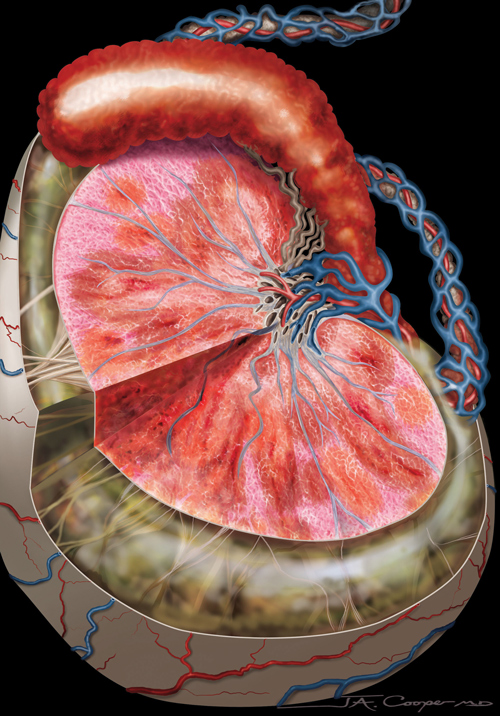
Examination of a patient with acute EO classically reveals a swollen, tender testis with swelling of the epididymis which starts at the tail (lower pole) and moves up towards the head of the epididymis at the upper pole of the testes. There may also be a tender and thickened spermatic cord, erythema of the scrotum, a reactive hydrocoele and penile discharge, suggestive of N. gonorrhoeae infection.15
In severe cases, the patient may be systemically unwell with a fever and require hospital admission. Patients with chronic EO will have a tender, large indurated testis.
UTI in men is very often associated with BOO. So it is important to examine the abdomen for a palpable bladder and to perform a digital rectal exam to check for benign prostatic hyperplasia (BPH), prostate cancer, constipation and prostatitis which can also cause EO.
All patients should be followed up by the GP to ensure that the symptoms are improving at three to seven days.3,16,17 Acute EO should typically resolve after one to three days but the pain and swelling can take up to four weeks to resolve.3
If symptoms are not resolving, alternative diagnoses of the testicular pain and swelling including testicular neoplasms and rarer causes will need to be investigated, see table 1. Complications of EO include testicular infarction, abscess formation, testicular atrophy, and chronic induration and there is some suggestion that infertility can result.18-20
Investigations
A urine dip is a sensitive and very useful test for diagnosing UTI and should be done on all patients presenting with symptoms of EO. Urine microscopy, culture and sensitivity can then confirm the urinary bacterium and guide treatment.
To investigate an STI-associated EO and in younger patients, the British Association of Sexual Health and HIV (BASHH) guidelines, recommend urethral swabs for Gram staining, gonorrhoea and chlamydial NAAT as well as first pass and mid-stream urine culture.15 These tests are summarised in table 2.
BASHH and the European Association of Urology (EAU) guidelines state that the urethral swabs and mid-stream urine samples should be taken before starting empirical antibiotics but this is often not done in practice.21
Referral
If there is any suspicion of testicular torsion, the patient should be referred immediately to secondary care (urology or general surgery depending on local arrangements) as surgery is required within four to six hours.22
Similarly, if patients are in severe pain or systemically unwell with fever, tachypnoea, tachycardia or hypotension, they should be referred to secondary care for analgesia, intravenous antibiotics and hydration.
If a patient with BPH is suffering from recurrent UTIs, NICE guidance recommends referral to a urologist as recurrent UTIs are a complication of BPH and would be an indication for transurethral resection of the prostate or other surgical intervention.23
Men between 15 and 50 do not typically get UTIs and so the EAU guidelines on treatment of urological infection recommend urological referral of this age group if they have a febrile UTI, pyelonephritis, recurrent infections or if a ‘complicating factor is suspected’.24 Another urinary tract cause such as a renal calculus or urethral stricture may be present.
Younger patients or those with a sexual history should be referred to a genitourinary medicine (GUM) department for initial investigations and treatment, if this is not possible in general practice, as well as for contract tracing and treatment.
Any patient whose symptoms are not responding should be referred to urology or GUM ideally with an ultrasound scan of the testes.
Treatment
Paracetamol and NSAIDs provide good analgesia. Ice packs and scrotal elevation and supports may also help relieve pain.3
Antibiotic treatment should be started before microbiological confirmation of the pathogen.15 The particular antibiotic depends on the likely pathogen meaning appropriate clinical assessment of the likely source is paramount. Guidelines based on the epidemiology recommend different treatments for the under and over 35s when it is the sexual and urological history that should guide treatment.
If an STI is suspected
The BASHH guidelines recommend a 500 mg intramuscular injection of ceftriaxone to cover EO when a sexual source is suspected. The dose of ceftriaxone has been increased from 250 mg in the earlier guidelines to 500 mg in the current guidelines for the treatment of non-complicated gonorrhoea because of increased resistance of N. gonorrhoeae to ceftriaxone.25, 26 For those with risk factors for N. gonorrhoeae infection including previous gonorrhoea or known contact, men who have sex with men or those with a purulent discharge, doxycycline 100 mg bd for two weeks is recommended as there is increased resistance of N. gonorrhoeae to quinolones.26
For those without urethral swabs showing Gram-negative diplococci, doxycycline 100 mg bd or ofloxacin 200 mg bd for two weeks should be used.5,27,28 Ofloxacin and doxycycline have been shown to be more effective against C. trachomatis than ciprofloxacin.29
If a UTI is suspected
If an enteric organism is suspected, ciprofloxacin 500 mg bd or ofloxacin 200 mg bd for two weeks is recommended.30 Fluoroquinolones are the preferred antibiotic as they have excellent penetration into the testes.31
Ofloxacin covers C. trachomatis and the majority of urinary pathogens so can be used to treat most causes of EO. Doxycycline needs to be used if there is any suggestion of N. gonorrhoeae. However, if there is any suspicion of an STI, the patient should be referred to GUM where appropriate treatment can be initiated.
Conclusion
EO tends to be caused by either urinary tract pathogens or by STI. The majority of cases can be managed in primary care. Without appropriate investigation STIs and functionally abnormal male urinary anatomy may be missed.
In the case of STIs, this would represent a lost opportunity for contact tracing and prevention of further spread of infection.
Similarly, it is unusual for men to suffer UTIs without abnormal functional anatomy and so accurate diagnosis and urological referral for EO could lead to improved urinary symptoms and quality of life.
REFERENCES
1 Nicholson A, Rait G, Murray-Thomas T et al. Management of epididymo-orchitis in primary care: results from a large UK primary care database. Br J Gen Pract 2010; 60(579):e407–22
2 Kaver I, Matzkin H, Braf ZF. Epididymo-orchitis: a retrospective study of 121 patients. J Fam Pract 1990;30(5):548–52
3 Trojian TH, Lishnak TS, Heiman D. Epididymitis and orchitis: an overview. Am Fam Physician 2009; 79(7):583–7
4 Luzzi GA, O'Brien TS. Acute epididymitis. BJU Int 2001;87(8):747–55
5 Berger RE, Alexander ER, Harnisch JP et al. Etiology, manifestations and therapy of acute epididymitis: prospective study of 50 cases. J Urol 1979;121(6):750–4
6 Hood SV, Bell D, McVey R et al. Prostatitis and epididymo-orchitis due to Aspergillus fumigatus in a patient with AIDS. Clin Infect Dis 1998;26(1):229–31
7 Lam WL, Dashefsky SM, Levi CS et al. US case of the day. Right epididymo-orchitis due to disseminated Blastomyces dermatitidis. Radiographics 1994;14(4):931–3
8 Monroe M. Proceedings: Granulomatous orchitis due to histoplasma capsulatum masquerading as sperm granuloma. J Clin Pathol 1974;27(11):929–30
9 Liao JC, Reiter RE. Coccidioidomycosis presenting as testicular mass. J Urol 2001 166(4):1396
10 Lyne JC, Flood HD. Bilateral fungal epididymo-orchitis with abscess. Urology 1995;46(3):412–4
11 Pimentel M, Nicolle LE, Qureshi S. Candida albicans epididymo-orchitis and fungemia in a patient with chronic myelogenous leukemia. Can J Infect Dis 1996;7(5):332–4
12 Nikolaou M, Ikonomidis I, Lekakis I et al. Amiodarone-induced epididymitis: a case report and review of the literature. Int J Cardiol 2007;121(1):e15–6
13 McMahon AJ, Buckley J, Taylor A et al. Chronic testicular pain following vasectomy. Br J Urol 1992;69(2):188–91
14 Berger RE, Kessler D, Holmes KK. Etiology and manifestations of epididymitis in young men: correlations with sexual orientation. J Infect Dis 1987;155(6):1341–3
15 Street E, Joyce A, Wilson J. Clinical Effectiveness Group, British Association for Sexual Health and HIV. BASHH UK guideline for the management of epididymo-orchitis, 2010. Int J STD AIDS 2011;361–5
16 Kadish HA, Bolte RG. A retrospective review of pediatric patients with epididymitis, testicular torsion, and torsion of testicular appendages. Pediatrics 1998;102(1 Pt 1):73–6
17 Haecker F-M, Hauri-Hohl A, Schweinitz von D. Acute epididymitis in children: a 4-year retrospective study. Eur J Pediatr Surg 2005;15(3):180–6
18 Osegbe DN. Testicular function after unilateral bacterial epididymo-orchitis. Eur Urol 1991;19(3):204–8
19 Schuppe H-C, Meinhardt A, Allam JP et al. Chronic orchitis: a neglected cause of male infertility? Andrologia 2008;40(2):84–91
20 Lu Y, Bhushan S, Tchatalbachev S et al. Necrosis is the dominant cell death pathway in uropathogenic Escherichia coli elicited epididymo-orchitis and is responsible for damage of rat testis. PLoS ONE 2013;8(1):e52919
21 Garthwaite MAE, Johnson G, Lloyd S, Eardley I. The implementation of European Association of Urology guidelines in the management of acute epididymo-orchitis. Ann R Coll Surg Engl 2007;89(8):799–803
22 Kallerhoff M, Gross AJ, Bötefür IC et al. The influence of temperature on changes in pH, lactate and morphology during testicular ischaemia. Br J Urol 1996;78(3):440–5
23 Jones C, Hill J, Chapple C on behalf of the Guideline Development Group. Management of lower urinary tract symptoms in men: summary of NICE guidance. BMJ 2010;340:c2354–4
24 Grabe M, Bjerklund-Johansen T, Botto H et al. EAU Guidelines on Urological Infections. European Association of Urology. 2013. www.uroweb.org/ guidelines/online-guidelines
25 Newman LML, Moran JSJ, Workowski KAK. Update on the management of gonorrhea in adults in the United States. Clin Infect Dis 2007;44 Suppl 3:S84–101
26 Martin IMCI, Hoffmann SS, Ison CAC. European Surveillance of Sexually Transmitted Infections (ESSTI): the first combined antimicrobial susceptibility data for Neisseria gonorrhoeae in Western Europe. J Antimicrob Chemother 2006;58(3):587–93
27 Melekos MD, Asbach HW. Epididymitis: aspects concerning etiology and treatment. J Urol 1987;138(1):83–6
28 Weidner W, Schiefer HG, Garbe C. Acute nongonococcal epididymitis. Drugs 1987;34(Suppl 1): 111–7
29 Catalan FF, Milovanovic AA, Prouteau CC, Soulignac MM. Evaluation of in vitro activity of ofloxacin against 73 strains of Chlamydia trachomatis isolated from gynecologic infections. Pathol Biol 1998;46(2):144–6
30 Eickhoff JHJ, Frimodt-Møller NN, Walter SS, Frimodt-Møller CC. A double-blind, randomized, controlled multicentre study to compare the efficacy of ciprofloxacin with pivampicillin as oral therapy for epididymitis in men over 40 years of age. BJU Int 1999;84(7):827–34
31 Cox CE. Ofloxacin in the management of complicated urinary tract infections, including prostatitis. Am J Med 1989;87(6C):61S–68S
32 Bansal N, Kaistha N, Chander J. Epididymo-orchitis: an unusual manifestation of salmonellosis. J Microbiol Immunol Infect 2012;45(4):318–20
33 Jones JW, Carter A, Ewings P, O'Boyle PJ. An MRSA outbreak in a urology ward and its association with Nd: YAG coagulation laser treatment of the prostate. J Hosp Infec 1999; 41 (1): 39-44
34 Paul J, Krishnamoorthy S, Teresa M, Kumar S. Isolated tuberculous orchitis: A mimicker of testicular malignancy. Indian J Urol 2010;26(2):284–6
35 Richens J. Genital manifestations of tropical diseases. Sex Transm Infect 2004;80(1):12–7
36 Harada H, Seki M, Shinojima H et al. Epididymo-orchitis caused by intravesically instillated bacillus Calmette-Guérin: genetically proven using a multiplex polymerase chain reaction method. Int J Urol 2006;13(2):183–5
37 Routh JC, Lischer GH, Leibovich BC. Epididymo-orchitis and testicular abscess due to Nocardia asteroides complex. Urology 2005;65(3):591
38 Clifford V, Wadsley J, Jenner B, Buttery JP. Mumps vaccine associated orchitis: Evidence supporting a potential immune-mediated mechanism. Vaccine 2010;28(14):2671–3
39 Willems WR, Hornig C, Bauer H, Klingmüller V. A case of Coxsackie A9 virus infection with orchitis. J Med Virol 1978;3(2):137–40
40 Parr NJ, Prasad BRP, Hayhurst V et al. Suppurative epididymo-orchitis in young “high risk” patients - a new problem? Br J Urol 1993;72(6):949–51
41 Mackenzie H, Mahmalji W, Raza A. The gumma and the gonad: syphilitic orchitis, a rare presentation of testicular swelling. Int J STD AIDS.2011;22(9):531–3
42 Persellin ST, Menke DM. Isolated polyarteritis nodosa of the male reproductive system. J Rheumatol 1992;19(6):985–8
43 Davol P, Mowad J, Mowad CM. Henoch-Schönlein purpura presenting with orchitis: a case report and review of the literature. Cutis 2006;77(2):89–92
44 Dhand S, Casalino DD. Idiopathic granulomatous orchitis. J Urol 2011;186(4):1477–8
ARTICLE IN PDF
 Download this article in PDF format
PRESET SEARCHES
Nice Evidence
PubMed
Epiididymo-orchitis in general practice
Immediate CPD prompts
These handy templates* prompt immediate drafting of personal learning, reflection and planning. Save your record straight into your personal development folder on your device or Cloud storage system.
*Adobe reader needed for iPad