SEARCH

Hill G, Aning J. History key in identifying cause of nocturia in men. Practitioner April 2019;263(1825):17-20
History key in identifying cause of nocturia in men
24 Apr 2019
AUTHORS
Mr George Hill BSc(Hons) MBBS MRCS, Core Surgical Trainee
Mr Jonathan Aning BMBS BMedSci DM FRCS(Urol), Consultant Urological Surgeon
Bristol Urological Institute, Bristol, UK
Competing interests: None
Article
Nocturia has been defined by the International Continence Society as the need ‘to wake at night one or more times to void.’ It has been associated with reduced quality of life, sleep deprivation, falls and depression. Nocturia can be a symptom of an underlying disease process or behavioural. The history should not just focus on lower urinary tract symptoms but should also include past medical history, current medications and fluid intake. It is important to ask specifically about the onset and progression of symptoms, and to what extent the patient is troubled by the nocturia. An important distinction is whether patients are woken by the need to void or simply choose to void when woken by something else. An abdominal examination should always be performed and should exclude urinary retention. A digital rectal examination of the prostate should also be offered. Lower limb oedema should be looked for and the patient’s height and weight measured. Routine urinalysis should be performed and blood samples sent for urea and electrolytes, calcium and serum osmolality. Fasting glucose or serum HbA1c should be requested if they have not been measured in the past 12 months. The most useful tool to confirm diagnosis and assist with identification of a cause is a frequency volume chart or bladder diary. This should be completed by the patient over at least three 24-hour periods. If the cause is unclear or there is no response to initial medical treatment, then routine referral to secondary care is appropriate. Patients presenting with a history of nocturnal enuresis and newly impaired renal function may have high pressure chronic retention and will require urgent hospitalisation for catheterisation and monitoring for diuresis.
Nocturia is defined by the International Continence Society (ICS) as ‘the complaint that the individual has to wake at night one or more times to void’ where each episode is preceded and followed by sleep.1
Nocturia is common, and its incidence increases with age. Between 1 in 5 and 1 in 6 younger people wake to void ≥ 2 times per night, increasing to two thirds of adults in their 70s and 80s.2 For some patients the condition may result in significant morbidity and impact on quality of life.3 Nocturia has been associated with sleep deprivation, falls and depression.4 The degree of bother caused by nocturia is therefore of more clinical relevance than the number of voids.
Men most commonly present because of increasing frequency or severity of nocturia. Men may describe tiredness caused by sleep disturbance from frequent night-time voids, or fear that a significant underlying disease may be causing their nocturia symptoms.5 Some men may be encouraged to see their GP by their partner because their partner’s sleep has been disturbed by the nocturia.6 Nocturia is acknowledged to be underreported by men.4 Many attribute the condition to aging and may only mention it when they consult for an unrelated complaint or if prompted.
Assessment
A broad range of differential diagnoses may potentially cause nocturia. In order to target treatment strategies appropriately these differential diagnoses need to be reduced. The clinical history is key in identifying the cause of nocturia. As such it is essential that a comprehensive history is taken when patients present; focusing not only on their lower urinary tract symptoms (LUTS) but also their past medical history, current medications and fluid intake. Potential causes of nocturia are summarised in table 1, however the list is not exhaustive.7 A thorough history will often help identify the underlying aetiology and enable targeted investigations if appropriate.
It is important to ask specifically about the onset, and progression, of symptoms and to what extent the patient is troubled by the nocturia.
It is one of a spectrum of LUTS8 and assessment of any other LUTS should also be undertaken. LUTS may be categorised into filling and voiding symptoms, these are summarised in table 2. When questioning patients about their fluid intake enquire about the quantity, type of beverage and timing of consumption. Alcohol, soft drinks and caffeinated drinks are all associated with urinary frequency.
There are several important diagnoses which must be excluded when patients present. Infection may cause urinary frequency therefore it is important to ask about dysuria. Urinary tract malignancies may uncommonly exacerbate urinary symptoms so a history of haematuria should also be excluded.7 Nocturnal enuresis can be a sign of high pressure chronic urinary retention. This urological condition is managed as an emergency. Patients presenting with a history of nocturnal enuresis and newly impaired renal function may have high pressure chronic retention and will require urgent hospitalisation for catheterisation and monitoring for diuresis.9
An important distinction to clarify in the history is whether patients are woken by the need to void urine or because of another reason, and then subsequently choose to void. This can help differentiate between pathological underlying causes. For example, untreated obstructive sleep apnoea (OSA) is associated with frequent night-time voids particularly because patients may wake after apnoeic episodes. Similarly, respiratory, cardiac and neurological disorders can affect night-time voiding. A review of the patient’s current medications, and when they are taken, may also help identify underlying aetiology; for example, the timing of taking medication such as diuretics can affect nocturia.4
A full medical examination should be performed, targeting systems identified in the history in detail: abdominal examination should always be performed and should exclude urinary retention (a bladder scanner should be used to measure post void residual if retention is suspected), a digital rectal examination (DRE) should be performed to assess the prostate size or contour which may often cause, or be associated with, LUTS. Lower limb oedema should be looked for and the patient’s height and weight measured.4,7
Routine urinalysis should be performed and blood samples should be sent for urea and electrolytes, calcium and serum osmolality. Fasting glucose or serum HbA1c should be recorded, if not performed in the past 12 months, to exclude diabetes as an underlying cause. Patients should be advised that nocturia is unlikely to be a symptom of prostate cancer and that if their prostate is clinically benign they are no more likely to have prostate cancer than asymptomatic patients. Men over 50 years old concerned about their prostate cancer risk or with a family history of prostate cancer should be counselled about the potential risks and benefits of undergoing a PSA test and empowered to make a shared decision about whether to undergo the test.
Frequency volume chart
The most clinically useful tool to confirm diagnosis and assist with identification of a cause is a frequency volume chart (FVC) or bladder diary. This should be completed by the patient over at least three 24-hour periods. As a minimum the patient should be encouraged to record the time, volume and type of each drink, and time, volume and urgency of each micturition. Of critical importance is the need for the patient to document their wake and sleep times, otherwise the FVC cannot be used to assess nocturia.9 Causes of nocturia are listed in table 1.
Confirming diagnosis
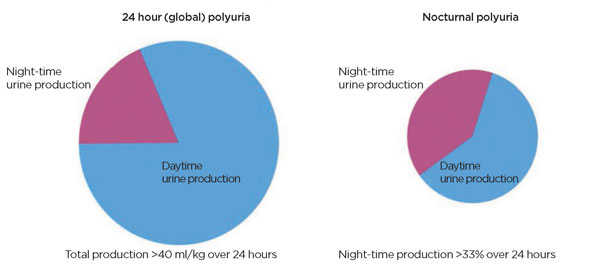
Nocturia can be confirmed by a correctly completed FVC. Nocturia is at least one episode of waking to micturate. Combining the FVC result with the history, examination and investigation findings is likely to identify the underlying cause. Table 3, can be used with an FVC to differentiate 24 hour polyuria from nocturnal polyuria.
Nocturia may be due to an increase in urinary frequency or increasing urinary volumes either globally (over 24 hours) or specifically at night.9Figure 1, shows a comparison of urine volumes produced in each condition. The ICS defines nocturnal polyuria as > 33% of urine production at night in > 65 year olds, where 24 hour polyuria has been excluded, though this definition has been criticised.10
24 hour polyuria can be caused by many organic medical pathologies, for example, poorly controlled diabetes mellitus, diabetes insipidus or salt loss.
Nocturnal polyuria may be caused by:
• OSA or peripheral oedema
• Reduced bladder capacity — often associated with filling LUTS
• Sleep disturbance — the patient is not specifically woken by the need to micturate, and volumes are not excessive
• Behavioural — polydipsia, fluid, salt or protein intake9,11
Figure 2, shows how aetiology may be identified from the FVC.
Management
Treatment should be targeted at the underlying cause. Controlling the causative disease process will improve the symptom of nocturia.
Lifestyle intervention
The treatment depends significantly on the underlying cause, but the initial step of lifestyle modification may provide some benefit. Generic advice on fluid intake is frequently given, though there is little evidence for this, e.g. no fluids at least 2 hours before bed time; reduce fluid intake to < 2L per day; reduce or eliminate caffeine and alcohol intake.
Weight loss, exercise and reducing dietary salt and protein intake may also help limit symptoms. Altering timing of medications, particularly diuretics to the morning, may be effective for some patients.4
Behavioural changes such as bladder emptying before going to bed, pelvic floor retraining exercises, clearing a path to the toilet, use of a commode, elevating legs before going to bed (if peripheral oedema is present) are beneficial in many patients.12 Sleep hygiene and evening exercise have been shown to be beneficial in improving nocturia.7Table 4, shows how specific lifestyle modifications may benefit each cause.
Pharmacotherapy
For men with nocturnal polyuria, for whom lifestyle modification has proved ineffective, an afternoon diuretic is a first-line pharmacological alternative, though existing evidence is low quality.3
The diuretic needs to have short bioavailability, with high sodium excretion over a short period. Loop diuretics such as furosemide work well.10 For those already on a loop diuretic, adjusting timing is appropriate.
Desmopressin has been demonstrated to be safe and effective as a treatment for nocturnal polyuria,13 but it is important to be aware that there is a risk of hyponatraemia in those over 65 or with low haemoglobin. This risk can be reduced with low-dose treatment and regular serum sodium monitoring.13 Desmopressin should not be used in patients with heart failure, psychogenic polydipsia, a creatinine clearance of < 50 ml/min, known hyponatraemia or syndrome of inappropriate antidiuretic hormone secretion (SIADH).14
Combination therapy can also prove effective; a daytime diuretic plus desmopressin has been shown to be effective and well tolerated in the elderly.14 NSAID use results in reduced afferent renal blood supply, thus decreasing urine production with a maximal effect at 2 hours.10 However, NSAIDs should be used with caution in the elderly population and should not be used together with desmopressin.14
Additionally, pharmacological therapy for any underlying cause of global polyuria will help alleviate daytime and nocturnal symptoms. Increasing hypertensive and diabetes control, and conventional treatments for heart failure may be of benefit.10
Urinary containment products may be used in elderly men where pharmacological treatment is unsuccessful or contraindicated. These include absorbent products, external urine collection devices or indwelling catheters.14
Referral
If the cause is unclear or there is no response to initial medical treatment, then routine referral to secondary care is appropriate for further investigation.4,14 Patients presenting with a history of nocturnal enuresis and newly impaired renal function may have high pressure chronic retention and will require urgent hospitalisation for catheterisation and monitoring for diuresis. Patients with findings suggestive of a sleep disturbance disorder may benefit from referral for sleep studies.
REFERENCES
1 van Kerrebroeck P, Abrams P, Chaikin D et al. The standardisation of terminology in nocturia: report from the Standardisation Sub-committee of the International Continence Society. Neurourol Urodyn 2002;21(2):179-83
2 Bosch JL Weiss JP. The prevalence and causes of nocturia. J Urol 2013;189:S86–S92
3 Van Dijk MM, Wijkstra H, Debruyne FM et al. The role of nocturia in the quality of life of men with lower urinary tract symptoms. BJU Int 2010;105:1141-46
4 Oelke M, De Wachter S, Drake MJ et al. A practical approach to the management of nocturia. Int J Clin Pract 2017;71(11)
5 Oelke M, Anderson P, Wood R, Holm-Larsen T. Nocturia is often inadequately assessed, diagnosed and treated by physicians: results of an observational, real-life practice database containing 8659 European and US-American patients. Int J Clin Pract 2016;70(11):940-49
6 Shvartzman P, Borkan JM, Stoliar L et al. Second-hand prostatism: effects of prostatic symptoms on spouses' quality of life, daily routines and family relationships. Family Pract 2001;18(6):610-13
7 Everaert, K, Hervé, F, Bosch, R et al. International Continence Society consensus on the diagnosis and treatment of nocturia. Neurourol Urodynam 2019;38:478‐98
8 Abrams P. New words for old: lower urinary tract symptoms for "prostatism". BMJ 1994;308(6934):929-30
9 Hashim H, Drake MJ. Basic concepts in nocturia, based on International Continence Society standards in nocturnal lower urinary tract function. Neurourol Urodyn 2018;37(S6):S20-S4
10 Kass-Iliyya A, Hashim H. Nocturnal polyuria: Literature review of definition, pathophysiology, investigations and treatment. J Clin Urol 2018;12(1):60-71
11 Oelke M, Adler E, Marschall-Kehrel D et al. Nocturia: state of the art and critical analysis of current assessment and treatment strategies. World J Urol 2014;32(5):1109-17
12 Vaughan CP, Bliwise DL. Sleep and nocturia in older adults. Sleep Med Clin 2018;13(1):107-16
13 Andersson KE, Van Kerrebroeck P. Pharmacotherapy for nocturia. Curr Urol Rep 2018;19(1):8
14 National Institute for Heath and Care Excellence CG97. Lower urinary tract symptoms in men: management. NICE. London. 2015
USEFUL INFORMATION
ARTICLE IN PDF
 Download this article in PDF format
EXTERNAL WEBLINKS
Bladder & Bowel Community
Patient information and support
A national charity for people affected by bladder and bowel problems