SEARCH

Ghanem S, Altell T, Challacombe B. Managing acute and chronic urinary retention in men. Practitioner April 2018;262(1814):17-21
Managing acute and chronic urinary retention in men
23 Apr 2018
AUTHORS
Dr Salma Ghanem MBBS, Foundation Year 2 Trainee, Homerton University Hospital, London, UK
Mr Tareq Altell, Medical Student, Faculty of Medicine, University of Jordan, Jordan
Mr Ben Challacombe MS FRCS(Urol), Consultant Urological Surgeon & Honorary, Senior Lecturer, Guy's Hospital & King's College London, UK
Competing interests: None
Article
Abstract
Urinary retention is the most common urological emergency and more than 95% of cases occur in men. Acute urinary retention (AUR) is defined as the sudden inability to pass any urine voluntarily associated with a painful, palpable or percussable bladder. In chronic urinary retention (CUR) there is a non‐painful bladder, which remains palpable or percussable after the man has passed urine, with a post-void residual volume > 300 ml. In acute on chronic urinary retention no urine can be voluntarily passed but the condition is relatively painless and the residual volume on catheterisation is > 1.5 litres. Urinary retention may result from bladder outflow obstruction, neurological impairment, or impaired detrusor smooth muscle function. It may also be linked to medication (anticholinergic and sympathomimetic drugs) and a detailed pharmacological history is vital. Patients with AUR present with inability to pass urine, associated with suprapubic pain or discomfort. CUR is usually painless. Men with low pressure CUR may complain of hesitancy, slow stream, and a feeling of incomplete emptying, while those with high pressure CUR may be asymptomatic or complain of urgency. Recent onset of bedwetting in a man is almost pathognomonic of high pressure CUR. Examination should include a digital rectal examination to evaluate for prostate size and possible malignancy, rectal masses, faecal impaction, perineal sensation, and rectal sphincter tone. A normal prostate examination does not rule out BPH as a cause of obstruction as small prostates can also cause retention.
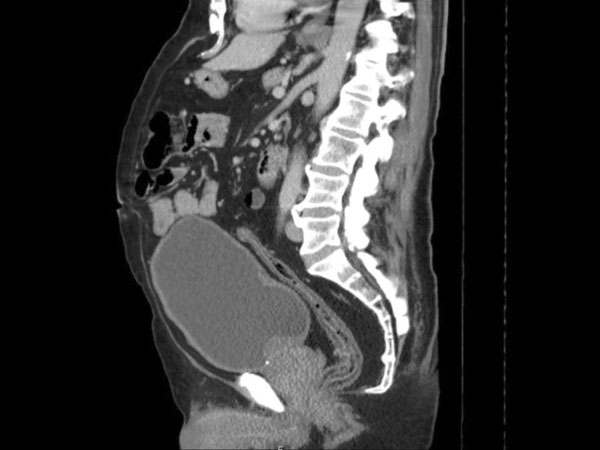
Urinary retention is the most common urological emergency1 and more than 95% of cases occur in men. It is most simply divided into acute urinary retention (AUR) and chronic urinary retention (CUR), see figure 1.
AUR is defined as a painful, palpable or percussable bladder, when the patient is unable to pass any urine voluntarily.2 In CUR there is a non‐painful bladder, which remains palpable or percussable after passing urine, with a post-void residual (PVR) volume of >300 ml, and these patients may become incontinent.2 Some patients may present with acute on chronic urinary retention when no urine can be voluntarily passed but the condition is relatively painless and the residual volume on catheterisation is > 1.5 litres.
Pathogenesis and aetiology
Urinary retention does not always signify benign prostatic hyperplasia (BPH).
Three factors predominate in the pathophysiological mechanisms of AUR: bladder outflow obstruction, neurological impairment, and an inefficient detrusor muscle.3
Patients with AUR present to primary care or the accident and emergency department with inability to pass urine, associated with suprapubic pain or discomfort.4 Patients with CUR usually present without pain but often with discomfort and a feeling of fullness or recurrent urinary tract infections (UTIs). In high pressure CUR, patients may present with nocturnal enuresis/overflow incontinence rather than inability to void urine, and occasionally with renal failure/fluid overload. The recent onset of bedwetting in an adult male is almost pathognomonic of CUR.5
CUR is generally classified as low pressure or high pressure CUR.6 High pressure refers to an increased detrusor pressure at the start of the filling phase and leads to hydronephrosis and renal failure. Low pressure CUR leads to progressive distention of the bladder and eventual bladder atonia. The two groups tend to have different symptoms, the low pressure group complaining of hesitancy, slow stream, and a feeling of incomplete emptying, while the high pressure group may be silent or also complain of urgency. An association between upper urinary tract dilatation and high pressure CUR is seen.
Assessment and examination
Assessment of patients with urinary retention should begin with a concise history (the patient may be in discomfort) and physical examination focusing on factors that can help identify an aetiology. A urine sample (voided or via catheter) should be obtained for urinalysis and culture in all patients. The need for other investigations will depend on the patient's presentation, see table 2.
History
Physicians should ask about prior lower urinary tract symptoms (LUTS), previous episodes of urinary retention, prostate disease either benign or malignant, specific symptoms such as dysuria, haematuria, fever and pelvic trauma. Patients should be asked whether they have a history of UTIs/sexually transmitted infections or urethral stricture.
Neurological symptoms should be looked for if there is a high index of suspicion of a neurological cause or obvious trauma to the spine.
A detailed pharmacological history must be obtained as it may point to the cause. Use of anticholinergic and sympathomimetic drugs may lead to urinary retention.7
Risk factors for urinary retention are listed in table 1.4
Physical examination
The physical examination should include the following:
Lower abdominal palpation
The urinary bladder may be palpable, either on abdominal or rectal examination. Deep suprapubic palpation will provoke discomfort.
Rectal examination
Digital rectal examination (DRE) to evaluate prostate size, possible malignancy, rectal masses, faecal impaction, perineal sensation, and rectal sphincter tone. A normal prostate examination does not preclude BPH as a cause of obstruction as small prostates can also cause retention.
Neurological evaluation
The neurological examination should include assessment of strength, sensation, reflexes, and muscle tone in cases where there is a high index of suspicion of a neurological cause.
Diagnosis
Most patients with suspected AUR can be diagnosed by a history of inability to void and palpating the bladder or via a portable bladder ultrasound in the practice or emergency room. However, in patients whose history strongly suggests a diagnosis of AUR and examination is difficult or equivocal, it is reasonable to proceed with catheterisation, which is both diagnostic and therapeutic, and not wait to obtain a bladder ultrasound first.
In CUR, incomplete bladder emptying is measured by the volume of urine left in the bladder after voiding, the PVR. There is no agreement on the threshold value to define a significant PVR. Different societies have produced guidelines with different thresholds ranging from 300 ml to 1,000 ml. (We would use a threshold of > 300 ml as CUR.) Generally, >150 ml is pathological and should be investigated. The AURO guidelines on BPH8 define as pathological a PVR of ‘more than one third of total bladder capacity’, but with evidence level IV. The European Association of Urology, American Urology Association and NICE guidelines on LUTS do not define threshold values for pathological PVR.
Examples of presentations in general practice or emergency departments are shown in table 3.
Management
Once AUR is suspected (see figure 2), decompression should be carried out immediately, which can be done using urethral or suprapubic catheterisation.
Urethral catheterisation
An initial attempt at urethral catheterisation is indicated in all patients with suspected urinary retention, but it is contraindicated in cases where the patient has had a recent urological procedure such as urethral reconstruction.
Care must also be taken post radical prostatectomy and TURP/bladder outflow surgery. Usually an indwelling catheter is used (14-18 gauge French catheter) but occasionally clean intermittent self-catheterisation (ISC) may be indicated or preferred by the patient.9
ISC should be offered before an indwelling catheter for men with CUR who are still voiding unless they have impaired renal function or hydronephrosis secondary to CUR.
If possible, the use of chronic urethral indwelling catheters should be avoided. Complications include UTI, sepsis, trauma, stones, urethral strictures or erosions, prostatitis, and potential development of squamous cell carcinoma of the bladder.10,11
In a one year prospective study of nursing home patients, catheter use was independently associated with increased mortality.12
Suprapubic catheterisation
Suprapubic catheterisation (SP) is used when urethral catheterisation is contraindicated (pelvic trauma/recurrent urethral stricture) or when it fails, but its drawback is that it needs a urologist, radiologist or other suitably trained person to do the procedure. This should be performed under ultrasound guidance to minimise risks of bowel perforation. It should not be performed in undiagnosed clot retention in case there is an underlying bladder tumour.
In cases where SP catheterisation is needed and no trained person is available, a suprapubic needle aspiration of the bladder can be performed.
SP catheters are associated with fewer complications than urethral catheters in terms of discomfort, prostatic bleeding, urethral stricture and sphincter dysfunction post catheterisation.13,14
Complications of bladder decompression
Haematuria, hypotension, and post-obstructive diuresis are potential complications of rapid decompression after CUR.6 However, there is no evidence that gradual bladder decompression will decrease these complications. Rapid and complete emptying of the bladder is therefore recommended with additional intravenous sodium chloride infusion, lying and standing blood pressures, and weight recorded daily if there is significant diuresis and the man cannot keep up with sufficient oral fluids.5,15
Catheter removal post retention
The decision on whether to remove the catheter for a trial of voiding, i.e. trial without catheter (TWOC), depends on the aetiology of the urinary retention. Optimally a TWOC should be performed 5-7 days after AUR ideally after the patient has been taking an alpha-blocker for this period. If there are reversible factors then catheter removal is a sensible option.
TWOC is more likely to be successful in younger men with smaller prostates who have had a precipitated AUR e.g. related to constipation/alcohol/recent anaesthetic. It is very unlikely to be successful in men over the age of 80 with high residual volumes (> 1.5 litres) and larger prostates. NICE guidelines state that an alpha-blocker should be offered to the patient for management of AUR before removal of the catheter.
Catheters should never be removed without bladder outflow surgery in men with hydronephrosis and renal failure due to CUR; these men should be booked directly for bladder outflow surgery.
Follow-up after initial decompression
Definitive management of urinary retention will depend upon the underlying aetiology and should involve referral to a urologist either urgently or electively. If there has been a clear precipitating factor that is reversed and no pre-existing urinary symptoms then management in primary care is appropriate. Otherwise investigation into the exact aetiology and potential medical or surgical management may be required.
The following are red flags for hospitalisation:6,9
• Evidence of urosepsis
• Evidence of malignancy
• Evidence of renal failure
• Acute spinal cord compression
REFERENCES
1 Marshall JR, Haber J, Josephson EB. An evidence-based approach to emergency department management of acute urinary retention. Emerg Med Pract 2014;16(1):1-20
2 Abrams P, Cardozo L, Fall M et al. The standardisation of terminology in lower urinary tract function: report from the standardisation sub-committee of the International Continence Society. Urology 2003;61(1):37-49
3 Fong YK, Milani S, Djavan B. Natural history and clinical predictors of clinical progression in benign prostatic hyperplasia. Curr Opin Urol 2005;15(1):35-38
4 Thomas K, Chow K, Kirby RS. Acute urinary retention: a review of the aetiology and management. Prostate Cancer Prostatic Dis 2004;7(1):32-7
5 Nyman MA, Schwenk NM, Silverstein MD. Management of urinary retention: rapid versus gradual decompression and risk of complications. Mayo Clin Proc 1997;72(10):951-56
6 Abrams PH, Dunn M, George N. Urodynamic findings in chronic retention of urine and their relevance to results of surgery. Br Med J 1978;2(6147):1258-60
7 Verhamme KMC, Sturkenboom MCJM, Stricker BHC, Bosch R. Drug-induced urinary retention: incidence, management and prevention. Drug Saf 2008;31(5):373-88
8 Spatafora S, Casarico A, Fandella A et al. Evidence-based guidelines for the treatment of lower urinary tract symptoms related to uncomplicated benign prostatic hyperplasia in Italy: updated summary from AURO. Ther Adv Urol 2012;4(6):279-301
9 Curtis LA, Dolan TS, Cespedes RD. Acute urinary retention and urinary incontinence. Emerg Med Clin North Am 2001;19(3):591-619
10 Drinka PJ. Complications of chronic indwelling urinary catheters. J Am Med Dir Assoc 2006;7(6):388-92
11 Delnay KM, Stonehill WH, Goldman H et al. Bladder histological changes associated with chronic indwelling urinary catheter. J Urol 1999;161(4):1108-09
12 Kunin CM, Douthitt S, Dancing J et al. The association between the use of urinary catheters and morbidity and mortality among elderly patients in nursing homes. Am J Epidemiol 1992;135(3):291-301
13 Horgan AF, Prasad B, Waldron DJ, O’Sullivan DC. Acute urinary retention. Comparison of suprapubic and urethral catheterisation. Br J Urol 1992;70(2):149-51
14 Ichsan J, Hunt DR. Suprapubic catheters: a comparison of suprapubic versus urethral catheters in the treatment of acute urinary retention. Aust N Z J Surg 1987;57(1):33-36
15 Oberst MT, Graham D, Geller NL et al. Catheter management programs and postoperative urinary dysfunction. Res Nurs Health 1981;4(1):175-81
ARTICLE IN PDF
 Download this article in PDF format
PRESET SEARCHES
PubMed
Urinary retention in men primary care
NICE Evidence search