SEARCH

Hopper AD. Early endoscopy improves survival in gastric cancer. Practitioner 2014;258 (1773):23-27
Early endoscopy improves survival in gastric cancer
25 Jul 2014
AUTHORS
Dr Andrew D Hopper MD FRCP, Gastroenterology Consultant, Department of Gastroenterology Royal Hallamshire Hospital, Sheffield, UK
Article
The incidence of gastric cancer has halved in the past 20 years but it is still the seventh and eighth most common cancer in men and women respectively.1 The decline in gastric cancer in the UK has been mirrored worldwide and is thought to be associated with a reduction in Helicobacter pylori infection and changes in diet in developed countries.2 However, despite this decline, gastric cancer often presents late and the mortality ratio remains one of the highest (0.7) compared with more common cancers such as colorectal cancer (0.39), prostate cancer (0.25) and breast cancer (0.22).1 Early diagnosis improves survival in this potentially curable cancer. Recognition of symptoms and risk factors should prompt early referral for endoscopy.
Gastric cancer in this article refers to gastric adenocarcinoma which arises from the mucosal lining and accounts for 95% of cancers related to the stomach.
There are also some rare, and sometimes more benign, forms of gastric cancer that arise in the muscle layer of the gastric wall (stromal tumours), neuroendocrine cells (carcinoid tumours), or lymphoid tissue (lymphomas).
Risk factors
Demographics
Men are twice as likely as women to develop gastric cancer; in 2012 the incidence was 17.8/100,000 in men and 7.2/100,000 in women. The vast majority of cases (96%) occur in people above the age of 55.1 There are significant worldwide variations with a high incidence in selected areas of Central and South America and East Asia (> 25/100,000) but gastric cancer is relatively rare in North America and North Western Europe.3
Helicobacter pylori
H. pylori prevalence in gastric cancer is estimated to be 90%.4 Given that the prevalence of infection is very high worldwide it has been estimated that H. pylori accounts for > 50% of all new cases of gastric cancer5 and its presence carries a relative risk of 2.56 for gastric cancer in western Europe.6H. pylori eradication trials in high-risk areas have shown a subsequent reduced risk of gastric cancer over
4-10 years from 1.7% to 1.1%.7 This has led to recommended population screening and antibiotic treatment of H. pylori in high-risk countries.8
As yet there has been no benefit shown for H. pylori eradication in lower risk areas such as North America and the UK. The National Screening Committee found that overall, the potential psychological harm outweighed the potential benefits of a national H. pylori and stomach cancer screening programme in the UK where the incidence of stomach cancer is low.9 A further analysis showed a possible cost benefit from H. pylori screening but concluded that before screening can be recommended further evidence is required on the effectiveness of H. pylori eradication on reducing risk of gastric cancer in low-risk populations.10
Smoking
Smoking is associated with a 60% increased risk of stomach cancer. The risk ratio in current smokers is 1.6 and in previous smokers 1.2.11 It has been estimated that smoking is responsible for more than 10-15% of all cases but if smokers quit the additional risk recedes after ten years.11,12 The recent decline in smoking prevalence in men from developed countries may account in part for the fall in gastric cancer rates.13
Alcohol and diet
A heavy alcohol intake (50-60 g/day or 6-7 units/day) has been shown to have an increased risk of gastric cancer, OR 1.2-1.65, with no excess risk demonstrated with moderate or mild alcohol intake.14,15
A high salt intake has a definite role. It has been shown that compared with people who consumed less than 10 g of salt per day, those who consumed more than 16 g per day have a relative risk of 2.98 of developing gastric cancer.16 There is evidence in mice that a high-salt diet increases the chance of H. pylori colonisation and also may potentiate gastric cancer risk by causing changes such as glandular atrophy and crypt hyperplasia in the gastric mucosa.17
An increased fruit and vegetable intake can result in a 44% reduction in the incidence of gastric cancer.18 Increased use of refrigeration, availability of fresh fruit and vegetables, and a reduction in the reliance on salted or preserved foods is a further explanation for the decrease in gastric cancer incidence.19
Pernicious anaemia
The overall relative risk for gastric cancer in pernicious anaemia is 6.8.20 However, despite this high risk surveillance evidence is lacking. The American Society for Gastrointestinal Endoscopy recommends a single endoscopic evaluation, but does not recommend routine follow-up surveillance thereafter.21 In comparison, the European guideline recommends follow-up every three years for patients with extensive gastric atrophy.22 National UK guidelines recommend endoscopy if dyspepsia develops even without alarm symptoms, see table 1, above. Therefore given the lack of agreement in pernicious anaemia guidelines, all patients with pernicious anaemia should be offered a gastroscopy and gastric biopsy to check for gastric atrophy severity if not done at diagnosis. A single gastroenterology review can then be performed and a decision made with the patient regarding future surveillance benefits.
Genetic syndromes
Hereditary diffuse gastric cancer is a rare autosomal dominant condition usually presenting under the age of 40. The condition is associated with
a CDH1 gene mutation and carries a cumulative risk of gastric cancer of 67% in men and 83% in women. Affected individuals should be offered total gastrectomy as screening is not thought to be effective.23
In hereditary non-polyposis colorectal cancer gastroscopy surveillance is recommended every two years from the age of 50 to 75 because of the increased risk of gastric cancer (standardised incidence ratio 3.4).24 However, there is no evidence that this approach reduces mortality.25
Presentation
Alarm symptoms
Specific at-risk or alarm symptoms for oesophago-gastric cancer have been highlighted in guidelines by NICE,26 SIGN,27 and the British Surgical and Gastroenterological Societies.28 These guidelines specify the symptoms that should prompt urgent referral and investigation, see table 1.
The presence of alarm symptoms and dyspepsia has a low positive predictive value (4%) but a high negative predictive value (98%) with respect to gastric cancer. 29 A study based on alarm symptoms for rapid access endoscopy showed dysphagia, weight loss and age over 55 years were significant predictors of cancer (finding 92% of cancer patients), but uncomplicated dyspepsia in patients
over 55 years was not helpful.30 Therefore it is accepted that alarm symptoms have a low predictive value, but it is recommended that they should be used in dyspepsia management for predicting gastric cancer until better approaches emerge.28
It has recently been demonstrated that the use of alarm symptoms alone to select patients for endoscopy results in patients with localised disease being overlooked.31 Hence, patients with at-risk conditions who develop dyspepsia should also be considered for urgent endoscopy.
In summary, all patients presenting with dyspepsia and either alarm features or known conditions that increase the risk of gastric cancer should be referred for urgent endoscopy, see table 1.
Uncomplicated dyspepsia
There is an absence of alarm symptoms at the initial presentation in up to 50% of patients with gastric cancer,32 and in those with alarm symptoms the vast majority have advanced disease.33 Diagnosis at an early stage greatly improves outcomes and 70% of patients with early gastric cancer have symptoms of uncomplicated dyspepsia.34 Therefore given that the majority of gastric cancer cases occur in people over 55, urgent endoscopy is also recommended in this group with new uncomplicated dyspepsia prior to treatment, even without alarm symptoms or if the symptoms respond to treatment, see table 1.26-28
In patients under 55 gastric cancer presenting with uncomplicated dyspepsia is extremely rare and the majority of young patients have alarm symptoms by the time of presentation.35,36
Many studies37-39 have shown that H. pylori testing and treatment is as effective as endoscopy in the initial management of patients under 55 presenting with uncomplicated dyspepsia. This strategy is supported by many guidelines as the number of missed cancers in patients with uncomplicated dyspepsia is extremely low. However, this approach relies on attentive primary care follow-up after H. pylori eradication therapy to ensure lack of response or unexplained persistent symptoms are followed up to prevent delays in diagnosis.
Confirming diagnosis
Endoscopy
Upper GI endoscopy with biopsy is the recommended investigation to confirm gastric cancer. Gastric cancer can sometimes appear very similar to a gastric ulcer therefore a biopsy and histological differentiation is required. If biopsies are benign follow-up gastroscopy performed after six weeks of anti-acid treatment is performed to ensure healing or to obtain repeat biopsies.
Despite improved advances in endoscopic imaging failure to diagnose gastric cancer at the patient’s first endoscopy is consistently around 10% hence patients require a second gastroscopy.40, 41 The principal factors associated with the need to re-endoscope are failure to suspect malignancy and (as a consequence) failure to take adequate numbers of biopsies.
Gastroscopy should be carried out when the patient has been off proton pump inhibitor (PPI) therapy for two weeks if possible as PPIs may mask endoscopic findings or alter the appearance of malignant ulcers.41, 42 Barium studies have a poor sensitivity for the diagnosis of malignancy and therefore are not the investigation of choice, histological sampling is also unavailable to differentiate between malignant and benign ulceration.
Gastric cancer staging
If a gastric lesion highly suspicious of gastric cancer is seen at gastroscopy, the patient is warned and referral to a specialist upper GI surgery unit is made. Thorough staging and high quality imaging has reduced the number of patients with advanced or incurable disease undergoing significant surgery. Gastric cancer staging employs the Tumour, Nodal, Metastases (TNM) classification system, 44 see table 2.
Computed tomography (CT) of the abdomen and pelvis is performed to detect local invasion. It has a sensitivity of 74% for liver metastases. It is also able to detect peritoneal metastases but with a lower sensitivity of 33%,45 hence when CT imaging shows potentially operable disease a staging laparoscopy is indicated. This can detect peritoneal and metastatic disease under 5 mm in diameter, and enables peritoneal cytology and biopsies to be obtained from suspicious lesions.
Staging laparoscopy can change treatment decisions to perform invasive surgery in up to 28% of patients with gastric cancer after CT.46
Positron emission tomography (PET) combined with CT has become increasingly available in tertiary centres as an alternative sensitive method of metastasis assessment and is currently used in oesophageal cancer staging and in gastric cancers that cross the gastro-oesophageal junction into the oesophagus, but not as standard in gastric cancer staging.
The stage of the cancer is closely related to prognosis emphasising the need to diagnose gastric cancer at an early stage, see table 3.44
Management
Management options are discussed at a specialist upper gastrointestinal multidisciplinary team meeting involving experienced surgeons, radiologists, pathologists, oncologists and cancer nurse specialists. The results of investigations are coupled with the patient’s fitness for surgery and/or chemotherapy and the final decision made with the patient after careful explanation and discussion about the recommended treatment options. Tumours that show local invasion (T4) or distant metastases (M1) are not amenable to curative treatment.
Curative treatment
Patients deemed medically fit should undergo surgical resection to cure early gastric cancer (stage I) and chemotherapy (neoadjuvant) followed by surgical resection for higher stage tumours (stage II-III).28
A total gastrectomy is performed for proximal gastric tumours, and a subtotal gastrectomy for distal tumours.47 Multiple lymph nodes are also removed including coeliac nodes if possible as despite increased risk of early morbidity this is outweighed by the overall benefit of lowering the risk of recurrence and cancer-related death.48 Laparoscopic procedures are possible and offer better post-operative pain control and can be associated with lower complication rates and comparable outcomes49 with current in-hospital mortality following surgery for cancer in the UK audit reported at 1.3-3.6%.50
Peri-operative combination chemotherapy has now become the standard of care for localised gastric cancer throughout the UK and most of Europe. For stage II or higher gastric cancers three preoperative cycles of neoaduvant chemotherapy (epirubicin, cisplatin, and infused 5-fluorouracil), followed when possible by three cycles after surgery are recommended.51 This results in a significantly greater five-year survival than surgery alone (36% versus 23%).
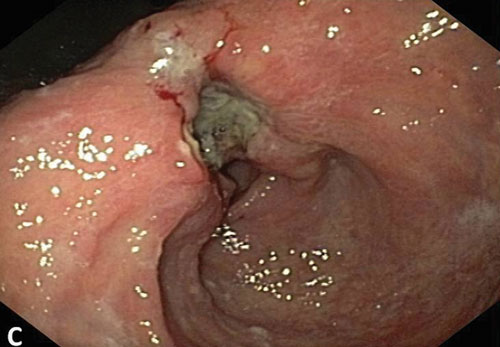
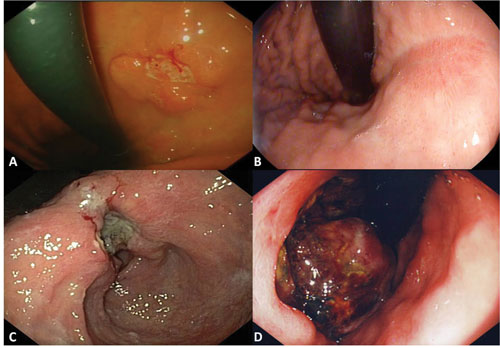
Very early gastric cancer (T1a) can be treated with endoscopy (mucosal resection) if it is confined to the mucosa and less than 2 cm in diameter. However, despite promising results from East Asia these lesions are rarely found at this stage in the UK, see figure 1A, 28 with more than 50% of patients at presentation having advanced incurable disease, see figure 1D.
Palliative treatment
Palliative chemotherapy can be offered for the treatment of advanced gastric cancer, with a median increased survival improved from 3-4 months to 7-10 months.52
For patients with advanced HER-2- positive gastric cancer (tested on the biopsy sample), addition of trastuzumab can result in a significant improvement in response rate and median overall survival (13.8 vs 11.1 months).53, 54
In distal gastric cancers causing upper GI obstruction, surgical jejunostomy can be performed or insertion of a pyloric stent can provide symptomatic relief. The standard treatment option for patients with advanced gastric tumours is uncertain, and where possible patients should be enrolled in a randomised trial.28
Patient support and follow-up
Review by a dietician and input from a cancer nurse specialist have been demonstrated to contribute to a faster recovery and better quality of life.55 The cancer nurse has a central role, consulting with multiple specialties and primary care to provide a co-ordinated approach and acting as the patient’s advocate.56
Regular review of patients following treatment of gastric cancer is required to manage post-treatment side effects such as dysphagia and diarrhoea following surgery and post-operative pain. Regular access to specialist nurses has been shown to be cost effective in supporting follow-up.57
Future directions
The assessment and evaluation of outcomes is a fundamental component of the management of gastric cancer and the National Oesophago-Gastric Cancer Audit has set a high standard.50 With drivers like this it is encouraging to see cancer registries across Europe showing slight improvements in five-year survival rates from 23∙3% in 1999-2001 to 25∙1% in 2005-2007. However they are generally still poor and vary across Europe (32.4% in Italy to 16.0% in Denmark) with the UK having one of the lowest five-year survival rates at 17.2%.58,59
Therefore prevention may be the key. Despite not recommending H. pylori screening in the UK the national screening committee did suggest a pilot of H. pylori screening in all 40-49 year olds and then all individuals as they reached the age of 40. This would define the effect of H. pylori eradication on cancer incidence in low-risk populations,9 and possibly make way for a screening programme in selected individuals.
In the meantime gastric cancer continues to pose a diagnostic challenge which requires a vigilant low threshold for early referral and meticulous early endoscopy to make successful treatment possible.
REFERENCES
1 Office for National Statistics. Cancer Registration Statistics England 2012. 19 June 2014. http://www.ons.gov.uk/ons/dcp171778_367563.pdf
2 Howson CP, Hiyama T, Wynder EL. The decline in gastric cancer: epidemiology of an unplanned triumph. Epidemiol Rev 1986;8:1-27
3 Bertuccio P, Chatenoud L, Levi F et al. Recent patterns in gastric cancer: a global overview. Int J Cancer 2009;125:666-73
4 de Martel C, Ferlay J, Franceschi S et al. Global burden of cancers attributable to infections in 2008: a review and synthetic analysis. Lancet Oncol 2012;13:607-15
5 Parkin DM. The global health burden of infection-associated cancers in the year 2002. Int J Cancer 2006;118:3030-44
6 Cavaleiro-Pinto M, Peleteiro B, Lunet N, Barros H. Helicobacter pylori infection and gastric cardia cancer: systematic review and meta-analysis. Cancer Causes Control 2011;22:375-87
7 Fuccio L, Zagari RM, Eusebi LH et al. Meta-analysis: can Helicobacter pylori eradication treatment reduce the risk for gastric cancer? Ann Intern Med 2009;151:121-8
8 Fock KM, Talley N, Moayyedi P et al. Asia-Pacific consensus guidelines on gastric cancer prevention.
J Gastroenterol Hepatol 2008;23:351-65
9 Hillier S, Fielder H. Screening for stomach cancer: A report for the National Screening Committee Nov 2008 www.screening.nhs.uk/policydb_download.php?doc=49
10 Roderick P, Davies R, Raftery J et al. Cost-effectiveness of population screening for Helicobacter pylori in preventing gastric cancer and peptic ulcer disease, using simulation. J Med Screen 2003;10:148-56
11 Tobacco smoke and involuntary smoking. IARC Monogr Eval Carcinog Risks Hum 2004;83:1-1438
12 Gonzalez CA, Pera G, Agudo A et al. Smoking and the risk of gastric cancer in the European Prospective Investigation Into Cancer and Nutrition (EPIC). Int J Cancer 2003;107:629-34
13 Ladeiras-Lopes R, Pereira AK, Nogueira A et al. Smoking and gastric cancer: systematic review and meta-analysis of cohort studies. Cancer Causes Control 2008;19:689-701
14 Tramacere I, Negri E, Pelucchi C et al. A meta-analysis on alcohol drinking and gastric cancer risk. Ann Oncol 2012;23:28-36
15 Duell EJ, Travier N, Lujan-Barroso L et al. Alcohol consumption and gastric cancer risk in the European Prospective Investigation into Cancer and Nutrition (EPIC) cohort. Am J Clin Nutr 2011;94:1266-75
16 Shikata K, Kiyohara Y, Kubo M et al. A prospective study of dietary salt intake and gastric cancer incidence in a defined Japanese population: the Hisayama study. Int J Cancer 2006;119:196-201
17 Fox JG, Dangler CA, Taylor NS et al. High-salt diet induces gastric epithelial hyperplasia and parietal cell loss, and enhances Helicobacter pylori colonization in C57BL/6 mice. Cancer Res 1999;59:4823-8
18 Larsson SC, Bergkvist L, Wolk A. Fruit and vegetable consumption and incidence of gastric cancer: a prospective study. Cancer Epidemiol Biomarkers Prev 2006;15:1998-2001
19 Park B, Shin A, Park SK et al. Ecological study for refrigerator use, salt, vegetable, and fruit intakes, and gastric cancer. Cancer Causes Control 2011;22:1497-502
20 Vannella L, Lahner E, Osborn J, Annibale B. Systematic review: gastric cancer incidence in pernicious anaemia. Aliment Pharmacol Ther 2013;37:375-82
21 Hirota WK, Zuckerman MJ, Adler DG et al. ASGE guideline: the role of endoscopy in the surveillance of premalignant conditions of the upper GI tract. Gastrointest Endosc 2006;63:570-80
22 Dinis-Ribeiro M, Areia M, de Vries AC et al. Management of precancerous conditions and lesions in the stomach (MAPS): guideline from the European Society of Gastrointestinal Endoscopy (ESGE), European Helicobacter Study Group (EHSG), European Society of Pathology (ESP), and the Sociedade Portuguesa de Endoscopia Digestiva (SPED). Endoscopy 2012;44:74-94
23 Fitzgerald RC, Hardwick R, Huntsman D et al. Hereditary diffuse gastric cancer: updated consensus guidelines for clinical management and directions for future research. J Med Genet 2010;47:436-44
24 Capelle LG, Van Grieken NC, Lingsma HF et al. Risk and epidemiological time trends of gastric cancer in Lynch syndrome carriers in the Netherlands. Gastroenterology 2010;138:487-92
25 Cairns SR, Scholefield JH, Steele RJ et al. Guidelines for colorectal cancer screening and surveillance in moderate and high risk groups (update from 2002). Gut 2010;59:666-89
26 National Institute for Health and Clinical Excellence. CG27. Referral guidelines for suspected cancer. NICE. London. 2005
27 Scottish Intercollegiate Guidelines Network. SIGN87. Management of oesophageal and gastric cancer. SIGN. Edinburgh. 2006
28 Allum WH, Blazeby JM, Griffin SM et al. Guidelines for the management of oesophageal and gastric cancer. Gut 2011;60:1449-72
29 Meineche-Schmidt V, Jorgensen T. 'Alarm symptoms' in patients with dyspepsia: a three-year prospective study from general practice. Scand J Gastroenterol 2002;37:999-1007
30 Kapoor N, Bassi A, Sturgess R, Bodger K. Predictive value of alarm features in a rapid access upper gastrointestinal cancer service. Gut 2005;54:40-5
31 Bowrey DJ, Griffin SM, Wayman J et al. Use of alarm symptoms to select dyspeptics for endoscopy causes patients with curable esophagogastric cancer to be overlooked. Surg Endosc 2006;20:1725-8
32 Panter SJ, O'Flanagan H, Bramble MG, Hungin AP. Empirical use of antisecretory drug therapy delays diagnosis of upper gastrointestinal adenocarcinoma but does not effect outcome. Aliment Pharmacol Ther 2004;19:981-8
33 Madsen LG, Bytzer P. The value of alarm features in identifying organic causes of dyspepsia. Can J Gastroenterol 2000;14:713-20
34 Hallissey MT, Allum WH, Jewkes AJ et al. Early detection of gastric cancer. BMJ 1990;301:513-5
35 Christie J, Shepherd NA, Codling BW, Valori RM. Gastric cancer below the age of 55: implications for screening patients with uncomplicated dyspepsia. Gut 1997;41:513-7
36 Gillen D, McColl KE. Does concern about missing malignancy justify endoscopy in uncomplicated dyspepsia in patients aged less than 55? Am J Gastroenterol 1999;94:75-9
37 McColl KE, Murray LS, Gillen D et al. Randomised trial of endoscopy with testing for Helicobacter pylori compared with non-invasive H pylori testing alone in the management of dyspepsia. BMJ 2002;324:999-1002
38 Lassen AT, Hallas J, Schaffalitzky de Muckadell OB. Helicobacter pylori test and eradicate versus prompt endoscopy for management of dyspeptic patients: 6.7 year follow up of a randomised trial. Gut 2004;53:1758-63
39 Jones R, Tait C, Sladen G, Weston-Baker J. A trial of a test-and-treat strategy for Helicobacter pylori positive dyspeptic patients in general practice. Int J Clin Pract 1999;53:413-6
40 Yalamarthi S, Witherspoon P, McCole D, Auld CD. Missed diagnoses in patients with upper gastrointestinal cancers. Endoscopy 2004;36:874-9
41 Bramble MG, Suvakovic Z, Hungin AP. Detection of upper gastrointestinal cancer in patients taking antisecretory therapy prior to gastroscopy. Gut 2000;46:464-7
42 Wayman J, Hayes N, Griffin SM. The response of early gastric cancer to proton-pump inhibitors. N Engl J Med 1998;338:1924-5
43 Dooley CP, Larson AW, Stace NH et al. Double-contrast barium meal and upper gastrointestinal endoscopy. A comparative study. Ann Intern Med 1984;101:538-45
44 Washington K. Seventh edition of the AJCC cancer staging manual: stomach. Ann Surg Oncol 2010;17: 3077-9
45 Wang Z, Chen JQ. Imaging in assessing hepatic and peritoneal metastases of gastric cancer: a systematic review. BMC Gastroenterol 2011;11:19
46 de Graaf GW, Ayantunde AA, Parsons SL et al. The role of staging laparoscopy in oesophagogastric cancers. Eur J Surg Oncol 2007;33:988-92
47 Gouzi JL, Huguier M, Fagniez PL et al. Total versus subtotal gastrectomy for adenocarcinoma of the gastric antrum. A French prospective controlled study. Ann Surg 1989;209:162-6
48 Songun I, Putter H, Kranenbarg EM et al. Surgical treatment of gastric cancer: 15-year follow-up results of the randomised nationwide Dutch D1D2 trial. Lancet Oncol 2010;11:439-49
49 Cheng Q, Pang TC, Hollands MJ et al. Systematic review and meta-analysis of laparoscopic versus open distal gastrectomy. J Gastrointest Surg 2014;18:1087-99
50 National Oesophago-gastric Cancer Audit - 2013, Annual report. 2013. www.hscic.gov.uk/catalogue/PUB11093/ clin-audi-supp-prog-oeso-gast-2013-rep.pdf
51 Cunningham D, Allum WH, Stenning SP et al. Perioperative chemotherapy versus surgery alone for resectable gastroesophageal cancer. N Engl J Med 2006;355:11-20
52 Cunningham D, Starling N, Rao S et al. Capecitabine and oxaliplatin for advanced esophagogastric cancer. N Engl J Med 2008;358:36-46
53 Bang YJ, Van Cutsem E, Feyereislova A et al. Trastuzumab in combination with chemotherapy versus chemotherapy alone for treatment of HER2-positive advanced gastric or gastro-oesophageal junction cancer (ToGA): a phase 3, open-label, randomised controlled trial. Lancet 2010;376:687-97
54 Rivera F, Carrato A, Gravalos C et al. Recommendations on current approach to gastric cancer. Clin Transl Oncol 2009;11:518-25
55 Isenring EA, Capra S, Bauer JD. Nutrition intervention is beneficial in oncology outpatients receiving radiotherapy to the gastrointestinal or head and neck area. Br J Cancer 2004;91:447-52
56 Douglas HR, Halliday D, Normand C et al. Economic evaluation of specialist cancer and palliative nursing: Macmillan evaluation study findings. Int J Palliat Nurs 2003;9:429-38
57 Verschuur EM, Steyerberg EW, Tilanus HW et al. Nurse-led follow-up of patients after oesophageal or gastric cardia cancer surgery: a randomised trial. Br J Cancer 2009;100:70-6
58 Lepage C, Sant M, Verdecchia A et al. Operative mortality after gastric cancer resection and long-term survival differences across Europe. Br J Surg 2010;97: 235-9
59 De Angelis R, Sant M, Coleman MP et al. Cancer survival in Europe 1999-2007 by country and age: results of EUROCARE--5-a population-based study. Lancet Oncol 2014;15(1):23-34
ARTICLE IN PDF
 Download this article in PDF format
PRESET SEARCHES
Immediate CPD prompts
These handy templates* prompt immediate drafting of personal learning, reflection and planning. Save your record straight into your personal development folder on your device or Cloud storage system.
*Adobe reader needed for iPad
US National Cancer Institute
Gastric Cancer Treatment (PDQ®)
Stomach (Gastric) Cancer Screening (PDQ®)
Stomach (Gastric) Cancer Home Page
Stomach (Gastric) Cancer Prevention (PDQ®)Study Links Meat Consumption to Gastric Cancer
PubMed central
NICE evidence
EXTERNAL WEBLINKS
Further reading
Guidelines for the management of oesophageal and gastric cancer www.bsg.org.uk/clinical-guidelines/gastroduodenal/guidelines-for-the-management-of-oesophageal-and-gastric-cancer.html
SIGN87. Management of oesophageal and gastric cancer
NICE CG27. Referral guidelines for suspected cancer www.nice.org.uk/guidance/cg027
National Oesophago-Gastric Cancer Audit 2013
Useful information
Cancer Research UK
www.cancerresearchuk.org/cancer-help/type/stomach-cancer/
Macmillan Cancer Support