SEARCH

Practitioner 2010; 254 (1733): 23–27
Managing acute and chronic pancreatitis
21 Oct 2010
AUTHORS
Mr James R A Skipworth BSc (Hons) MRCS, Jason Boas Hepatopancreaticobiliary Research Fellow
Department of Surgery & Interventional Science, UCL
Mr Arjun Shankar MD FRCS, Consultant in hepatopancreaticobiliary surgery
Department of Hepato- pancreaticobiliary Surgery, Royal Free Hospital, London
Dr Stephen P Pereira BSc (Hons) PhD FRCP, Reader in hepatology & gastroenterology
UCL Institute of Hepatology
Article
Pancreatitis, inflammation of the pancreatic parenchyma, may be acute (AP) or chronic (CP). Although both can be caused by similar aetiologies, they tend to follow distinct natural histories.
A multitude of triggers can cause AP, however, in western societies, approximately 80% of AP diagnoses occur secondary to gallstone disease and alcohol misuse (see table 1, right). In the UK, AP is currently diagnosed in 150-420 per million population per annum, with a male to female ratio of 1.9:1.1 The incidence of AP in the UK has doubled since the 1960s, rising particularly in women under the age of 35 (by 11% per annum), which may be associated with altered patterns of alcohol consumption.1,2
AP of any cause can result in the initiation of multiple inflammatory cascades and the systemic inflammatory response syndrome, which can lead to multi-organ failure and even death early in the course of disease. If the disease is severe or prolonged, third space fluid losses and hypoperfusion can result in pancreatic necrosis, which is particularly susceptible to infection, and is responsible for most late deaths occurring secondary to acute pancreatitis.
CP follows continued, repetitive or sustained injury to the pancreas, and 70% of diagnoses occur secondary to alcohol abuse (see table 2).3 The incidence of CP in the UK is reported to be 1 per 100,000 per annum1; however, given that CP may follow a slowly progressive pattern or be characterised by acute episodes (mimicking acute pancreatitis) with intervening, quiescent periods, the true incidence and natural history of CP remains difficult to define.
CP is characterised by gradual destruction of pancreatic parenchyma, which is replaced with fibrotic tissue, but is also associated with considerable catabolic stress and significant inflammatory responses, resulting in increased resting energy expenditure.4 These act in combination with pain, nausea and vomiting, gastrointestinal effects (ileus, gastric outlet obstruction, mesenteric ischaemia) and ongoing alcohol consumption to contribute to decreased oral intake.
Pancreatic insufficiency, which develops as functioning cell mass is lost, further plays a role in depleting nutritional stores and may result in decreased breakdown and absorption of nutrients, with steatorrhoea and weight loss, and eventually diabetes mellitus.4, 5 In patients with advanced, uncomplicated CP, complete loss of functioning pancreatic parenchyma may be associated with spontaneous regression of pain, although local complications may still cause pain.6
Further local pancreatic abnormalities also occur in the form of parenchymal calcification and ductal stone formation, as well as pancreatic and common bile duct (CBD) obstruction and stricturing.
Both AP and CP patients can develop fluid collections rich in pancreatic enzymes that can become encapsulated by fibrous or granulation tissue to form pseudocysts;7 and visceral artery pseudoaneurysms, resulting from enzyme-induced weakening of vessel walls, potentially resulting in rupture and death.8
Diagnosis and assessment
Acute pancreatitis
AP is commonly associated with a sudden onset of upper abdominal pain radiating to the back that is usually severe enough to warrant the patient seeking urgent medical attention. The onset of pain may be related to a recent alcohol binge or rich, fatty meal (or other predisposing factor) or occur de novo. It may be associated with jaundice secondary to local pancreatic complications (e.g. CBD obstruction) or sympathetic responses such as sweating, flushing, nausea, vomiting and anorexia.
On examination, the patient may appear unwell, be tachycardic and have exquisite tenderness in the upper abdomen. If the episode is severe, the patient may also demonstrate tachypnoea and decreased oxygen saturation.
The diagnosis and assessment of AP is based on the Atlanta criteria which reflect the various pathophysiological processes occurring in AP, as well as helping to define organ failure, severity and the presence of complications (see tables 3 and 4, above).9
Overall, 10-25% of AP episodes are classified as severe,10-13 leading to a mortality rate associated with AP of 7.5%,14 a figure that has not fallen since the 1970s.1 Predicting which patients are likely to suffer from severe disease therefore remains crucial; however, commonly used diagnostic markers (serum amylase and lipase) are unhelpful. Disease severity is best predicted from a number of clinical scoring systems which can be applied at diagnosis, in association with repeated clinical assessment, measurement of acute inflammatory markers, and CT to assess the presence and extent of necrosis, and for diagnosis of local complications.
Chronic pancreatitis
The characteristic presenting feature of CP is insidious progression of chronic, severe, upper abdominal pain, radiating to the back, caused by a combination of progressive pancreatic destruction, inflammation and duct obstruction (with resultant parenchymal hypertension).
Associated signs and symptoms include weight loss and steatorrhoea resulting from exocrine failure as well as azotorrhoea (malabsorption of protein) and loss of trace elements and vitamins A, D, E, and K;15 and later in the course of disease, diabetes secondary to loss of functioning islet cells. However, CP patients may also present with recurrent episodes mimicking AP, both symptomatically and metabolically.
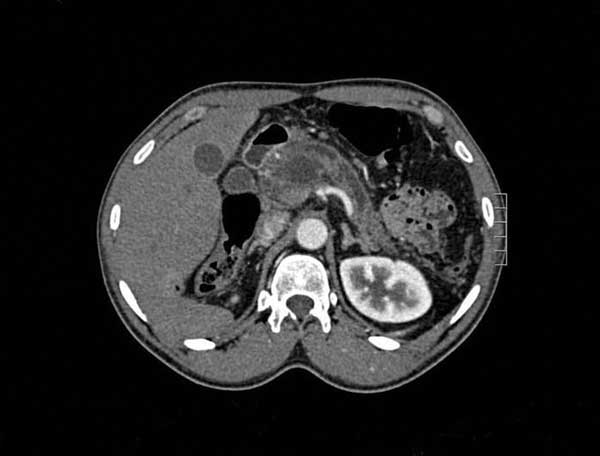
Histological alterations in pancreatic structure and function are distinct in CP. However, because histological biopsy is rarely performed unless malignancy is suspected, the NICE guideline on alcohol use disorders, published in June, recommends that diagnosis of CP should be based on symptom profile, imaging and standard assessment of exocrine and endocrine pancreatic function.16 It also recommends that CT (see figure 1, p 23) rather than ultrasound should be used as the first-line imaging investigation in any patient with suspected CP as it has a significantly higher sensitivity (78-95% vs. 35-75%) and specificity (75-91% vs. 58-94%), as well as being more cost-effective overall.16
Referral
Acute pancreatitis
All patients with suspected AP should be referred immediately and urgently to the local emergency department or the local general surgical team. National guidelines state that all patients with predicted or diagnosed severe acute pancreatitis, potentially life-threatening complications, or those requiring surgical intervention should be relocated to tertiary centres with specialist, multidisciplinary access.17
Chronic pancreatitis
Patients with suspected CP should be referred according to the urgency of their symptoms. Those presenting with an acute form of the disease should be managed and referred in a similar fashion to those with AP. However, those patients with a more chronic presentation may be referred to the local gastroenterology or hepatopancreaticobiliary surgery outpatient clinic for multidisciplinary assessment and investigation. Referrals to specialist centres may additionally facilitate patient management through the provision of specialist access to multimodal pain clinics and interventional therapeutic options.
Management
Acute pancreatitis
Elimination of the initiating factor (i.e. prevention of alcohol consumption, treatment of hyperlipidaemia/ hypercalcaemia, cholecystectomy for removal of gallstones, cessation of initiating drug etc) is vital in the management of AP. Effective supportive therapy including rapid and effective restoration of circulating volume (which may require invasive haemodynamic monitoring to guide both fluid and inotrope administration), oxygen administration, nutritional provision, support of failing organ systems as necessary and management of specific complications as they develop, is also essential (see tables 5 and 6).
Nutrition is often a problem in both AP and CP as it can be limited by abdominal pain, nausea and vomiting and local complications that can obstruct or compress the gastric outlet. Alternative routes of feeding may therefore become necessary, particularly during severe episodes and evidence suggests that enteral nutrition should be instituted as soon as safely possible, as it is associated with decreased length of stay, morbidity and mortality, when compared with no nutrition or parenteral nutrition, as well as being more cost-effective.16, 17
The use of prophylactic antibiotics for the prevention of superinfection of pancreatic necrosis remains a contentious issue; however, current guidelines state that antibiotics (usually carbapenems) should not be used prophylactically and should be reserved for cases of confirmed, infected pancreatic necrosis.9 Infected necrosis can usually be satisfactorily managed via drain insertion with aspiration and lavage together with the use of appropriate antibiotics.
Rarely, surgical intervention may become necessary for the removal of infected necrotic matter. It should be minimally invasive18 and reserved for infected necrosis refractory to conservative treatment.19 Surgery should be avoided in sterile necrosis or oedematous pancreatitis as it is associated with high mortality, morbidity and re-operation rates.19, 20
Chronic pancreatitis
The most clinically significant symptom in CP, as well as the most troublesome and difficult to manage, is abdominal pain. Abstinence from alcohol should be encouraged and may not only arrest the chronic inflammatory and fibrotic processes, thereby improving pain (and allowing better control of exocrine and endocrine function), but may also enhance the response to treatments aimed at improving pain. Similarly, patients should also be encouraged to stop smoking as this may also improve the chances of pain relief while receiving treatment.21
Depression remains common in chronic diseases and can contribute to poor outcomes.22 It may be exacerbated by the effects of alcohol withdrawal, which may initially add to pain and worsen the patient's quality of life. Support groups and specialist nursing input may be invaluable for the management of these effects.23 However, well controlled, randomised trials studying the pain-relieving effects of various management strategies remain limited. This is mainly because the quantification of pain remains difficult, no standardised management guidelines exist and the fact that those undergoing interventional and surgical procedures may represent a more severe end of the disease spectrum.
Validated pain scores, such as the McGill score,24 can be used in combination with validated CP quality of life scores, such as the Izbicki score,25 to evaluate pain more objectively and aid in the decision to proceed to interventional measures, as well as in determining the success of the intervention.
Pain can be initially managed with simple analgesics, but swiftly increasing doses are often required, either orally or transdermally, resulting in many patients requiring high-dose opiates to achieve adequate pain relief.
Interventional treatments aimed at relieving pain are multiple and include coeliac plexus nerve blocks (percutaneous or endoscopic), shock wave lithotripsy (to break up intraductal stones), endoscopic intervention (for duct stenting or cyst drainage), thoracoscopic splanchnicectomy (for division of sensory nerves from the pancreas) and open pancreatic surgery (for resection of diseased parenchyma, improved pancreatic duct drainage or both).
Early surgery has been shown to be more effective at pain reduction than endoscopy in large duct (obstructive) CP, as well as being more cost-effective and associated with a decreased number of overall procedures.16 Patients with small duct CP can be offered a range of treatments, but may ultimately require surgery (see table 6).16 The underlying aims of surgery are to relieve duct obstruction (together with underlying parenchymal hypertension) and resect the most diseased/inflamed areas of the pancreas. However, the decision to operate should only be undertaken following in-depth multidisciplinary discussion and preoperative patient assessment (see table 7).
Pancreatic enzyme supplementation should be prescribed for the treatment of pancreatic exocrine dysfunction, but should not be used in patients with pain but no evidence of insufficiency, despite the theory that exogenous enzyme administration may reduce endogenous enzyme production and thereby rest the pancreas.16 There is no evidence for one enzyme preparation being superior to another; however, older preparations, which are not microencapsulated, may require gastric acid suppression with proton pump inhibitors or H2 receptor antagonists to improve absorption.16
Diabetes should be managed according to national guidelines and patients with ongoing inability to tolerate oral intake because of poorly controlled pain or gastric/duodenal outlet obstruction and those with significant weight loss should be considered for enteral feeding via a nasogastric (NG) or nasojejunal (NJ) route, as for AP.16
Follow-up
Acute pancreatitis
Patients with mild pancreatitis of any cause that has been definitively treated (i.e patients with gallstone AP who have undergone cholecystectomy) require minimal follow-up. However, patients diagnosed with rare and problematic causes of AP (i.e. autoimmune or hereditary) require referral to appropriate specialties and in some cases, lifelong follow-up. Those with ongoing alcohol misuse disorders require close follow-up and provision of alcohol cessation support in the community setting, even if the episode of AP was mild, in order to prevent disease recurrence and progression.
Patients discharged following an episode of severe AP may require long-term primary care and specialist follow-up for the management of specific complications, as well as monitoring for endocrine and exocrine dysfunction.
Chronic pancreatitis
Patients with chronic pancreatitis often require significant support to aid alcohol abstinence, smoking cessation and medication compliance, and to prevent opiate dependence. This can often be achieved in primary care with the assistance of local hospital nursing specialists and outpatient clinics but remains challenging. Further, because of the progressive nature of the condition, regular follow-up may help in the early identification of complications.
Conclusion
AP can result in local and systemic complications that may lead to multi-organ failure and death. Although a diagnosis can be made based upon simple clinical, serological and radiological investigations; a lack of specific therapeutic interventions means that it is a condition that remains best managed via specific guidelines by multidisciplinary teams in high volume centres.
CP develops following continued, sustained or repetitive pancreatic injury and is often characterised by continuous, severe abdominal pain, which should be investigated by CT to confirm diagnosis and rule out alternative causes. The pain and weight loss associated with CP remain extremely challenging to manage and all patients whose pain or weight loss is inadequately managed in the community setting should be referred for multidisciplinary assessment and consideration of interventional therapies.
REFERENCES
1 Goldacre MJ and Roberts SE. Hospital admission for acute pancreatitis in an English population, 1963-98: database study of incidence and mortality. BMJ 2004; 328(7454):466-9
2 Roberts SE, Williams JG, Meddings D et al. Incidence and case fatality for acute pancreatitis in England: geographical variation, social deprivation, alcohol consumption and aetiology--a record linkage study. Aliment Pharmacol Ther 2008; 28(7):931-41
3 Meier R, Ockenga J, Pertkiewicz M et al. ESPEN Guidelines on Enteral Nutrition: Pancreas. Clin Nutr 2006; 25(2): 275-84
4 Hebuterne X , Hastier P, Péroux JL et al. Resting energy expenditure in patients with alcoholic chronic pancreatitis. Dig Dis Sci 1996; 41(3): 533-9
5 Petersen JM, Forsmark CE. Chronic pancreatitis and maldigestion. Semin Gastrointest Dis 2002; 13(4) 191-9
6 Ammann RW and Muellhaup B. The natural history of pain in alcoholic chronic pancreatitis. Gastroenterology 1999;116(5):1132-40
7 Bradley EL 3rd. A clinically based classification system for acute pancreatitis. Summary of the International Symposium on Acute Pancreatitis, Atlanta, Ga, September 11 through 13, 1992. Arch Surg 1993;128(5):586-90
8 Balachandra S and Siriwardena AK. Systematic appraisal of the management of the major vascular complications of pancreatitis. Am J Surg 2005; 90(3):489-95
9 Acute Pancreatitis Classification Working Group: Revision of the Atlanta Classification of Acute Pancreatitis (3rd revision based on worldwide review/suggestions). 2009
10 Cavallini G, Frulloni L, Bassi C et al. Prospective multicentre survey on acute pancreatitis in Italy Prospective m(ProInf-AISP): results on 1005 patients. Dig Liver Dis 2004;36(3): 205-11
11 Uomo G, Pezzilli R, Gabbrielli A et al. Diagnostic assessment and outcome of acute pancreatitis in Italy: results of a prospective multicentre study. ProInf-AISP: Progetto informatizzato pancreatite acuta, Associazione Italiana Studio Pancreas, phase II. Dig Liver Dis 2007;39(9):829-37
12 Gislason H, Horn A, Hoem D et al. Acute pancreatitis in Bergen, Norway. A study on incidence, etiology and severity. Scand J Surg 2004; 93(1):29-33
13 Bai Y, Liu Y, Jia L et al. Severe acute pancreatitis in China: etiology and mortality in 1976 patients. Pancreas 2007;35(3):232-7
14 McKay CJ. Recent developments in the management of acute pancreatitis. Dig Surg 2002; 19(2):129-34
15 Twersky Y and Bank S. Nutritional deficiencies in chronic pancreatitis. Gastroenterol Clin North Am 1989;18(3):543-65
16 National Institute for Health and Clinical Excellence. (CG100) Alcohol use disorders: diagnosis and clinical management of alcohol-related physical complications. NICE. London. 2010
17 UK guidelines for the management of acute pancreatitis. Gut 2005;54 Suppl 3: iii1-9
18 van Santvoort HC, Besselink MG, Bakker OJ et al. A step-up approach or open necrosectomy for necrotizing pancreatitis. N Engl J Med 362;(16):1491-502
19 Heinrich S, Schäfer M, Rousson V et al. Evidence-based treatment of acute pancreatitis: a look at established paradigms. Ann Surg 2006; 243(2):154-68
20 Büchler MW, Gloor B, Müller CA et al. Acute necrotizing pancreatitis: treatment strategy according to the status of infection. Ann Surg 2000; 232(5):619-26
21 Seicean A, Grigorescu M, Tanţău M et al. Pain in chronic pancreatitis: assessment and relief through treatment. Rom J Gastroenterol 2004;13(1):9-15
22 Hedayati SS, Minhajuddin AT, Afshar M et al. Association between major depressive episodes in patients with chronic kidney disease and initiation of dialysis, hospitalization, or death. JAMA 2010;303(19):1946-53
23 Shepp PH, Chase P, and Rawls E. Pancreatitis Partners: a sharing and educational support group. Gastroenterol Nurs 1999: 22(4):155-7
24 Melzack R and Torgerson WS. On the language of pain. Anesthesiology 1971; 34(1): 50-9
25 Izbicki JR Bloechle C, Broering DC et al. Longitudinal V-shaped excision of the ventral pancreas for small duct disease in severe chronic pancreatitis: prospective evaluation of a new surgical procedure. Ann Surg 1998; 227(2):213-9
USEFUL INFORMATION
For patients
The Pancreatitis Supporters' Network
www.pancreatitis.org.uk
For healthcare professionals
The British Society of Gastroenterology
www.bsg.org.uk
For patients & healthcare professionals
The Pancreatic Society of Great Britain and Ireland
www.pancsoc.org.uk
 Download this article in PDF format