SEARCH

Practitioner 2010; 254 (1733): 17–21
Improving detection of colorectal cancer
20 Oct 2010
AUTHORS
Mr James Orbell MRCS
Surgical registrar, SW Thames
Mr Nicholas J West FRCS
Senior registrar in colorectal surgery, SW Thames
Article
Colorectal cancer is the third most common cancer in the UK, with an annual incidence of 36,100 in England and Wales. It is also the second leading cause of death from cancer in the UK.1 However, there has been a significant increase in five-year survival over the past decade, from 22% to 50% despite more than 55% of patients presenting with lymph node or distant metastases.1
Guidelines published by the Department of Health2 and subsequently by NICE3 have set down criteria for the urgent referral of patients with clinical features suggestive of colorectal cancer. Analysis of this referral system, however, shows that it lacks sensitivity for detecting cancers (only 10.3% of referrals are ultimately found to have cancer) and that it fails to identify those with earlier, more treatable disease.4 Nevertheless, it is important to remember that the clinical features included within the guidelines have been selected because of their strong association with the disease.
Risk factors
Around 80% of colorectal cancer is sporadic i.e. caused by the interaction of genetic and environmental factors via the adenoma-carcinoma sequence and cancer may take up to ten years to develop in this way.5 Adenomas are more common with age and one in four of the population aged over 50 will develop one or more polyps, with 10% of these polyps progressing to cancer over time.6,7
Risk factors implicated in the development of sporadic colorectal cancer include:
- age over 60
- K-ras and p53 mutations8
- diet high in saturated animal fat9 and low in fibre10 and vegetables11
- lack of exercise
- obesity12
- excessive alcohol intake13
With adjustments to lifestyle the majority of colorectal cancer may therefore be avoided.
Inflammatory bowel disease, both Crohn's disease and ulcerative colitis, is a risk factor for development of colorectal cancer through the association of chronic inflammation with development of malignancy. The risk rises with the duration of disease from the time of diagnosis (2% after 10 years and 18% after 30 years,14 and the intervals for surveillance colonoscopy decrease accordingly.
Around 20% of colorectal cancer cases are familial (two or more first-degree relatives affected) and people with this family history have a two- to three-fold risk of developing the disease.15 True hereditary syndromes include:
- the Lynch syndrome (hereditary non-polyposis colorectal cancer)
- familial adenomatous polyposis (FAP)
- MYH-associated polyposis.
Familial cases of syndrome-type cancer account for approximately 6% of cases.15 In a primary care setting taking a family history may determine those with a higher than average risk who may need onward referral.
Clinical presentation
A large proportion of patients with rectal or sigmoid cancers present with a combination of rectal bleeding and a change in bowel habit (usually an increased frequency of defecation and/or looser stools). Fewer patients will present with only one of these symptoms.16, 17 Rectal bleeding in the absence of anal symptoms occurs in over 60% of those with cancer,18 and a palpable rectal mass, with or without tenesmus, is present in 40-80% of those with rectal cancer.17, 19
Patients with more proximal tumours are more likely to present as emergencies with bowel obstruction, symptomatic iron deficiency anaemia or an abdominal mass.16, 17
Referral
NICE has produced guidance for primary care referral including general recommendations (see table 1, above left) and specific recommendations for high-risk patients (see table 2, above).3
Screened patients without symptoms are found with cancer and therefore the risk of bowel cancer in asymptomatic patients is not zero. Some patients will have cancer found incidentally on testing for symptomatic benign conditions and it can develop in those with functional problems or piles.
The Association of Coloproctologists of Great Britain and Ireland (ACGBI) recommends routine referral to a specialist for those with persistent low-risk symptoms or for those with symptoms resistant to treatment.20 The criteria indicating a low risk of colorectal cancer are listed in table 3, above. However, these features in combination with a positive family history or positive faecal occult blood test (FOBT) warrant an urgent referral.
Isolated normocytic anaemia without abdominal or bowel symptoms is not normally a criterion for referral to a colorectal clinic. However, if no other cause for the anaemia is obvious, a serum ferritin and/or FOBT may be useful and if results are abnormal, a specialist referral would be appropriate.
Carcinoembryonic antigen (CEA) is a serum tumour marker used to monitor patients already treated for colorectal cancer for signs of recurrence or for response to treatment in those patients undergoing chemotherapy. It is not useful as a diagnostic investigation and the practice of requesting CEA in this context should be discouraged.
Investigations
Specialist investigations following referral will depend on symptoms. A full history and examination with per rectal examination and usually sigmoidoscopy and proctoscopy will be performed in clinic.
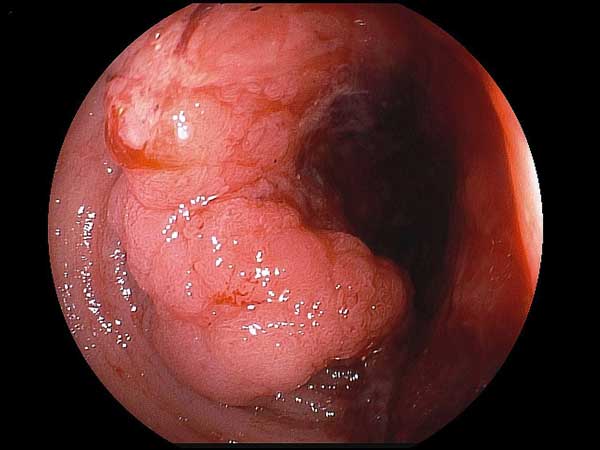
The majority of cancers presenting with rectal bleeding and/or a change in bowel habit, without other diagnostic features will be found within 60 cm of the anal verge and these may be diagnosed at flexible sigmoidoscopy. Figure 2, shows the distribution of colorectal cancer.
The majority of those patients with a suspicion of colorectal cancer will, however, undergo full colorectal visualisation, most commonly with colonoscopy. Barium enema (in conjunction with sigmoidoscopy) or CT colonography may be used in place of colonoscopy.
If a tumour is diagnosed on flexible sigmoidoscopy complete full large bowel investigation will be undertaken to eliminate the presence of synchronous tumours (or within
6 months postoperatively for an endoscopically impassable tumour or one resected as an emergency). The quoted risks for colonoscopy include significant bleeding (1:500) and perforation (1:1,000).
Staging
Preoperative staging is essential to determine both the local and distant status of the disease. Subsequent treatment (neo-adjuvant, adjuvant, surgical and palliative) can be planned following this. Staging investigations consist of CT chest, abdomen and pelvis with MRI for rectal cancers. Endorectal ultrasound may be performed for early rectal tumours, when local excision is planned. The most common staging systems for colorectal cancer are the Dukes and TNM systems (see table 4, above and table 5, left).
Treatment
All patients with colorectal cancer should be managed by a specialist multidisciplinary team and have access to a colorectal nurse specialist.
Surgery
Resection, either laparoscopic or open, should be performed by specialist surgeons as it has been shown that outcomes are better under the care of surgeons who have been through a specialised training programme21 or who have a high degree of specialisation.22
Laparoscopic surgery is becoming more widespread and the patient has the right to be offered a laparoscopic resection either locally or elsewhere.
Neo-adjuvant therapy for rectal cancer
Following discussion with the multidisciplinary team, certain patients with rectal cancer may be selected for neo-adjuvant (preoperative) radiotherapy. This will be decided on fixity within the pelvis (on per rectal examination); distance of tumour to the outer mesorectal fascia and presence of nodes within the mesorectum or the pelvis as demonstrated on staging MRI scanning.
This form of treatment has been shown to reduce local recurrence rates, although no survival benefit has been demonstrated.23
Neoadjuvant chemoradiation may be offered to those with non-metastatic but irresectable disease with a view to downstaging the tumour prior to curative resection or to palliate patients with incurable disease.
Adjuvant treatment
Advances in chemotherapy have resulted in improved survival for colorectal cancer over the past few years. Overall five-year survival for patients with node positive disease (Dukes C) has increased from 51% to 64% for patients undergoing surgery with adjuvant (postoperative) chemotherapy (5-fluorouracil modulated by folinic acid) compared with surgery alone.24
The addition of oxaliplatin to this regimen further increases survival,25, 26 with three-year disease-free survival improving from 72.9% to 78.2%.25
Chemotherapy carries a risk of morbidity, however, and its use needs to be carefully discussed with the patient and oncologist. Its benefit in Dukes B disease is less clear but it may be offered to those with features of high-risk disease (such as serosal involvement, perforated or obstructed tumours, poor differentiation and perineural or extramural vascular invasion).
Postoperative radiotherapy is used but not commonly and also reduces local recurrence but to a lesser degree and also with no survival benefit.27 Because of its limited benefit and side-effects it is only recommended in cases of incomplete surgical resection.20
Resectable metastatic disease
Patients with liver or lung metastases may be considered for resection irrespective of age. These patients will be staged with CT scan for chest disease and MRI for liver metastases and discussed at dedicated hepatobiliary or thoracic multidisciplinary team meetings. The five-year survival following resection of liver metastases is approximately 33%.28, 29
Follow-up
The ACGBI recommends CT chest, abdomen and pelvis for fit, asymptomatic patients within two years following resection, to screen for resectable metastases. Colonoscopy should be performed at five-yearly intervals.20 Local protocols for colorectal cancer follow-up may vary slightly.
Screening
Eight out of ten people affected by colorectal cancer are over 60. The lifetime risk for developing colorectal cancer is 5%.30 Screening is designed to identify and remove early cancers or polyps before malignant change and in doing so reduce the incidence of colorectal cancer and improve the survival of those with asymptomatic cancer. Screening with FOBT has been shown to reduce colorectal cancer mortality rates by 15-18%.31
The NHS Bowel Cancer Screening Programme (NHS BCSP) in England started in April 2006 and currently invites men and women aged 60-69 (planned to be extended to 74) to participate via submission of an FOBT every two years. Those with a positive result will be offered colonoscopy as the next investigation of choice.
In Northern Ireland, as for England, men and women aged between 60 and 69 years old are screened with FOBT every two years. In Scotland, the population aged between 50 and 74 years is screened and in Wales the screening programme sends FOBT kits to people aged between 60 and 69, but this is planned to be extended to people between the ages of 50 and 74.
The NHS BCSP is arranged around five programme hubs across England, with up to 20 local screening centres assigned to a hub. The hub sends out the FOBT to the subject in the post. It is then completed and posted back.
Those subjects with a positive test will be offered a colonoscopy, performed by an accredited colonoscopist. Twenty out of every 1,000 patients will have a positive FOBT and be offered colonoscopy. Sixteen will attend colonoscopy, with eight (50%) being normal, six (38%) being diagnosed with polyps and entering a surveillance programme and two (12.5%) will have a cancer. Incomplete colonoscopy will require completion barium enema or CT colonography.30 A more detailed account of the background and structure of the NHS BCSP has been recently published.30
Conclusion
The challenges over the next few years, as bowel cancer rates continue to increase and the NHS rationalises funding, will be to focus first on prevention of the disease via changes to lifestyle, in which primary care physicians will be directly involved and second, to increase the proportion of the population screened. Screening will continue to target the removal of potentially malignant polyps and to detect tumours at an earlier stage, which will yield benefits both in terms of patient survival and quality of life and consequently reduce the requirements for costly adjuvant and palliative treatments.
In light of recent work assessing the benefits of bowel cancer screening via flexible sigmoidoscopy and the interest shown in this by the Department of Health, the method by which screening occurs may change in the future.32
REFERENCES
1 UK Bowel Cancer Statistics 2006. www.cancerresearchuk.org
2 Department of Health. Referral guidelines for suspected cancer. DoH. London. 2000
3 National Institute for Health and Clinical Excellence. Referral guidelines for suspected cancer. NICE. London. 2005
4 Thorne K, Hutchings HA, Elwyn G. The effects of the two-week rule on NHS colorectal cancer diagnostic services: a systematic literature review. BMC Health Serv Res 2006;6:43
5 Winawer SJ. Natural history of colorectal cancer. Am J Med 1999;106(1A):3S-6S; discussion 50S-1S
6 Winawer SJ, Fletcher RH, Miller L et al. Colorectal cancer screening: clinical guidelines and rationale. Gastroenterology 1997;112(2):594-642
7 Scholefield JH. ABC of colorectal cancer: screening. BMJ 2000;321(7267):1004-6
8 Font A, Abad A, Monzo M et al. Prognostic value of K-ras mutations and allelic imbalance on chromosome 18q in patients with resected colorectal cancer. Dis Colon Rectum 2001;44(4):549-57
9 Norat T, Bingham S, Ferrari P et al. Meat, fish, and colorectal cancer risk: the European Prospective Investigation into cancer and nutrition. J Natl Cancer Inst 2005;15: 97(12):906-16
10 Howe GR, Benito E, Castelleto R et al. Dietary intake of fiber and decreased risk of cancers of the colon and rectum: evidence from the combined analysis of 13 case control studies. J Natl Cancer Inst 1992;16;84(24):1887-96
11 Thornalley P. More good things in vegetables than you ever imagined. Biochemistry 1999;21:19-23
12 Bergstrom A, Pisani P, Tenet V et al. Overweight as an avoidable cause of cancer in Europe. Int J Cancer 2001; 91(3):421-30
13 Cho E, Smith-Warner SA, Ritz J et al. Alcohol intake and colorectal cancer: a pooled analysis of 8 cohort studies. Ann Intern Med 2004;140(8):603-13
14 Eaden JA, Abrams KR, Mayberry JF. The risk of colorectal cancer in ulcerative colitis: a meta-analysis. Gut 2001;48(4):526-35
15 Cunningham D, Atkin W, Lenz HJ et al. Colorectal cancer. Lancet 2010;375(9719):1030-47
16 Flashman K, O'Leary DP, Senapati A et al. The Department of Health's "two week standard" for bowel cancer: is it working? Gut 2004;53(3):387-91
17 Shallow TA, Wagner FB, Jr, Colcher RE. Clinical evaluation of 750 patients with colon cancer; diagnostic survey and follow-up covering a fifteen-year period. Ann Surg 1955;142(2):164-75
18 Thompson MR, Perera R, Senapati A et al. Predictive value of common symptom combinations in diagnosing colorectal cancer. Br J Surg 2007;94(10):1260-5
19 McSherry CK, Cornell GN, Glenn F. Carcinoma of the colon and rectum. Ann Surg 1969;169(4):502-9
20 Association of Coloproctologists of Great Britain and Ireland. Guidelines for the Management of Colorectal Cancer. 3rd edition. 2007
21 Martling AL, Holm T, Rutqvist LE et al. Effect of a surgical training programme on outcome of rectal cancer in the County of Stockholm. Stockholm Colorectal Cancer Study Group, Basingstoke Bowel Cancer Research Project. Lancet 2000;356(9224):93-6
22 McArdle CS, Hole DJ. Influence of volume and specialization on survival following surgery for colorectal cancer. Br J Surg 2004;91(5):610-7
23 Sebag-Montefiore D, Stephens RJ, Steele R et al. Preoperative radiotherapy versus selective postoperative chemoradiotherapy in patients with rectal cancer (MRC CR07 and NCIC-CTG C016): a multicentre, randomised trial. Lancet 2009;373(9666):811-20
24 National Institute for Health and Clinical Excellence. Guidance on cancer services: Improving outcomes in colorectal cancer. Manual update. NICE. London. 2004
25 Andre T, Boni C, Mounedji-Boudiaf L et al. Oxaliplatin, fluorouracil, and leucovorin as adjuvant treatment for colon cancer. N Engl J Med 2004;350(23):2343-51
26 Wolmark N, Colangelo L, Wieand S. National Surgical Adjuvant Breast and Bowel Project trials in colon cancer. Semin Oncol 2001;28 (Suppl 1):9-13
27 Colorectal Cancer Collaborative Group. Adjuvant radiotherapy for rectal cancer: a systematic overview of 8,507 patients from 22 randomised trials. Lancet 2001;358(9290):1291-304
28 Scheele J, Stangl R, Altendorf-Hofmann A. Hepatic metastases from colorectal carcinoma: impact of surgical resection on the natural history. Br J Surg 1990;77(11):1241-6
29 Garden OJ, Rees M, Poston GJ et al. Guidelines for resection of colorectal cancer liver metastases. Gut 2006;55 Suppl 3:iii1-8
30 West NJ, Poullis AP, Leicester RJ. The NHS Bowel Cancer Screening Programme - a realistic approach with additional benefits. Colorectal Dis 2008;10(7):708-14
31 Mandel JS, Church TR, Bond JH, et al. The effect of fecal occult-blood screening on the incidence of colorectal cancer. N Engl J Med 2000;343(22):1603-7
32 Atkin WA, Edwards R, Kralj-Hans I et al. UK Flexible Sigmoidoscopy Trial Investigators. Once-only flexible sigmoidoscopy screening in prevention of colorectal cancer: a multicentre randomised controlled trial. Lancet 2010;375:1624-33
ARTICLE IN PDF
 Download this article in PDF format